



You're sitting on 47 content ideas for next quarter. Your team spent three days brainstorming, the whiteboard's full, everyone's excited. Two months later, half those posts are sitting at 12 likes and zero meaningful engagement.
The problem isn't creativity. It's that nobody actually evaluated whether these ideas deserved production time.
Why traditional content planning breaks down
Social media managers face an impossible choice every Monday morning. Limited time, maybe one designer, definitely not enough budget, and somehow you need to maintain quality across five platforms while your boss asks why that competitor's terrible dance video got 50k views.
The real breakdown happens in the gap between ideation and execution. Teams generate ideas without actually thinking through:
-
Production effort versus probable outcome
-
Whether your audience even wants this type of content
-
If you have the capacity to execute it properly
-
How similar content has performed historically
What typically happens: teams default to whatever's easiest or copy whatever's trending. Three weeks later, you're churning out quote cards nobody shares and "Monday Motivation" posts that make your brand look desperate.
Building a scoring system that actually works
A solid content prioritization rubric needs four core metrics that balance effort against impact. Not twelve metrics. Not some complex algorithm. Four numbers you can calculate in under two minutes per idea.
Stop managing your social media the hard way.
Postyly helps you plan, schedule, and analyze every post with precision.
- Multi-platform scheduling
- Real-time engagement tracking
- Automated performance reports
No credit card required
Reach Potential (1-5 scale)
This isn't about going viral. It's about understanding the realistic audience for each content type based on your specific channels and what your historical data actually shows.
Score 5: Content with proven viral mechanics for your audience (UGC campaigns, controversy within your niche, breaking industry news)
Score 4: Shareable formats that consistently perform (data visualizations, insider tips, before/after transformations)
Score 3: Solid educational content your core audience needs (how-tos, explanations, product updates)
Score 2: Niche content for specific segments (technical deep-dives, advanced tutorials)
Score 1: Internal updates or narrow-interest topics (company culture posts, minor feature announcements)
Effort Score (1-5 scale, inverted)
This is where teams mess up constantly. Lower effort should mean higher score because you want efficient content.
Score 5: Under 30 minutes total (text post, simple graphic, reposting with commentary)
Score 4: 30-90 minutes (basic designed post, short video edit, simple infographic)
Score 3: 2-4 hours (custom illustration, edited video under 60 seconds, multi-slide carousel)
Score 2: 4-8 hours (long-form video, complex animation, detailed guide graphics)
Score 1: 8+ hours or requires external resources (professional photoshoot, commissioned artwork, multi-person video production)
Relevance Score (1-5 scale)
This measures how closely content aligns with your current business objectives and audience needs right now, not in general.
Score 5: Directly supports an immediate business goal or a trending topic your audience actually cares about
Score 4: Supports quarterly objectives or addresses frequent customer questions
Score 3: Generally valuable to your audience but not time-sensitive
Score 2: Interesting but tangential to your core value proposition
Score 1: Off-topic or pure entertainment with no real brand connection
ROI Indicator (1-5 scale)
Not everything needs to drive sales, but you need to be honest about what return you're chasing.
Score 5: Direct conversion driver (product demos, offers, case studies with clear CTAs)
Score 4: High-value lead generation (downloadable resources, webinar announcements, free tools)
Score 3: Brand authority builders (thought leadership, industry analysis, expert interviews)
Score 2: Community engagement (polls, discussions, user celebrations)
Score 1: Pure awareness plays (memes, cultural moments, entertainment)
The calculation that changes everything
The formula: (Reach + Relevance + ROI) - (6 - Effort) = Priority Score
Maximum score: 14 Minimum score: -4
Anything above 10 moves to immediate production.
Anything above 10 moves to immediate production. Scores between 6-10 go into your regular content calendar. Below 6? Either rework the idea or kill it.
The formula intentionally weights against high-effort content. A viral-potential post requiring 10 hours of work often scores lower than three solid posts you could produce in the same timeframe.
Real scoring examples from actual content calendars
Here's how this works with real content ideas from a B2B SaaS company I worked with last quarter:
| Content Idea | Reach | Effort | Relevance | ROI | Total Score | Decision |
|---|---|---|---|---|---|---|
| Customer success story video (3 min) | 3 | 1 | 4 | 5 | 7 | Regular calendar |
| Industry report breakdown (carousel) | 4 | 3 | 5 | 3 | 9 | Regular calendar |
| Product update announcement | 2 | 5 | 4 | 4 | 9 | Regular calendar |
| Meme about industry pain point | 4 | 5 | 3 | 1 | 8 | Regular calendar |
| CEO thought leadership post | 3 | 4 | 4 | 3 | 8 | Regular calendar |
| Interactive quiz (with landing page) | 4 | 2 | 3 | 4 | 7 | Rework or kill |
| Behind-scenes office tour | 2 | 3 | 2 | 1 | 2 | Kill |
| Detailed technical tutorial (video) | 2 | 1 | 3 | 3 | 3 | Kill |
| Quick tip Tuesday (text + simple graphic) | 3 | 5 | 4 | 3 | 11 | Immediate production |
| Trending topic newsjack | 5 | 4 | 5 | 2 | 12 | Immediate production |
Notice how the highest-effort content scored lowest despite seeming valuable? That three-minute customer story would eat two full days between filming, editing, and approvals. In that same window, you could produce five "Quick tip Tuesday" posts.
Common scoring mistakes that tank your system
Overestimating reach potential
Every idea feels like it could go viral when you're brainstorming. Reality check: look at your last 50 posts. How many actually exceeded your follower count in impressions? That's your real viral rate. Score from there.
Ignoring compound effort
That "simple" video needs scripting, filming, editing, thumbnail creation, captions, and probably three rounds of stakeholder feedback. What looks like a two-hour project becomes eight hours spread across four days. Factor in every step, including approval loops.
Confusing relevance with preference
Your CMO loves thought leadership content. Fine. But if your audience data shows they engage 3x more with practical tips than executive insights, score based on audience behavior, not internal preferences.
ROI score inflation
Not every post needs to sell something. If you score everything as a 5 because "brand awareness matters," you've broken your rubric. Be honest about what each piece actually accomplishes.
Operational adjustments for different team sizes
Solo social media manager
Focus on ideas scoring 10+ exclusively. You don't have bandwidth for anything else. Batch similar content types to reduce context switching. If something takes over 90 minutes, it better score 12+.
Small team (2-3 people)
Set different thresholds by person. Your designer handles anything visual scoring 8+. Your copywriter takes text-heavy content scoring 7+. Collaborative content needs to score 11+ to justify the coordination overhead.
Larger team (4+ people)
Create specialized scoring tracks. Video content uses different effort scales than graphic design. Add a "collaboration complexity" modifier (-1 point for each additional person needed). Run weekly scoring sessions where everyone scores independently, then average.
When to override your scores
Sometimes a post scoring 4 still needs to happen. Your CEO is retiring. There's a product issue. These aren't content opportunities—they're organizational necessities.
Keep an override category for:
-
Crisis communications
-
Mandatory corporate announcements
-
Legal or compliance requirements
-
Executive mandates (pick your battles)
Track these separately. If overrides exceed 20% of your content, you have a strategy problem, not a scoring problem.
The spreadsheet template that runs everything
Here's the actual template structure you can copy:
Column A: Content Idea - Brief description
Column B: Format - Video, carousel, text, etc.
Column C: Platform - Primary channel
Column D: Reach Score - 1-5 based on criteria
Column E: Effort Score - 1-5 (remember: low effort = high score)
Column F: Relevance Score - 1-5 for current objectives
Column G: ROI Score - 1-5 for business impact
Column H: Formula - =(D+F+G)-(6-E)
Column I: Priority - =IF(H>=10,"Immediate",IF(H>=6,"Calendar","Review"))
Column J: Assigned To - Team member
Column K: Status - Planning/Production/Published
Column L: Actual Performance - Fill post-publish for calibration
Color code by priority: Green for immediate (10+), Yellow for calendar (6-9), Red for review (below 6).
Calibrating scores based on actual performance
Your scoring improves when you track what actually happened versus what you predicted. Every couple weeks, revisit published content and compare:
-
Predicted reach score vs. actual reach percentile
-
Estimated effort vs. actual time tracked
-
Expected ROI vs. measured conversions
Adjust your scoring criteria when patterns emerge. Maybe video consistently takes twice as long as estimated. Maybe carousel posts outperform your reach predictions. Update the rubric monthly based on real data, not gut feel.
Who shouldn't use this system
This scoring system fails for:
-
Brands built entirely on viral content (you need different metrics)
-
Personal brands where everything is high-touch creative
-
News organizations where timeliness trumps everything
-
Highly regulated industries where every post needs legal review
If you're spending more time scoring than creating, you've overcomplicated it. The whole point is making faster, better decisions about what deserves your time.
Turning scoring into actual workflow
The rubric means nothing if it sits in a spreadsheet nobody opens.
Weekly scoring session (30 minutes)
-
Everyone brings 5 ideas
-
Score independently first
-
Discuss only discrepancies over 3 points
-
Lock in production priorities
Daily check-in (5 minutes)
-
Review today's scheduled content scores
-
Confirm nothing urgent overrides the calendar
-
Flag any capacity issues
Monthly calibration (1 hour)
-
Compare predicted vs. actual scores
-
Adjust rubric criteria
-
Archive low-performing content types
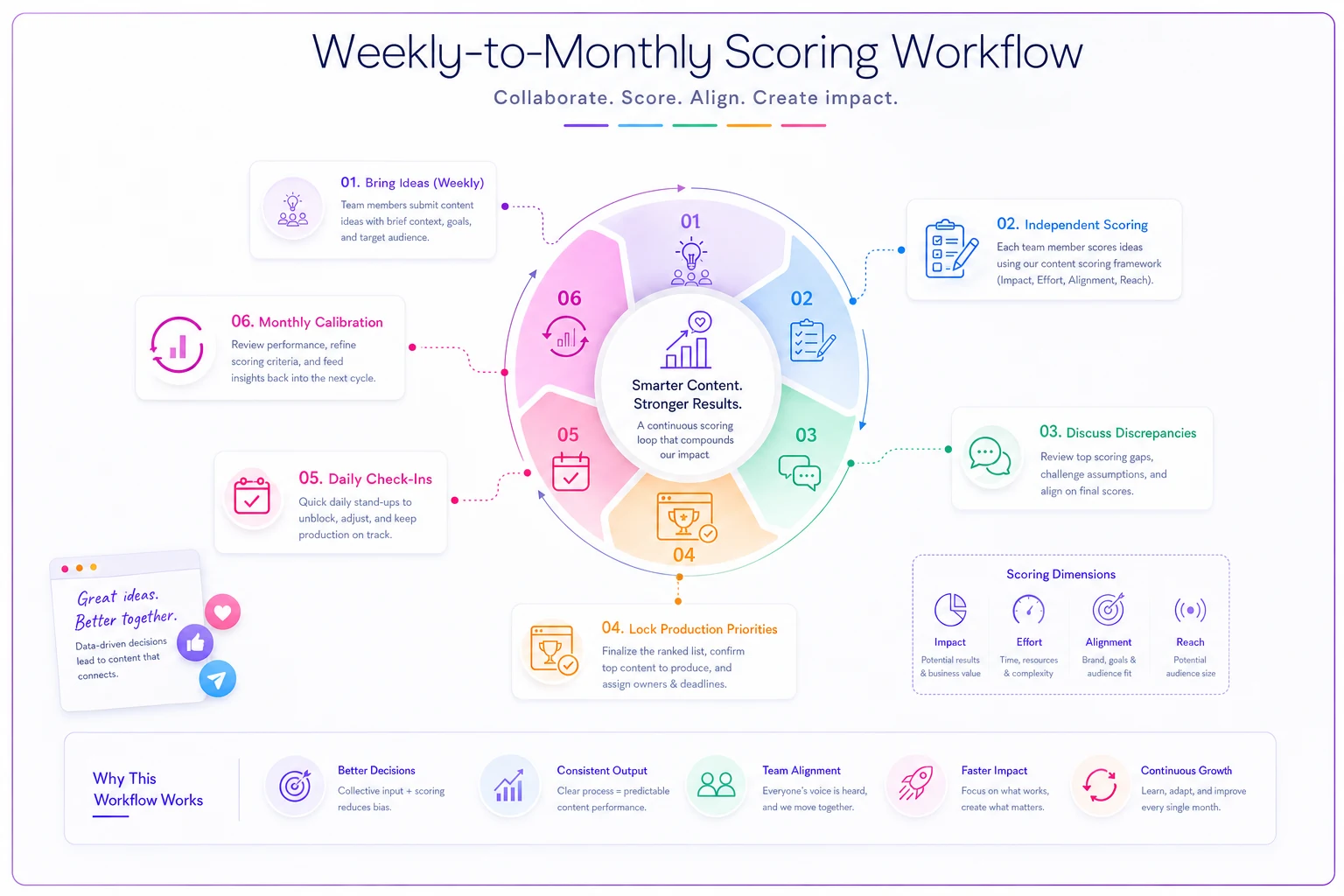
This diagram shows the scoring workflow from weekly sessions through monthly calibration.
Teams that succeed with this treat scores as guidance, not gospel. A perfectly scored calendar that nobody follows is worthless. But when you're choosing between five ideas on a Tuesday afternoon, having clear numbers beats another hour-long debate about what "feels right."
Moving from scoring to scaled execution
Once your scoring system runs smoothly, patterns show up fast. Certain content types consistently score high. Specific formats always underperform. That data becomes the foundation for making real operational improvements.
It also makes resource conversations much easier. "We're leaving 40+ high-scoring ideas unproduced monthly due to a design bottleneck" carries more weight than "we need more help." When you can show that hiring a part-time video editor would unlock a consistent pipeline of 12-scoring content instead of 8-scoring content, budget conversations get a lot less political.
The scoring data also surfaces where workflow tools could eliminate real bottlenecks. If simple graphic creation is eating 40% of your team's time on mid-tier content, fixing that piece might let you redirect energy toward your highest-priority opportunities instead. Not every efficiency gain requires more headcount.
Track your scoring data for a few months and you'll see exactly where your content operations break down. Maybe it's approval delays. Maybe it's asset creation. Maybe it's ideas that sound great in a meeting but consistently bomb in the wild. Whatever the pattern, you now have data to fix it.
The best content doesn't always win on social media. But the best-prioritized content calendar beats random posting every single time.
Ready to amplify your brand’s voice?
Join 2,500+ marketers using Postyly to save time, boost engagement, and grow their audiences effectively.