

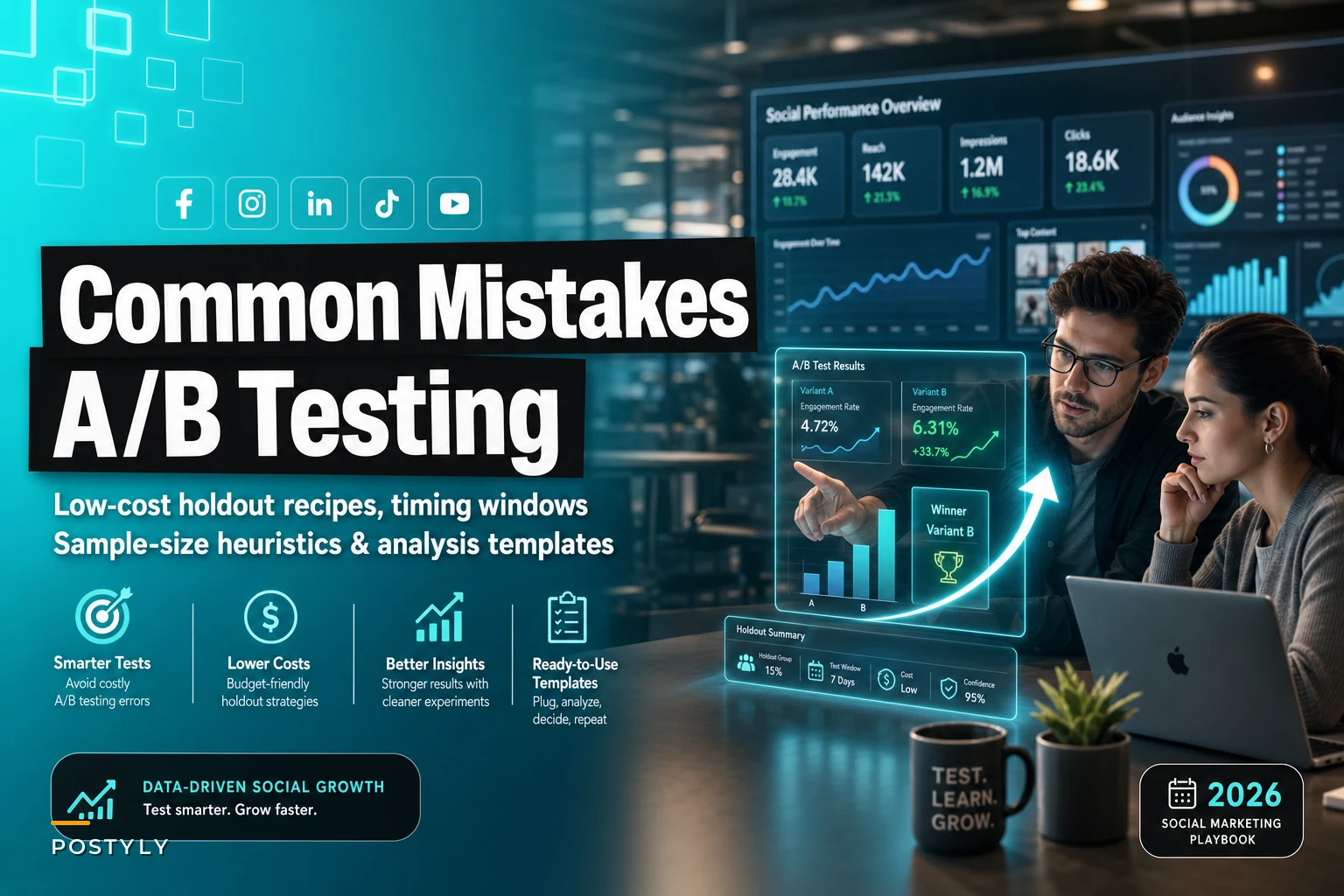

You run two versions of a post. Version A gets 847 likes. Version B gets 1,234 likes. Version B wins, right?
Not even close.
This is exactly how social media teams waste months testing organic content without getting real answers. That engagement difference? Could be timing. Could be the algorithm having a good day. Could be one random influencer who shared version B.
The same mistakes keep showing up. Teams run tests that tell them nothing, make big strategy changes based on noise, and chase engagement spikes that disappear the following week.
The core problem isn't that organic A/B testing doesn't work. It's that most teams don't account for the fundamental difference between paid and organic. With paid ads, you control the audience. With organic, the algorithm decides who sees what, when, and how often. That changes everything.
The timing trap that ruins most organic tests
What typically happens: Monday morning you post version A. Wednesday afternoon you post version B. Version B gets 3x the engagement.
Except Monday morning reach is completely different from Wednesday afternoon reach. Your Monday post competed with weekend recap content, motivation posts, and everyone clearing their notifications. Your Wednesday post landed when people were actively scrolling through lunch.
A fitness studio tested the same exact post at 6 AM Monday vs 12 PM Wednesday for three weeks. The Wednesday version consistently pulled 2-4x more engagement. Same content, same caption, same hashtags — just different time slots.
The algorithm makes this worse. When your Monday post gets lower initial engagement, it gets shown to fewer people. When Wednesday's post gets higher initial engagement, it gets pushed wider. You're not testing content anymore — you're testing time slots multiplied by algorithm momentum.
Instagram gives you roughly 1-2 hours to prove your post deserves reach. LinkedIn gives you 1-3 hours. TikTok makes that call in minutes. Post at the wrong time and your test is dead before it starts.
The holdout group approach
Posting at the same time helps, but it doesn't fully solve this. What actually works is adapting something paid advertisers use — a holdout group — for organic content.
Instead of comparing post A to post B directly, compare each post against your baseline performance for that specific time slot.
Track your average engagement rate per posting slot over 30 days. Monday 9 AM might average 3.2% engagement. Wednesday 2 PM might average 5.1%. Friday 5 PM might average 2.8%.
Compare each test post to its time-slot baseline to account for timing and algorithm momentum.
Now when you test, you're measuring how much each post beat or missed its slot baseline — not just which post got higher raw numbers.
Post A on Monday 9 AM got 4.1%? That's 28% above baseline. Post B on Wednesday 2 PM got 5.3%? That's only 4% above baseline. Post A actually performed better, even though the absolute number was lower.
Sample size problems hiding in your analytics
A bakery tested two Instagram Reel styles. Style A (behind-the-scenes baking) averaged 2,300 views. Style B (quick recipe tips) averaged 3,100 views. After four posts of each, they went all-in on recipe tips. Three months later, their engagement dropped hard.
Stop managing your social media the hard way.
Postyly helps you plan, schedule, and analyze every post with precision.
- Multi-platform scheduling
- Real-time engagement tracking
- Automated performance reports
No credit card required
The problem: they made a major decision based on 8 total posts. That's like flipping a coin 8 times, getting 5 heads, and concluding the coin is biased.
The honest reality about organic testing: you need far more data than feels reasonable. Statistical confidence typically requires 100+ instances of each variation. For brands posting 3-5 times per week, that's 40+ weeks per test. Nobody's doing that.
The 30-touch approach
What actually works — and what we've seen hold up across different business types — is testing elements rather than full posts.
Pick one variable. Test your hook style across 30 posts while keeping everything else consistent. Test caption length across 30 posts. Test hashtag strategy across 30 posts.
A recruitment firm tested only their LinkedIn opening lines this way. First 30 posts started with industry statistics. Next 30 started with candidate success stories. The success story posts drove 47% more profile visits, consistently, across the full 30-post sample.
This works because you're isolating variables while building enough data to trust the pattern.
Track in batches of 10 — posts 1-10, 11-20, 21-30. If all three batches show the same direction, that's a real signal. If results bounce around between batches, you're still looking at noise.
The platform bias most teams ignore
Your Instagram audience isn't your LinkedIn audience. Sounds obvious. But watch how teams actually run tests.
They post a motivational quote on Instagram, it performs well, so they push the same thing to LinkedIn. It flops. They conclude LinkedIn doesn't respond to motivational content. Except LinkedIn's algorithm specifically deprioritizes text-on-image posts, while Instagram's tends to reward them.
A consulting firm discovered this with case study posts. On LinkedIn, they drove 10x normal engagement. Reformatted for Instagram Stories, they got basically nothing. The content wasn't wrong — the format was wrong for the platform.
Each platform has rules that override content quality:
Instagram: The algorithm checks for interactions within the first 60 seconds. Long captions that require "see more" clicks can actually help here, despite what you've probably heard about keeping captions short.
LinkedIn: Dwell time matters — how long people actually stop scrolling to read. Native documents and text posts outperform external links by roughly 3-5x, regardless of content quality.
TikTok: Completion rate and rewatches are what the algorithm cares about most. A mediocre 7-second video people watch twice beats a genuinely good 30-second video people skip at the 20-second mark.
When you test across platforms, you're not just testing content. You're testing content filtered through completely different algorithmic priorities.
The cross-platform testing matrix
Stop testing the same content across platforms. Instead, test the same concept expressed in each platform's native format.
| Concept to test | Instagram version | LinkedIn version | TikTok version |
|---|---|---|---|
| Behind-the-scenes content | 60-second reel with trending audio | Native LinkedIn video with text overlay | 7-second quick cut montage |
| Educational tips | Carousel post with 10 slides | Text post with numbered list | Screen recording with voiceover |
| Customer success stories | Story highlights series | Long-form article post | Before/after transformation video |
| Industry commentary | Instagram Live or IGTV | Native LinkedIn newsletter | Reaction video to industry news |
A digital agency tested their "design process reveal" concept this way. Instagram Reel with music: 4.2% engagement. LinkedIn native video with captions: 8.7%. TikTok speed-run version: 12%. Same core concept, completely different results once formatted correctly for each platform.
The consistency problem nobody plans for
Paid ads let you run clean A/B tests because you can show different versions to similar audiences at the same time. Organic doesn't work that way. Your audience sees everything you post, in order.
This creates an audience fatigue problem that most testing guides skip over entirely.
A meal prep company tested 12 different carousel styles across three weeks. By week three, engagement dropped 60%. Not because the content got worse — because their audience was seeing similar posts repeatedly and started scrolling past. The later variants performed worse not because they were worse, but because the audience had already seen five similar versions.
The rotation method
Run tests in rotation, not in blocks. Instead of 10 posts of style A then 10 posts of style B, alternate: A-B-C-A-B-C. Add buffer content between test posts — completely different content types that reset expectations before the next test variant appears.
A test calendar that holds up in practice:
-
Monday
Test variant A (educational carousel)
-
Tuesday
Buffer content (behind-the-scenes video)
-
Wednesday
Test variant B (educational single image)
-
Thursday
Buffer content (customer testimonial)
-
Friday
Test variant C (educational Reel)
This takes longer to get results, but it prevents the engagement decay that kills most organic tests. A skincare brand using this rotation approach maintained steady engagement while testing five different educational formats over two months.
Low-budget testing that actually works
Most analytics tools promising A/B testing insights run $300-800/month and still don't solve the core problems — timing bias, algorithm changes, insufficient sample sizes. They give you cleaner dashboards, but the underlying data issues remain.
Here's a testing system that costs nothing:
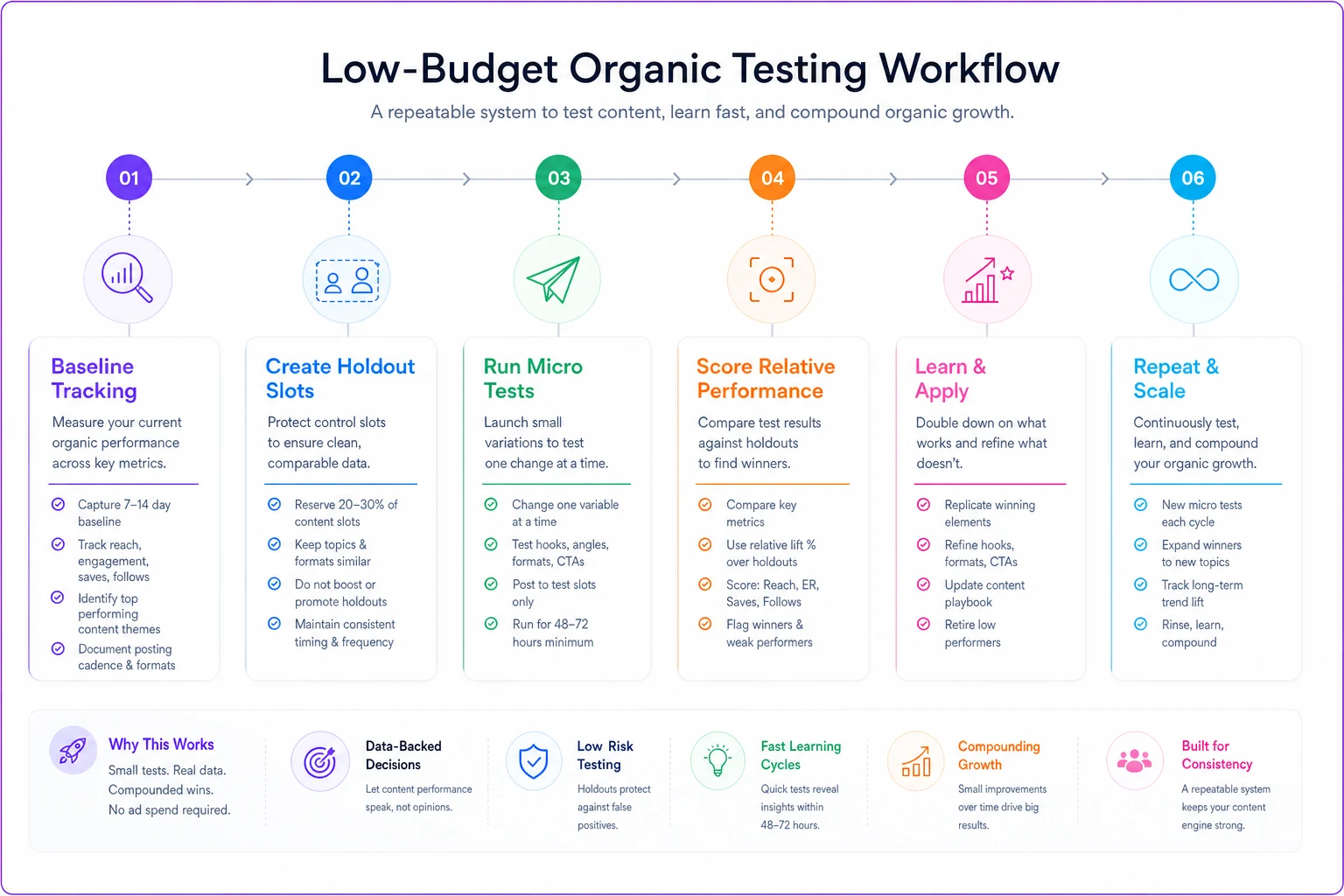
Step 1: Build your baseline tracker
Spreadsheet, nothing fancy. Track every post for 30 days before testing anything. Columns: date, time, day of week, content type, engagement rate, reach, profile visits.
Step 2: Set up holdout slots
Reserve 20% of your posting slots as "control" slots — these always get your standard, proven content. The other 80% are test slots. This gives you a running baseline to check against throughout the test.
Step 3: Track relative performance
Score every test post against its time slot baseline. Post performed 20% above its usual Monday morning baseline? Score: +20. Performed 10% below its Friday afternoon baseline? Score: -10.
Step 4: Run micro-tests continuously
Instead of big quarterly tests, test small things constantly. This week: test adding questions to captions. Next week: user-generated content. Week after: different video lengths.
Visual workflow of the low-budget testing system:
A travel blog ran 52 micro-tests in a year this way. They found their audience engaged 3x more with posts that included specific prices, responded better to videos under 15 seconds, and largely ignored hashtags. No expensive tools — just consistent tracking.
When you shouldn't bother testing
Sometimes the right call is to not test at all.
If you're posting fewer than four times per week per platform, you don't have enough volume to get statistically meaningful results before the algorithm shifts. Focus on consistency first.
If your engaged audience is under 1,000 followers, one active power-user can skew all your metrics. Build the audience before worrying about testing.
If you're in a niche where algorithms change fast — and a lot of spaces feel like that right now — your test results can expire before you can do anything with them.
A fitness creator spent three months testing post formats, then Instagram overhauled how it surfaces Reels. Every insight became useless overnight. They ended up switching to rapid experimentation with whatever format the platform was currently favoring, without running formal tests. That was honestly the smarter move for their situation.
The operational side most teams miss
Running proper organic tests creates a lot of overhead that nobody accounts for upfront. You're not just creating content anymore — you're managing multiple variants, tracking complex metrics, analyzing results, and coordinating all of it across people handling different platforms.
A SaaS company's social team tried to run systematic A/B tests manually. Within two weeks, they were spending around 15 hours per week just on tracking and analysis. Content quality dropped because they were spending more time in spreadsheets than actually creating.
Whether you build your own tracking systems or use operational software to manage the testing workflow, you need clean processes for:
-
Creating test variants without doubling production time
-
Tracking metrics consistently across platforms
-
Analyzing results without drowning in data
-
Documenting what worked for future reference
-
Coordinating tests across team members
Teams that run successful ongoing tests treat it like a systematic operation, not a creative experiment. They have templates for common test types, automated tracking where possible, and weekly review rhythms to analyze results and plan what comes next. Some of the more operationally mature teams use AI-assisted workflow platforms to handle the tracking and documentation side automatically, which frees up time for the actual analysis and decision-making.
The businesses getting real insights from organic testing aren't the ones with the fanciest tools. They're the ones who built testing into their operational workflow from the beginning.
Making insights stick after the test
The average social media team runs tests, finds a winner, then drifts back to posting randomly within a few months. It happens more than you'd think.
A restaurant chain found that behind-the-kitchen videos outperformed food glamour shots by around 200%. Six months later, they were mostly back to glamour shots. The person who ran the tests had moved on, and the insights went with them.
Document everything in a simple playbook: what you tested, sample size, results with context about timing and variables, and implementation rules going forward.
More importantly, build winning formats directly into your content calendar template. If 15-second videos consistently beat 30-second ones, make 15 seconds the default. Put the burden on someone to justify going longer — not shorter.
The strongest organic content strategies aren't built purely on creative instinct. They're built on systematic testing, clean documentation, and the operational discipline to keep using what works even as team members change and platforms evolve.
Organic testing will always be messier than paid ad testing. But with proper holdout methods, enough sample size, and platform-specific approaches, you can pull real insights without a paid media budget. The teams winning at organic social aren't necessarily posting the best content — they're testing more systematically and implementing what they find.
The strongest organic content strategies aren't built purely on creative instinct. They're built on systematic testing, clean documentation, and the operational discipline to keep using what works even as team members change and platforms evolve.
Organic testing will always be messier than paid ad testing. But with proper holdout methods, enough sample size, and platform-specific approaches, you can pull real insights without a paid media budget. The teams winning at organic social aren't necessarily posting the best content — they're testing more systematically and implementing what they find.
Ready to amplify your brand’s voice?
Join 2,500+ marketers using Postyly to save time, boost engagement, and grow their audiences effectively.