



Managing content across LinkedIn, Instagram, TikTok, Twitter, and email feels like running five different restaurants out of one kitchen. Each platform wants something different — LinkedIn craves thought leadership, Instagram demands visual stories, TikTok needs raw authenticity — yet your brand message still needs to stay coherent across all of them.
Most social teams fall into one of two traps. Either they post identical content everywhere and tank engagement, or they create completely different content for each platform and exhaust the team while fracturing brand identity. The real operational challenge isn't choosing between consistency and customization — it's building a system that delivers both without burning everyone out.
The teams that figure this out don't just adapt content randomly. They build what I'd call a core-message matrix — essentially a translation guide that preserves your key points while reshaping delivery for each platform's unique culture and format constraints.
Why traditional content calendars break at scale
A standard editorial calendar tells you what to post and when. That's fine when you're managing one or two channels. But once you're juggling five platforms with different posting frequencies, format requirements, and audience behaviors, that simple calendar becomes a version control nightmare.
A B2B software company I worked with had solid thought leadership content — detailed case studies, industry insights, technical deep-dives. Their LinkedIn posts performed well. But when they tried expanding to Instagram and TikTok, things fell apart fast. The Instagram team started creating completely unrelated lifestyle content because "that's what works on Instagram." The TikTok person went rogue with trending audio clips that had nothing to do with the product. Within three months, their brand message was completely fractured.
The problem wasn't creativity or effort. It was the absence of any systematic framework for adaptation. No rules for what stays constant versus what changes. No guidelines for translating a technical concept into visual storytelling. No tagging system to track which messages were landing where.
The core-message matrix structure
A functional cross-platform content strategy framework starts with identifying your non-negotiables — the 3 to 5 core messages that must appear consistently regardless of platform. These aren't word-for-word scripts. They're conceptual anchors that keep your brand coherent while leaving room for creative flexibility.
Stop managing your social media the hard way.
Postyly helps you plan, schedule, and analyze every post with precision.
- Multi-platform scheduling
- Real-time engagement tracking
- Automated performance reports
No credit card required
Here's the basic matrix structure that works in practice:
Core Message Components:
-
Primary value proposition (the problem you solve)
-
Key differentiator (why you vs alternatives)
-
Brand personality markers (tone, style, perspective)
-
Proof points (data, testimonials, examples)
-
Call-to-action hierarchy (primary, secondary, soft)
For each platform, you then define adaptation rules:
Platform-Specific Variables:
-
Content format (text, image, video, carousel)
-
Length constraints (character limits, video duration)
-
Visual style (polished, raw, animated, static)
-
Engagement mechanics (comments, shares, saves, DMs)
-
Posting frequency (daily, weekly, real-time)
-
Hashtag strategy (volume, type, placement)
The translation templates are where things get interesting. A technical case study becomes a LinkedIn article with data visualizations, an Instagram carousel breaking down the process step-by-step, and a TikTok showing the "before and after" transformation in 30 seconds with trending audio. Same core message, three completely different executions.
Building your adaptation rulebook
Adaptation rules need to be specific enough to maintain consistency but flexible enough to allow platform-native creativity. Generic guidelines like "be more casual on TikTok" don't actually help your team make decisions in real time.
Concrete adaptation formulas work much better:
LinkedIn to Instagram Translation:
-
1,500-word article → 10-slide carousel
-
Opening statistic → Visual hook slide
-
Three main points → Three content slides (one point each)
-
Supporting data → Simplified charts or icons
-
Conclusion → CTA slide with link in bio
Instagram to TikTok Translation:
-
Static carousel → Motion graphics or footage
-
10 slides → 30-60 second narrative
-
Text-heavy slides → Voiceover or on-screen captions
-
Polished graphics → Raw, behind-the-scenes footage
-
Link in bio → Comment engagement hook
One marketing agency I observed developed what they called "content atoms" — the smallest possible units of a message that could be recombined across platforms. Their case study about increasing client revenue by 47% broke down like this:
-
The percentage itself (atom 1)
-
The timeframe — 6 months (atom 2)
-
The method — automated email sequences (atom 3)
-
The client type — e-commerce (atom 4)
LinkedIn got all four atoms in a detailed post. Instagram focused on atoms 1 and 2 with a before/after visual. TikTok used atoms 3 and 4 in a "try this marketing hack" format. Same story, different emphasis based on what each audience actually responds to.
The tagging taxonomy that keeps everything straight
Without proper tagging, your cross-platform content becomes impossible to track or optimize. You need a classification system that captures both the message and its variations across platforms.
Message Tags:
-
Core message ID (CM001, CM002, etc.)
-
Topic category (product, culture, education, promotion)
-
Campaign association (if applicable)
-
Evergreen vs time-sensitive
Adaptation Tags:
-
Platform code (LI, IG, TT, TW, EM)
-
Format type (text, image, video, mixed)
-
Adaptation depth (direct repost, light edit, full recreation)
-
Performance tier (after posting)
Operational Tags:
-
Creator/adapter name
-
Approval status
-
Version number
-
Publication date/time
This might seem excessive, but without it you end up in situations like this: you post an Instagram reel that takes off, and three months later you want to adapt it for LinkedIn but can't remember which core message it was supporting or what specifically drove the performance. Or someone accidentally reposts near-identical content because nobody tracked that it had already been adapted and published.
Common failure points and fixes
The biggest mistake teams make is treating the framework like a rigid template instead of a flexible guide. Your TikTok manager spots trending audio that perfectly fits your brand message but doesn't match any pre-approved adaptation format. Do they skip it or break the framework?
Neither. Build in an "experimental" category with its own fast-track approval. Maybe 80% of content follows the framework strictly, and 20% tests new approaches. Tag experiments clearly so you can track what works and fold successful patterns into future adaptation rules.
Involve platform specialists when drafting adaptation rules so constraints become creative prompts, not top-down mandates.
Another consistent failure point: platform specialists who feel the framework limits their creativity. They're not entirely wrong — any system introduces constraints. But constraints can actually sharpen creativity when they're clear and well-reasoned. The key is involving platform specialists in writing the adaptation rules, not handing rules down to them from above.
Version control tends to become a mess around month three. You've got v1, v1.2, v1.2final, v1.2final_FINAL scattered across Google Drive, Dropbox, and someone's desktop. This is where AI-powered operational software genuinely helps — not for creating content, but for managing the administrative overhead underneath it. Automated change tracking, version conflict flagging, surfacing past-performance patterns to inform platform-specific decisions — these are the kinds of repetitive coordination tasks that eat hours every week without adding much value. When your team spends less time chasing file versions, they spend more time making good content.
Measuring matrix effectiveness
You can't assume the framework is working just because you built it. You need specific metrics to track whether your cross-platform content strategy is actually delivering results.
Track these operational metrics:
| Metric | What It Tells You | Warning Signs |
|---|---|---|
| Message consistency score | How well core messages stay intact across platforms | Below 70% = too much drift |
| Adaptation time | Hours from source content to platform-ready versions | Increasing over time = process breaking |
| Engagement variance | Performance difference between platforms for same message | One platform way below others = bad adaptation |
| Team utilization | How much time spent creating vs adapting | Over 60% adapting = need better templates |
| Revision rounds | Number of edits before approval | More than 2 = unclear guidelines |
A fashion retailer using this approach tracked adaptation time dropping from around 6 hours per message to roughly 90 minutes once their matrix was fully operational. More importantly, cross-platform engagement climbed roughly 40% because content felt native to each platform while still maintaining brand coherence. Those aren't magical numbers — they reflect what happens when a team stops winging it and starts working from a system.
When to break your own rules
Sometimes the framework needs to bend. Major news events, viral moments, or sudden algorithm shifts can require rapid pivots your matrix didn't anticipate.
Build clear escalation triggers for these situations:
-
Trending topic directly related to your industry
-
Competitor crisis worth responding to
-
Platform feature launch (like when Instagram launched Reels)
-
Viral mention of your brand
-
Time-sensitive partnership opportunities
For these moments, you need a "break glass" protocol that bypasses normal adaptation rules while maintaining some guardrails. Maybe you skip the full approval chain but still require two-person sign-off. Maybe you abandon your visual style guide but keep core messaging intact. The specifics matter less than having the protocol defined before you need it.
The tech stack reality
Most teams try managing this entire process through spreadsheets and Slack threads. That holds together for maybe two weeks before it collapses into chaos. You need actual infrastructure to operationalize a cross-platform content strategy framework at scale.
The minimum viable stack includes:
-
Central content repository (not just Google Drive)
-
Platform scheduling tools with version tracking
-
Tagging and search functionality
-
Performance aggregation across platforms
-
Approval workflow management
AI-powered operational platforms are genuinely useful here — not for generating creative content, but for handling the operational complexity underneath it. Automated tagging based on your taxonomy, adaptation suggestions based on historical performance, drift detection when messages start veering too far from core themes — these are the kinds of repetitive tasks that eat hours every week without adding much value. When your social media manager spends three hours a day tracking versions and chasing approvals, that's three hours not spent crafting good content.
Building your first matrix
Start small. Pick one core message and two platforms. Build out the complete adaptation framework for just that combination, test it for a couple of weeks, measure what you can, and refine before expanding.
Core Message: "Our product saves 10 hours per week on data entry"
LinkedIn Adaptation:
-
Format
Text post with data visualization
-
Length
300-400 words
-
Tone
Professional but conversational
-
Evidence
Client case study excerpt
-
CTA
"Check comments for detailed breakdown"
TikTok Adaptation:
-
Format
45-second demonstration
-
Style
Screen recording with voiceover
-
Hook
"Stop wasting Mondays on data entry"
-
Evidence
Real-time demo showing speed
-
CTA
"Follow for more productivity hacks"
The core message — 10 hours saved — stays constant. Everything else adapts to platform norms. LinkedIn provides context and credibility. TikTok shows immediate value through demonstration. Same idea, completely different framing.
A rough workflow for rolling this out in practice looks like:
-
Define your 3-5 non-negotiable core messages
-
Audit current content across all platforms for message drift
-
Write platform-specific adaptation rules for each message
-
Build your tagging taxonomy before you start publishing
-
Run a two-week pilot with one message across two platforms
-
Measure adaptation time, engagement variance, and revision rounds
-
Refine rules based on what the data shows
-
Expand to additional messages and platforms one at a time
Here's a visual workflow for rolling this out.
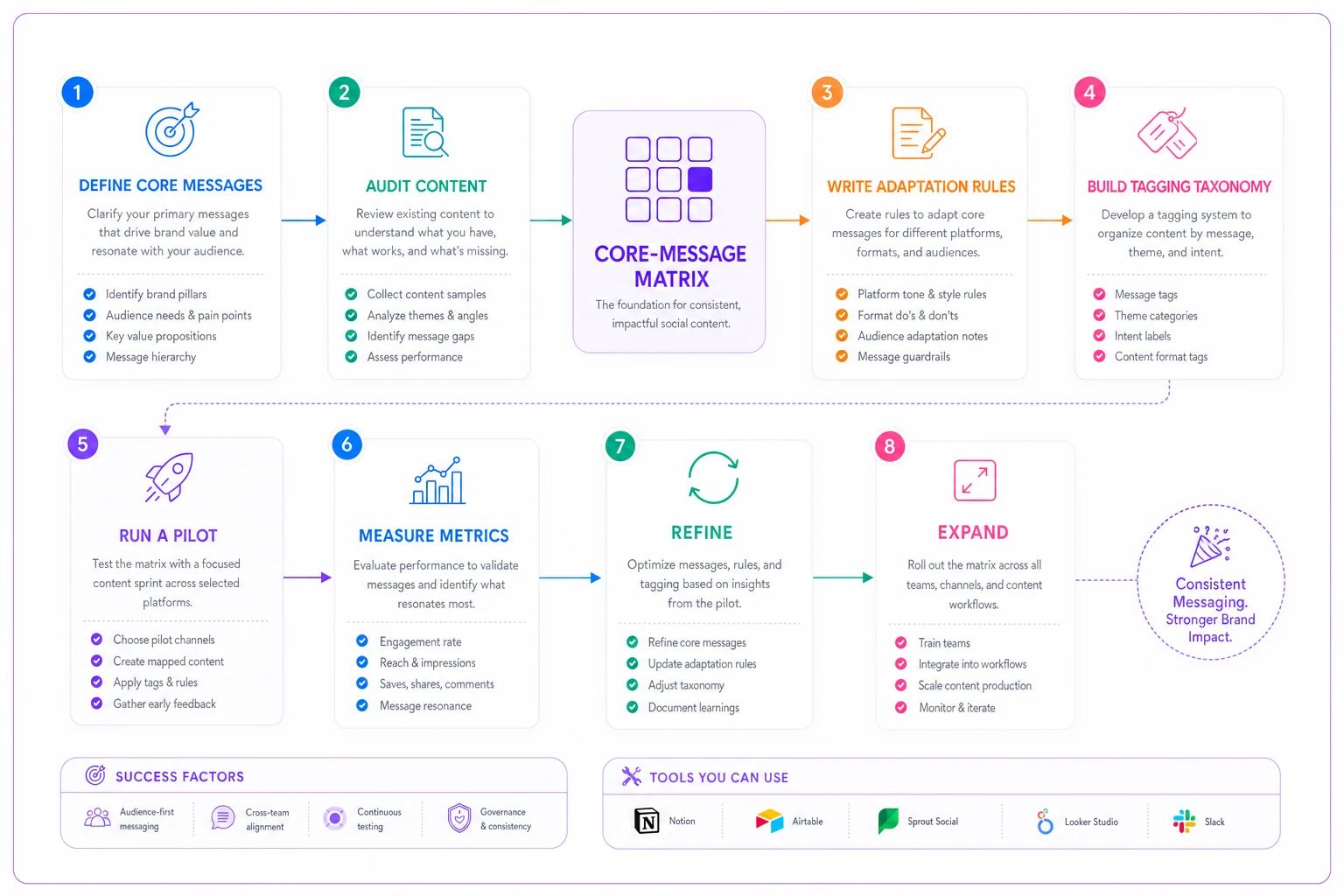
Skipping steps 4 and 5 is where most teams blow it. They build the whole matrix, launch everywhere at once, and then have no clean data to learn from.
The long game
A functioning cross-platform content strategy framework isn't built in a week or a month. It's an evolving system that improves with each iteration, and the teams that get results treat it like operational infrastructure, not a one-time project.
After around six months of consistent use, patterns start emerging. Certain adaptation formulas consistently outperform others. Some messages naturally travel across platforms better than others. Your team builds an intuitive sense for what will land where.
The real value isn't just message consistency or better engagement rates. It's turning content creation from a chaotic daily scramble into something predictable and scalable. When your team knows exactly how to adapt winning content for every platform, when approvals run smoothly, when you can actually track message performance across channels — that's when marketing operations stop being reactive and start being strategic.
The difference between teams drowning in content chaos and those scaling successfully usually isn't talent or budget. It's having a systematic approach to multi-platform content management. Build the matrix, establish the rules, implement the taxonomy, and what used to be a daily struggle starts looking more like a competitive advantage.
Ready to amplify your brand’s voice?
Join 2,500+ marketers using Postyly to save time, boost engagement, and grow their audiences effectively.