



Mixed social campaigns create attribution nightmares. You boost a post, it gets shared organically, someone clicks through three days later — and Facebook credits everything to paid. Meanwhile your boss sees inflated paid performance numbers and cuts organic budget, not realizing half those "paid" conversions came from unpaid shares.
The problem runs deeper than basic UTM tagging. Social platforms deliberately muddy attribution to make paid performance look better. Default attribution windows stretch days or weeks, capturing organic interactions that happen long after someone scrolled past your sponsored post. Most marketers never question these defaults.
Platforms overcount paid reach by somewhere between 40–60% when campaigns generate meaningful organic sharing. Small businesses running mixed campaigns on tight budgets feel this most — they need accurate data to make every dollar count.
The stepwise attribution method breaks mixed campaigns into measurable chunks
Traditional attribution treats social campaigns as single entities. Either something is paid or it's organic. But real campaigns move through multiple stages: initial paid push, organic amplification, delayed engagement, cross-platform sharing. Each stage needs a different measurement approach.
Stepwise attribution tracks campaigns through distinct phases. First, the paid launch period where boosted posts hit cold audiences. Then the organic amplification window when shares and comments extend reach without additional spend. Finally, the tail period where content keeps circulating through earned channels.
A clothing brand that implemented stepwise tracking for their seasonal launch found week one showed $8,000 in paid reach generating 450 conversions. Standard Facebook attribution claimed 890 conversions from that same spend. The difference? Organic shares in weeks two and three that Facebook's 28-day window captured as "paid."
Below is a simple workflow showing how the stepwise attribution method separates paid launch, organic amplification, and tail measurement, and how tracking layers feed into reconciliation.
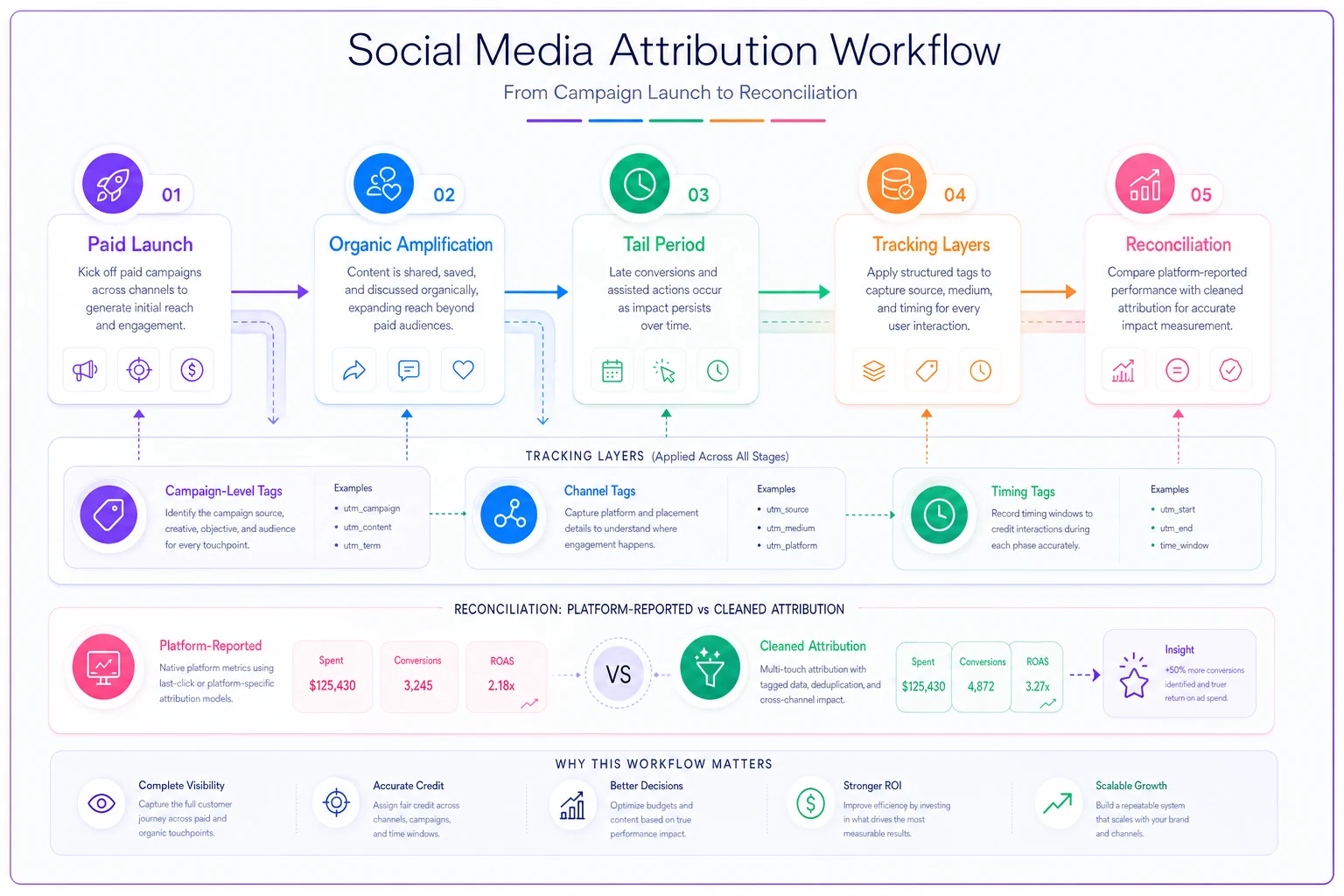
The method requires three tracking layers working together. Campaign-level tags identify which initiative drove the interaction. Channel tags separate paid from organic at the source. Timing tags capture when engagement actually happened relative to paid pushes.
Most social platforms make this deliberately difficult. They profit from inflated paid metrics. Instagram hides organic reach data behind API restrictions. LinkedIn extends attribution windows without clear documentation. TikTok changes measurement definitions quarterly. You need workarounds for each platform's obstacles.
UTM parameters need dual-layer structures for mixed campaigns
Basic UTM tagging falls apart in mixed environments. Using utm_medium=paid for boosted posts seems logical until organic shares carry those same parameters forward. Suddenly your earned reach is showing up as paid traffic in analytics.
Stop managing your social media the hard way.
Postyly helps you plan, schedule, and analyze every post with precision.
- Multi-platform scheduling
- Real-time engagement tracking
- Automated performance reports
No credit card required
The fix requires parallel tagging systems. Primary UTMs track the current state — paid when boosted, organic when shared. Secondary parameters preserve campaign origin. This dual structure lets you measure both immediate channel performance and total campaign impact.
Here's a working structure that captures both layers:
| Parameter | Paid Post | Organic Share | Re-share |
|---|---|---|---|
| utm_source | |||
| utm_medium | paid_social | social | social |
| utm_campaign | summer_launch | summer_launch | summer_launch |
| utm_content | boost_v2 | shareboostv2 | reshareboostv2 |
| custom_origin | paid_initial | earnedfrompaid | earned_secondary |
The utmcontent parameter becomes your breadcrumb trail. It shows content lineage without polluting channel attribution. Adding version numbers tracks creative iterations. The customorigin parameter explicitly states traffic source, cutting ambiguity.
Facebook's link shorteners strip custom parameters. Instagram's link stickers override UTMs entirely. Twitter truncates long parameter strings. Each platform requires specific workarounds to preserve tracking integrity.
Dynamic UTM builders help but introduce complexity. Marketing teams already juggling twenty campaigns struggle with parameter conventions, and the operational overhead often kills tracking initiatives before they gain momentum.
How timing windows determine whether shares count as earned or paid
Platform default windows destroy attribution accuracy. Facebook's 28-day click window captures organic activity weeks after paid campaigns end. Google Analytics' last-click model ignores the paid push that sparked organic sharing in the first place. Neither reflects what actually happened.
Smart timing windows align with actual user behavior. Paid attribution should match your boost duration — usually 3–7 days. Organic measurement extends through natural content lifespan — typically 14–30 days depending on platform and content type.
A fitness studio tested multiple window configurations on identical campaigns. Three-day paid windows showed $4,200 in paid conversions. Seven-day windows showed $7,100. Twenty-eight-day windows claimed $11,400. The actual paid budget was $3,500. Longer windows simply captured organic activity and called it paid.
Different content types need different windows:
News-related content: 24–48 hour paid window, 3–5 day organic tail
Educational content: 3–5 day paid window, 14–21 day organic tail
Product launches: 5–7 day paid window, 30+ day organic tail
Event promotion: Match paid window to early-bird deadlines
Your timing windows should reflect campaign goals. Brand awareness campaigns might use longer organic windows to capture full reach. Direct response campaigns need tighter windows to measure immediate impact. Mixed objectives require parallel tracking with different window lengths.
The technical implementation gets messy fast. You need timestamp parameters on every link, server-side tracking to capture actual click times, and scripts to categorize traffic based on timing rules. Most analytics platforms aren't built for this out of the box.
Real measurement requires isolating boost periods from organic growth
Clean measurement demands clear boundaries. When you boost a post from Tuesday through Thursday, only interactions during that window should count as paid. Everything after becomes earned reach, regardless of what the platform reports.
Platforms actively fight this separation. They use view-through attribution to claim organic engagement as paid. Someone sees your boosted post Tuesday, shares it organically Saturday, their friend converts Monday — Facebook credits the paid campaign for all of it.
Phase 1 — Paid Push (Nov 15–17)
-
Spend
$2,400
-
Reach
84,000 (paid)
-
Engagement
3,200 (paid)
-
Conversions
127 (paid)
Phase 2 — Organic Amplification (Nov 18–24)
-
Reach
156,000 (earned)
-
Engagement
8,900 (earned)
-
Conversions
312 (earned)
Platform Reported (28-day window)
-
All metrics attributed to paid
240,000 reach, 439 conversions from $2,400 spend
-
Apparent ROAS
7.3x
-
Actual paid ROAS
2.1x
They nearly tripled their boost budget based on false performance data. Proper windowing revealed the organic content quality drove success, not the paid targeting. That's a very different strategic conclusion.
Implementing clean windows requires campaign calendars with explicit on/off dates, no overlapping boosts that muddy attribution, and clear documentation of when paid pushes start and stop. It's operational discipline most teams don't actually maintain.
Cross-platform complications multiply tracking challenges
Single-platform campaigns are hard enough. Cross-platform campaigns become attribution chaos. Someone sees your boosted Instagram post, searches your brand on Google, clicks your organic Twitter result, then converts. Who gets credit?
Each platform claims the conversion. Instagram's view-through attribution grabs it. Google counts the search click. Twitter tracks the final referrer. The actual customer journey spans all three, but platform analytics can't see beyond their own walls.
Cross-platform sharing adds another layer. Your boosted Facebook post gets screenshotted to Instagram Stories. That Story gets saved and shared to Twitter. The Twitter post gets embedded in a blog. The viral chain breaks every tracking system.
Manual journey mapping helps but doesn't scale. You can track individual power users who drive sharing, document which platforms generate downstream engagement, build custom attribution models for common paths. But that requires dedicated analyst time most small teams simply don't have.
The practical solution combines platform-specific tracking with a unified reporting layer. Each platform tracks its own silo accurately. A central system reconciles overlapping claims. Custom attribution logic determines final credit based on your business rules.
Hidden platform gotchas that inflate paid metrics
Platforms bury dozens of attribution quirks in their documentation. Most marketers never discover them until budget has already been wasted.
Facebook's "Engaged Shoppers" audience includes anyone who clicked any ad in the past 365 days. Your organic post reaching these users gets credited to paid if you have any active campaign running — even if the organic reach had nothing to do with it.
Instagram's Reels distribution algorithm gives paid content persistent organic reach. Boost a Reel for two days and it can keep getting pushed organically for weeks afterward. The platform credits all subsequent views to your original paid push, inflating ROAS dramatically.
LinkedIn's view-through window extends 90 days for some campaign types. Someone sees your sponsored post in January, converts from organic search in March — LinkedIn claims the conversion. Their attribution reports don't exactly advertise this.
TikTok's Spark Ads let you boost other users' content mentioning your brand. But organic mentions after running Spark Ads get attributed to paid, even when you didn't boost those specific posts. The platform assumes all branded UGC stems from paid amplification.
Twitter's Promoted Trend attribution includes all organic tweets using the hashtag during and after promotion. Buy a trending hashtag for one day and Twitter attributes a week of organic usage to that campaign.
Practical workarounds for common attribution problems
Problem: Shared links carry paid UTM parameters
Build link redirect chains that swap parameters based on source. Paid traffic hits link.company.com/paid which adds paid UTMs. Organic shares use link.company.com/earned with different parameters. Both redirect to the same landing page but maintain attribution integrity.
Problem: Platforms strip custom parameters
Use subdomain routing as backup attribution. Paid traffic goes to paid.company.com, organic to organic.company.com. Both point to your main site but server logs capture the source. It's crude but survives platform link mangling.
Problem: View-through attribution inflates paid metrics
Export raw conversion data with timestamps. Compare conversion times against boost schedules. Reclassify conversions that happened outside paid windows. Build reports that show platform attribution and cleaned attribution side-by-side.
Problem: Organic reshares lose tracking
Implement pixel-based backup tracking. First-party cookies identify users who arrived via paid campaigns. When they return through organic channels, your pixel recognizes them and lets you separate genuinely new organic traffic from paid-influenced returns.
Problem: Cross-platform journeys break attribution
Use campaign-specific landing pages that capture entry source. When users traverse platforms, the landing page parameter persists. Final conversion reports show first-touch source regardless of journey complexity.
Here's the order that makes implementation manageable rather than overwhelming:
-
Audit your current UTM conventions and document what's inconsistent
-
Build a dual-layer parameter structure for new campaigns going forward
-
Configure custom channel definitions in Google Analytics
-
Set timing windows that match your actual boost durations
-
Create side-by-side reports comparing platform-reported vs. cleaned attribution
-
Add redirect chains or subdomain routing to protect parameters from platform stripping
-
Implement pixel-based tracking as a backup layer for cross-platform journeys
-
Build a campaign calendar with explicit boost on/off dates enforced before launch
Start with UTMs and windows — those two changes alone will reveal how distorted your current picture is.
Don't try to fix everything at once. Start with UTMs and windows — those two changes alone will reveal how distorted your current picture is.
Setting up measurement infrastructure that actually works
Clean measurement of earned versus paid reach needs three systems working together. Campaign management tools that enforce consistent tagging. Analytics platforms configured with proper attribution windows. Reporting that reconciles conflicting data sources.
The campaign management layer prevents human error. Marketing teams running dozens of campaigns simultaneously can't manually maintain parameter conventions. URL builders should auto-generate proper dual-layer UTMs. Calendar systems need to track boost windows. Version control needs to preserve parameter history.
Your analytics configuration determines data quality. Default Google Analytics settings won't cut it. You need custom channel definitions separating paid social from organic social, filtered views that exclude internal traffic, custom dimensions capturing timing parameters, and calculated metrics that measure true earned reach.
Reporting automation bridges platform silos. Scripts pull data from each platform API. Custom attribution logic applies your timing windows. Outputs show performance both ways — platform reported and properly attributed. Stakeholders see the full picture instead of whatever the platform wants them to see.
Most teams try building this infrastructure themselves. They spend months wrestling with APIs, debugging attribution logic, fighting platform changes. The fortunate ones end up with maybe 60% accuracy. The rest give up and go back to trusting platform metrics.
AI-powered operational software is worth looking into seriously if measurement complexity is already eating your team's time. These platforms can track campaigns across channels, apply consistent windowing, and separate earned from paid without requiring a manual process every time. The same tools that manage campaign workflows can enforce measurement standards — making sure every link gets tagged correctly and every boost window gets documented before campaigns go live, rather than reconstructed after the fact.
Why getting this right matters more than ever
Social platforms want you confused about attribution. Confusion leads to higher ad spend. When you can't separate earned from paid performance, you allocate budget based on inflated metrics, which benefits the platform, not you.
Accurate measurement reveals which content actually drives organic reach. You discover certain creative formats generate far more shares. Specific posting times trigger viral chains. Some audience segments become natural amplifiers. These insights only emerge when you correctly separate earned from paid.
Small businesses feel this most acutely. They can't afford wasted spend based on false metrics. Proper attribution often reveals their organic content outperforms paid — they just couldn't see it through the platform reporting fog.
The operational discipline required for clean measurement also improves overall campaign performance. Teams that track properly tend to plan better, document strategies, and test more systematically. They scale what works based on real data instead of platform-generated optimism.
Getting measurement right isn't just about accurate reporting — it fundamentally changes how you run campaigns. You stop chasing vanity metrics. You invest in content that generates actual earned reach. You build sustainable audience growth instead of renting attention through endless boosts.
The complexity keeps growing. New platforms emerge. Attribution windows change without notice. Privacy regulations keep eliminating tracking methods. But the core challenge stays the same: separating what you paid for from what you earned. Get that distinction right and your social campaigns stop feeling like expensive guesswork.
The complexity keeps growing. New platforms emerge. Attribution windows change without notice. Privacy regulations keep eliminating tracking methods. But the core challenge stays the same: separating what you paid for from what you earned. Get that distinction right and your social campaigns stop feeling like expensive guesswork.
Ready to amplify your brand’s voice?
Join 2,500+ marketers using Postyly to save time, boost engagement, and grow their audiences effectively.