

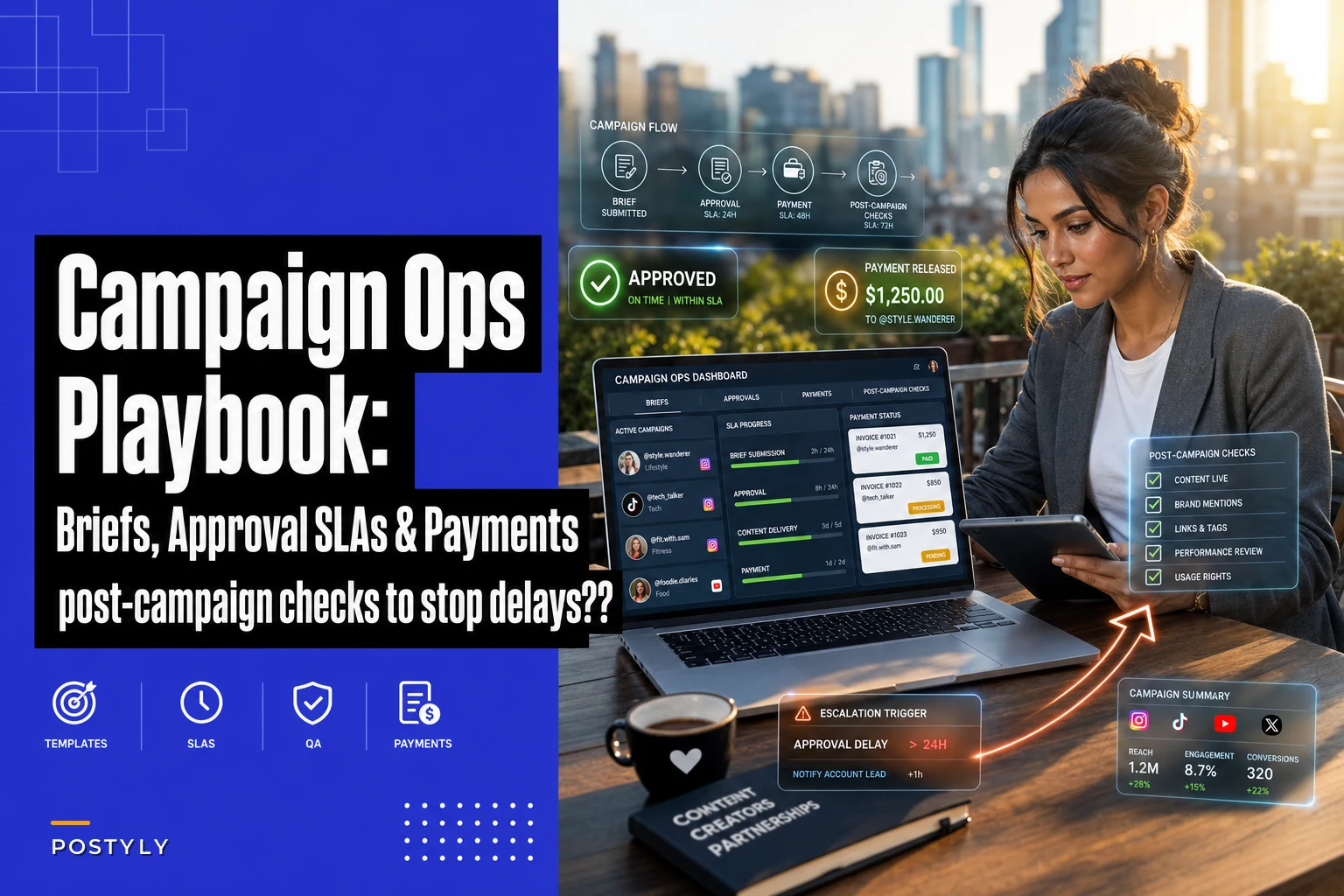

Managing influencer campaigns feels straightforward until you're tracking 47 creators across different time zones, each with their own interpretation of "urgent" and their own definition of what "final approval" means. The operational complexity compounds fast — one fashion brand I worked with found their influencer campaigns were taking 3x longer to execute than traditional paid social, despite involving fewer total assets.
The problem isn't the influencers. It's that most teams try running influencer operations using the same workflows they use for in-house content creation. It's a completely different beast.
Brief templates that prevent the endless back-and-forth
Generic briefs create generic content. But overly detailed briefs cause paralysis. After watching campaigns stall at the briefing stage more times than I can count, the sweet spot is clear: structured flexibility.
Your influencer brief needs three distinct sections that most teams collapse into one confusing document. First, the non-negotiables — brand safety guidelines, required disclosures, forbidden competitor mentions. These get their own single page with checkboxes. No interpretation needed. Second section covers creative direction through examples, not instructions. Instead of writing "maintain our premium brand voice," show three previous posts that nail the tone you want. Influencers pattern-match better than they interpret marketing language. Include one example of what you don't want — sometimes the contrast clarifies more than any description could. The third section is pure logistics. Deadlines, payment terms, usage rights, approval process. It reads like a contract because functionally, it is one. One DTC supplement brand reduced their brief clarification emails by nearly 80% just by separating creative guidance from operational requirements.
Most teams also miss this: brief templates need versioning for campaign types. A product launch brief differs from an awareness campaign brief. Create four core templates:
-
Product launch (timeline critical, messaging precise)
-
Brand awareness (tone critical, messaging flexible)
-
Conversion-focused (CTA critical, creative flexible)
-
Event coverage (timing critical, content reactive)
Each template pre-fills different sections based on what actually matters for that campaign type.
Permission matrices that scale beyond five influencers
The approval chain breaks first. Marketing wants to review everything. Legal needs to check disclosures. Brand team wants to ensure voice consistency. Meanwhile, your influencer posted their own interpretation because they got tired of waiting.
Stop managing your social media the hard way.
Postyly helps you plan, schedule, and analyze every post with precision.
- Multi-platform scheduling
- Real-time engagement tracking
- Automated performance reports
No credit card required
Build your permission matrix around content risk, not team hierarchy. Low-risk content — lifestyle shots with the product visible — needs one reviewer. Medium-risk content like product claims or comparisons needs two. High-risk content triggers full review.
The operational trick: you define risk categories upfront in the matrix, not per post. A simple grid works well:
| Content Type | Risk Level | Reviewers Needed | Max SLA |
|---|---|---|---|
| Product in lifestyle setting | Low | Social manager | 4 hours |
| Product demonstration | Medium | Social + Brand | 8 hours |
| Product claims/benefits | High | Social + Brand + Legal | 24 hours |
| Competitor comparison | High | Full team | 24 hours |
| User testimonial reshare | Low | Social manager | 2 hours |
SLAs shrink for lower-risk content. This prevents bottlenecks when you're managing multiple creators at once. One beauty brand running 30+ monthly influencer collaborations cut their average approval time from 3 days to around 11 hours using this approach.
The matrix also needs escalation rules. If someone doesn't respond within their SLA window, who gets notified? After how many hours does it escalate? And at what point does the social manager get override authority to avoid missing a posting window?
Approval SLAs that influencers will actually follow
SLAs fail when they're one-sided. You demand 48-hour turnaround from influencers but take a week to approve their content. The relationship deteriorates fast.
Reciprocal SLAs fix this. If an influencer submits content by Monday noon, you guarantee feedback by Tuesday 5pm. Miss your window? They get to post without final approval, assuming it meets safety guidelines. That mutual accountability changes the entire dynamic.
Initial submission window: Influencer submits first draft 7 days before planned post date
First feedback round: Brand provides feedback within 24 hours
Revision window: Influencer implements changes within 48 hours
Final approval: Brand approves or requests minor tweaks within 12 hours
Buffer time: 2 days remain for unexpected issues
Always build buffer time into schedules to account for vacations or unexpected account issues.
The key is building buffer time into the schedule from day one. Campaigns fail when you plan for best-case scenarios. Plan for someone being on vacation, someone misreading the brief, and someone's account getting temporarily suspended all at once. Track SLA performance both ways. Which influencers consistently deliver on time? Which internal reviewers consistently cause delays? One software company found their legal team was the bottleneck in nearly three-quarters of delayed campaigns — they fixed it by having legal pre-approve standard language templates that influencers could pull from directly.
Deliverable checks beyond "did they post?"
Most teams check if content went live and move on. But real operational quality means systematic checks across multiple dimensions.
Build a deliverable checklist someone can complete in under 3 minutes per post:
-
Link clicks working correctly (not broken, not pointing to competitors)
-
Disclosure visible and compliant (#ad, #sponsored in first 3 lines)
-
Brand handles tagged properly
-
Key messaging included (did they mention the specific product feature you briefed?)
-
Posting time within agreed window
-
Content format matches brief (Reel vs post, Story vs feed)
But deliverable checks go beyond the post itself. You're also tracking:
-
Audience authenticity (a sudden engagement spike can suggest bought followers)
-
Comment management (are they responding? hiding negative feedback?)
-
Story/highlight additions (did they save it as promised?)
-
Cross-platform posting if contracted for multiple platforms
A simple scoring system helps. Each element gets a yes/no/partial. Yes = 2 points, Partial = 1 point, No = 0 points. Influencers scoring below 80% trigger a conversation before the next campaign. Those hitting 95%+ get preferred partner status with simplified approval processes.
Automate what you can. Set up Google Alerts for brand mentions without proper disclosure. Use link shorteners that flag broken redirects. Build a spreadsheet that calculates compliance scores automatically based on checklist inputs. Nothing fancy — just consistent.
Payment workflows that don't destroy relationships
Payment delays kill influencer relationships faster than any creative disagreement. Yet most teams treat influencer payments as an afterthought, running them through the same accounts payable system used for office supplies.
Structure payments around milestones, not just final delivery:
-
25% upon signed agreement
-
25% upon content approval
-
50% upon posting confirmation
This protects both sides. Influencers get partial payment even if posting gets delayed for reasons outside their control. Brands keep leverage until content actually goes live.
For ongoing partnerships, shift to monthly cycles. Instead of processing 20 individual payments, batch them monthly. Influencers know they'll be paid on the 15th for all approved content from the previous month. Predictability beats speed for most creators.
International payments are where things actually break. Different tax requirements, payment methods, currency conversions. Build separate workflows for domestic versus international creators. Platforms designed for the creator economy — like Tipalti or Trolley — handle international well. Keep traditional ACH or wire for domestic.
Document payment requirements upfront:
-
W9/W8 forms before any work begins
-
Invoice requirements (what needs to be included)
-
Payment methods accepted
-
Currency for international creators
-
Late payment penalties, both ways
The platform fees are worth avoiding the compliance headaches.
Post-campaign evaluation that improves future campaigns
Most post-campaign reviews ask the wrong questions. "How would you rate this campaign?" tells you nothing actionable. "Would you work with this influencer again?" is too binary.
Influencer-specific metrics:
-
Brief clarification requests (how many emails or DMs were needed?)
-
Revision rounds required
-
SLA adherence rate
-
Actual reach vs. promised reach
-
Engagement rate vs. their historical average
-
Sales or conversions attributed, if trackable
Process-specific metrics:
-
Which brief sections caused confusion?
-
Where did approvals bottleneck?
-
Which requirements got missed most often?
-
How many exceptions to standard process were needed?
Relationship metrics:
-
Communication responsiveness score
-
Flexibility when issues arose
-
Professionalism rating
-
Audience comment quality
-
Brand safety incidents
What makes evaluations actually useful is comparative context. Don't just score an influencer 7/10 on communication — note that they're in the 70th percentile compared to everyone you've worked with. Relative scoring helps identify genuinely exceptional partners versus just acceptable ones.
Categorize based on evaluation scores:
-
Preferred partners (top 20%)
Simplified approvals, first access to campaigns, premium rates
-
Standard partners (middle 60%)
Normal process, standard rates
-
Provisional partners (bottom 20%)
Additional oversight, detailed briefs required
-
Do not engage
Failed major requirements or created brand risk
Share evaluation insights with influencers who want to improve. A micro-influencer who's eager but inexperienced can benefit from knowing they're taking too long on revisions. They can't fix what they don't know is broken.
Tying it all together with operational software
The manual coordination required for influencer campaigns creates natural breaking points as you scale. Tracking brief versions in email threads, chasing approvals through Slack, managing payments through spreadsheets — each additional influencer multiplies the coordination overhead.
This is where AI-powered operational software genuinely changes the workflow. Instead of manually checking whether an influencer posted on time, automated systems can scan for posts, verify disclosure compliance, and trigger payment workflows without anyone having to babysit the process. The repetitive coordination tasks — reminder emails, status updates, flagging posts that need review — can largely run on their own.
A simple visual of how these systems connect:
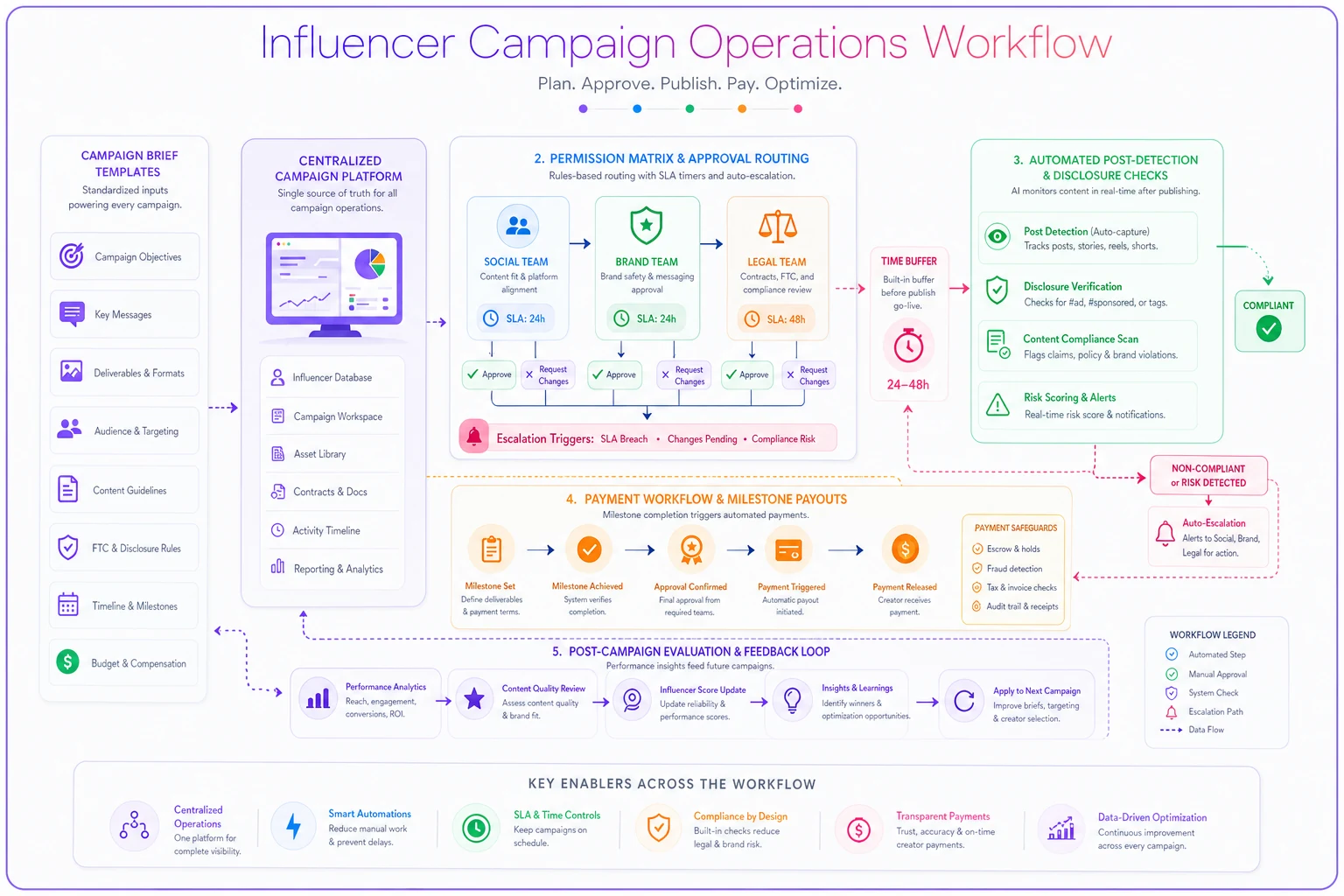
The real efficiency gain comes from centralizing everything in one platform. Brief templates, approval workflows, payment schedules, and evaluation forms all live in one system that tracks status automatically. When an influencer submits content, the right people get notified based on your permission matrix. When SLAs are about to expire, the system escalates rather than waiting for someone to notice.
One consumer goods brand reduced their campaign management time by roughly two-thirds after consolidating onto operational software that automated their standard workflows. Their team went from managing 8 influencer campaigns monthly to 25, same headcount. The software didn't replace judgment calls — it just eliminated the administrative drag that was eating most of their time.
The compound effect of systematic operations
Building an influencer campaign operations playbook isn't just about efficiency — it's about predictability. When every campaign follows consistent processes, you can accurately forecast timelines, budget resources, and set realistic expectations with stakeholders.
The brands succeeding with influencer marketing at scale aren't necessarily the ones with the biggest budgets or the flashiest campaigns. They're the ones who've turned influencer management into a repeatable, measurable system. They know how long each stage takes, where problems typically surface, and how to stop the same issues from recurring.
Your playbook will evolve. The brief template that works for fashion influencers might fall flat for B2B thought leaders. The payment structure perfect for macro-influencers might not make sense for nano-influencer campaigns. But having a documented starting point — templates, matrices, SLAs, workflows — means you're improving a system instead of reinventing the process every time.
The operational discipline built for influencer campaigns also lifts your broader marketing operations. The approval workflows, quality checks, and evaluation frameworks apply across content types. The rigor required to coordinate external creators tends to raise the bar for internal content work too.
Start with one complete campaign using all these components. Document what breaks. Adjust the templates. Run another campaign. Within five campaigns, you'll have a playbook that eliminates the majority of friction that makes influencer marketing feel impossible to scale. The goal isn't a perfect system — it's a predictable, improving one that lets you focus on strategy instead of logistics.
Ready to amplify your brand’s voice?
Join 2,500+ marketers using Postyly to save time, boost engagement, and grow their audiences effectively.