

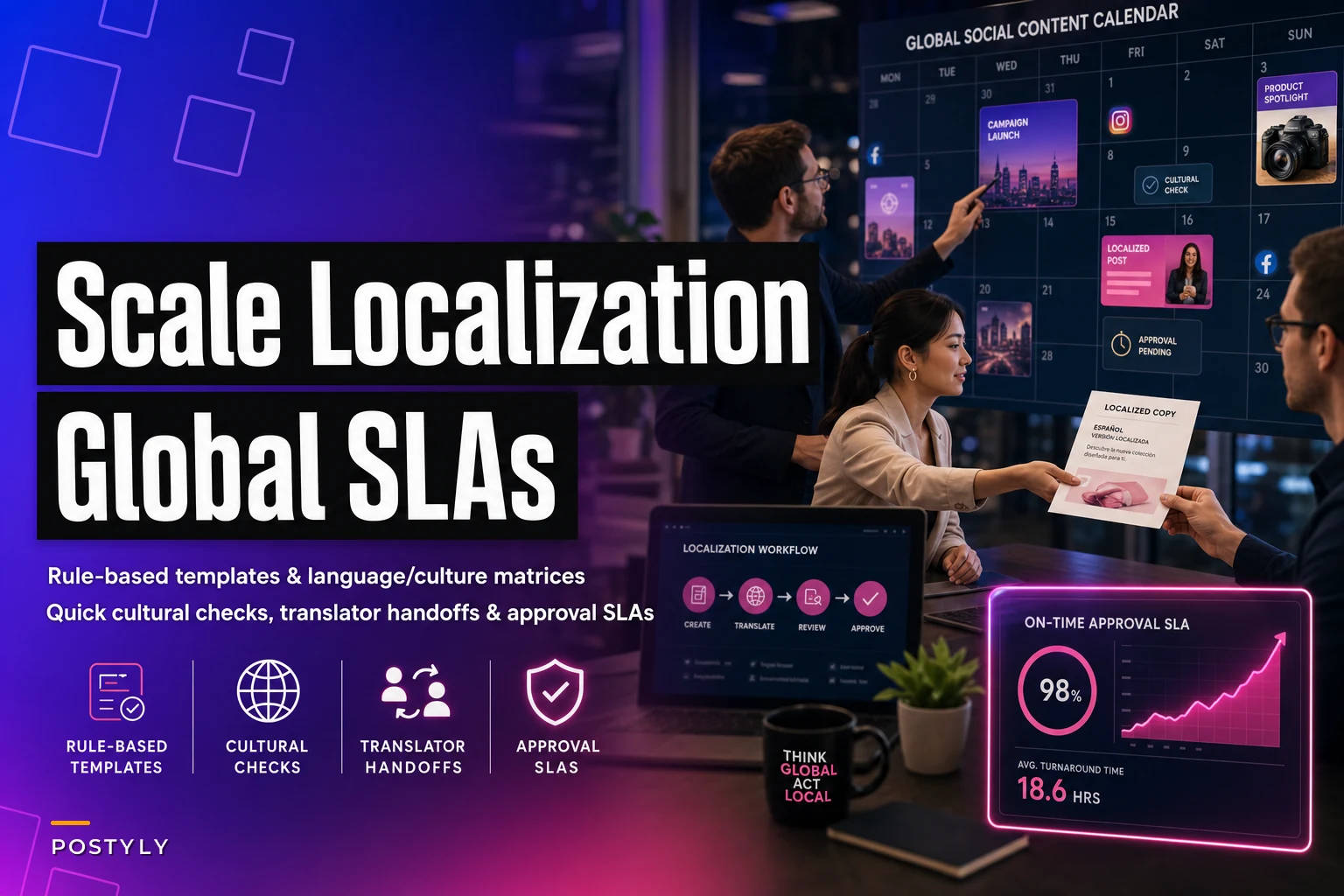

Managing social content for multiple regions isn't just translation work. It's watching your German team reject content because the humor doesn't land, your Japanese office sit on approvals for days because the imagery feels off, and your Mexico City team scrambling to rewrite posts at the last minute because the messaging misses entirely.
The operational nightmare hiding in your global social calendar
Most social teams discover this problem after they've already scaled to five or more markets. By then you're managing chaos across time zones, dealing with broken approval chains, and watching engagement drop in markets where the content feels imported rather than native.
Hiring more translators won't fix it. You need operational systems that catch cultural misalignment before content ever reaches regional teams.
Why traditional localization workflows create approval bottlenecks
Standard localization usually flows like this: create English content, send to translation, regional team reviews, they request changes, back to translation, another review cycle, finally approved three days past deadline.
Stop managing your social media the hard way.
Postyly helps you plan, schedule, and analyze every post with precision.
- Multi-platform scheduling
- Real-time engagement tracking
- Automated performance reports
No credit card required
Each handoff adds anywhere from 12 to 48 hours. Regional teams feel like afterthoughts getting content dumped on them. Your posting schedule slips. Engagement drops because the content feels forced rather than native.
The real breakdown happens in the gray area between translation and cultural adaptation. Translators handle language but miss context. Regional teams understand culture but don't have time to rewrite everything. Marketing sits in the middle trying to hold brand consistency together while local teams push for more autonomy.
What actually works is building rule-based checks into your content creation process — not your review process. Stop treating localization as post-production. Make it part of initial content development.
Building rule-based templates that prevent cultural missteps
Start with cultural dimension mapping. Not complex anthropological analysis — practical rules your team can actually follow. Map these five dimensions for each market: Communication style: Direct vs. indirect messaging Visual preferences: Color meanings, gesture interpretations, representation expectations Humor tolerance: What's funny vs. what's offensive Formality level: Professional distance vs. casual friendliness Value signals: Individual achievement vs. collective success
For each dimension, create specific content rules. Germany prefers direct communication? Your template notes: "Lead with data and facts, avoid emotional appeals." Japan values visual harmony? Template says: "Avoid aggressive color contrasts, ensure balanced compositions."
These aren't suggestions. They're pre-flight checks built into your content creation workflow.
The template structure that actually works
Universal content core: The message that stays consistent across all markets — your product benefit, campaign theme, CTA Regional adaptation zones: Specific areas marked for required localization — opening hooks, cultural references, visual elements No-touch elements: Brand elements that never change — logos, taglines, core value props
Mark adaptation zones clearly in your templates. Use brackets or highlighting, whatever makes them impossible to miss. When content creators see [CULTURAL HOOK - CHECK MATRIX], they know to reference market-specific rules before writing.
[CULTURAL HOOK - CHECK MATRIX] Our new feature helps you [UNIVERSAL BENEFIT]. [LOCAL PROOF POINT - MARKET SPECIFIC] [VALUE SIGNAL - CHECK DIMENSION MAP] Available now: [UNIVERSAL CTA]
The creator fills in bracketed sections using your cultural rule matrix. The German version leads with efficiency metrics. The Brazilian version opens with community benefit. The Japanese version emphasizes harmony with existing workflows.
Mark adaptation zones clearly in your templates so creators can't miss them.
These templates make cultural checks part of creation instead of an afterthought.
Quick cultural-check heuristics that catch problems early
Full cultural review takes time you don't have. These rapid checks catch the majority of issues in under five minutes per post.
The grandmother test: Would someone's grandmother in that market understand and appreciate this? Catches overly casual language, inappropriate humor, and confusing references.
The competitor scan: Pull up three local competitor posts from that market. Does your content feel similar in tone and style? A major divergence signals potential cultural mismatch.
The visual flip: Replace your imagery with local stock photos from that market. Does the message still work? This often reveals when visuals carry unintended cultural weight.
The back-translation check: Translate your content to the local language, then back to English. What changed? Idioms, metaphors, and cultural phrases reveal themselves through that distortion.
Build these checks into your workflow as required steps, not optional ones. Content doesn't move forward until someone runs all four and documents the results.
Creating your cultural sensitivity matrix
Stop relying on native speakers to catch every issue. Build a simple matrix that flags common problems:
| Content Element | US OK | UK OK | Germany Caution | Japan Avoid | Brazil OK |
|---|---|---|---|---|---|
| Emoji use | Heavy | Moderate | Minimal | Selective | Heavy |
| Humor style | Self-deprecating | Dry/witty | Avoid | Subtle only | Playful |
| Personal stories | Yes | Sometimes | Rarely | No | Yes |
| Direct CTAs | Yes | Yes | Yes | Soften | Moderate |
| Casual language | Yes | Yes | No | No | Yes |
Update this matrix monthly based on actual performance data and regional team feedback. It becomes your early warning system for content that won't translate well culturally — not just linguistically.
Translator handoff templates that preserve context
The handoff to translation usually loses critical context. Translators get bare text without understanding campaign goals, audience segments, or cultural considerations. They translate words, not meaning.
Fix this with structured handoff templates that include: Campaign context: Two sentences explaining the broader campaign and what it's trying to do Audience profile: Age, interests, cultural touchpoints for this specific market Tone guidance: The exact tone you're targeting — professional but approachable, excited but not hyperbolic Must-preserve elements: Phrases, concepts, or emotions that need to survive translation intact Flexibility zones: Areas where translators can adapt freely for local resonance
Here’s a real handoff template: POST TEXT: "This Black Friday, transform your workspace with deals that actually matter." CAMPAIGN CONTEXT: B2B campaign targeting small business owners preparing for holiday sales rush. Focus on preparation, not consumption. AUDIENCE: Small business owners, 35-50, stressed about Q4 performance TONE: Supportive partner, not salesy vendor MUST PRESERVE: "transform" concept (not just "change" or "improve"), sense of selective value ("that actually matter") FLEXIBLE: "Black Friday" can adapt to local shopping events, "workspace" can be office/shop/studio based on market norm CULTURAL NOTES: Germany - emphasize efficiency gains. Japan - soften direct benefit claims. Brazil - add community success angle.
Translators now understand intent, not just words. They become cultural adapters instead of language converters.
Setting approval SLAs that respect time zones and cultural working styles
Standard 24-hour approval SLAs break down across global teams. Your Tokyo team gets content at 6 PM their time, expected to approve by 6 PM your time — giving them just a few morning hours to review. Meanwhile your São Paulo team sits on content for days because their approval process involves multiple stakeholders.
Build SLAs that account for both time zones and cultural working patterns.
Time zone-adjusted SLAs
Same-day timezone overlap (4+ hours): 24-hour SLA Next-day timezone overlap (2-4 hours): 36-hour SLA Minimal timezone overlap (<2 hours): 48-hour SLA
Add buffer for cultural work styles: Consensus cultures (Japan, Nordics): +12 hours for stakeholder alignment Hierarchical cultures (Korea, Middle East): +12 hours for upward approval Relaxed deadline cultures (Southern Europe, Latin America): +24 hours buffer
Your final SLA formula: Base timezone SLA + Cultural buffer = Realistic deadline.
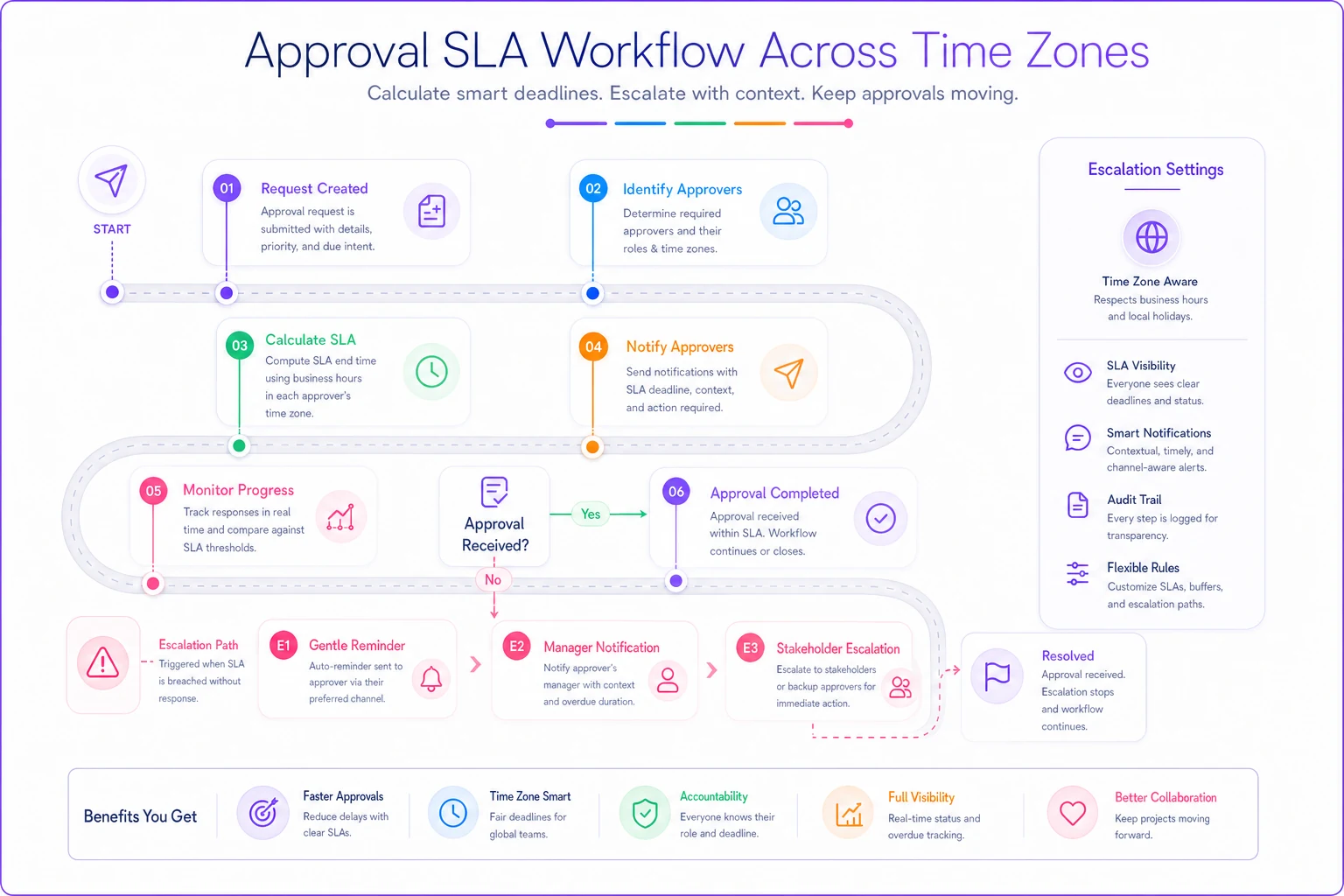
A simple visual helps teams understand SLA math and escalation responsibility at a glance.
The escalation matrix that actually gets content approved
-
Hour 1–12
Original reviewer owns approval
-
Hour 13–24
Backup reviewer notified, can approve if needed
-
Hour 25–36
Regional lead can override and approve
-
Hour 36+
Global team can publish with documented override
Document who fills each role for each market. Update quarterly as teams change.
Build this into your operational platform. When someone submits content for the German market on Monday at 2 PM EST, the system automatically calculates: 48-hour base (minimal timezone overlap) + 12 hours (consensus culture) = Thursday 2 AM EST deadline. Notifications go out accordingly. This is exactly where AI-powered operational software earns its keep — not replacing human judgment, but making sure that judgment gets triggered at the right time with the right context.
The operational reality of scaling localized social
A mid-sized software company went through this exact pain. They'd expanded from US-only to five markets — US, UK, Germany, Japan, and Brazil — and their social team was drowning in revision cycles, missed deadlines, and content that felt generically "international" rather than locally relevant.
Instagram engagement in Japan sat around 0.8% while their US accounts hit 3.4%. German LinkedIn posts were getting formal rejection emails from the regional team. Brazilian content kept getting completely rewritten locally, which defeated the whole point of centralized creation.
They implemented rule-based templates with clear adaptation zones, built the five-dimension cultural matrix, and set realistic SLAs based on actual working patterns instead of arbitrary deadlines. The transition took about six weeks to fully implement. They started with product announcement posts — easiest to templatize — then expanded to thought leadership content, then engagement posts.
Three months in: Japanese Instagram engagement climbed to around 2.1%. German content approval time dropped from a five-day average to roughly a day and a half. The Brazilian team stopped rewriting entirely and started adding local flavor to pre-approved frameworks. Overall content production increased roughly 40% while approval delays dropped around 60%.
Not perfect numbers, but the kind of operational improvement that compounds. Every week gets slightly smoother as teams internalize the system.
Common localization mistakes that kill engagement
Watch for these patterns — they usually signal your localization process needs work:
The literal translation trap: Your English "crushing it" becomes German "zerstören es" — literally destroying something. Idioms and colloquialisms need cultural equivalents, not word-for-word translation.
The single translator dependency: One person handling all German content creates a bottleneck and a single point of failure. Build translator pools with clear handoff protocols.
The cultural assumption cascade: Assuming UK and Australian markets are similar enough to share content. They're not. Treating Latin America as one monolithic market. It isn't.
The emoji disaster: Heavy emoji use that works in the US and Brazil falling flat in Germany and Japan. Your 🔥🔥🔥 reads as aggressive or childish in more formal markets.
The timing mismatch: Posting "Monday motivation" when it's already Tuesday in Sydney. Referencing "weekend plans" when your Middle East audience has Friday/Saturday weekends.
Each mistake seems small but compounds into content that feels foreign, slowly eroding trust and engagement in markets you're trying to grow.
When localized content actually hurts more than helps
Not every piece of content needs localization. Sometimes forcing local adaptation makes content feel inauthentic or, worse, patronizing.
Skip localization when:
-
Content is purely factual or technical — product specs, downtime notices
-
You're sharing global milestones — company anniversary, worldwide user count
-
The audience expects English content — developers, international business community
-
Local team lacks bandwidth and poor localization is worse than none at all
The worst localized content is obviously machine-translated or culturally tone-deaf. Better to post in English with a brief acknowledgment ("Sharing from our global team...") than to butcher local language and custom.
Building operational workflows that scale across 10+ markets
The system above handles three to five markets well. Beyond that, you need additional operational layers.
Group markets by similarity to share some adaptation work: English-first markets: US, UK, Australia, Canada — share base content, adapt slang and spelling DACH region: Germany, Austria, Switzerland — share formal tone, adapt dialects Latam Spanish: Mexico, Colombia, Argentina — share base translation, adapt local terms
Create regional hub reviewers who handle multiple similar markets. Your German reviewer also covers Austria and Switzerland. Your Mexico City team handles Spanish-speaking Americas.
Implement staggered posting schedules too. Don't try to post everywhere simultaneously. Roll out content in waves — APAC first, then EMEA, then Americas. Gives you time to catch issues before they spread globally.
Your operational platform needs to track all of this complexity — who reviewed what, which templates were used, what adaptations were made. Manual tracking in spreadsheets breaks down fast at scale. AI-assisted operational software helps here by flagging content that hasn't been culturally checked, automatically routing to the right reviewers based on timezone and workload, and surfacing patterns from past rejections. It's not replacing human judgment — it's making sure human judgment happens at the right points instead of getting skipped because someone was busy.
The uncomfortable truth about global social content
Perfect localization doesn't exist. You're always trading between brand consistency and local relevance, between speed and cultural sensitivity, between central control and regional autonomy.
The goal isn't perfection. It's building operational systems that catch obvious mistakes, respect regional differences, and keep content flowing at a sustainable pace.
Your regional teams will always want more control. Your global team will always want more consistency. Your translators will always need more context. These tensions are permanent — build workflows that balance them rather than try to eliminate them.
Start with one market, one content type, one platform. Get that flowing smoothly. Add complexity gradually. Most teams try to build comprehensive global systems immediately and end up with broken processes everywhere instead of one thing working well.
The biggest unlock isn't better translation or deeper cultural knowledge. It's operational workflows that make good localization possible at the speed social media demands. Build the system first, then improve the content quality within it. Consistently good localized content beats occasionally perfect content that arrives three days late.
Ready to amplify your brand’s voice?
Join 2,500+ marketers using Postyly to save time, boost engagement, and grow their audiences effectively.