



Your paid social team just spent three days perfecting a campaign creative. Then it sits in someone's inbox for another five days waiting for approval. By the time it launches, your competitor's campaign has already captured half your target audience's attention.
This approval lag shows up everywhere, but the damage varies a lot. A DTC brand launching seasonal products loses thousands in daily revenue. A B2B software company misses their conference window. Local service businesses watch their weekend promotion budgets burn while waiting for Monday morning sign-off.
The frustrating part? Most teams try fixing this with more meetings, more Slack messages, more "urgent" tags. But the real problem runs deeper — there's no structured approval system that actually respects both creative quality and campaign timelines.
The permission matrix most teams never document (but desperately need)
Every approval process breaks down at the same predictable point: nobody knows who can approve what. Your junior designer needs creative director sign-off for a simple resize. Your media buyer waits for CMO approval on a $500 test campaign. Meanwhile, a $50,000 campaign goes live with a typo because "someone else probably checked it."
Here's the permission structure that actually works:
Level 1: Auto-approval territory
-
Existing creative resizes (same copy, different dimensions)
-
A/B test variations under 20% change from control
-
Budget shifts under 10% between existing campaigns
-
Creative refreshes using pre-approved brand assets
Level 2: Single stakeholder approval
-
New creative concepts within brand guidelines
-
Copy variations for established campaigns
-
Audience expansion tests under $5,000
-
Platform-specific adaptations
Level 3: Dual approval required
-
Campaign strategy changes
-
New audience segments over $5,000 spend
-
Creative concepts outside standard guidelines
-
Multi-platform campaign launches
Level 4: Full committee review
-
Brand positioning shifts
-
Compliance-sensitive content
-
Crisis response campaigns
-
Budgets exceeding monthly thresholds
The difference comes when you actually document these levels somewhere people can see them — not buried in a brand guide PDF nobody opens, but inside the actual workflow tools where decisions get made.
Why generic SLAs fail for creative approvals
Standard SLAs treat all approvals equally. "24-hour turnaround" sounds reasonable until it applies to both a simple image swap and a full campaign overhaul. Same timeline, wildly different work. That's operationally backwards.
Stop managing your social media the hard way.
Postyly helps you plan, schedule, and analyze every post with precision.
- Multi-platform scheduling
- Real-time engagement tracking
- Automated performance reports
No credit card required
Real approval SLAs need context awareness. A retail brand running Black Friday campaigns needs different speeds than a B2B company planning quarterly webinars. Your SLA structure should reflect actual business impact, not arbitrary uniformity.
The context-based SLA framework:
Campaign urgency determines base timeline:
-
Emergency response (competitor attack, crisis)
2-4 hours
-
Time-sensitive promotions (flash sales, events)
6-12 hours
-
Standard campaigns (evergreen, planned)
24-48 hours
-
Exploratory tests (new platforms, audiences)
3-5 days
Then layer in complexity modifiers:
-
Single asset approval
Base timeline
-
Multi-asset package
Base × 1.5
-
New concept development
Base × 2
-
Compliance review needed
Add 24 hours minimum
A fashion brand that implemented this tiered system cut their average approval time from 6 days down to under 2. More importantly, urgent campaigns started launching within hours instead of missing the window entirely.
The versioning nightmare that kills campaign momentum
You've seen this before: CreativeFinalv2FINALactuallyFinalMarch15approved.jpg
Then someone finds a typo.
Most teams treat versioning like an afterthought, then wonder why campaigns go live with outdated creatives. A solid versioning system isn't just about organization — it's about maintaining approval integrity while allowing fast iteration.
The three-part versioning system that actually scales:
Part 1: The naming convention
[Platform][Campaign][Format][Version][Status]
Real example: FBSpringSaleCarouselv3.2InReview
The decimal system matters. Major versions (v1, v2, v3) represent concept changes. Minor versions (v3.1, v3.2) track iterations within the same concept. This kills the "which version was approved?" chaos that derails launches.
Part 2: The approval checkpoint
Each major version requires fresh approval. Minor versions within an approved major version can launch under Level 1 permissions. Speed without sacrificing oversight.
Part 3: The archive trigger
Once v4 gets approved, versions 1-3 automatically archive. Not deleted — you may need them for performance comparisons — but pulled from active workflow so nobody accidentally launches the wrong one.
| Component | Example |
|---|---|
| Platform | FB |
| Campaign | SpringSale |
| Format | Carousel |
| Version | v3.2 |
| Status | InReview |
Once v4 gets approved, versions 1-3 automatically archive. Not deleted — you may need them for performance comparisons — but pulled from active workflow so nobody accidentally launches the wrong one.
Building automation triggers that respect creative judgment
Automation in creative approvals sounds like a contradiction. Can software judge whether a creative "feels right" for the brand? No. But it can handle everything else that slows down the human judgment calls.
The automation sweet spot is process management, not creative evaluation. Triggers should clear the mundane work out of the way so humans can focus on what actually requires their attention.
Triggers that improve approval velocity:
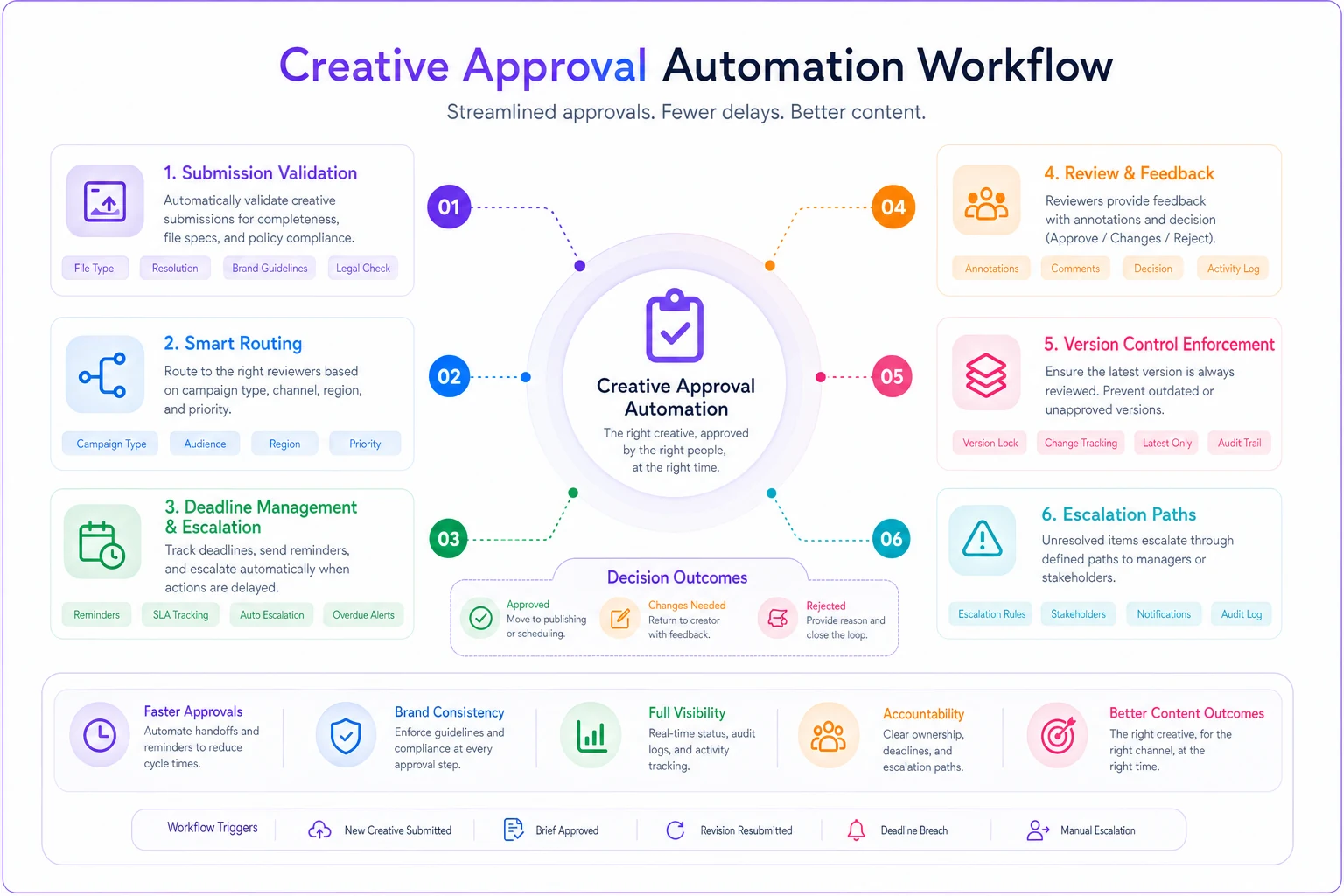
Submission validation — Before any creative enters approval, automation checks:
-
File formats match platform requirements
-
Dimensions align with media plan specs
-
Required metadata fields are complete
-
Copy matches character limits
One agency found that roughly 30% of their approval delays came from resubmissions over technical specs. Basic validation cut an entire round of back-and-forth.
Smart routing based on context — The system reads campaign parameters and routes accordingly:
-
Budget under $1,000 → Junior approver pool
-
Regulated industry keywords detected → Compliance first
-
Retargeting campaign → Skip brand review
-
New creative concept → Full approval chain
Deadline escalation — As deadlines approach, notifications intensify:
-
48 hours out
Standard notification
-
24 hours out
Email + Slack + SMS
-
12 hours out
Escalate to backup approver
-
6 hours out
Auto-approve if within Level 1 parameters
Version control enforcement — System prevents common mistakes:
-
Blocks upload of duplicate filenames
-
Warns when launching older versions
-
Requires approval confirmation for major version changes
-
Archives superseded versions automatically
Use filename patterns and automated checks to prevent duplicate uploads and accidental launches of older versions.
Here's how an automation workflow for routing, validation and escalation might look in practice.
One agency found that roughly 30% of their approval delays came from resubmissions over technical specs. Basic validation cut an entire round of back-and-forth.
The parallel approval paths that cut timeline significantly
Sequential approval chains are timeline killers. Legal reviews creative, then brand reviews legal's changes, then performance marketing reviews brand's edits. Three days minimum, assuming nobody's out of office.
Parallel approval paths run simultaneously where possible, converging only when necessary. This isn't about cutting corners — it's about recognizing which reviews actually depend on each other and which ones don't.
The parallel structure:
Track A: Creative & Brand
-
Visual assets review
-
Brand guideline compliance
-
Tone and messaging alignment
Track B: Legal & Compliance
-
Claims verification
-
Disclaimer requirements
-
Platform policy compliance
Track C: Performance & Media
-
Technical specifications
-
Targeting alignment
-
Budget confirmation
These tracks run simultaneously, meeting at defined convergence points. A healthcare marketing team using this approach compressed their approval timeline from 8 days down to just over 3, while actually catching more errors because each track stayed focused on its domain.
The key insight: most feedback doesn't conflict. Brand wants the logo bigger, legal needs a disclaimer added, performance wants a stronger CTA. These changes layer together without requiring sequential review.
Common approval flow failures (and their fixes)
The zombie campaign problem
Old campaigns keep running because nobody officially approved stopping them. A local gym chain discovered they'd spent over $18,000 across three months on campaigns targeting closed locations. The creative was approved, the campaign was approved, but nobody approved a sunset plan.
Fix: Every approval includes an expiration date. Campaigns don't run indefinitely without explicit reapproval.
The Friday afternoon scramble
Urgent approvals always seem to land at 4:47 PM on Friday. By Monday, the weekend opportunity is gone along with the budget allocated for it.
Fix: Implement approval coverage schedules. Rotate on-call approvers for time-sensitive campaigns. One person covers evenings, another covers weekends, with Level 1 auto-approval as backup.
The perfectionism paralysis
Some approvers treat every creative like the Sistine Chapel. Minor campaigns sit for days while someone wordsmithes taglines that a fraction of viewers will ever read.
Fix: Match scrutiny to impact. Set "good enough" thresholds for test campaigns and minor variations. Save deep creative reviews for hero campaigns and brand-defining moments.
Making operational software handle the approval orchestration
Manual approval management burns hours of coordinator time — someone's tracking who reviewed what, chasing stragglers, updating spreadsheets, playing telephone between teams. It's operational quicksand.
Platforms built with AI automation turn that chaos into something systematic. Instead of a human tracking approval status, the system maintains real-time visibility. Instead of manually routing creatives, workflows direct assets based on campaign parameters. When someone forgets to approve, automated escalation steps in before it becomes a bottleneck.
The point isn't to replace human judgment — it's to strip out the administrative layer that makes approval processes painful. Your creative director should be evaluating creatives, not chasing down missing reviews. Your project manager should be optimizing workflows, not sending reminder emails.
These systems also surface patterns over time — which reviewers move fastest for specific campaign types, where bottlenecks tend to form, what process improvements are actually worth making based on real throughput data rather than gut feel.
The approval audit that reveals hidden delays
Run this quarterly, or whenever approval delays spike:
-
Track actual vs. SLA timelines — Pull 20 recent campaigns. Compare promised vs. actual approval times. Where's the consistent gap?
-
Map the ping-pong pattern — Count how many times each creative goes back and forth. More than two rounds usually means your initial requirements weren't clear.
-
Identify the bottleneck humans — Which specific approvers consistently delay? They might need different SLAs or backup coverage.
-
Measure rework rates — How often do approved creatives need post-launch fixes? High rework means the approval process missed something upstream.
-
Calculate opportunity cost — For each delayed campaign, estimate what the delay cost in missed revenue. This number is what gets CFO attention.
A subscription box company ran this audit and found their average approval delay was costing them close to $850 per campaign in missed opportunity. Multiply that across 40 campaigns a month, and suddenly fixing the approval workflow becomes a real business priority.
Building approval flows that scale with growth
Your approval process that works for 10 campaigns monthly will break at 50. The system managing 50 will crumble at 200. Growth doesn't just mean more volume — it means more complexity, more stakeholders, more platforms.
Scalable approval flows share three characteristics:
-
Clear escalation paths — Not every decision needs senior input. Define exactly when and why approvals escalate. This prevents senior bottlenecks as volume grows.
-
Flexible permission sets — New team members should slot into existing workflows without restructuring everything. Role-based permissions beat person-specific approvals every time.
-
Performance visibility — Everyone can see approval velocity metrics. When the data is visible, teams naturally optimize their portion of the process.
Teams that build this infrastructure early see the returns quickly. Approval delays drop. Campaign velocity increases. The same headcount handles significantly more campaign volume because they're not buried in process overhead.
Moving from approval theater to actual quality control
Most approval processes are pure theater. Everyone reviews everything because nobody trusts anyone. The result is diluted accountability and delayed campaigns.
Real quality control means specific people own specific aspects. The copywriter owns grammar and tone. The designer owns visual standards. The media buyer owns technical specs. The creative director owns concept integrity. When everyone owns everything, nobody owns anything.
This focused accountability model requires trust, clear boundaries, and genuine expertise. But teams that get there see both quality and speed improve — experts catch more issues in their own domain while ignoring noise outside it.
The path forward starts with documenting your current reality, then systematically improving each component. Build your permission matrix. Define contextual SLAs. Implement proper versioning. Add smart automation. Enable parallel paths. Every day you delay is another day of campaigns launching late, opportunities missed, and teams burning out on friction that's entirely preventable.
Ready to amplify your brand’s voice?
Join 2,500+ marketers using Postyly to save time, boost engagement, and grow their audiences effectively.