


Most social media managers treat cross-platform posting like a copy-paste job. Post on Instagram, duplicate to Facebook, throw it on LinkedIn, maybe remember Twitter exists. Then wonder why engagement drops week after week while audience complaints about "seeing the same thing everywhere" pile up.
The problem isn't posting to multiple platforms. It's posting without understanding how audiences move between platforms throughout their day, how content ages differently on each network, and why the same person seeing your content three times in different contexts either builds momentum or triggers the unfollow button.
Cross-platform post sequencing isn't about avoiding repetition entirely. It's about orchestrating when, where, and how your content appears so you're building a cohesive narrative rather than an echo chamber.
The platform overlap problem nobody talks about
Your audience doesn't live on one platform. A marketing director might check LinkedIn during their morning commute, scroll Instagram at lunch, browse Twitter during afternoon meetings, and catch up on Facebook groups after dinner. Each platform serves a different mental state, different purpose, different expectation.
When that same marketing director sees your identical "5 tips for better ROI" post four times across four platforms within six hours, you've shifted from helpful to annoying. What most people miss is that it's not really about posting different content everywhere. It's about understanding the sequencing patterns that turn repetition into reinforcement.
Cross-platform post sequencing isn't about avoiding repetition entirely. It's about orchestrating when, where, and how your content appears so you're building a cohesive narrative rather than an echo chamber.
Why traditional posting schedules create fatigue patterns
The standard approach looks logical on paper. Post at "peak times" for each platform:
Stop managing your social media the hard way.
Postyly helps you plan, schedule, and analyze every post with precision.
- Multi-platform scheduling
- Real-time engagement tracking
- Automated performance reports
No credit card required
-
LinkedIn at 7
30 AM for the commute crowd
-
Instagram at noon for lunch scrollers
-
Facebook at 3 PM for the afternoon break
-
Twitter throughout the day
Except this creates a fatigue cascade. Someone active on multiple platforms encounters your content in rapid succession, usually within a four-to-six hour window. By the third or fourth exposure, they're not engaging — they're actively avoiding. Worse, platform algorithms detect this avoidance and reduce your reach across all networks.
The real damage is more subtle. Your audience starts associating your brand with content overload. They might not unfollow immediately, but they mentally tune out. Your posts become background noise.
Campaign-specific sequencing templates that actually work
Different campaign types require completely different sequencing logic. A product launch operates on different timing principles than evergreen educational content or time-sensitive promotions.
Launch Campaign Sequencing
For product or feature launches, the "blast everything at once" approach wastes momentum. Successful launches follow a platform cascade pattern instead.
Start with your highest-intent platform — usually email or owned communities — 24 to 48 hours before the public launch. This gives your core audience first access and makes them feel valued. They become your amplifiers.
Twitter/X goes next, roughly 12 hours before other platforms. The real-time nature of Twitter means news spreads fast and dies fast. You want that initial buzz building before you hit platforms with longer content lifecycles.
LinkedIn follows six to eight hours later, timed for morning corporate browsing. LinkedIn users expect a professional frame, so your launch content here should lean into business value, ROI, and strategic advantages.
Instagram and Facebook come last, four to six hours after LinkedIn. By this point, you have social proof from other platforms — comments, shares, early adoption stories — and that proof becomes part of your Instagram and Facebook narrative.
The gap between platforms isn't arbitrary. It accounts for:
-
Platform-specific peak times
-
Audience overlap patterns
-
Content decay rates
-
Algorithm boost windows
Educational Content Sequencing
Educational content follows reverse-cascade logic. Start with platforms that reward depth (LinkedIn, blog, YouTube), then distill for platforms that prefer brevity (Twitter, Instagram).
-
Week 1
Publish comprehensive LinkedIn article or blog post
-
Week 1, Day 3
Extract three to five key points for a Twitter thread
-
Week 2
Create Instagram carousel from the Twitter thread
-
Week 2, Day 3
Share carousel to Facebook with additional context
-
Week 3
Compile reactions and questions into follow-up content
This sequencing respects how educational content naturally moves through networks. Early adopters on LinkedIn share insights with their networks. Those insights get condensed and spread on Twitter. Visual learners discover the carousel version. Each platform adds its own layer of discussion.
Promotional Campaign Sequencing
Time-sensitive promotions require compressed sequencing with built-in suppression logic. You can't wait weeks between platforms when your sale ends Friday.
The trick is varying creative and messaging enough that multi-platform users feel informed rather than harassed:
Monday morning: Email announcement to subscribers
Monday afternoon: Twitter with emphasis on limited time
Tuesday morning: LinkedIn focusing on business value
Tuesday afternoon: Instagram Stories with a behind-the-scenes angle
Wednesday: Facebook with social proof from early buyers
Thursday: Platform-specific reminder variations
Friday morning: Final push with platform-appropriate urgency
Each platform gets slightly different framing. Same promotion, different psychological triggers based on platform culture and user mindset.
Timing gap heuristics that prevent overlap fatigue
The gaps between your cross-platform posts matter more than the posts themselves. Too short, you create fatigue. Too long, you lose momentum. The sweet spot depends on three factors:
Audience overlap percentage: How many followers you share between platforms. Higher overlap requires longer gaps. If roughly 60% of your Instagram followers also follow you on Facebook, you need at least eight to twelve hours between posts on those platforms.
Content decay rate: How quickly content loses visibility on each platform:
-
Twitter
15–30 minutes
-
Facebook
2–3 hours
-
Instagram Feed
5–6 hours
-
LinkedIn
24–48 hours
-
Instagram Stories
24 hours
-
YouTube
Days to weeks
Engagement window: When your audience actually engages with content after seeing it. LinkedIn users might save articles to read later. Instagram users engage immediately or never. This affects how you time follow-up content.
A practical framework based on actual posting patterns:
| Platform Pair | Minimum Gap | Optimal Gap | Maximum Gap |
|---|---|---|---|
| Twitter → Instagram | 2 hours | 4–6 hours | 12 hours |
| Instagram → Facebook | 4 hours | 8–12 hours | 24 hours |
| LinkedIn → Twitter | 1 hour | 3–4 hours | 8 hours |
| Facebook → LinkedIn | 6 hours | 12–18 hours | 36 hours |
| Any → Email | 24 hours | 48–72 hours | 1 week |
These aren't rigid rules. A breaking news story might require simultaneous posting. Evergreen content might spread across weeks. But they give you a starting point to adjust based on your actual audience behavior.
Here's a quick visual workflow to help decide gaps between posts.
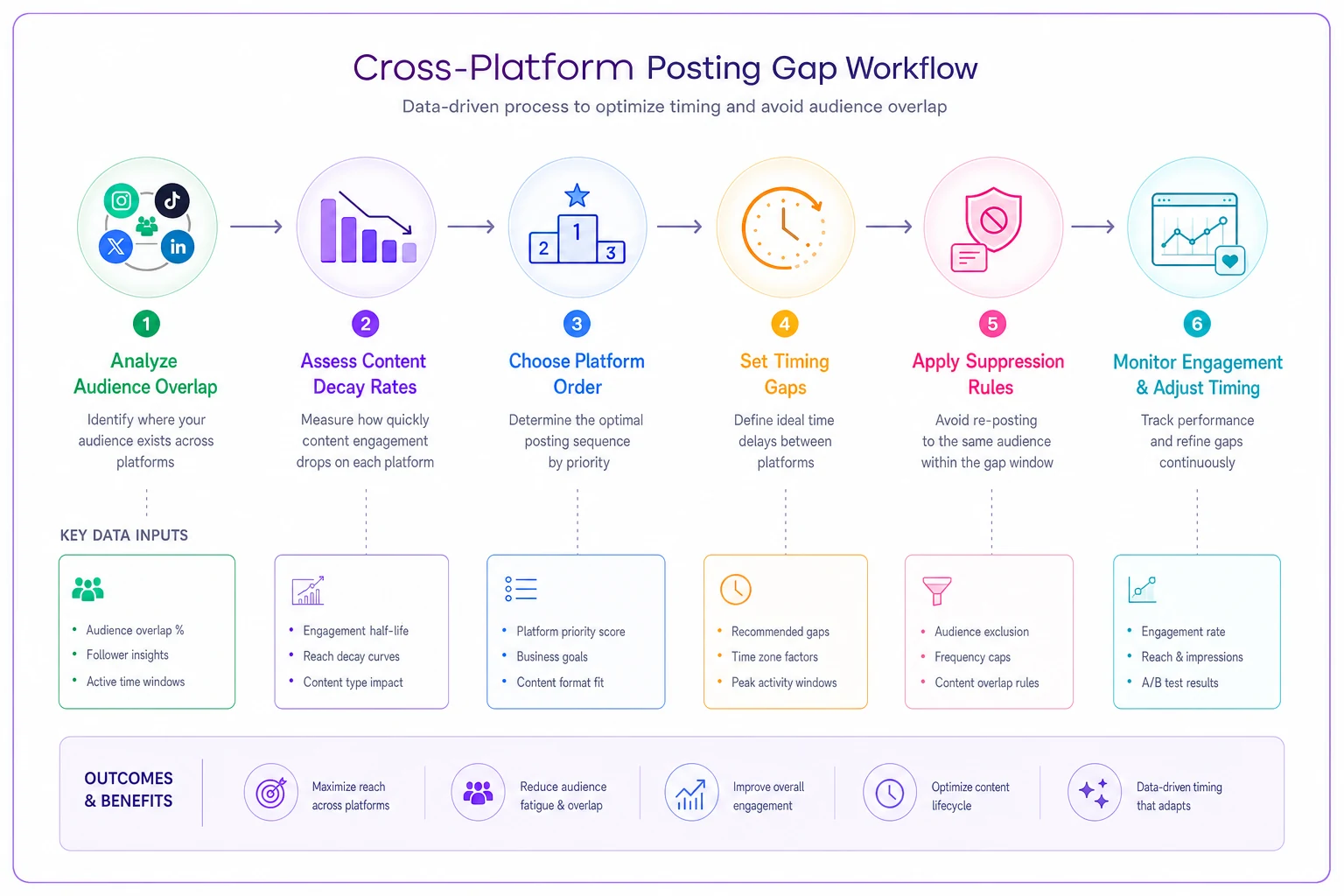
Use the steps above as adjustable knobs rather than fixed settings.
Creative variation rules that maintain message consistency
The biggest misconception about cross-platform posting is that you need completely different content for each platform. You don't. You need the same core message expressed through platform-native formats.
Think of it like translating between languages. The meaning stays constant, but the expression adapts to local customs and expectations.
Visual Variation Strategy
A single concept might become:
-
LinkedIn
Data-rich infographic with professional design
-
Instagram
Carousel with bold colors and minimal text
-
Twitter
Four-panel comic strip or screenshot thread
-
Facebook
Native video with captions
-
Pinterest
Vertical infographic optimized for mobile
The information stays consistent. The visual language changes.
Copy Adaptation Framework
Your core message needs platform-specific framing. Using a hypothetical data point as an example:
LinkedIn: "Our Q3 analysis revealed that B2B companies investing in video content saw significantly higher engagement rates. Here's what this means for your content strategy..."
Twitter: "B2B video content outperforms static posts by a wide margin. We analyzed thousands of posts. The pattern is clear. Thread on what actually works 👇"
Instagram: "Video content hits different in B2B 📈 Swipe for the data that changed how we create content →"
Facebook: "We spent months analyzing B2B content performance, and the results surprised us. Video isn't just for B2C anymore. Here's what we found..."
Same core idea. Different platform personalities.
Hashtag and Tagging Logic
Hashtag strategy varies dramatically between platforms:
-
Instagram
10–30 highly specific hashtags mixed with broader ones
-
LinkedIn
3–5 professional hashtags maximum
-
Twitter
1–3 trending or conversation-specific hashtags
-
Facebook
Minimal hashtags, focus on groups and pages
-
TikTok
3–5 trending sounds/challenges plus topic hashtags
Using identical hashtag sets across platforms immediately signals lazy cross-posting. Audiences notice, and algorithms punish it.
Suppression and overlap decision trees
Not every piece of content belongs on every platform. Sometimes the smartest sequencing decision is not posting at all.
Platform Fit Score — Before cross-posting, evaluate:
-
Does this content format naturally fit this platform?
-
Does your audience expect this type of content here?
-
Will the platform algorithm favor or bury this content type?
-
Can you adapt the creative without losing impact?
If you score less than 3 out of 4, consider suppressing that platform.
Audience Overlap Threshold — When overlap exceeds roughly 70% between two platforms, you need either:
-
48+ hour gaps between posts
-
Significant creative variation
-
Platform exclusivity (post to one, not both)
Content Decay Analysis — Some content has natural platform limitations:
-
Time-sensitive content doesn't work on slow-moving platforms
-
Evergreen content gets buried on fast-moving platforms
-
Visual content needs modification for text-heavy platforms
-
Long-form content needs extraction for short-form platforms
Engagement History Patterns — Track which content types perform on which platforms for your specific audience:
-
Behind-the-scenes content might thrive on Instagram but fall flat on LinkedIn
-
Data visualizations might dominate LinkedIn but get ignored on Facebook
-
Humor might work everywhere except your more formal Twitter audience
Build suppression rules based on actual performance data, not assumptions about what should work.
Real-world sequencing in action
The clearest example I've watched play out was a content team running a campaign on "AI in marketing." They had the topic, a rough plan, and about three weeks to execute. What made it work wasn't the content — it was the pacing.
Week 1, Monday: Published a comprehensive LinkedIn article (roughly 2,000 words) on AI implementation frameworks. Focused on strategic business value, included case studies, aimed squarely at C-suite and senior marketing people.
Week 1, Wednesday: Pulled five key insights out for a Twitter thread. Added real-time examples of specific AI tools, engaged with replies as they came in, let the discussion build around practical applications rather than theory.
Week 1, Friday: Built an Instagram carousel from the Twitter insights. Redesigned for visual impact, simplified the language, added stylized graphics. Posted to Stories with polls about AI concerns — which, honestly, drove more engagement than the carousel itself.
Week 2, Tuesday: Shared the carousel to Facebook with expanded context about small business applications. Posted to three relevant groups with slightly different introductions for each community. The groups had different demographics and the copy reflected that.
Week 2, Thursday: Compiled questions and feedback from all platforms into a FAQ-style blog post. Addressed common concerns people had actually raised, not hypothetical ones. Linked back to the original LinkedIn article.
Week 3, Monday: Recorded a YouTube video walking through the top questions from social media. Showed actual tools in use — not screenshots, actual demos of the things people had been asking about. Embedded the video in the blog post and cut short clips for Stories and Twitter.
No audience complaints about seeing the same thing repeatedly. Each platform fed the next one with new angles and new questions. The sequencing created a conversation that compounded over three weeks rather than a one-time broadcast that burned out on day two.
The automation opportunity most teams miss
Managing complex sequencing logic manually burns hours every week. You're tracking platform timings, remembering variation rules, checking overlap patterns, making suppression decisions on the fly. This is where AI-powered operational software starts to make a real difference — shifting posting from exhausting checklist management to something closer to actual strategy.
Modern platforms can analyze your audience overlap in real-time, automatically adjust posting gaps based on engagement patterns, suggest creative variations that maintain message consistency, and flag when suppression makes sense. Instead of managing spreadsheets of posting times, you focus on creating quality content while the platform handles sequencing complexity.
The more useful benefit is that AI learns your audience's actual behavior patterns, not generic best practices. It identifies when your specific audience moves between platforms, which variations drive engagement, and what sequencing patterns prevent fatigue. Your posting strategy evolves based on real data rather than guesswork.
Building your own sequencing template
Start with one campaign type and two platforms. Map out:
Test for two weeks. Track:
-
Your actual audience overlap (poll them or analyze followers)
-
Current engagement patterns on each platform
-
Content formats that work on each
-
Realistic gaps you can maintain
Test for two weeks. Track:
-
Engagement rates per platform
-
Audience feedback about repetition
-
Reach changes across platforms
-
Conversion or goal completion
Adjust gaps, variations, and suppression rules based on results. Add one platform at a time as you solidify the pattern.
Start small: prove the concept on two platforms before scaling.
Most teams try to perfect everything at once and then abandon the whole strategy when it gets overwhelming. Start small, prove the concept, then expand. Your audience would rather see thoughtful content on two platforms than scattered noise across six.
The compound effect of smart sequencing
Cross-platform post sequencing isn't about gaming algorithms or tricking audiences into engaging multiple times. It's about respecting how people actually consume content across their digital day.
When you get the sequencing right, something shifts. Instead of fatigue, you start building anticipation. Your audience knows your Twitter thread usually signals a more detailed LinkedIn article is coming. They save the Instagram carousel because they know you'll expand on it. They engage more because each platform offers something distinct while contributing to a larger narrative.
The platforms stop competing for the same attention and start complementing each other. Your Twitter becomes the trailer. Your LinkedIn becomes the full story. Your Instagram becomes the visual summary. Your Facebook becomes the discussion room.
That's when cross-platform posting stops feeling like an exhausting distribution exercise and starts functioning as actual audience development. You're not just reaching more people — you're deepening relationships with the ones already paying attention. And that depth, not the reach number, is what drives real business results.
That's when cross-platform posting stops feeling like an exhausting distribution exercise and starts functioning as actual audience development. You're not just reaching more people — you're deepening relationships with the ones already paying attention. And that depth, not the reach number, is what drives real business results.
Ready to amplify your brand’s voice?
Join 2,500+ marketers using Postyly to save time, boost engagement, and grow their audiences effectively.