


There's this weird phase when your social team grows from three people to twelve, and suddenly everything that worked stops working. The casual Slack messages about who's posting what become a mess. The Google Drive folder that was fine with 200 assets now has 2,000, and nobody can find anything. Your star content creator who used to handle everything from ideation to publishing is now drowning in approval chains.
This operational breakdown tends to hit somewhere between 8 and 15 team members. Before that point, everyone can hold the entire social calendar in their head. After that, you need actual systems or watch your team slowly fall apart from coordination overhead.
Most mid-size social teams—say, 10 to 25 people across content, design, community, paid, and analytics—live in this awkward middle ground. Too big for startup chaos, too small for enterprise process. The result? Talented people spending close to 40% of their time on coordination instead of creation.
Why social operations break differently than other marketing functions
Social content has this unique problem where speed and quality pull in opposite directions. Your email team can spend three days perfecting a campaign. Your blog team might take two weeks on a pillar post. Social? You've got trending topics that expire in hours, platform algorithm changes that demand fast pivots, and community conversations that need responses in minutes.
The traditional marketing playbook falls apart here. You can't run social like you run demand gen. The approval flows that work for whitepapers will kill your TikTok momentum. Quarterly planning cycles are useless when a viral moment drops on a Tuesday afternoon.
What actually happens in most mid-size teams: you end up with this shadow operation where the "official" process sits in some dusty wiki, but the real work moves through DMs, emergency Slack huddles, and whoever happens to be online when something needs to ship. This works until someone important goes on vacation, or you onboard three new people at once, or your CMO asks why that controversial post went live without legal review.
Teams that figure this out don't try to force traditional marketing ops onto social. They build something different—lighter weight but more structured, flexible but repeatable.
Team sizing that matches actual social velocity
Here's a mistake almost every growing social team makes: hiring more generalists when you need specialists, or hiring specialists before you have the volume to keep them busy.
Stop managing your social media the hard way.
Postyly helps you plan, schedule, and analyze every post with precision.
- Multi-platform scheduling
- Real-time engagement tracking
- Automated performance reports
No credit card required
Here's the realistic progression based on content volume and channel mix:
8-10 person team (Foundation tier)
-
2-3 content creators (mixed organic/paid focus)
-
2 designers (one motion, one static)
-
1 community manager
-
1 paid social specialist
-
1 social strategist/lead
-
1 coordinator/project manager
-
1 analytics person (often shared with broader marketing)
12-15 person team (Growth tier)
-
3-4 content creators (with platform specialization emerging)
-
3 designers (two static, one motion, starting to specialize by platform)
-
2 community managers (split by platform or timezone)
-
2 paid specialists (one acquisition, one retargeting)
-
1 social strategist
-
1 operations manager
-
1 dedicated analyst
-
1-2 coordinators
18-25 person team (Scale tier)
-
5-6 content creators (clear platform ownership)
-
4-5 designers (platform-specific, including dedicated video editor)
-
3 community managers (platform or audience segment focus)
-
3 paid specialists (by funnel stage or platform)
-
2 strategists (organic vs. paid, or by objective)
-
2 operations managers (workflow vs. tools/tech)
-
2 analysts (performance vs. insights)
-
1-2 coordinators
| Tier | Roles |
|---|---|
| 8-10 person team (Foundation tier) | 2-3 content creators (mixed organic/paid focus); 2 designers (one motion, one static); 1 community manager; 1 paid social specialist; 1 social strategist/lead; 1 coordinator/project manager; 1 analytics person (often shared with broader marketing) |
| 12-15 person team (Growth tier) | 3-4 content creators (with platform specialization emerging); 3 designers (two static, one motion, starting to specialize by platform); 2 community managers (split by platform or timezone); 2 paid specialists (one acquisition, one retargeting); 1 social strategist; 1 operations manager; 1 dedicated analyst; 1-2 coordinators |
| 18-25 person team (Scale tier) | 5-6 content creators (clear platform ownership); 4-5 designers (platform-specific, including dedicated video editor); 3 community managers (platform or audience segment focus); 3 paid specialists (by funnel stage or platform); 2 strategists (organic vs. paid, or by objective); 2 operations managers (workflow vs. tools/tech); 2 analysts (performance vs. insights); 1-2 coordinators |
This setup handles roughly 15-25 posts per day across 3-4 primary platforms. The weakness? No redundancy. When your motion designer gets sick, video content stops.
This handles 30-50 posts daily across 4-6 platforms. You've got basic coverage redundancy and can maintain posting during PTO. The challenge? Role boundaries get messy. Who owns Instagram Stories when both the Instagram specialist and the motion designer could handle it?
This manages 60-100+ posts daily across all major platforms plus emerging channels. Full redundancy, specialized expertise, multiple campaigns running simultaneously.
The thing most teams miss: you don't need perfect ratios. You need clear ownership and backup plans.
Service Level Agreements that actually work for social
Traditional SLAs assume predictable inputs and outputs. Social doesn't work that way. Your SLA needs to handle both the daily drumbeat of planned content and the chaos of real-time opportunities.
The two-track SLA system
Track 1: Planned content
-
Standard post creation
3 business days
-
Design asset creation
2 business days
-
Video editing (under 60 seconds)
4 business days
-
Campaign concepting
5 business days
-
Platform optimization
1 business day
-
Final approval
4-6 hours
Track 2: Reactive content
-
Trending topic response
2 hours
-
Crisis response
30 minutes
-
Community escalation
1 hour
-
Real-time event coverage
15 minutes
-
Newsjacking opportunity
4 hours
The value isn't the specific times—it's having two distinct tracks with different resource allocation. Most teams treat everything as either planned (too slow for opportunities) or reactive (burns out the team).
Approval matrix by risk level
Low risk (auto-approval after peer review):
-
Educational content
-
Product features
-
Customer testimonials
-
Behind-the-scenes content
-
Reposting user-generated content
Medium risk (manager approval):
-
Competitive comparisons
-
Industry commentary
-
Influencer collaborations
-
Paid campaign creative
-
New format experiments
High risk (leadership + legal):
-
Crisis responses
-
Political/social issues
-
Major partnership announcements
-
Regulatory-related content
-
Controversial topics
Build your matrix based on your industry's specific risks. A consumer brand might put humor in low-risk. A healthcare company probably puts it in high-risk.
Role templates that prevent overlap and gaps
The biggest operational killer? Three people think they own something, or worse, nobody thinks they own it. Clear role templates fix this.
Content Creator role template
Owns completely:
-
Ideation for assigned platforms/themes
-
Copy creation within brand guidelines
-
Trend identification for their area
-
Initial performance assessment
Collaborates on:
-
Visual brief creation (with designers)
-
Campaign messaging (with strategists)
-
Paid adaptation (with paid specialists)
Doesn't touch:
-
Final publishing (coordinator handles)
-
Design execution (designers handle)
-
Performance analysis (analysts handle)
Designer role template
Owns completely:
-
Visual execution from brief
-
Template creation and maintenance
-
Asset versioning and sizing
-
Design system updates
Collaborates on:
-
Creative concepting (with creators)
-
Motion graphics planning (with video editor)
-
Paid creative testing (with paid team)
Doesn't touch:
-
Copy creation (creators handle)
-
Publishing schedule (coordinators handle)
-
Strategic direction (strategists handle)
Every role needs three buckets: what they own alone, what they collaborate on, and what they explicitly don't touch. This prevents both the "too many cooks" problem and the "nobody's watching this" problem.
Handoff checklists that eliminate dropped balls
The average social post touches 4-7 people before publishing. Without clear handoffs, things disappear into the void. Three critical handoff points to lock down:
Handoff 1: Creator to Designer
Required elements:
-
Final copy (approved)
-
Visual direction (mood, not prescription)
-
Platform specs and formats needed
-
Brand elements to include/avoid
-
Deadline and priority level
-
Context (campaign, standalone, series)
Not required:
-
Design specifics (that's the designer's job)
-
Multiple copy versions (decide first)
-
"Inspiration" from competitors (legal nightmare)
Handoff 2: Designer to Coordinator
Required elements:
-
Final assets in correct formats
-
Naming convention followed
-
Alt text provided
-
Any platform-specific requirements noted
-
Confirmation of brand compliance
Not required:
-
Copy (should already be final)
-
Publishing strategy (already determined)
-
Performance predictions (not designer's role)
Handoff 3: Coordinator to Community Manager
Required elements:
-
Published links
-
Initial engagement strategy
-
Escalation thresholds
-
Key talking points for responses
-
Related content for follow-up
Not required:
-
Full campaign strategy (TMI for this role)
-
Design rationale (not relevant post-publish)
-
Budget information (stay in your lane)
Enforce a strict naming convention at the designer-to-coordinator handoff to speed up scheduling and reduce publishing errors.
Without these clear handoffs, work slips and accountability blurs. Locking these points down reduces friction and publishing mistakes.
Capacity planning beyond "posts per week"
Most teams measure capacity wrong. They count posts, but posts aren't equal. A Twitter thread takes different effort than an Instagram carousel. A TikTok isn't comparable to a LinkedIn article.
The effort point system
1 point items:
-
Single image posts
-
Text-only posts
-
Retweets/shares with comment
-
Story posts (single frame)
3 point items:
-
Carousels (3-5 slides)
-
Short video (under 30 seconds)
-
Twitter threads
-
Story series (3-5 frames)
5 point items:
-
Long-form video (over 30 seconds)
-
Complex carousels (6-10 slides)
-
Interactive content
-
Multi-platform campaigns
8 point items:
-
Platform-native series
-
Live streaming
-
Major campaign launches
-
Influencer collaborations
A healthy creator should handle 40-50 points per week. A designer manages 30-40 points—their work is more intensive. Community managers can handle 60-70 points since their work is more responsive than creative.
This system surfaces the truth: the person creating three TikToks a week might be working harder than someone posting twenty tweets.
The weekly sprint template that handles both planning and chaos
Forget monthly planning for social. By week three, half your calendar is irrelevant. The weekly sprint gives you structure without rigidity.
Monday: Sprint planning (90 minutes)
First 30 minutes: Review last week's performance
-
What overperformed and why?
-
What underperformed and why?
-
Any community feedback to address?
Next 45 minutes: Lock this week's calendar
-
Planned content (should be 70% done already)
-
Tentative slots for reactive content
-
Campaign continuations
-
Resource allocation
Final 15 minutes: Identify risk zones
-
Trending topics to monitor
-
Potential crisis scenarios
-
Resource conflicts
-
Approval bottlenecks
Tuesday-Thursday: Production sprint
Daily standup (15 minutes, 10am):
-
Blockers from yesterday
-
Focus for today
-
Help needed
Reactive slot (2pm-3pm daily):
-
Trend assessment
-
Newsjacking opportunities
-
Community fires
-
Quick-turn content
That dedicated reactive slot prevents everything from becoming an emergency. Worth protecting.
Friday: Polish and prep
-
Morning
Final approvals and scheduling
-
Afternoon
Next week's content prep
-
Last hour
Process improvements
One rule that matters: no new content initiatives after Thursday at 3pm. If it hasn't started by then, it waits until next week. This stops the Friday scramble that burns out teams.
The "swing capacity" allocation
Most teams plan for 100% capacity. Then someone gets sick, or a crisis hits, or the CEO wants something special, and everything collapses.
Build in 20% swing capacity:
-
10% for reactive opportunities
-
5% for internal requests
-
5% for actual emergencies
If your team can theoretically produce 100 pieces of content weekly, plan for 80. The remaining capacity handles the chaos that will definitely come.
Here's a simple visual of the weekly sprint workflow.
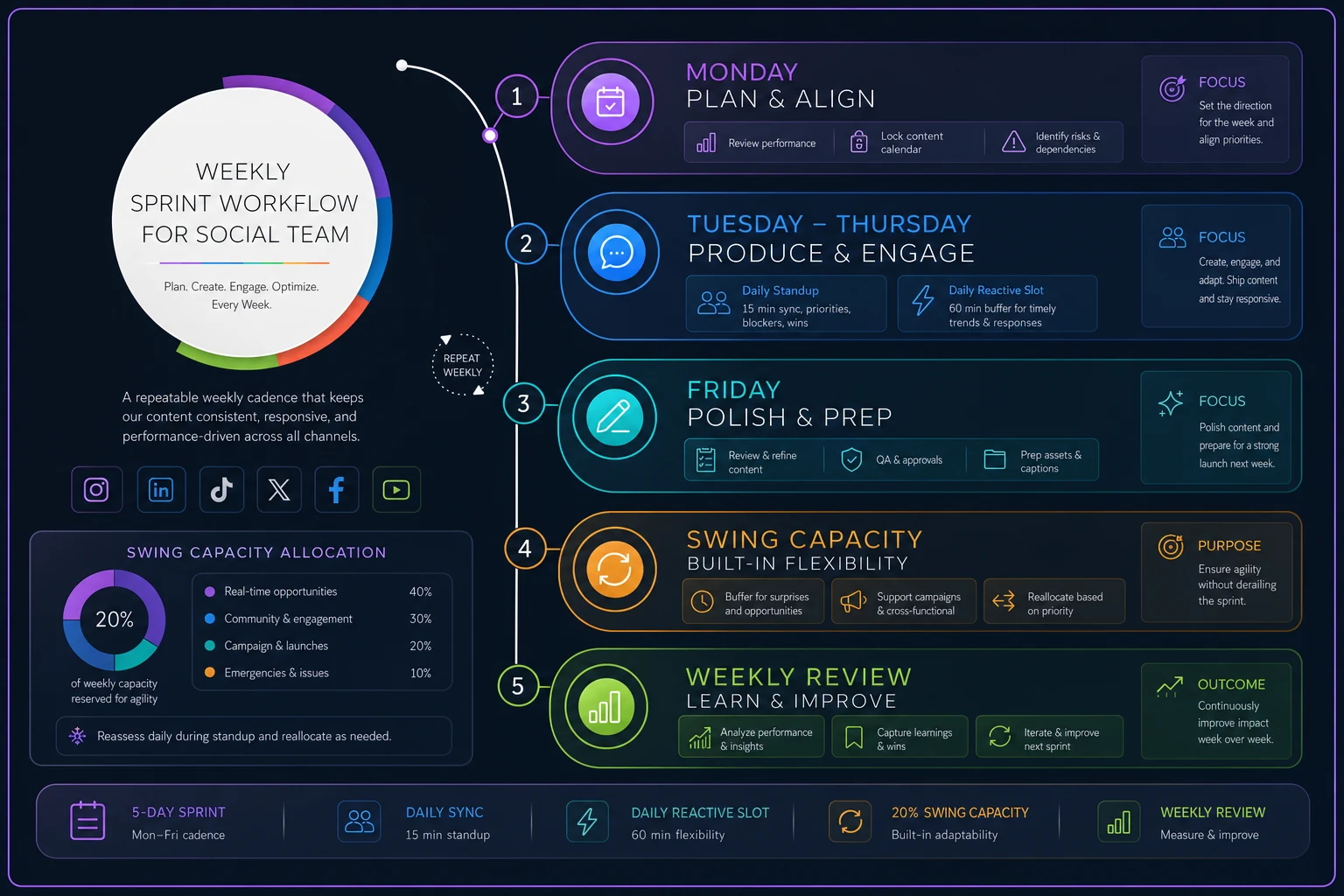
Protecting the reactive slot and swing capacity is what keeps the weekly sprint resilient to surprises.
Coordination tools without the tool overwhelm
Mid-size teams love tools. Asana for project management, Slack for communication, Hootsuite for publishing, Canva for design, Google Drive for storage, Notion for documentation, Later for scheduling, Sprout Social for analytics. By the time someone figures out where to find what they need, the moment has passed.
The minimum viable tool stack:
-
One project management system (everything lives here)
-
One communication platform (no splitting between email and Slack)
-
One asset repository (with brutal naming conventions)
-
One publishing platform (that handles all channels)
-
One analytics dashboard (no spreadsheet archaeology)
That's it. Every additional tool adds 5-10% coordination overhead.
Real efficiency comes from operational discipline, not tool features. A simple spreadsheet with a solid process beats a complex platform with loose adoption every time.
What breaks when you grow (and early warning signs)
Watch for these signals that your operations need upgrading:
The 10-person breaking point:
-
Slack becomes chaos
-
"Who's handling this?" becomes a daily question
-
Quality inconsistency emerges
-
Publishing errors increase
The 15-person breaking point:
-
Role confusion escalates
-
Approval bottlenecks form
-
Freelancers feel disconnected
-
Platform specialization battles begin
The 20-person breaking point:
-
Silos form between organic and paid
-
Strategy and execution disconnect
-
Tools proliferate without governance
-
Measurement becomes political
Each breaking point needs different fixes. Ten-person problems need basic process. Fifteen-person problems need role clarity. Twenty-person problems need organizational design.
Building sustainable operations with AI-powered platforms
The teams succeeding at scale aren't just adding more people—they're building better operational systems. Modern AI-powered operational software handles the repetitive coordination tasks that eat up 30-40% of team time. Instead of manually routing content through approval chains, AI-assisted platforms can distribute work based on capacity, expertise, and deadlines without anyone having to babysit the process.
Think about how much time your team burns on operational overhead. Finding the right asset. Checking if copy was approved. Tracking down who has the final video file. Remembering which platforms need which formats. These aren't creative tasks—they're coordination tasks. That's exactly where AI automation adds real value, not by generating content, but by eliminating the friction between idea and execution.
When you remove that friction, something measurable happens: creative output increases without adding headcount. Your content creator focuses on creating. Your designer focuses on designing. The operational platform handles the routing, versioning, and tracking that used to eat everyone's afternoons.
The reality check: perfect process vs. good enough
You'll never achieve perfection in social content operations. Social moves too fast, platforms change too quickly, and trends emerge too suddenly for any process to handle everything cleanly.
The goal isn't perfection. It's creating enough structure to prevent chaos while maintaining enough flexibility to seize opportunities. Your SLAs won't always be met. Your handoffs will occasionally drop. Your capacity planning will sometimes explode.
But with a solid operational foundation—clear roles, realistic SLAs, simple handoffs, capacity buffers, and weekly sprints—your team can handle both the daily drumbeat and the unexpected. Less firefighting, more creating.
The teams that thrive in this middle zone between startup and enterprise don't necessarily have more resources or better talent. They have better operations. They've figured out how to maintain velocity while adding structure without killing creativity in the process.
Start with one piece. Pick either role clarity or weekly sprints, get that working, then build from there. Done that way, scaling from 10 to 20 people doesn't have to mean doubling your chaos.
Ready to amplify your brand’s voice?
Join 2,500+ marketers using Postyly to save time, boost engagement, and grow their audiences effectively.