


Most social teams monitor competitors wrong. They screenshot interesting posts, dump them in random folders, and forget about them. Or they copy trending formats without understanding why they worked — which leads to content that feels forced and performs just as poorly.
Watching teams waste months chasing competitor trends that were already declining is more common than you'd think. The problem isn't collecting competitor signals. It's converting those signals into ethical, testable experiments that actually improve your content performance.
The ethical line most teams cross without realizing
Competitive research becomes unethical faster than most people expect. Taking "inspiration" from a competitor's viral post often slides into copying their creative angle, visual style, or messaging framework. Teams rationalize it as "industry best practices" while essentially repackaging someone else's creative work.
The distinction matters operationally. When you copy surface-level tactics, you miss the underlying strategy that made the content work. A wellness brand learned this the hard way — they replicated a competitor's "morning routine" series format exactly, down to the shot angles and music style. It tanked. Their audience cared about scientific credibility, not lifestyle aspiration. The competitor's audience was the opposite.
What ethical signal collection actually looks like:
-
Track content themes and topic patterns, not specific posts
-
Monitor engagement patterns across content types
-
Note messaging angles and positioning strategies
-
Identify underserved audience segments
-
Catalog content gaps and missed opportunities
What crosses the line:
-
Recreating specific posts with minor tweaks
-
Using similar visuals or creative concepts
-
Copying caption structures or storytelling formats
-
Replicating campaign mechanics or hashtag strategies
-
Taking proprietary frameworks or methodologies
Ethical competitive intelligence means understanding principles, not copying executions. You're looking for patterns in what resonates with shared audiences, gaps in how competitors serve those audiences, and opportunities they've overlooked.
Signal collection that actually captures useful patterns
Raw competitive monitoring creates noise. You end up with hundreds of screenshots and no actionable insights. The teams that actually improve from competitive intelligence use structured signal collection — not ad hoc observation.
Stop managing your social media the hard way.
Postyly helps you plan, schedule, and analyze every post with precision.
- Multi-platform scheduling
- Real-time engagement tracking
- Automated performance reports
No credit card required
A structured checklist forces you to capture context, not just content. When a competitor's post performs well, you need to understand the surrounding factors — timing, audience state, cultural moment, platform algorithm changes. Without that context, you're guessing about causation.
The signal evaluation checklist
Performance signals:
-
Engagement rate relative to their baseline (not absolute numbers)
-
Comment sentiment and themes
-
Share-to-engagement ratio
-
Audience growth during content period
-
Cross-platform performance variations
Context signals:
-
Cultural or seasonal timing
-
Platform algorithm state
-
Competitor's recent content arc
-
Audience conversation topics
-
Competitive landscape shifts
Strategic signals:
-
New messaging angles
-
Audience segment targeting
-
Content format innovations
-
Platform feature adoption
-
Community interaction patterns
Gap signals:
-
Topics they avoid
-
Audiences they ignore
-
Formats they haven't tried
-
Platforms they've abandoned
-
Messages they won't touch
The checklist also helps prevent confirmation bias. Teams naturally notice competitor content that validates their existing assumptions. Structured collection forces you to document contradictory signals and uncomfortable truths about what's actually working in your market.
Converting signals into testable hypotheses
Signal collection without hypothesis development is expensive entertainment. You need a repeatable process for turning observations into experiments, and the most important shift is this — each signal should become a hypothesis about audience behavior, not a directive to copy tactics. You're testing audience preferences, not chasing competitor moves.
Signal-to-hypothesis conversion template
Signal observed: Document the specific pattern, including performance metrics and context
Audience insight hypothesis: What this suggests about audience preferences, needs, or behaviors
Our unique angle: How we can serve this audience need differently given our brand position
Test parameters:
-
Content format to test
-
Messaging angle to explore
-
Success metrics to track
-
Test duration and sample size
-
Control group approach
Risk assessment:
-
Ethical considerations
-
Brand alignment check
-
Resource requirements
-
Opportunity cost evaluation
A fintech client used this template to turn a competitor signal into their highest-performing content series. They noticed competitors getting strong engagement on "money mistake" content, but almost all of it leaned into shame and regret. Their hypothesis was that the audience wanted acknowledgment without judgment. They tested educational content about common financial missteps with empathetic framing. Engagement went up roughly 3x over their baseline — because they found white space within a proven theme, not a carbon copy of it.
The template isn't complicated, but it forces a discipline most teams skip. Before anything gets produced, there's a documented reason it's being tested — and a clear definition of what success looks like.
The prioritization rubric that prevents shiny object syndrome
Not every signal deserves a test. Teams chase trending formats and viral moments without thinking about strategic fit or resource reality. You need a scoring framework that balances opportunity against what you can actually execute.
Test prioritization scoring rubric
| Category | 3 Points | 2 Points | 1 Point | 0 Points |
|---|---|---|---|---|
| Strategic alignment | Directly supports core brand message | Adjacent to brand territory | Exploratory but relevant | Off-brand or conflicting |
| Audience match | Exact audience overlap | Similar demographics | Adjacent audience potential | Different audience entirely |
| Competitive advantage | We can execute uniquely well | We have natural advantages | Level playing field | Competitors better positioned |
| Resource efficiency | Uses existing assets | Minor new resources needed | Significant resources required | Major investment necessary |
| Learning value | Tests critical strategic assumption | Explores important new territory | Incremental learning opportunity | Confirms known information |
Tests scoring 11–15 get immediate priority. Scores of 7–10 go into the quarterly planning queue. Anything below 7 gets documented and set aside unless something changes.
The rubric prevents the team from defaulting to whatever feels exciting that week. A signal might generate a lot of conversation internally, but if it scores a 5, it's not worth the bandwidth right now.
Building an experiment pipeline that maintains momentum
Individual tests tell stories. Systematic experimentation reveals truth. You need an operational pipeline that continuously converts signals into experiments, and experiments into performance improvements — because social media moves too fast to operate any other way.
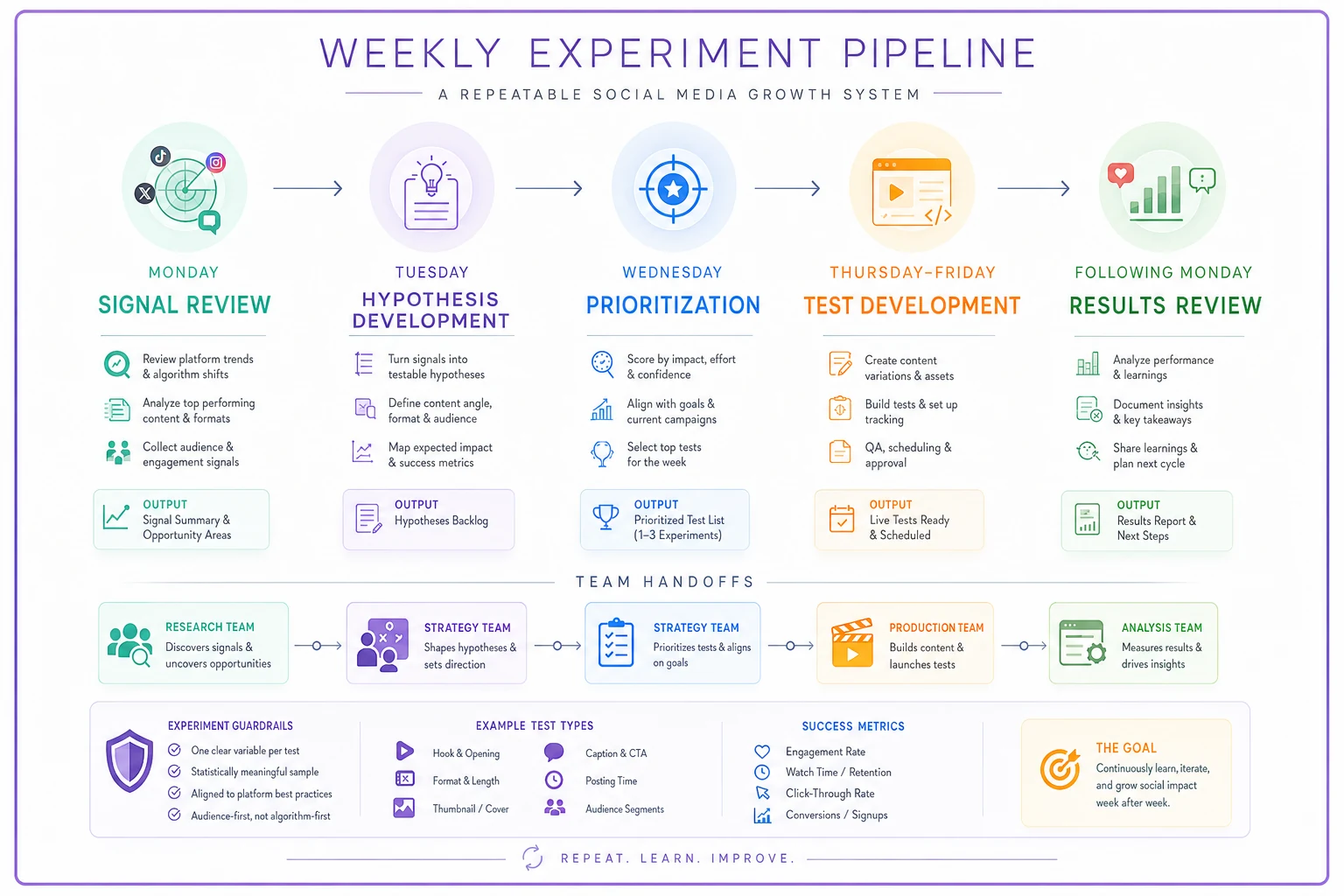
Weekly pipeline operations
-
Monday — Signal review Review collected signals from the previous week. Apply evaluation checklist to each. Flag high-potential patterns.
-
Tuesday — Hypothesis development Convert top signals to hypotheses. Complete conversion templates. Document test parameters.
-
Wednesday — Prioritization session Score all new hypotheses. Compare against existing test queue. Allocate resources for the week.
-
Thursday–Friday — Test development Create test content. Set up measurement systems. Launch experiments.
-
Following Monday — Results review Analyze completed tests. Document learnings. Archive or iterate based on results.
This cadence keeps learning continuous without overwhelming the team. A consumer goods brand running this pipeline for about six months identified a dozen high-value content opportunities their competitors had completely missed. Their engagement improved steadily as they carved out unique positions within proven content territories — rather than fighting for the same space everyone else was already crowding.
Here's a visual of the weekly pipeline.
By the time you've fully analyzed one competitor signal, three new trends have already emerged. Without a system, you're always behind.
Measurement frameworks that capture real learning
Most teams measure competitive tests wrong. They track vanity metrics or compare absolute performance against competitors with much larger audiences. You need measurement that captures strategic learning, not just tactical output.
Three questions your measurement should answer: Did the audience hypothesis prove correct? Can you execute this sustainably? Does it create any real competitive advantage?
Baseline establishment: Calculate your typical performance for similar content types over the past 30 days. This is your control benchmark — not what competitors are doing.
Use your 30-day baseline as the control for every test to keep comparisons consistent.
Relative performance tracking:
-
Test content vs your baseline (not competitor numbers)
-
Engagement depth, not just volume
-
Audience quality metrics (relevant followers gained)
-
Downstream impact (link clicks, conversions)
Hypothesis validation:
-
Did the predicted audience behavior occur?
-
What unexpected patterns emerged?
-
Which assumptions proved wrong?
Sustainability assessment:
-
Resource requirement vs return
-
Team capability development needs
-
Long-term content calendar fit
-
Competitive defensibility
A home services company discovered through structured measurement that their audience responded to educational content around 40% better than their competitors' audiences — but only through carousel posts, not video. That insight came from measuring hypothesis accuracy, not just engagement rates. Without the measurement framework in place, they would have drawn the wrong conclusion entirely.
Common pipeline failures and fixes
Failure: Analysis paralysis
Teams collect signals for months without testing anything. They want perfect intelligence before moving. By the time they've thoroughly analyzed a trend, it's over.
Fix: Set a maximum signal-to-test timeline of 72 hours. Better to test quickly with 70% confidence than wait for information that's never going to be perfect.
Failure: Correlation confusion
A competitor's post goes viral during a platform algorithm change. Teams attribute success to the content when timing was the real factor.
Fix: Test similar content at different times. Include platform state in your signal documentation from the start.
Failure: Ethical drift
Starting with competitive intelligence, teams gradually shift toward copying as pressure for results increases. It's a slow slide and most don't notice until they're already over the line.
Fix: Require every test to include a "unique value addition" — something only your brand can provide. This forces creative differentiation before anything goes into production.
AI automation in competitive intelligence operations
Processing signal volumes across multiple platforms manually doesn't scale. Content velocity is too high. This is where AI-powered operational software shifts competitive intelligence from periodic reports into something that actually runs continuously.
Automated systems can track performance patterns, surface anomalies, and flag significant shifts in real time — things a human analyst simply can't process at that volume. Correlation patterns across thousands of content pieces, subtle sentiment shifts in comment sections, emerging topic clusters before they fully trend. That's where automation earns its keep.
The more interesting layer is AI-assisted workflows that convert observations into structured insights — evaluating signals against your strategic criteria, scoring opportunities, and surfacing hypothesis frameworks based on past test performance. Teams using this kind of AI-enhanced competitive intelligence software typically cut their signal-to-test time significantly while improving how often tests surface useful learnings.
That said, automation should accelerate human judgment — not replace it. AI is strong at pattern recognition and data processing. Humans are better at strategic thinking and knowing when something feels off-brand. The technology speeds up the pipeline. It shouldn't be setting your strategy.
Making competitive intelligence systematic, not reactive
Competitive intelligence becomes valuable when it's operational, not observational. The framework, checklist, and pipeline here transform random competitor watching into systematic performance improvement.
Your competitors are running experiments every day. Some fail, some succeed, all generate learning. When you build proper signal collection and testing operations, you benefit from their experiments while carving out your own unique advantages.
Start with five signals this week. Run them through the checklist. Convert the top two into hypotheses. Test one immediately. The learning compounds faster than most teams expect — and within a few months, you'll be setting trends rather than chasing them.
Ready to amplify your brand’s voice?
Join 2,500+ marketers using Postyly to save time, boost engagement, and grow their audiences effectively.