


Most social media managers treat long-form content like a buffet — grab random quotes, pull a stat here and there, maybe screenshot a paragraph. Then wonder why their social calendar feels disconnected and engagement drops off after week two.
The problem isn't the content. It's the extraction method.
The teams that maintain consistent engagement don't just chop up their content randomly. They follow a systematic mapping process that pulls specific elements from long-form pieces and transforms them into interconnected social sequences.
Why Traditional Content Repurposing Falls Apart
Traditional repurposing usually looks like this: take a 2,000-word blog post, pull five quotes, create three graphics with statistics, maybe record a quick video summary. Post them sporadically over two weeks. Done.
Except it's not working anymore.
Social algorithms have gotten better at recognizing disconnected content chunks. When you post random excerpts without narrative flow, each post competes from zero. Your audience sees fragments without context. Engagement drops because there's no thread to follow.
The bigger problem happens behind the scenes. Without a clear extraction framework, team members spend hours debating which parts to use, reformatting the same content multiple times, and losing track of what's been posted where. Marketing operations turn into a scramble every Monday morning.
A structured mapping method solves both problems — it creates better content flow for algorithms and audiences while cutting down on the operational chaos of content production.
The Three-Layer Extraction Framework
Instead of randomly grabbing pieces, think of long-form content as having three distinct layers you can mine systematically:
Stop managing your social media the hard way.
Postyly helps you plan, schedule, and analyze every post with precision.
- Multi-platform scheduling
- Real-time engagement tracking
- Automated performance reports
No credit card required
Hook Layer: The attention-grabbing elements that make people stop scrolling. Counterintuitive statements, surprising statistics, pattern-breaking observations, questions that challenge assumptions.
Story Layer: The micro-narratives embedded throughout. Before/after transformations, specific examples, case studies broken into scenes, decision moments, turning points.
Action Layer: The practical takeaways people can implement. Step-by-step processes, templates, checklists, frameworks, specific tactics.
Each layer serves a different purpose in your social calendar. Hooks drive discovery and reach. Stories build connection and engagement. Actions provide value and drive saves and shares.
The mistake most teams make is pulling only from one layer — usually the action layer — and wondering why their content feels repetitive and preachy.
Mapping Process: From Article to Calendar
Here's the exact extraction process that consistently generates 30+ unique social posts from a single long-form piece:
Phase 1: Initial Extraction (Day 1)
Read through your long-form content three times, once for each layer. Use different colored highlights:
-
Yellow for hooks
-
Blue for micro-stories
-
Green for actionable elements
Don't stress about perfect categorization. Some elements work across multiple layers.
For a typical 1,500-word article, you should identify roughly 8–12 hook moments, 4–6 micro-stories, and 6–10 actionable elements.
Phase 2: Element Expansion (Day 2)
Take each extracted element and expand it into multiple formats:
Hook expansions:
-
Original statement
-
Question version
-
Comparison version
-
"Most people think X, but actually Y" version
Story expansions:
-
Full narrative (3–5 posts)
-
Single moment focus
-
Lesson extraction
-
Character perspective
Action expansions:
-
Full process
-
Single step deep-dive
-
Common mistake to avoid
-
Quick win version
This expansion phase typically doubles your content options.
Phase 3: Sequence Building (Day 3)
Arrange these elements into thematic sequences:
| Week | Focus | Post Mix |
|---|---|---|
| Week 1 | Discovery | Heavy on hooks |
| Week 2 | Education | Mix of stories and actions |
| Week 3 | Implementation | Action-heavy with success stories |
| Week 4 | Advanced | Deeper insights, variations, edge cases |
Each week should have a clear narrative arc while maintaining variety in post types.
Here's a quick visual of the mapping workflow.
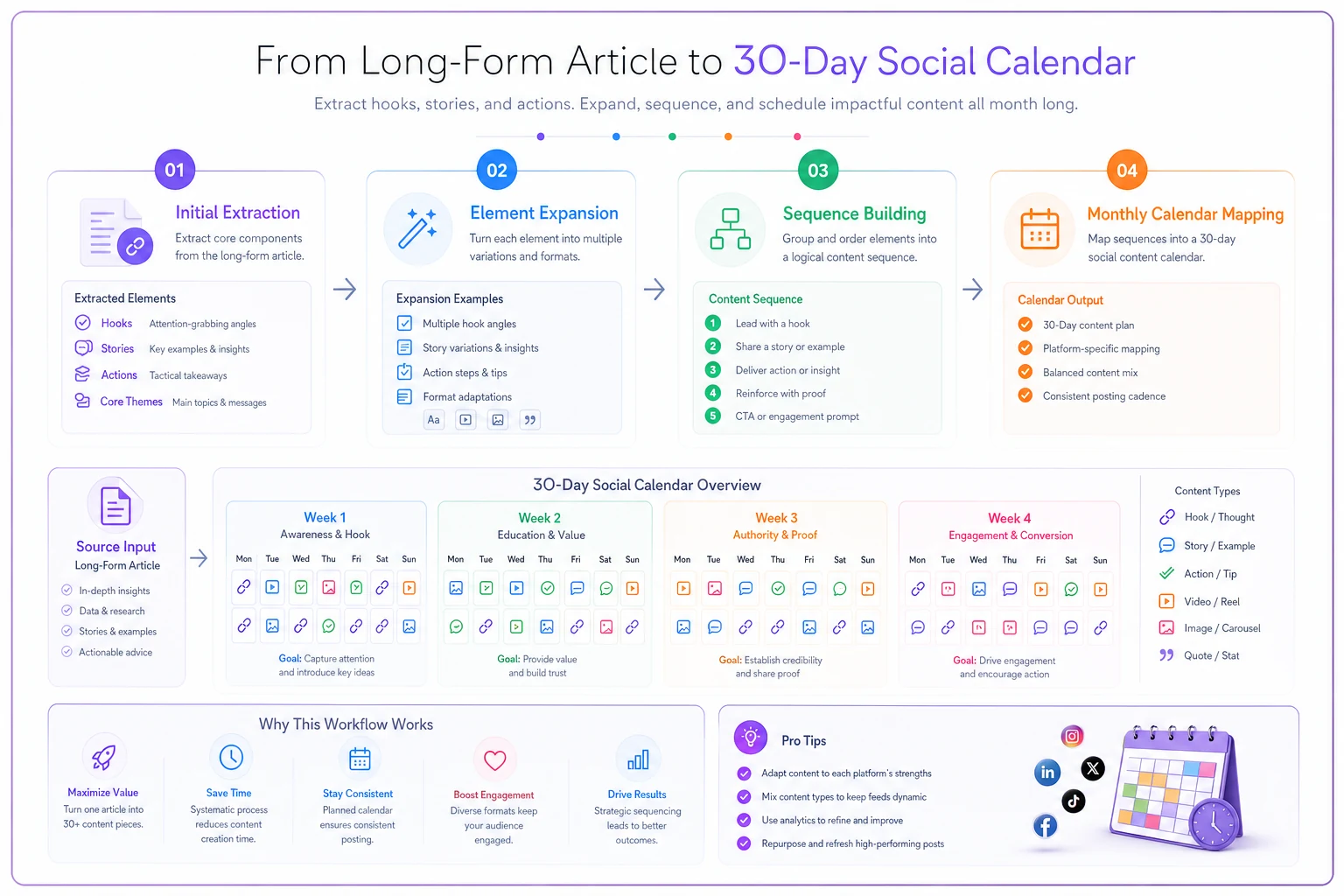
Do a quick pass for each layer rather than trying to perfect categories on the first read.
Use this workflow to keep your posts connected and your calendar predictable.
Real Example: B2B SaaS Case Study Breakdown
A B2B software company published a 2,200-word case study about how a client reduced churn by 23%. Standard repurposing would pull the stat and maybe quote the client.
Hook extractions:
-
"Their best customers were actually the ones churning fastest"
-
"The solution had nothing to do with product features"
-
"They were measuring the wrong engagement signals"
-
"Support tickets predicted retention better than usage data"
Story extractions:
-
The moment they discovered power users were leaving (3-post sequence)
-
The failed intervention that made things worse (2-post sequence)
-
The accidental discovery during a support audit (4-post sequence)
-
The CEO's reaction to the real data (single post)
Action extractions:
-
The 5-metric dashboard they built
-
Support ticket categorization framework
-
Early warning system setup
-
Customer success playbook template
-
Quarterly business review structure
From these extractions, they built 6 LinkedIn posts, 12 Twitter threads, 8 Instagram carousels, 4 email newsletter segments, and 10 internal team updates. Total reach across all platforms came out to roughly 127,000 impressions versus their typical 15,000–20,000 for similar content. More importantly, the content stayed coherent across the full month, with engagement actually increasing in weeks 3 and 4 as the story built momentum.
Template Library for Different Content Types
Not all long-form content extracts the same way. Here are extraction templates for common formats:
Research Report Template
Week 1: Surprising findings
-
Lead with most counterintuitive stat
-
Challenge industry assumptions
-
Methodology teaser
-
"What nobody talks about" angle
Week 2: Deep dive into data
-
Break down key segments
-
Correlation revelations
-
Visual data stories
-
Expert commentary clips
Week 3: Implications and applications
-
What this means for [specific role]
-
Action items by company size
-
Implementation roadmap
-
Common misinterpretations to avoid
Week 4: Extended insights
-
Edge cases and exceptions
-
Future predictions based on trends
-
Unanswered questions
-
Call for community input
Product Launch Article Template
Week 1: Problem agitation
-
Current solution failures
-
Hidden costs of status quo
-
User frustration stories
-
Market gap analysis
Week 2: Solution revelation
-
Feature-benefit bridges
-
Behind-the-scenes development
-
Early user feedback
-
Comparison to alternatives
Week 3: Implementation focus
-
Getting started guides
-
Advanced use cases
-
Integration tutorials
-
Success metrics
Week 4: Community building
-
User-generated examples
-
Feature requests discussion
-
Roadmap teasers
-
Celebration of early wins
Templates like these help you start with a predictable arc and then customize based on the content's unique strengths.
The Coordination Challenge
Once you've extracted and mapped your content, the real operational challenge begins: coordinating across platforms without overwhelming your audience or your team.
Most teams try to manage this through spreadsheets and manual posting. By Thursday, half the content hasn't gone out, posts are getting duplicated across platforms, and nobody knows what's scheduled versus what's actually published.
You need a system that tracks not just what content goes where, but how different elements connect across your calendar. Which hooks led to the highest engagement? Which story sequences drove the most link clicks? Which action items got saved most often?
AI-powered operational platforms can analyze your extraction patterns and suggest optimal sequencing based on past performance. They track which combinations of hooks, stories, and actions drive specific outcomes, then help you adjust your calendar to match actual goals rather than just filling time slots.
For instance, the platform might notice that story-heavy weeks drive more comments but action-heavy weeks drive more link clicks. You can then sequence your calendar accordingly — engagement-focused content early in the month when you're building momentum, conversion-focused content when you're pushing toward specific campaigns.
Common Extraction Mistakes
Mistake 1: Over-extracting from popular sections
Just because a section got lots of comments doesn't mean it should dominate your social calendar. Pull from quieter sections too — they often resonate differently on social platforms than they did in long-form format.
Mistake 2: Ignoring transition content
The connecting tissue between main points often contains solid micro-content. Those "which leads us to..." moments can become bridge posts that maintain narrative flow across weeks.
Mistake 3: Extracting without context markers
Each extracted piece needs enough context to stand alone while still connecting to the larger narrative. Include subtle callbacks to the original piece without requiring people to have read it first.
Mistake 4: Front-loading all your best content
Spread your strongest extractions across the full month. Week 3 and 4 need compelling content too, not just whatever's left over.
Building Your Extraction System
Start with one piece of long-form content and follow this process:
-
Choose your richest piece — something with data, stories, and actionable insights
-
Do the three-layer extraction — physically highlight or copy into separate documents
-
Expand just 3–4 elements to start — don't try to expand everything at once
-
Create one week of content — test your extraction quality before mapping a full month
-
Track performance religiously — which extractions drive which metrics?
-
Refine your templates — adjust based on what resonates with your specific audience
The goal isn't perfection on the first attempt. It's building a repeatable process that gets more efficient with each piece you map.
Measuring Extraction Effectiveness
Track these metrics to refine your extraction process:
Extraction Quality Metrics:
-
Engagement rate by extraction type (hook/story/action)
-
Save/share rates for different formats
-
Comment depth (simple reactions vs. meaningful discussion)
-
Click-through to original content
Operational Efficiency Metrics:
-
Time from publication to fully mapped calendar
-
Number of usable extractions per 1,000 words
-
Team hours spent on extraction and expansion
-
Calendar completion rate (planned vs. published)
Teams using systematic extraction typically see 3–4x more social content from each long-form piece, 40–60% reduction in content planning time, more consistent engagement across the full month, and higher team satisfaction because there's less scrambling and more strategic work.
When This Method Doesn't Work
This extraction approach fails in specific scenarios:
News or time-sensitive content — by the time you've mapped a month of content, the moment has passed.
Highly technical documentation — some content simply doesn't break down into social-friendly chunks.
Single-point arguments — if your long-form content makes one simple point, you can't extract 30 different angles.
Borrowed or curated content — extraction works best with original content where you can expand on your own insights.
Know when to use this method and when to stick with simpler repurposing.
The Compound Effect of Systematic Extraction
The real value compounds over time. After six months of systematic extraction, you'll have a library of proven hooks you can remix, story formats that consistently resonate, action templates your audience expects and shares, and a clear picture of which extraction patterns drive which outcomes.
Your extraction process becomes faster and more precise. What initially takes three days shrinks to half a day. Your team develops an instinct for spotting extractable moments while creating the original content.
Your audience also starts to recognize and anticipate your content patterns. They know that your Tuesday post will give them something actionable. Your Thursday story will make them think differently. Your Monday hook will challenge their assumptions.
That predictability might seem limiting, but it actually increases engagement. People like patterns they can rely on, especially in the noise of social media.
The teams that master content extraction don't just repurpose long-form content into social posts — they transform single pieces into month-long narratives that build momentum and deliver consistent value without burning out their creative resources.
Start with one piece and refine your process with each iteration. Your social calendar doesn't have to be a weekly scramble. With the right extraction method, it becomes a natural extension of your long-form content strategy.
Ready to amplify your brand’s voice?
Join 2,500+ marketers using Postyly to save time, boost engagement, and grow their audiences effectively.