

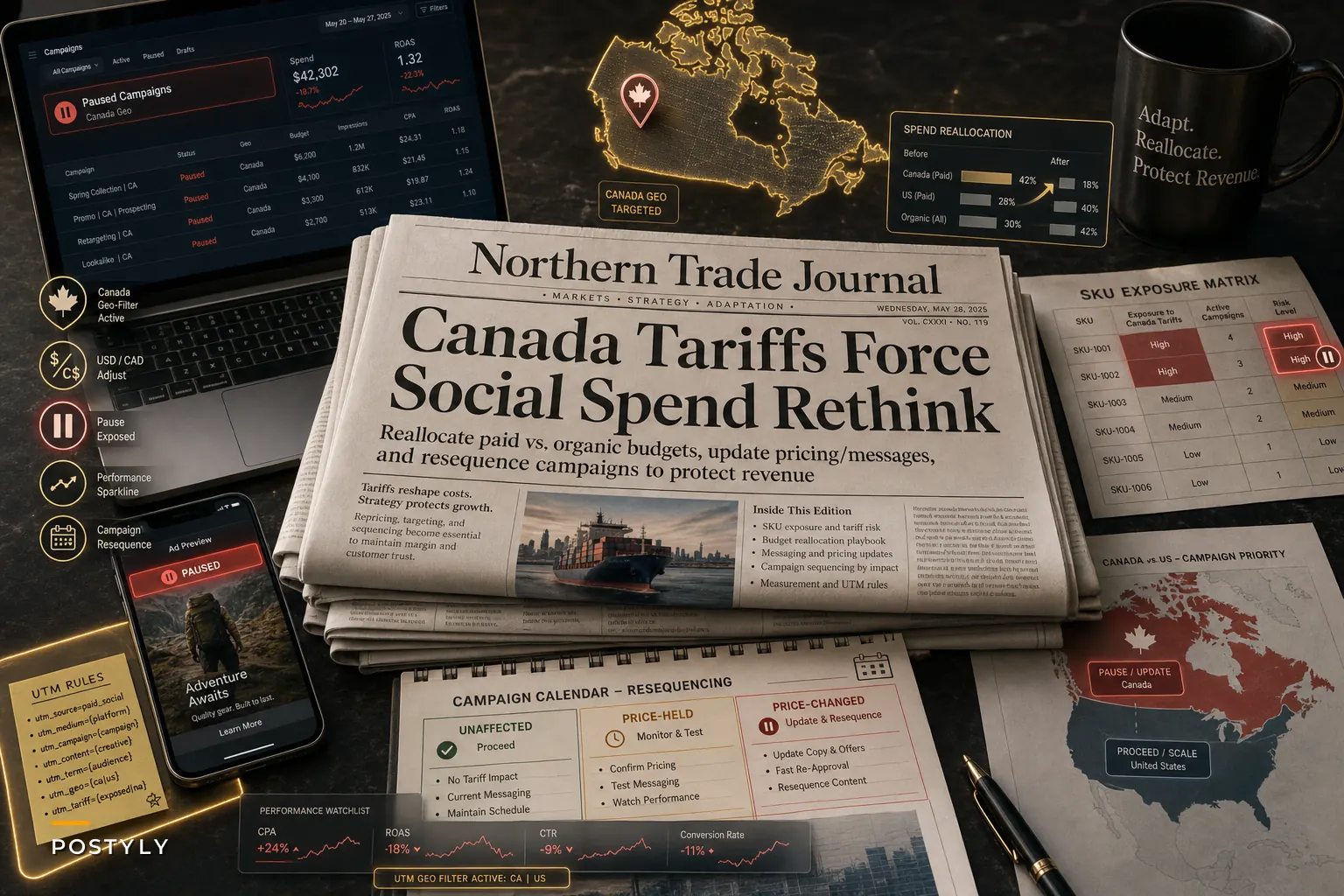

If you run social for a brand that sells into Canada — or sources from suppliers who do — your fall calendar just got complicated. Canada confirmed dollar-for-dollar retaliatory tariffs covering roughly CA$27.6 billion in U.S. goods, with 15%, 25%, and 50% duties across hundreds of product categories — steel, aluminum, dairy, appliances, electronics. It takes effect September 8, 2026.
What most marketing teams miss in the first week of a tariff announcement: the problem isn't the tariff itself. It's that your entire content calendar was built assuming stable prices, stable margins, and stable promo math. All three of those assumptions just got shaky for a subset of your SKUs — and nobody told the social team which SKUs.
Below is what actually breaks operationally, and how to sequence your response before you accidentally publish a "20% off" post on a product that just got 25% more expensive to land in Toronto.
The first mistake: treating this as a pricing problem instead of a targeting problem
When tariff news hits, the reflex is to loop in finance and wait for updated pricing. Necessary, yes — but slow. And while you're waiting, your scheduled posts keep firing.
The faster move is geographic. You don't need final pricing to know that a campaign targeting Ontario shoppers for an imported appliance line is now a liability. You need to know which of your live and queued campaigns touch Canada — through geo-targeting, cross-border shipping messaging, or comparison pricing that references U.S. dollar amounts.
The official Canada Department of Finance list of affected products is your starting point. Pull it, cross-reference against your catalog, tag every SKU that appears. Tedious, but it's probably the most valuable hour your team spends this month, because everything downstream — copy, budget, sequencing — depends on knowing your actual exposure.
One pattern worth flagging: teams tend to over-scope this. They assume the whole catalog is affected and freeze everything. For most mid-size retailers, the exposed SKUs are a slice — often 15–30% of the assortment. Freezing all of social because a third of products got hit is an overcorrection that kills the clean campaigns you could still be running.
What actually breaks in your live campaigns
Once you've got your exposed SKU list, here's where the damage shows up, roughly in order of urgency:
Stop managing your social media the hard way.
Postyly helps you plan, schedule, and analyze every post with precision.
- Multi-platform scheduling
- Real-time engagement tracking
- Automated performance reports
No credit card required
-
Promo copy that references specific savings — "$50 off" reads very differently when landed cost just jumped
-
Comparison and value messaging — "best price in Canada" claims that may no longer hold
-
Cross-border shipping promises — free shipping to Canada math that assumed old duty rates
-
Retargeting pools — Canadian cart-abandoners you're chasing on products about to reprice
-
Influencer content in the pipeline — briefs already out that quote prices or discounts
-
Evergreen/scheduled posts — the stuff running on autopilot that nobody's actively watching
That last one bites people more than they expect. A recent CNBC report on the retaliatory tariffs noted how quickly these measures create cost pressure for U.S. sellers — and your automated content queue doesn't know any of that happened. If you've got a month of posts scheduled with hard price points baked in, some of them are already wrong.
Reallocating paid vs. organic by geography
This is where most teams under-think it.
The instinct is to pause paid spend on affected products in Canada. Sometimes right, sometimes wrong — it depends on what you're actually trying to do with each channel during a repricing window.
| Situation | Paid social | Organic social |
|---|---|---|
| Prices confirmed higher, no promo | Pause or reduce; conversion copy will underperform | Keep running brand/value content; no hard price claims |
| Prices being finalized (unknown) | Hold spend; don't burn budget on possibly-wrong offers | Shift to educational/brand posts, no pricing |
| Absorbing cost (holding price) | Lean in — "price held" is a genuinely strong message | Amplify the reassurance, but don't over-promise |
| Passing cost to Canadian buyers | Reduce conversion campaigns; protect brand equity | Careful transparency; avoid sounding defensive |
The part that gets missed: organic is where you buy yourself time. Paid spend on a wrong price point is money lit on fire. Organic brand content — the stuff not tied to a specific offer — lets you stay present in the Canadian feed without committing to numbers you might have to walk back next week.
The part that gets missed: organic is where you buy yourself time.
This is the same logic behind running paid and organic as one connected system rather than two separate budgets. If you've built an integrated paid-and-organic portfolio strategy, a shock like this is exactly what it's designed to absorb — you shift weight between channels by geography and message-readiness instead of blunt-force pausing everything.
The sequencing problem nobody plans for
Say finance lands on final Canadian pricing three days before your big fall push. Now you've got a sequencing headache: the campaign was built and approved weeks ago, at old prices.
-
Freeze exposed-SKU campaigns first — before touching anything else, stop the queue on tagged products so nothing wrong publishes while you sort this out.
-
Split your calendar into three buckets — unaffected (proceed normally), price-held (lean into it), and price-changed (rebuild copy).
-
Rebuild copy for the price-changed bucket — strip hard numbers, shift to value and quality framing, hold on specific offers until confirmed.
-
Re-approve in a fast lane — set a temporary shorter approval SLA for tariff-related edits so they don't sit in the normal queue for days.
-
Re-slot into the calendar by readiness — publish unaffected content on schedule, delay price-changed content until pricing is locked, don't hold the whole calendar hostage to one bucket.
-
Add tracking slices — tag every tariff-affected campaign so you can measure performance variance separately from your baseline.
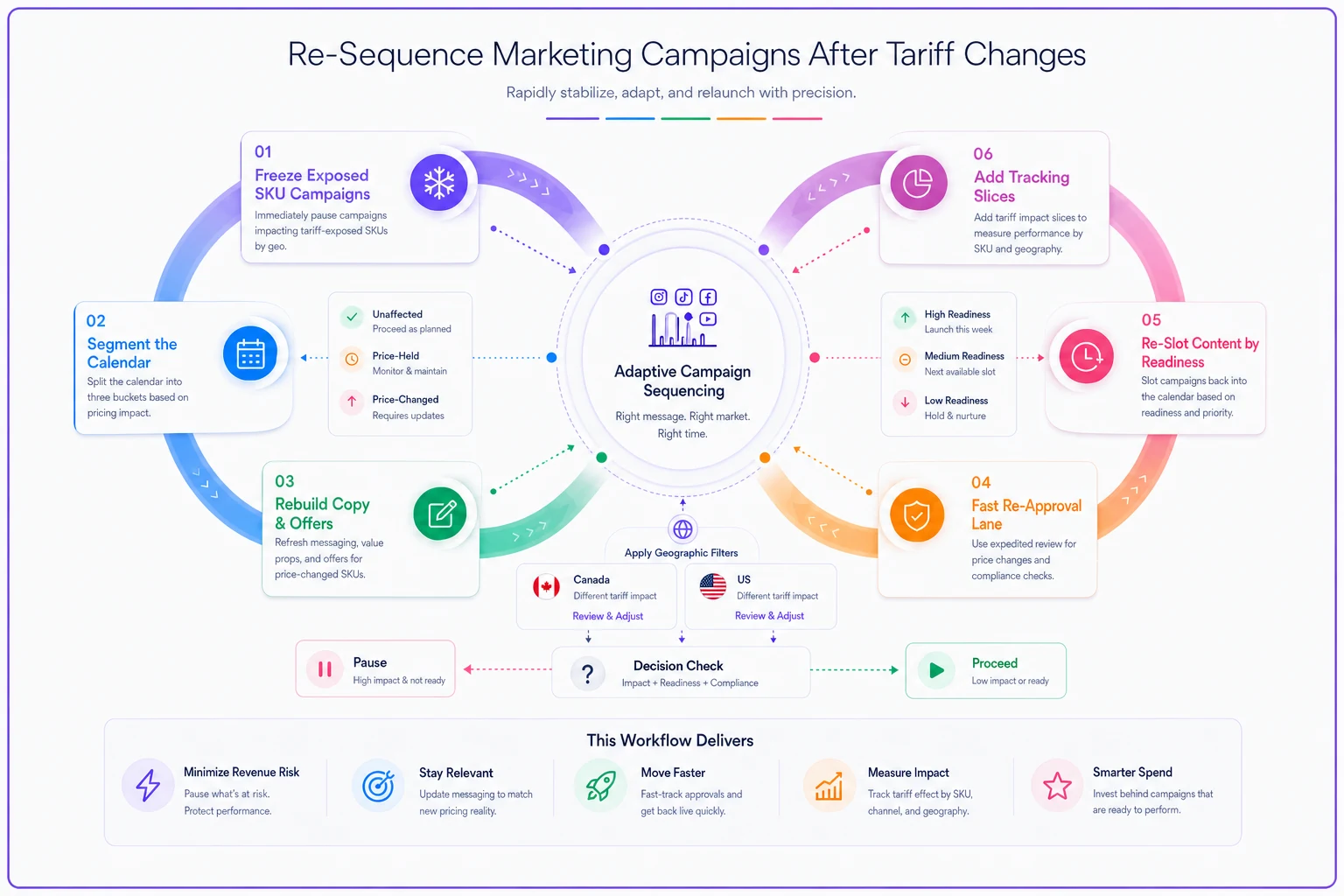
A quick visual of the re-sequencing workflow helps teams follow the steps fast.
That last step matters more than it looks. If you don't slice tariff-affected campaigns separately in reporting, their softer performance will drag down your overall numbers and you'll spend Q4 wondering why "the whole account" looks off — when really it's a contained group of repriced products.
A real scenario
A mid-size housewares retailer sells small kitchen appliances into both the U.S. and Canada, with Canada making up roughly a quarter of online revenue. About 40% of their imported appliance line landed on the counter-tariff list.
Their queued fall campaign had "$40 off select appliances" running across paid and organic, geo-targeted to include several Canadian provinces. Left alone, those posts would've gone live promoting a discount on products whose landed cost was climbing 25%.
-
Tagged affected SKUs against the official list (took most of an afternoon)
-
Paused paid conversion campaigns on those SKUs in Canada, kept them running in the U.S.
-
Swapped the Canadian organic slot from "$40 off" to durability-and-warranty brand content — no price claims
-
Held the discount copy until finance confirmed which products they'd absorb versus pass through
-
Added a "tariff-affected" tag to reporting to watch those SKUs separately
The outcome wasn't dramatic, and that's kind of the point. Canadian revenue on the affected line dipped — maybe 10–15% below their fall plan — but they avoided the much worse outcome of promoting discounts they'd have to yank, confusing shoppers, and flooding customer service with "why did the price change after I saw your ad" messages. Their unaffected products, roughly 60% of the line, ran on schedule and carried the quarter.
Who should NOT overreact to this
If your Canadian exposure is small — under 10% of revenue, and few or none of your top SKUs on the list — resist the urge to blow up your calendar. A handful of geo-targeting tweaks and a quick copy scrub on a few posts is proportionate. Rebuilding your whole fall strategy over a rounding error in your revenue mix is a waste of the team's energy heading into your busiest weeks.
The teams that get burned aren't usually the ones who ignore the tariffs. They're the ones who either freeze everything and lose clean revenue they could've earned, or ignore it entirely and let wrong prices publish on autopilot. The answer is in the boring middle: audit exposure, isolate the affected slice, protect the rest.
The deeper issue this exposes
Tariffs are just the current trigger. The underlying weakness is that most social calendars are built with pricing and promo math hard-coded into the creative, with no fast way to identify which posts reference which products at which prices.
When something shifts prices suddenly — tariffs, supplier cost spikes, a currency swing, a competitor's move — teams can't answer "which of our scheduled posts are now wrong?" quickly, because that mapping between SKU, price, and content doesn't exist anywhere except in people's heads.
Teams that came through this cleanly had one thing in common: they could trace a line from any piece of scheduled content back to the specific products and price points it referenced. That's a content-operations capability, not a tariff response. Whether you maintain it in a proper platform or a well-disciplined spreadsheet, the ability to instantly flag every post touching an affected SKU is what turns a five-day scramble into a five-hour audit.
The tariffs land September 8. Your real prep isn't updating this one campaign — it's building the tagging and geo-slicing discipline so the next shock, whatever it is, doesn't catch your queue running on numbers that stopped being true last week.
Ready to amplify your brand’s voice?
Join 2,500+ marketers using Postyly to save time, boost engagement, and grow their audiences effectively.