


Most paid and organic teams don't actually fight. That's the weird part. They just operate in parallel universes that occasionally send each other Slack messages. Paid runs on a daily budget cadence, watches CPA hour by hour, and reallocates money before lunch. Organic plans in monthly cycles, thinks in reach and saves, and measures wins over weeks. When you glue those two rhythms together without a shared rulebook, you don't get integration — you get two departments pointing at the same dashboard and disagreeing about what it means.
The phrase "integrated paid and organic strategy" gets thrown around like it's a tooling problem or a reporting problem. It's neither. It's a governance problem. Who's allowed to move money based on what signal, how fast, and what does each team owe the other in return? Get that wrong and you'll spend on creative that's already fatiguing organically, or you'll leave a viral post starved of the ad dollars that would have doubled its life.
This is the part nobody writes a playbook for, so here's one.
Why the two systems drift apart in the first place
The drift is structural, not personal. Paid teams are rewarded for efficiency inside a tight window. If a campaign's cost per result creeps up on Tuesday, someone's job is to notice by Wednesday. Organic teams are rewarded for building an audience and a content engine that compounds — a job you literally can't judge on a Tuesday.
So the two teams end up optimizing for different time horizons with different tolerance for noise. When leadership says "align them," what usually happens is a shared weekly meeting where organic reports last month's numbers and paid reports yesterday's. Nobody's lying. They're just speaking different measurement languages, and no meeting fixes a units mismatch.
The second reason they drift: attribution ownership. When a signal is ambiguous — did that spike in demo requests come from the paid retargeting push or the organic thread that went semi-viral the same week? — both teams quietly claim it, or both quietly disown the flat weeks. Without clear rules for who reads which signal, the credit fight poisons the reallocation conversation before it starts. If you haven't already nailed down how you'll cleanly separate contribution, the funnel-to-metric matrix for measuring social impact across the funnel is the foundation you want in place before any of this governance works.
What breaks specifically at scale
At a small team — say one person doing organic and one running ads — integration happens informally. They sit near each other. They talk. The organic person says "this reel is popping, can you put money behind it," and by afternoon it's a campaign. That works up to a point.
Stop managing your social media the hard way.
Postyly helps you plan, schedule, and analyze every post with precision.
- Multi-platform scheduling
- Real-time engagement tracking
- Automated performance reports
No credit card required
The point it stops working is usually around the moment you cross roughly 8–12 active campaigns and more than one content producer. Now the informal signal — "this one's popping" — has to compete with five other "popping" posts, and there's no shared definition of what popping actually means. One producer means 40k views. Another means a save rate that's 3x their baseline. Paid can't act on vibes at that volume, so they default to their own data and effectively ignore organic entirely. That's the failure mode: at scale, "integration" quietly collapses back into two silos that each pretend the other doesn't exist.
-
Signal latency. Organic wins are identified in weekly reviews. By the time paid hears about it, the creative's peak organic window has already closed.
-
Budget inertia. Money sits in campaigns that are technically hitting KPIs but are clearly underperforming what a fresh organic winner could do.
-
Duplicate fatigue. Paid keeps running a creative that organic already knows is tired, because nobody told them the organic engagement curve rolled over two weeks ago.
-
No stop rule. There's a clear trigger to add budget to a winner, but almost never a trigger to pull it. Spend only ratchets up.
That last one is the sneaky killer. Reallocation frameworks obsess over where to put money and forget the discipline of taking it back.
Reallocation frameworks obsess over where to put money and forget the discipline of taking it back.
The reallocation trigger system
Reallocation should never be a debate. It should be a rule that fires. Debates happen when you don't have triggers, and debates always favor whoever argues hardest, not whoever's data is best.
The trick is defining triggers in terms both teams already trust. Organic signals get translated into a form paid can act on, and paid signals get translated into a form organic can plan around. Here's the structure that tends to hold up:
| Signal source | Trigger condition | Action | Who owns the call | Response window |
|---|---|---|---|---|
| Organic engagement | Save/share rate ≥ 2.5x the format's rolling 30-day baseline | Flag creative for paid amplification test | Organic lead flags, paid validates | 48 hours |
| Organic velocity | Post crosses reach threshold within first 6 hours | Pre-approve small "boost within the window" budget | Paid, using pre-set cap | Same day |
| Paid fatigue | Frequency > 3.2 and CTR down 20%+ from launch | Pause paid, request organic replacement creative | Paid flags, organic supplies | 3–5 days |
| Paid efficiency | CPA under target for 7+ days on a creative | Feed the winning angle back to organic content queue | Paid shares, organic tests organically | Weekly |
| Portfolio-level | Any campaign at <70% of category benchmark for 10 days | Mandatory reallocation review | Both, jointly | Weekly cadence |
The response windows matter more than the thresholds. A 48-hour window on an organic-to-paid handoff is the difference between amplifying a wave and boosting a corpse. Most teams get the thresholds roughly right and the timing catastrophically wrong.
Diagram of the trigger-to-action workflow and response windows.
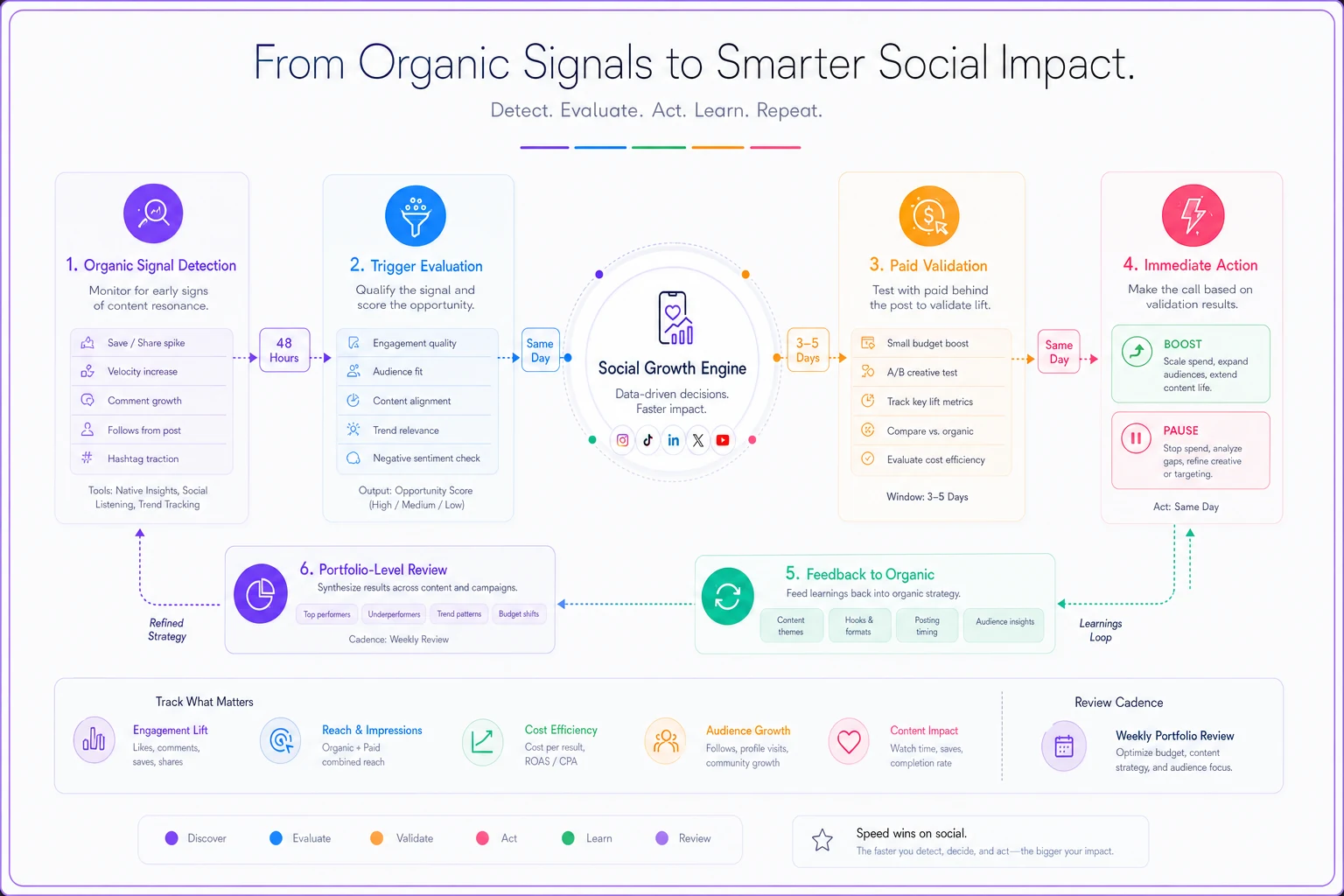
Notice the pre-approved boost budget in row two. That's the single highest-leverage rule in the whole table. When something is spiking organically in the first six hours, there's no time to route an approval request. You need a standing, capped budget — a few hundred dollars — that paid can deploy inside the window without a meeting. The workflow around turning those spikes into structured tests is worth building deliberately; the creative iteration loop for turning organic winners into predictable paid tests covers the signal thresholds and test templates that keep this from becoming a guessing game.
Cadence: matching two teams running on different clocks
You can't force organic onto a daily cadence or paid onto a monthly one. Both fail. Instead you layer cadences so each team keeps its natural rhythm but they intersect at fixed, non-negotiable points.
Here's a workable layering:
-
Daily (paid only) Paid runs its normal efficiency checks. No organic involvement. The only rule is that any pause of a shared creative gets logged in a channel organic can see.
-
Twice weekly (handoff pulse) A 15-minute async check — not a meeting — where organic posts its current top three performers against baseline and paid posts any creative it's about to fatigue out. This is where the 48-hour triggers get caught in time.
-
Weekly (reallocation review) The real decision meeting. Portfolio-level triggers get actioned. Budget moves between campaigns. Underperformers below the 70% benchmark get pulled or fixed.
-
Monthly (strategy alignment) Organic reports its compounding metrics. Paid reports blended efficiency. This is the only cadence where you evaluate the portfolio, not individual campaigns.
The twice-weekly async pulse is the part most teams skip, and it's the part that actually makes integration real. A weekly meeting is too slow to catch a six-hour organic spike. A daily meeting is too heavy and organic will resent it. Twice-weekly, async, structured — that's the cadence that respects both clocks.
Fix it to a template — creative ID, metric, baseline multiple, recommended action, done.
One honest caveat: this only works if the async pulse has a rigid format. "Post your top three" turns into an essay contest within two weeks if you don't lock it down. Fix it to a template — creative ID, metric, baseline multiple, recommended action, done.
KPI contracts: what each team actually owes the other
A KPI contract is not a target dashboard. It's a written agreement about what each team is responsible for producing for the other, with consequences when they don't. Regular KPIs measure output. Contracts measure the handoff.
Handoffs fail because responsibility evaporates at the boundary. Organic says "we flagged it." Paid says "the flag came in too late." Both are technically right and nothing improves. A contract closes that gap by defining the obligation on both sides.
Organic owes paid:
-
A minimum number of validated creative candidates per week (3–5 that clear the amplification threshold)
-
Flags delivered inside the 48-hour trigger window, not in the weekly review
-
Baseline context attached to every flag, so paid isn't reverse-engineering what "good" means
Paid owes organic:
-
Winning-angle feedback within 48 hours of a creative proving out in paid
-
Fatigue warnings before pulling a shared creative, so organic can queue a replacement
-
Clean spend/result data at the creative level, tagged consistently enough that organic can learn from it
Both owe the portfolio:
-
Honest signal reads — no claiming ambiguous wins
-
Adherence to the stop rules, not just the start rules
-
Showing up to the weekly review with decisions, not status updates
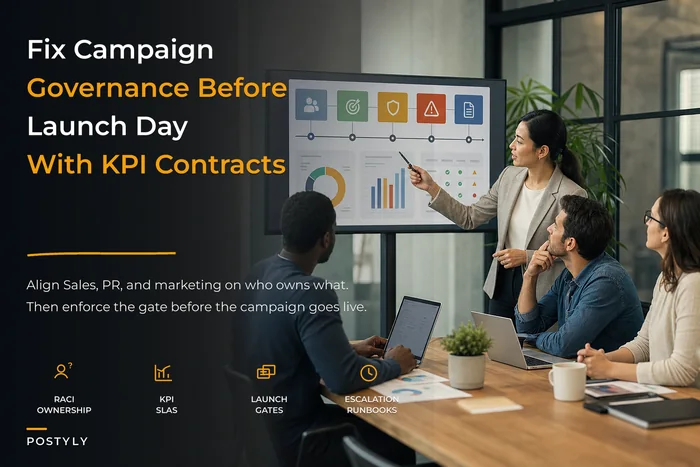
If you already run campaign governance with KPI contracts and launch gates elsewhere in your org, this slots right on top of it — the mechanics of writing enforceable contracts and RACI ownership are covered in the cross-functional campaign governance playbook, and the paid-organic loop is essentially a specialized instance of that same discipline.
A real scenario
A mid-size DTC skincare brand — small team, roughly $40k–$50k monthly paid social spend, one content lead plus two producers on organic. Classic silo setup. Organic was doing genuinely good work; a couple of their educational reels were consistently outperforming, save rates well above baseline. Paid never touched them. Paid ran its own studio-produced creative on a separate track.
The gap showed up in the numbers. Paid CPA was drifting up quarter over quarter as their polished creative fatigued faster and faster. Meanwhile the organic winners died at their reach ceiling and were never amplified.
They put in three rules — nothing fancier than what's above: a twice-weekly async pulse, a pre-approved boost budget capped at around $300 per spike, and a 48-hour handoff obligation on both sides. No new headcount, no new dashboard at first. Just a shared channel and a locked template.
Over the following quarter, blended CPA came down noticeably — not a dramatic overnight drop, more like a steady clawback of the drift they'd been fighting, somewhere in the 15–20% range on the amplified creative cohort. The bigger win was less visible: organic creative that used to die at its reach ceiling now had a second life in paid, and paid's fatigue curve got flatter because it was constantly being fed pre-validated angles instead of guessing. The two teams stopped arguing about credit because the contract already assigned it.
None of that required a heroic effort. It required admitting that the informal "hey can you boost this" system had quietly stopped working somewhere around campaign number ten.
When this makes sense — and when it doesn't
When it's worth building:
You're past roughly 8–10 active campaigns, you have more than one organic producer, and your paid efficiency is drifting while organic winners go unamplified. If both of those are true, you're leaving money on the table every week.
When it's premature:
If you're a two-person team sitting next to each other, don't build this. The informal system genuinely works at that scale, and imposing async pulses and KPI contracts on two people who already talk all day is just bureaucracy for its own sake. Add structure when the informal system starts dropping signals, not before.
Who should not do this:
Teams that haven't yet solved clean attribution between earned and paid reach. If you can't reliably tell which channel drove a result, your triggers will fire on garbage data and your reallocation reviews will devolve into the same credit fights you were trying to escape. Fix your measurement layer first. The triggers are only as good as the signals feeding them.
The part everyone underinvests in
The reason most integration efforts fizzle isn't that the framework is wrong. It's that the stop rules never get enforced. It's emotionally easy to add budget to a winner and emotionally hard to pull budget from a campaign that's technically fine but clearly underperforming what your best organic winner could do. So spend ratchets up, the portfolio bloats, and within two quarters you're back to two silos each defending their turf.
The governance loop only stays alive if the weekly review has real teeth — if "this campaign is at 68% of benchmark for ten days" automatically triggers a reallocation conversation whether anyone feels like having it or not. The whole point of writing the triggers down is to remove the discretion that lets underperformers survive on inertia.
Integration isn't a state you reach. It's a loop you keep running: organic surfaces signals fast, paid validates and amplifies inside the window, paid feeds winning angles back, and the portfolio-level review keeps both honest about what to fund and what to kill. Keep the loop tight, keep the windows short, and treat the stop rules as sacred as the start rules — that's the whole game.
Integration isn't a state you reach. It's a loop you keep running: organic surfaces signals fast, paid validates and amplifies inside the window, paid feeds winning angles back, and the portfolio-level review keeps both honest about what to fund and what to kill. Keep the loop tight, keep the windows short, and treat the stop rules as sacred as the start rules — that's the whole game.
Ready to amplify your brand’s voice?
Join 2,500+ marketers using Postyly to save time, boost engagement, and grow their audiences effectively.