


Most social teams watch organic posts blow up, screenshot the metrics, then do absolutely nothing with them. The viral reel with 2.3 million views? Never tested in paid. That carousel generating 400+ saves per day? Still sitting in organic only. Meanwhile, the paid team burns through creative testing budgets on brand-new concepts with zero organic validation.
The disconnect costs real money. A fitness apparel brand had three organic posts each driving 50+ conversions monthly through link-in-bio traffic. Their paid team was testing completely different creative angles and wondering why CAC stayed high. Once they built an actual organic-to-paid creative loop with clear signal thresholds, paid CAC dropped 34% in eight weeks.
Building this loop isn't about copying viral posts into ads manager. It's about creating systematic translation rules that turn organic signals into structured paid experiments.
Signal thresholds that predict paid performance
Raw engagement means nothing if it doesn't correlate with conversion potential. A meme might get 100k likes and generate zero purchase intent. A boring product demo with 3k views might drive consistent sales.
The signal threshold framework separates vanity metrics from revenue indicators:
Primary signals (direct revenue correlation):
-
Link clicks above 2.5% of reach
-
Profile visits exceeding 8% of impressions
-
Save rates over 4% (especially for product content)
-
DM inquiries asking about price or availability
-
Comments containing buying language ("where can I get this," "what's the link")
Secondary signals (audience quality indicators):
-
Watch time completion above 65% for videos under 30 seconds
-
Share-to-reach ratio exceeding 1
15
-
Comment sentiment skewing purchase-intent positive
-
Follower growth from a single post exceeding baseline by 3x
False positive signals to ignore:
-
Pure entertainment metrics (laugh reacts, meme shares)
-
Controversy-driven engagement
-
Off-brand audience expansion
-
Platform-gaming metrics (loops, trending audio boost)
A meal kit service found their highest-converting paid creative came from organic posts with mediocre reach but exceptional save rates. Posts with 5k reach and 400+ saves consistently outperformed viral content with 500k reach when moved to paid. The threshold that actually mattered: save rate above 7% with at least 200 absolute saves.
Paid test design templates based on organic winners
Converting organic winners requires more than copying the post into ads manager. You need structured templates that preserve what worked while optimizing for paid mechanics.
Stop managing your social media the hard way.
Postyly helps you plan, schedule, and analyze every post with precision.
- Multi-platform scheduling
- Real-time engagement tracking
- Automated performance reports
No credit card required
The Performance Preservation Template:
-
Duplicate creative exactly (same copy, visual, duration)
-
Test against cold audiences only
-
Run for 72 hours minimum
-
Compare CTR and thumb-stop rate to organic baseline
-
If performance holds at 70%+ of organic, proceed to optimization
The Hook Enhancement Template:
-
Extract the highest-retention 3-second segment from organic
-
Loop it 2x at the beginning
-
Add text overlay with core value prop
-
Test original audio vs voiceover vs captions
-
Shorten total duration by 20-30%
The Conversion Optimization Template:
-
Insert product shots at 0
03, 0:07, and final frame
-
Add pricing in first 5 seconds
-
Include availability or urgency messaging
-
Test with and without CTA buttons
-
Create 1
1, 4:5, and 9:16 variants
A subscription box company tested their organic unboxing video (850k views) using all three templates. The Performance Preservation version tanked—2.1% CTR versus 8.3% organic. The Hook Enhancement version improved to 4.2% CTR. The Conversion Optimization version hit 6.8% CTR with 40% lower CPA than their previous best creative.
Run the Performance Preservation version first to validate organic-to-paid translation before optimizing.
Organic validates interest. Paid templates optimize for action. They're doing genuinely different jobs, and treating them the same is where most teams bleed budget.
Translation rules for different content types
Not every organic format translates directly to paid. Each content type needs specific adaptation rules.
User-Generated Content (UGC):
-
Add brand context within first 2 seconds
-
Subtitle everything (organic relies on sound-on, paid doesn't)
-
Crop to focus on product or result
-
Remove platform-specific elements (comments, username overlays)
-
Add social proof overlays (ratings, review count)
Educational/Tutorial Content:
-
Start with the end result
-
Compress steps by 50%
-
Add progress indicators
-
Include pricing during demonstration
-
End with clear next action
Behind-the-Scenes Content:
-
Lead with the "what you get" not the "how we make it"
-
Focus on quality and craftsmanship signals
-
Add comparison points to competitors
-
Include founder credibility markers
-
Close with exclusive offer
Trend-Jacking Content:
-
Extract the format, not the trend itself
-
Replace trending audio with evergreen music
-
Remove time-sensitive references
-
Focus on problem/solution, not entertainment
-
Test within 72 hours of organic peak
A jewelry brand's trending audio reel hit 1.2M organic views. Direct translation to paid: 0.8% CTR, negative ROAS. After applying translation rules—removed trending audio, added product focus, shortened by 40%—the paid version sustained 3.2% CTR for four months. The format worked. The trend didn't.
The feedback calendar that actually gets followed
Most teams create elaborate feedback loops that die after week two. The calendar that survives focuses on minimal viable process.
Weekly Quick Wins Review (15 minutes):
-
Every Tuesday at 2 PM
-
Pull top 5 organic posts by primary signals
-
Flag any exceeding thresholds
-
Assign to paid test queue
-
No discussion, just identification
Bi-Weekly Translation Session (45 minutes):
-
Every other Thursday
-
Creative team presents organic winners
-
Paid team applies templates
-
Agreement on test budget allocation
-
Document translation decisions
Monthly Performance Correlation (30 minutes):
-
First Monday
-
Compare organic signals to paid results
-
Adjust thresholds based on data
-
Update templates based on winners
-
Kill underperforming translations
Quarterly Strategy Alignment (2 hours):
-
End of quarter
-
Full organic/paid performance review
-
Threshold calibration based on 90-day data
-
Template evolution based on platform changes
-
Resource allocation for next quarter
The calendar works because it's specific and lightweight. No vague "sync up on creative performance" meetings. Each session has a narrow purpose and a defined output.
Measurement recipes that connect organic to revenue
The biggest failure in organic-to-paid loops: measuring different things. Organic celebrates reach while paid optimizes CAC, so a successful translation can look like failure depending on who's reading the report.
The Unified Success Metric:
-
Cost Per Incremental Action (CPIA) across both channels
-
Organic CPIA = (Creation Cost + Boost Spend) / (Conversions - Baseline)
-
Paid CPIA = Media Spend / Conversions
-
Translation Success Rate = Organic CPIA / Paid CPIA
The Signal Correlation Matrix:
| Organic Signal | Paid CTR Correlation | Paid CVR Correlation | ROAS Correlation |
|---|---|---|---|
| Save Rate | 0.72 | 0.81 | 0.78 |
| Link Clicks | 0.83 | 0.69 | 0.71 |
| Watch Time | 0.54 | 0.62 | 0.58 |
| Share Rate | 0.41 | 0.38 | 0.35 |
| Like Rate | 0.22 | 0.19 | 0.16 |
Update this monthly and kill thresholds with correlation below 0.5. Like rate in particular is nearly useless as a paid predictor—most teams already suspect this but keep tracking it anyway.
The Creative Decay Monitor:
-
Day 1-3
Peak organic performance
-
Day 4-7
Begin paid testing
-
Day 8-14
Scale paid winners
-
Day 15-21
Monitor frequency and fatigue
-
Day 22+
Reduce spend or refresh creative
A home goods brand found their organic winners maintained paid performance for around 18 days on average. Building campaigns around that cycle improved ROAS by 23%.
Common pitfalls when building your loop
The Viral Trap:
That post with 5M views probably won't convert in paid. High virality often means broad appeal, which translates to low purchase intent. Focus on signals from your actual customer base, not the entire internet.
The Speed Obsession:
Racing organic winners into paid before understanding why they worked wastes budget. The 72-hour validation window exists for a reason. Let organic data mature before committing paid spend.
The Perfect Translation Fallacy:
Trying to preserve every organic element kills paid performance. Organic succeeds through algorithm favor and community connection. Paid succeeds through clear value props and conversion mechanics. They're different games.
The Attribution Mess:
Running organic and paid simultaneously without proper attribution separation creates data chaos. Use geo-holdouts, time-based windows, or platform-specific tracking to keep data clean.
Real workflow automation opportunities
The manual version of this loop requires constant monitoring, spreadsheet updating, and cross-team coordination. That's where operational software transforms the process from theory into consistent execution.
AI-powered platforms can automatically flag organic posts exceeding your thresholds, populate test templates with winning creative elements, and slot them into your paid testing calendar. Instead of manually checking performance every day, you get alerts when organic content crosses into paid-worthy territory.
Here’s a simple visual of the automated workflow:
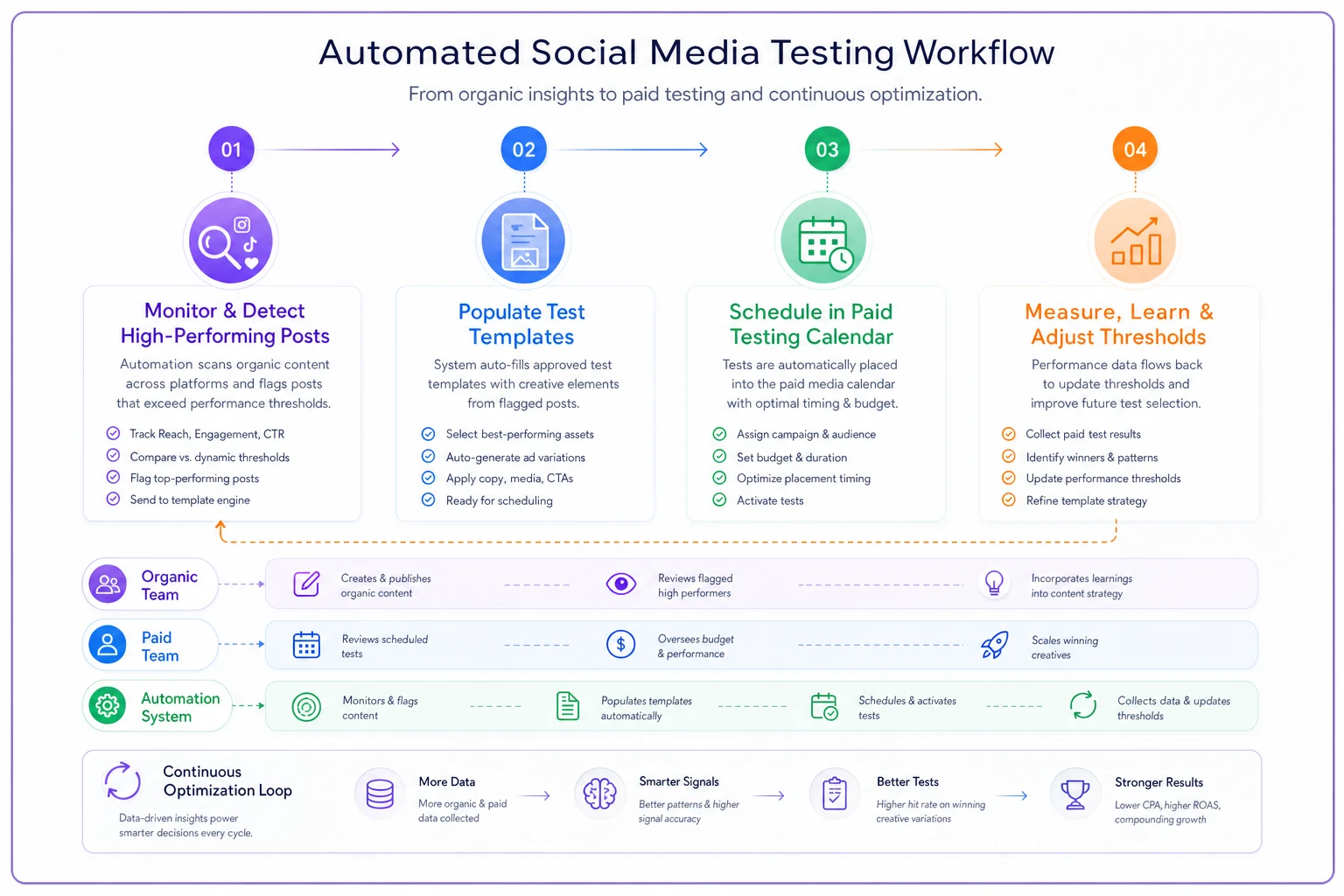
The automation handles the tedious parts: pulling metrics, calculating thresholds, formatting creative for different placements, tracking translation performance over time. Your team focuses on strategy and creative decisions rather than spreadsheet management.
More importantly, automation enforces consistency. That bi-weekly translation session actually happens because the system schedules it, prepares the materials, and documents the decisions. The measurement framework updates automatically based on performance data, keeping thresholds relevant without manual recalibration every month.
When this loop actually drives results (and when it's pointless)
Perfect fit scenarios:
-
E-commerce with consistent product launches benefits significantly. Each launch creates fresh organic content that can quickly validate and scale through paid. A cosmetics brand using this system reduced new product CAC by 42% within two quarters.
-
Subscription services see strong results too. The loop helps identify which value props resonate organically, then amplifies them through paid. A meal delivery service discovered their "customize your menu" content consistently beat "convenience" messaging—but only because they tested organic first.
Waste of time scenarios:
-
B2B with long sales cycles won't see immediate impact. Your organic LinkedIn post might influence a decision six months later, but that signal gets lost in paid attribution windows.
-
Brands with a small organic presence simply lack the data volume. You need at least 20-30 pieces of content monthly hitting threshold signals for the numbers to mean anything. Below that, you're pattern-matching noise.
-
Event-based businesses face timing challenges. Your viral post about last month's concert won't translate to paid for next month's completely different show.
Every piece of content teaches you something about your audience when you have a system to capture it. That knowledge compounds over time, making both organic and paid progressively more effective.
Building your first loop this week
Start minimal. Pick your top performing organic post from the past 30 days based on link clicks, not likes. Apply the Performance Preservation template exactly—no optimizations yet. Run for $100 over 72 hours to cold audiences.
Document everything: organic metrics, paid results, translation decisions, performance correlation. This becomes your baseline.
Week two, add thresholds. Set them conservatively—better to test too much than miss winners. Week three, try your first template variation. Week four, run your first monthly correlation review.
Sophistication comes through iteration. A footwear brand started with basic reposting of organic winners. Six months later, they were running a loop with a dozen signal thresholds, multiple translation templates, and rough predictive models for paid performance. But they started with one post and one template.
The organic-to-paid creative loop closes the gap between what audiences love and what actually drives revenue. Your organic team stops creating in a metrics vacuum. Your paid team stops gambling on untested creative. Your CFO stops asking why social media spend keeps climbing while conversion rates stay flat.
The brands winning on social aren't always the ones with the biggest budgets. They're the ones with systems that turn signals into action, consistently, week after week.
Every piece of content teaches you something about your audience when you have a system to capture it. That knowledge compounds over time, making both organic and paid progressively more effective.
Ready to amplify your brand’s voice?
Join 2,500+ marketers using Postyly to save time, boost engagement, and grow their audiences effectively.