


You know that moment when the paid media team launches a campaign that PR swears they never heard about? Or when Sales gets blindsided by leads they can't properly qualify because nobody told them the messaging angle? That's not a communication problem — it's a governance problem.
Cross-functional campaign governance isn't about more meetings or extra approval layers. It's about creating operational agreements between teams so everyone knows their role, their targets, and what happens when things go sideways. The same governance gaps keep showing up across DTC brands, B2B SaaS platforms, and pretty much everything in between.
The irony is most marketing teams already have all the right people. They just lack the operating agreements that turn those people into something that actually moves in the same direction.
Why launch gates save campaigns (and careers)
Launch gates are quality checkpoints, not roadblocks. They're predetermined moments where specific criteria have to be met before moving forward. Without them, you get situations like a fintech startup I worked with: their biggest product launch of Q4 went live with broken tracking pixels, misaligned sales enablement materials, and social assets legal hadn't reviewed.
A proper gate system would have caught all three.
Gate 1: Strategy Lock (T-minus 6 weeks)
-
Campaign brief approved by all stakeholders
-
Budget allocation confirmed across channels
-
Success metrics defined and measurement plan documented
-
Legal/compliance review initiated for regulated industries
Gate 2: Creative & Messaging Alignment (T-minus 4 weeks)
-
Core creative concepts approved
-
Message testing completed if budget allows
-
Channel-specific adaptations mapped
-
Influencer briefs sent (if applicable)
Gate 3: Technical Readiness (T-minus 2 weeks)
-
Tracking implementation verified
-
Landing pages QA'd across devices
-
UTM structure documented and shared
-
Sales enablement materials distributed
Gate 4: Final Pre-Launch (T-minus 48 hours)
-
All assets uploaded to platforms
-
Paid media budgets loaded
-
PR embargoes confirmed
-
Customer service briefed on expected inquiries
The practical value of gates is they create natural escalation points. If something isn't ready by Gate 2, you have time to fix it or push the launch — not discover the problem after you've already spent $30k on media.
RACI matrices that actually match campaign reality
RACI frameworks usually fail because they're too generic. A product launch needs different governance than an always-on social campaign or a crisis response. Here's what works across three common campaign types.
Stop managing your social media the hard way.
Postyly helps you plan, schedule, and analyze every post with precision.
- Multi-platform scheduling
- Real-time engagement tracking
- Automated performance reports
No credit card required
Product Launch Campaign RACI
| Activity | Social Media | Paid Media | PR | Product Marketing | Sales |
|---|---|---|---|---|---|
| Campaign strategy | C | C | C | A/R | C |
| Creative development | R | C | I | A | I |
| Media planning | C | A/R | C | C | I |
| Influencer outreach | A/R | I | C | C | I |
| Sales enablement | I | I | I | R | A |
| Launch day execution | R | R | R | A | I |
| Performance reporting | R | R | C | A | C |
Brand Awareness Campaign RACI
| Activity | Social Media | Paid Media | PR | Brand Team | Creative Agency |
|---|---|---|---|---|---|
| Campaign concept | C | C | C | A | R |
| Creative production | C | I | I | C | A/R |
| Channel strategy | R | R | R | A | C |
| Community management | A/R | I | C | C | I |
| Earned media outreach | C | I | A/R | C | I |
| Campaign optimization | R | A/R | I | C | C |
Crisis Response Campaign RACI
| Activity | Social Media | PR | Legal | Executive Team | Customer Service |
|---|---|---|---|---|---|
| Initial response | R | A | C | C | R |
| Messaging approval | C | R | A | C | C |
| Channel deployment | R | C | I | I | R |
| Media relations | I | A/R | C | C | I |
| Internal comms | I | C | I | A/R | C |
| Monitoring & updates | R | R | I | A | C |
Notice how accountability shifts depending on campaign type. In a crisis, Legal becomes the approver. For product launches, Product Marketing owns the narrative. These aren't suggestions — they're operational agreements that prevent the "I thought you were handling that" conversation from happening on launch day.
KPI contracts that prevent finger-pointing
Most teams mess up by setting shared goals without defining individual contributions. "Generate 1,000 MQLs" sounds great until Social and Paid are both claiming credit for the same leads. Or worse, nobody hits the target and everyone points at everyone else.
KPI contracts solve this by pre-negotiating each team's specific contribution and how it gets measured. Here's a template that holds up across different campaign types.
Social Media <> Paid Media KPI Contract
Campaign: Q1 Product Launch Total MQL Target: 1,000
Social Media Commits To:
-
300 MQLs through organic social (tracked via utmsource=socialorganic)
-
15% engagement rate on launch week posts
-
50 pieces of UGC generated
-
Response time under 2 hours during launch week
Paid Media Commits To:
-
600 MQLs through paid social (tracked via utmsource=socialpaid)
-
CPA under $75
-
2% CTR on conversion campaigns
-
Daily optimization during first 72 hours
Shared Responsibility:
-
Remaining 100 MQLs from earned/referral/direct
-
Creative performance insights shared weekly
-
A/B test results documented in shared dashboard
Escalation Trigger:
Either team tracking below 70% of target by day 7 triggers a joint optimization session.
PR <> Sales Enablement KPI Contract
PR Commits To:
-
3 tier-1 media placements
-
10 tier-2/3 placements
-
Media coverage summary delivered to Sales within 24 hours
-
Approved talking points for Sales to reference
Sales Commits To:
-
Follow up on PR-generated leads within 4 hours
-
Track "PR influence" field in CRM
-
Share customer feedback from PR-driven conversations
-
Participate in 2 media briefings as subject matter experts
Escalation Trigger:
Less than 1 media placement in the first week, or Sales follow-up time exceeding 8 hours.
When targets slip, you know exactly who needs support and what adjustments to make. No politics, no guessing.
Escalation runbooks that actually get followed
Most escalation plans fail because they're either too vague ("escalate to leadership") or too complicated to use under pressure. The runbooks that actually get used are simple, specific, and scenario-based.
Performance Escalation Runbook
Scenario: Campaign performing below 50% of KPI target at midpoint
Hour 1–4: Team lead identifies the issue
-
Document specific underperformance metrics
-
Quick diagnosis
creative, targeting, or technical issue?
-
Implement immediate fixes if possible
Hour 4–8: Cross-functional sync
-
Convene rapid response team (Social, Paid, Analytics)
-
Share diagnosis and attempted fixes
-
Decide
optimize, pivot, or pause?
Hour 8–24: Leadership decision
-
If pause or major pivot needed, escalate to CMO
-
Present current performance, root cause hypothesis, and recommended action
-
Get a decision and communicate it to all stakeholders
Day 2+: Recovery execution
-
Implement approved changes
-
Daily performance updates until back on track
-
Post-mortem scheduled for campaign end
Budget Escalation Runbook
Scenario: Campaign needs a budget increase due to unexpected opportunity
Day 1: Opportunity identification
-
Team identifies expansion opportunity (e.g., viral moment, competitor crisis)
-
Calculate required budget and expected return
-
Check available budget pools
Day 1–2: Build the business case
-
Document opportunity window and urgency
-
Project incremental results from additional spend
-
Identify budget source — pull from other campaigns or request new
Day 2–3: Approval circuit
-
Under $10k
Marketing Director approval
-
$10k–$50k
CMO approval
-
Over $50k
CFO approval required
-
Verbal approval acceptable if documented in writing within 24 hours
Crisis Escalation Runbook
Minute 0–30: Detection and assessment
-
Social media manager flags potential crisis
-
Assess severity
complaint, viral moment, or actual crisis?
-
Alert PR lead and legal if brand reputation is at risk
Minute 30–60: Initial response
-
Pause all scheduled content
-
Draft holding statement if needed
Hour 1–4: Full response mobilization
-
Crisis team assembles (PR, Legal, Social, Executive sponsor)
-
Develop response strategy and messaging
-
Deploy across channels with coordinated timing
The key to escalation actually working is that everyone knows these runbooks exist and has practiced them. A governance system without practiced escalation paths is like a fire escape nobody's ever used.
Stakeholder cadence templates that prevent surprises
Regular stakeholder syncs sound tedious until you realize they're insurance policies against campaign disasters. The ones worth keeping are efficient and action-oriented — not status theater.
Weekly Campaign Standup (30 minutes)
Attendees: Channel leads only (Social, Paid, PR, Email)
Agenda:
-
Metrics snapshot (2 min per channel)
-
This week's launches and tests
-
Blockers needing cross-functional solve
-
Next week's priority alignment
Output: Documented decisions and owner assignments
Bi-Weekly Stakeholder Review (45 minutes)
Attendees: Channel leads + Sales, Product Marketing, Creative
Agenda:
-
Performance against KPI contracts (10 min)
-
Creative performance insights (10 min)
-
Sales/market feedback (10 min)
-
Upcoming campaign checkpoints (10 min)
-
Decisions needed (5 min)
Output: Updated campaign dashboard and decision log
Monthly Executive Briefing (30 minutes)
Attendees: CMO, channel leads, Finance representative
Dashboard Review (10 min):
-
Campaign ROI vs. forecast
-
Channel performance rankings
-
Competitor activity summary
Strategic Decisions (15 min):
-
Budget reallocation recommendations
-
Major campaign approvals
-
Resource needs
Forward Look (5 min):
-
Next month's major initiatives
-
Risks and dependencies
Frequency decreases as seniority increases, but information quality goes up. Executives get refined insights, not raw data dumps. That distinction matters more than most teams realize.
Building governance into your operational platform
Manual governance starts breaking down around the third concurrent campaign. That's when spreadsheets multiply, Slack threads disappear, and someone claims they "never saw that email." This is where operational software enhances your existing workflows rather than just adding another tool to manage.
Modern campaign management platforms can codify governance directly into the workflow. Launch gates become required checkpoints in your project management tool. KPI contracts live in dashboards that automatically track each team's contribution. Escalation triggers fire alerts when metrics drop below thresholds.
Automate gate checks that are binary to reduce manual bottlenecks and prevent last-minute holds.
Here's a simple workflow visualization of how governance maps into the platform.
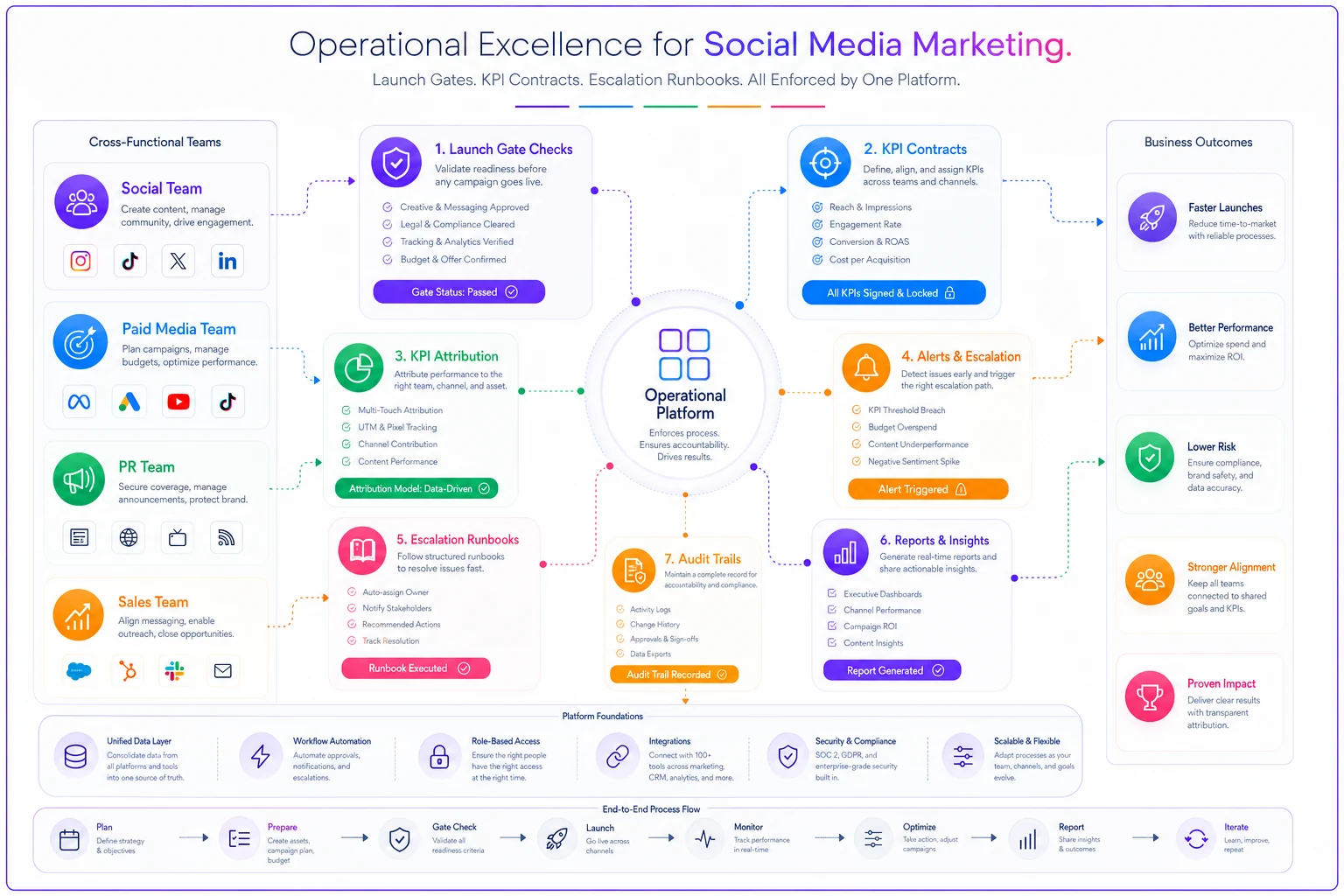
A properly configured platform can handle a lot of the manual enforcement work:
-
Block campaign launch until all gate requirements are checked off
-
Automatically calculate each team's contribution to shared KPIs using predefined attribution rules
-
Send escalation alerts when performance drops below 70% of target
-
Generate stakeholder reports pulling from multiple data sources
-
Maintain audit trails of all approvals and decisions
AI-assisted automation takes this further by monitoring for governance gaps before they become problems — flagging when creative assets haven't been uploaded 48 hours before launch, or when PR and Social messaging starts to diverge. It's not about replacing human judgment. It's about making sure your governance framework actually holds up when everyone's juggling multiple campaigns at once.
Strong governance tooling doesn't fix bad process, but it does make good process sustainable at scale.
The hidden cost of weak governance
Poor cross-functional campaign governance doesn't just cost you missed KPIs. An e-commerce brand I worked with lost roughly $180k in Q4 — not from bad campaigns, but from governance failures. It's worth breaking down because most of these costs are invisible until they've already happened.
-
$45k in wasted media spend when Sales couldn't handle lead volume from an unexpectedly successful campaign
-
$30k in rush creative costs when legal flagged issues three days before launch
-
$50k in lost revenue when inventory wasn't aligned with the marketing push
-
$35k in overtime and contractor costs to fix tracking post-launch
-
$20k in reputation management after conflicting messages went out across channels
They had talented people in every role. The governance agreements just weren't there, so those people kept colliding instead of coordinating. None of those line items feel like governance failures in the moment — they feel like one-off fires. But they're not.
When governance becomes competitive advantage
The best marketing teams don't win because they're more creative or have bigger budgets. They win because they can execute complex, multi-channel campaigns without dropping balls or burning out their teams.
Cross-functional campaign governance isn't glamorous, but it's the difference between teams that scale and teams that implode. Once you have clear RACI matrices, KPI contracts, launch gates, and escalation paths in place, campaigns start feeling repeatable rather than chaotic. Teams stop protecting their turf and start protecting the outcome.
The companies doing this well right now have turned governance into an operational edge. Their approval flows are clear and fast. Their KPIs are specific and owned. Their escalation paths are practiced and trusted.
Start with one campaign type. Build the governance framework, document what works, iterate on what doesn't, and expand from there. Within a quarter, you'll notice fewer fire drills and clearer accountability — and campaigns will actually hit their targets more often.
Governance isn't about control. It's about giving talented people the structure they need to do their best work together, and that's when marketing actually gets interesting.
Ready to amplify your brand’s voice?
Join 2,500+ marketers using Postyly to save time, boost engagement, and grow their audiences effectively.