

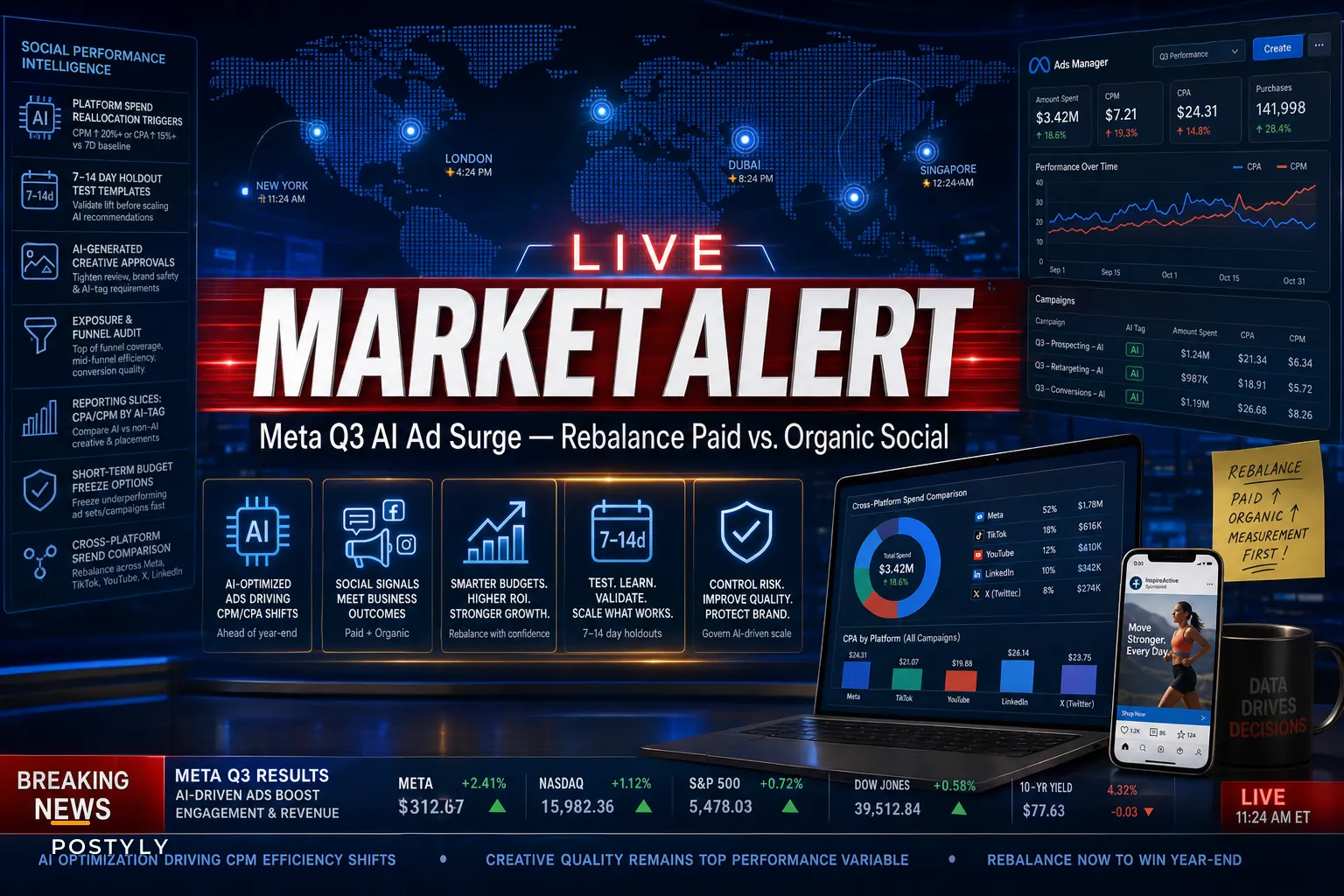

Meta just posted a quarter that's going to reshape a lot of budget conversations heading into next year. Ad revenue up roughly 26% year-over-year while Google's Search business grew around 12%—and most of the analysis pins the gap squarely on how fast advertisers adopted Meta's AI-driven ad tooling. A CNBC breakdown framed it plainly: AI is lifting Meta's ad machine while simultaneously chipping away at the old search-and-click discovery habit. People are spending more time inside Instagram and less time typing queries into a search box.
That's the headline. But if you own portfolio strategy or campaign ops, the headline isn't what you need to react to. The quieter operational shift underneath it is. The lever that used to drive your paid performance—your manual targeting skill, your lookalike stacking, your placement logic—is getting handed to an algorithm that decides most of it for you. And when that happens mid-planning-season, a lot of teams make the same mistake: they treat it as a budget reallocation problem when it's actually a measurement and control problem.
The budget math only works if you fix the measurement first.
The real shift isn't where the money goes—it's who's making the decisions
For years the paid vs. organic debate was mostly about allocation. How much to spend, which platform, which funnel stage. You could defend every dollar because you controlled the knobs: audiences, bids, placements, creative rotation.
AI-driven ad buying quietly removes most of those knobs. You feed it creative, a goal, and a budget, and it figures out the rest. On Meta properties that's producing real conversion lifts—which is exactly why spend is flowing there. But the uncomfortable part: when the platform optimizes the whole campaign, your reporting can't cleanly tell you why it worked. You lose the granular levers, and you also lose some of the attribution clarity you used to argue with.
What tends to happen in practice: a team sees CPA drop 15–20% after switching to the AI-optimized campaign type, declares victory, and shifts another chunk of budget over. Three weeks later CPMs creep up, the AI has exhausted the cheap audience pockets, and blended CPA quietly climbs back to where it started—except now there's more money riding on it and less organic activity feeding the top of the funnel.
The AI didn't lie. It optimized exactly what you told it to optimize, over the window it was measured on. The problem is the measurement window was too short and too isolated to catch the real cost.
Why organic gets quietly starved in this moment
The pattern that's most concerning about this particular surge: when paid performance improves fast, organic budget becomes the easiest thing to cut. It's harder to attribute, slower to show returns, and nobody's CPA dashboard lights up red when you pull a content producer off the schedule.
Stop managing your social media the hard way.
Postyly helps you plan, schedule, and analyze every post with precision.
- Multi-platform scheduling
- Real-time engagement tracking
- Automated performance reports
No credit card required
But the time-spent shift the CNBC analysis pointed to—people living inside Instagram rather than searching—cuts both ways. Yes, it means paid reach on those surfaces is more valuable. It also means organic presence on those same surfaces is where discovery is now happening. If search-driven discovery is softening, the organic content that used to be a nice-to-have is increasingly your replacement for the top-of-funnel traffic you used to get from blue links.
Teams rushing to defund organic to feed AI-optimized paid are, in a lot of cases, defunding the exact surface that's absorbing the discovery behavior they're now paying premium rates to reach through ads.
This is why treating paid and organic as one connected system rather than competing line items matters more now than it did a year ago. If you haven't built that muscle yet, the framework in our integrated paid-and-organic portfolio strategy is the baseline I'd start from before you touch a single budget cell this quarter.
A quick comparison: what you control now vs. before
Broadly speaking, the control model has flipped. Where targeting craft once separated good operators from average ones, that edge has largely been absorbed by the platform. What's left is creative strategy and measurement discipline—which sounds like less, but is actually harder to do well.
| Lever | Manual campaign era | AI-driven campaign era |
|---|---|---|
| Audience targeting | You built and stacked it | Mostly automated, broad inputs |
| Placement control | Granular, per-placement | Largely delegated to the system |
| Creative volume needed | Lower—targeting did the work | Higher—creative is the main input |
| Attribution clarity | Messier but legible | Cleaner surface, harder to explain |
| Where your skill matters | Targeting + bidding | Creative, measurement, holdouts |
| Biggest risk | Mis-targeting | Over-trusting short-window lift |
The right-hand column is where the real shift sits. Your value as an operator moved. It's no longer in the targeting craft—it's in feeding the system enough quality creative and building the measurement discipline to verify what the platform tells you. Teams that don't make that mental shift tend to either over-trust the AI or fight it. Both lose.
The validation step almost everyone skips
The single highest-value thing you can do right now costs very little and takes under two weeks: run short holdout tests against the AI's recommendations before you believe them.
Platform-reported lift is reported by the entity selling you the ads. That's not a conspiracy—it's just a conflict of incentive baked into the measurement. A proper holdout, where a slice of your audience or geo sees no paid exposure, is the only clean read on incremental impact.
-
Pick your top two AI-optimized campaigns by spend. Don't test everything—test where the money concentrates.
-
Hold out 10–15% of the addressable audience or a comparable geo for a 7–14 day window. Match it as closely as you can to the exposed group.
-
Freeze creative and budget during the window. If you change inputs mid-test you've learned nothing.
-
Measure incremental conversions, not platform-attributed ones. The gap between the two is your real signal.
-
Compare blended CPA across the whole window, not just the first few high-performing days.
-
Document the delta and decide the reallocation off the incremental number—not the dashboard number.
This usually surfaces one of two things: either the AI tool is genuinely pulling incremental conversions (great, fund it confidently), or a meaningful chunk of its "wins" were conversions that would've happened anyway. Both answers are worth knowing before you move year-end dollars.
Here's a quick visual of a tight holdout process.
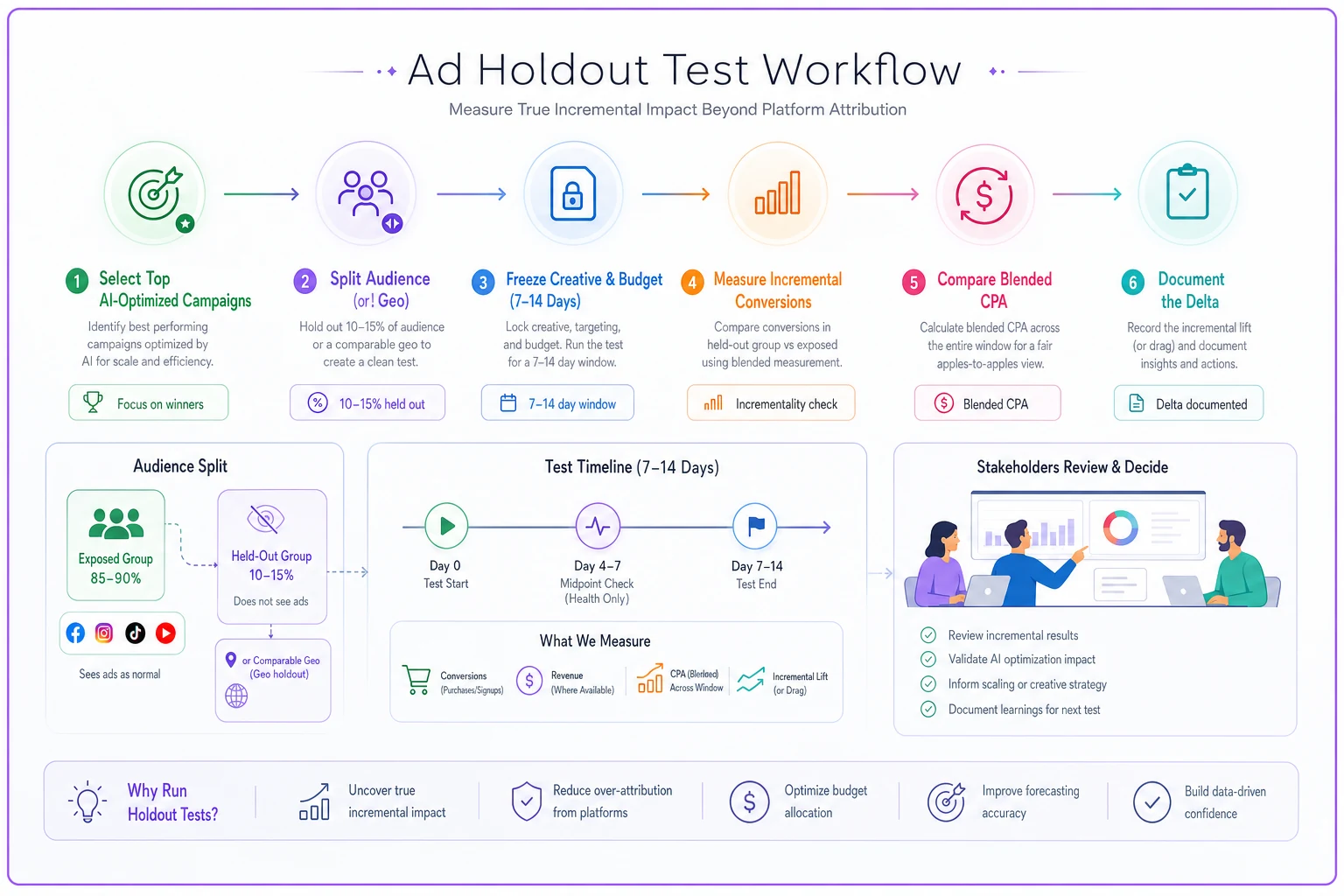
Use that visual to align stakeholders on the test steps and the cadence for measurement.
Creative becomes the bottleneck—plan for it
When targeting gets automated, creative volume becomes the constraint that actually governs performance. The AI needs variety to optimize against. Teams that fed five creatives into a manual campaign and did fine now find those same five starve an AI-optimized one.
That changes your production and approval operations more than your budget. You need more variants, faster—which means your approval SLAs and provenance tracking matter more, especially now that a lot of those variants will be AI-generated or AI-assisted. If you can't tell which creative was human-made versus generated, and you can't tell who approved what, you'll have a governance mess the first time a generated asset says something it shouldn't.
-
Tag every creative with its generation source (human, AI-assisted, fully generated)
-
Keep a versioning trail so you can trace what shipped
-
Tighten approval SLAs so creative volume doesn't blow past review
-
Flag any generated claim or stat for a human fact-check before it runs
-
Keep a "kill list" of generated phrasings or visuals that are off-brand or risky
Tagging every creative with its generation source prevents governance issues when volume scales.
None of this is glamorous. It's the stuff that prevents the 2 a.m. "why is this ad live" conversation.
AI-powered operational software can help here more than most teams expect. Platforms built around workflow management and content approval can centralize creative tagging, track version history, and enforce review steps automatically—so when volume scales, governance doesn't collapse under its own weight.
A real scenario
A mid-size DTC home goods brand—roughly $4M in annual revenue, small social team of three—shifted about 60% of their paid budget into Meta's AI-optimized campaigns in early fall after seeing CPA drop from around $38 to the mid-$20s in the first two weeks. Encouraged, they cut their organic content producer's hours to redirect spend.
By week five, two things had happened. Blended CPA had drifted back up to roughly $34 as the cheap audience pockets dried out, and organic reach—which had quietly been feeding a chunk of their branded search and direct traffic—dropped off enough that overall new-customer cost went up despite the paid dashboard still looking fine in isolation.
They ran a two-week geo holdout before year-end planning. The incremental lift from the AI campaigns was real but smaller than the platform claimed—closer to a 9–11% genuine improvement than the 30%+ the dashboard implied. They kept paid elevated but restored organic hours, and locked their next-year split off the incremental number. New-customer cost settled back down over the following month. Nothing dramatic—just a more honest read that stopped them from over-committing.
When leaning hard into AI-driven paid actually makes sense
There are real situations where shifting more weight toward AI-optimized paid is the right call. The conditions that tend to make it work:
-
You have the creative throughput to feed it (steady variant volume, not a trickle)
-
Your conversion events are clean and firing reliably
-
You can afford a short holdout to validate before scaling
-
Your organic presence is healthy enough to survive a budget shift
If those four things are true, the AI tools are worth leaning on. If even two of them are shaky, you're probably scaling on a foundation that'll crack under pressure.
When it's a bad idea
Some teams should pump the brakes entirely:
-
Your creative pipeline is thin and already strained
-
You're defunding organic on the same surfaces to pay for it
-
You're reading success purely off platform-reported lift
-
You're making the shift during your locked year-end plan without validation time
The last one catches more people than you'd expect. Locking a reallocation into a year-end plan based on two weeks of AI-reported lift, without any holdout, is how you end up defending a bad number in Q2 with no clean way to explain what happened.
Who should hold off entirely
If your top-of-funnel discovery still leans heavily on search and you haven't rebuilt any of that into social-native organic content, don't yank organic budget to chase the paid lift yet. You'll be cutting the thing that's supposed to catch the traffic the search decline is shedding.
This is also where operational software with centralized reporting can actually change the conversation. When paid and organic data live in separate dashboards, it's too easy to cut organic because it looks quiet—when in reality it's doing meaningful work that just doesn't show up in CPA columns. Centralizing that view, even roughly, forces a more honest budget discussion.
Where to land for year-end planning
The move this quarter isn't "shift everything to Meta's AI tools." It's letting the AI handle what it's good at, verifying it independently, and protecting the organic surface that's now doing double duty as your discovery engine. The budget decision is the last step, not the first.
Run the holdouts. Fund off incremental numbers, not dashboard numbers. Keep creative volume high and tagged. And resist the reflex to treat organic as the sacrifice that pays for paid—because on these surfaces, right now, they're feeding the same funnel.
The teams that come out of this planning season ahead won't be the ones who moved money fastest. They'll be the ones who could actually explain, with their own data, why they moved it.
Ready to amplify your brand’s voice?
Join 2,500+ marketers using Postyly to save time, boost engagement, and grow their audiences effectively.