

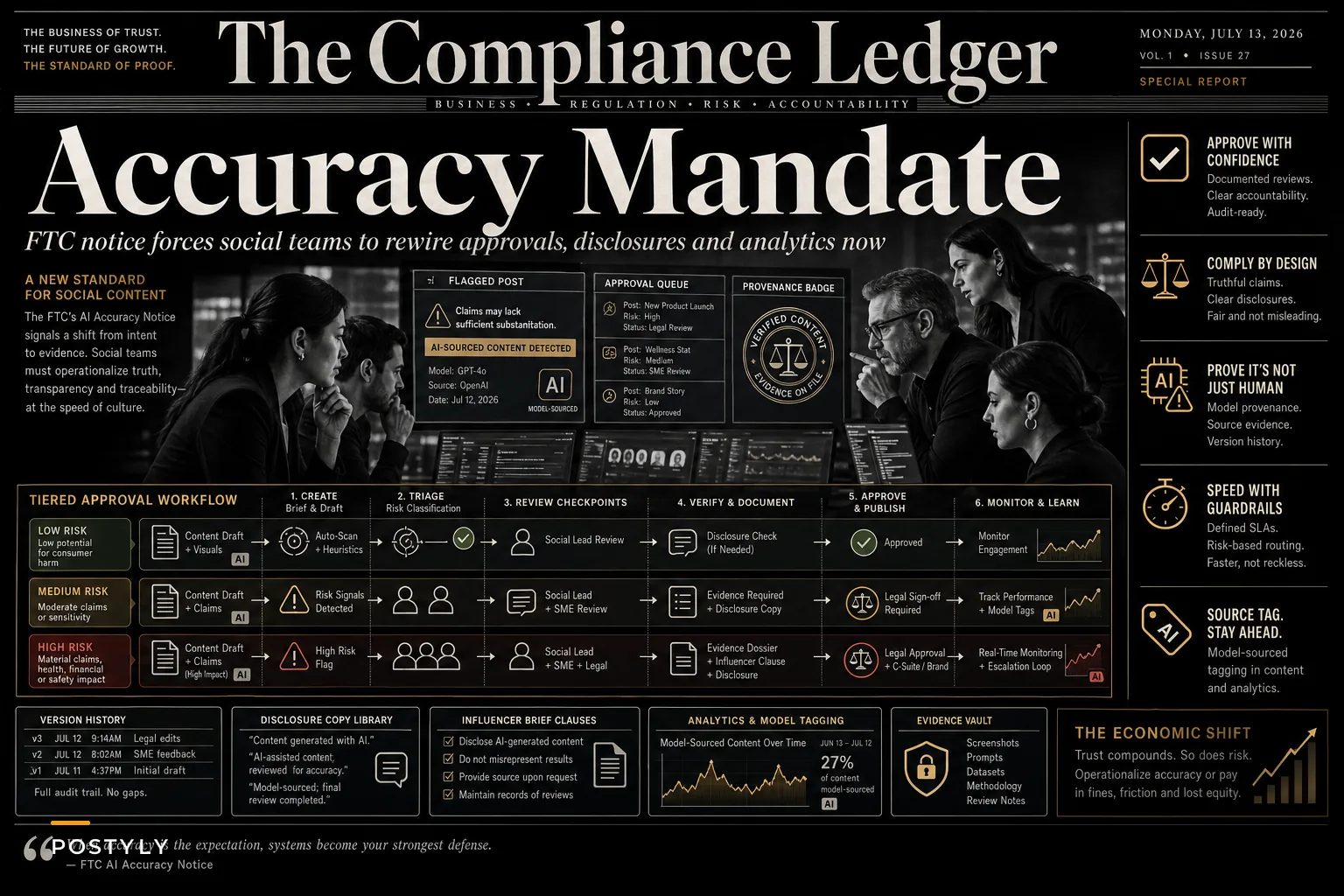

Social teams using AI for copywriting, image generation, or analytics just got a wake-up call. The FTC opened public comment on July 1st for a proposed policy statement addressing AI accuracy, with comments closing July 31st. The message is clear: AI-generated content that misleads consumers falls under existing deceptive practices rules.
This isn't theoretical. Brands publishing AI-written social posts, using AI for creative generation, or relying on AI-powered attribution models now face direct regulatory exposure. The FTC is essentially saying that if your AI tool writes a product claim that turns out false, or generates an image that misrepresents your service, you're on the hook — same as if a human copywriter made that mistake.
Every social team running AI-assisted campaigns needs to rebuild their approval workflows before enforcement starts. Not next quarter. Now.
FTC AI accuracy social media approval workflows need urgent restructuring
Your existing approval matrix probably routes AI-generated content through the same review process as human-created posts. That's now a compliance gap. AI outputs need additional verification steps that most teams haven't built yet.
Take a typical mid-size brand running 40-50 social posts weekly across platforms. Maybe 60% use AI for first-draft copy, another 20% use AI image generation, and everyone's using AI-powered analytics for attribution. Under the FTC's interpretation, each AI touchpoint needs documented accuracy checks.
The disclosure requirements alone multiply your workflow complexity. It's not just adding "#AIGenerated" to posts anymore. You need to track which specific AI tools touched each piece of content, maintain version histories showing human review, and document any accuracy verification performed. One fashion retailer discovered their AI copywriting tool had been subtly inflating product benefits across 200+ posts over three months. Under the new guidance, that's potentially 200 separate violations.
Legal will demand new approval gates. Marketing ops needs audit trails. Analytics teams must document their attribution methodologies. And someone needs to own the growing pile of compliance documentation.
The hidden measurement problem nobody's discussing
Beyond approvals and disclosures, there's a measurement problem brewing. AI-powered analytics platforms that social teams rely on for attribution and ROI calculations fall under this same accuracy scrutiny.
Stop managing your social media the hard way.
Postyly helps you plan, schedule, and analyze every post with precision.
- Multi-platform scheduling
- Real-time engagement tracking
- Automated performance reports
No credit card required
Consider how most teams measure campaign performance. You're probably using AI-enhanced tools to calculate earned media value, predict engagement rates, or attribute conversions across touchpoints. According to Reuters coverage of the announcement, the FTC specifically calls out situations where AI systems might suppress certain outcomes to avoid appearing biased — but that suppression itself could constitute deception.
What happens when your AI attribution model assigns conversion credit differently than a manual analysis would? Or when your sentiment analysis AI misreads sarcasm as genuine praise? These aren't edge cases. They happen constantly, and they now carry regulatory risk.
A consumer goods brand recently found their AI analytics platform was consistently overestimating organic reach by excluding negative engagement from calculations. The tool's documentation buried this detail in technical specs. Using those inflated metrics in investor presentations or performance reports — under the FTC's framework — could trigger enforcement action.
Building compliant workflows without destroying velocity
The knee-jerk reaction is to ban AI tools entirely or build approval processes so layered that nothing ships on time. Neither works. Social moves too fast, and AI has become too embedded in operations to rip out.
Smart teams are building tiered approval systems based on risk levels instead:
-
Low-Risk AI Usage (Grammar checking, hashtag suggestions, scheduling optimization): - Single reviewer approval - Spot-check audits weekly - Basic disclosure in content management system
-
Medium-Risk AI Usage (Copy generation for organic posts, basic image editing): - Two-person review required - Fact-checking against source materials - Public disclosure when AI substantially created content - Weekly accuracy audits on random sample
-
High-Risk AI Usage (Product claims, pricing information, testimonials, performance metrics): - Legal review for first instance of each template - Subject matter expert verification - Detailed versioning and edit history - Clear public disclosure - Daily monitoring for drift or hallucination
The key is building these checks into your existing operational flow rather than bolting them on after the fact. This connects directly to the permissioned approval flows framework we covered previously, but with AI-specific checkpoints added at each permission level.
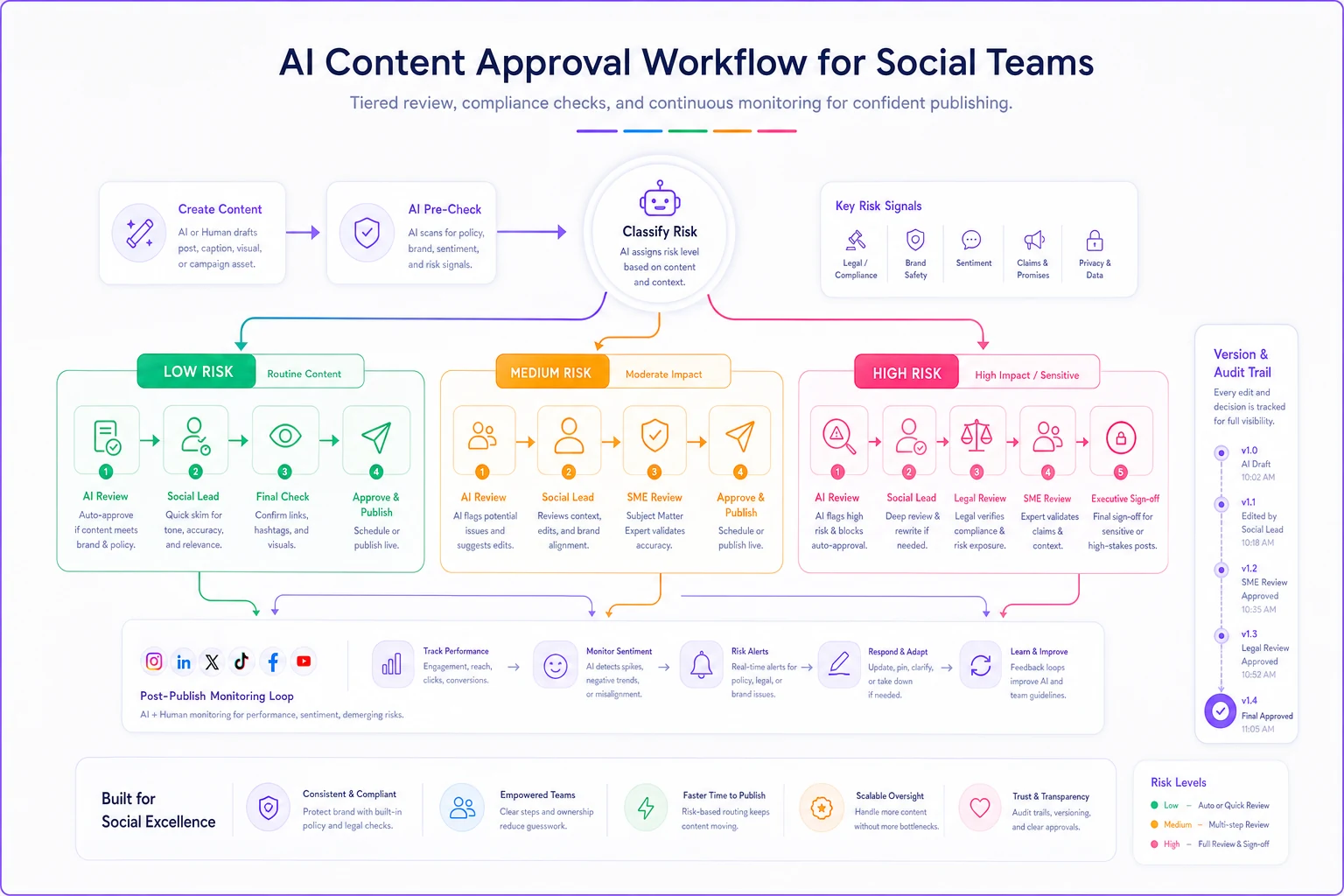
Here's a quick visual of how those tiers and gates fit together in a single workflow.
Prioritize legal review for first instances of high-risk templates to avoid widespread rework later.
This connects directly to the permissioned approval flows framework we covered previously, but with AI-specific checkpoints added at each permission level.
Disclosure templates that actually work at scale
Generic AI disclosures won't cut it. The FTC wants transparency about what AI did and how it might affect accuracy. But lengthy disclaimers on every post kill engagement fast.
Effective teams are developing modular disclosure systems:
-
"Draft created with AI assistance, reviewed by our team"
-
"Image edited using AI tools"
-
"Performance metrics calculated using automated analysis"
-
"Created with AI assistance for [specific element]"
These disclosures need to be:
-
Platform-appropriate (Twitter character limits vs Instagram caption space)
-
Consistent across campaigns
-
Trackable in your content management system
-
Legally reviewed quarterly
One travel brand created 15 different disclosure variations based on platform, content type, and AI involvement level. Engagement dropped about 3% initially but recovered within six weeks as audiences adapted. More importantly, they've documented compliance across 2,000+ posts.
Influencer briefs just got more complicated
Every influencer partnership now needs updated contracts addressing AI usage. Most creator agreements don't cover whether influencers can use AI for caption writing, image editing, or response generation.
The FTC guidance puts brands on the hook for influencer AI usage too. If a creator uses ChatGPT to write sponsored post copy that includes false claims, the brand faces liability. Same for AI-edited product photos or AI-generated testimonials.
Updated influencer contracts should specify:
-
Allowed vs prohibited AI tools
-
Required disclosures for any AI usage
-
Approval requirements for AI-assisted content
-
Indemnification clauses for undisclosed AI usage
-
Audit rights to verify compliance
Some brands are going further — providing approved AI tools and prompts directly to influencers. This standardizes output quality while keeping things compliant. One beauty brand created a private GPT instance trained on their brand guidelines and fact-checked product information. Influencers get consistent, compliant copy assistance; the brand keeps control.
Analytics documentation requirements
The measurement side might be the biggest operational shift. Every AI-powered analytics claim needs supporting documentation showing:
-
Methodology transparency — How the AI calculates metrics
-
Accuracy validation — Comparison to manual calculations
-
Limitation acknowledgments — What the AI can't measure
-
Update tracking — When algorithms change
-
Dispute resolution — Process for challenging results
Monthly performance reports need appendices now. Dashboard screenshots need footnotes. Case studies need methodology sections.
A retail brand spent three weeks documenting how their AI attribution model works, only to discover it was making assumptions about customer journey timing that couldn't be validated. They had to rebuild their entire measurement framework from scratch.
The pre-publish verification checklist
Before any AI-touched content publishes, run through this:
Content Accuracy:
-
[ ] All factual claims verified against source documentation
-
[ ] Product specifications match current database
-
[ ] Pricing information confirmed with sales system
-
[ ] Testimonials traced to real customers
-
[ ] Statistics linked to verifiable sources
AI Disclosure:
-
[ ] AI involvement level documented
-
[ ] Appropriate disclosure added
-
[ ] Disclosure visible without clicking "more"
-
[ ] Platform-specific requirements met
Approval Trail:
-
[ ] Required reviewers signed off
-
[ ] Version history preserved
-
[ ] Edit rationale documented
-
[ ] Legal review completed (if required)
Measurement Prep:
-
[ ] Baseline metrics recorded
-
[ ] Attribution methodology documented
-
[ ] Comparison group identified
-
[ ] Measurement limitations noted
Before any AI-touched content publishes, run through this:
Platform-specific compliance variations
Each platform interprets AI disclosure differently, which adds another layer of complexity:
-
Instagram Allows AI disclosure in first comment but recommends in-caption placement for sponsored content
-
TikTok Requires AI disclosure for filters/effects but is vague on copy generation
-
LinkedIn No specific AI disclosure requirements yet, but enforces accuracy in professional claims
-
Twitter/X Character limits make disclosure challenging; abbreviations are acceptable
-
Facebook Follows Instagram guidelines but stricter on AI-generated images in ads
-
YouTube Requires AI disclosure for realistic AI-generated video content
Track platform policy updates monthly. What's acceptable today might violate terms by next quarter.
Who actually owns compliance in your org?
Most teams are trying to answer this question right now, and it's harder than it sounds because AI touches every role. Social managers prompt the AI. Designers review generated images. Copywriters edit AI drafts. Analytics teams configure attribution. Legal reviews high-risk content. Ops maintains the tech stack.
Traditional accountability structures weren't built for this. A lot of teams are responding by appointing an "AI Accuracy Officer" — someone who understands both the technical and compliance sides. This person doesn't approve every post, but they design the workflows, train the team, and own the documentation.
In smaller teams, this tends to fall to ops managers who already handle approval workflows. They're extending existing systems to include AI checkpoints. The critical piece is giving them actual authority to pause campaigns when accuracy concerns come up — not just an advisory role.
Testing and monitoring for drift
AI tools drift. The model writing accurate product descriptions last month might hallucinate features today. Without monitoring, you won't catch problems until customers complain or regulators come knocking.
-
Weekly spot checks Random sample 10% of AI content for accuracy
-
Monthly deep dives Full audit of one campaign including all AI touchpoints
-
Quarterly tool reviews Verify AI platforms haven't changed their algorithms
-
Annual compliance audit External review of entire AI workflow
Document everything. When the FTC investigates, you want to show proactive compliance efforts — not scrambled reactions after the fact.
The operational reality check
A typical social team publishing around 200 posts monthly across five platforms now realistically needs:
| Operational reality check |
|---|
| 15-20 additional approval hours weekly |
| 3-4 new workflow documents |
| 10+ disclosure templates |
| 50+ pages of compliance documentation |
| 2-3 new tech tools for tracking |
| 1 dedicated compliance owner |
| 40+ hours of team training |
The temptation is to slow everything down. That kills effectiveness. The better path is building intelligence into your operational platform. AI-powered operational software can actually help with compliance — automatically flagging high-risk content, tracking disclosure requirements, maintaining audit trails without manual filing. The same AI creating exposure can reduce it when properly configured. Automated verification workflows catch mistakes before human reviewers see them. Intelligent routing sends high-risk content to the right approvers automatically.
Moving forward with confidence
The FTC's guidance isn't trying to kill AI in marketing. The full policy statement is establishing guardrails that probably should have existed already. Brands that build compliant workflows now will operate more smoothly when enforcement begins — and they'll look a lot better than competitors scrambling to retrofit compliance after the fact.
Start with your highest-risk content — paid social campaigns with specific product or pricing claims. Build approval workflows there first, then expand to organic content. Document everything. Train everyone.
The comment period closes July 31st, but don't wait for final guidance to act. The FTC's direction is clear. "We didn't know" won't be an acceptable defense once enforcement starts.
Your AI tools aren't going away. Neither are regulatory requirements. The winning approach is building operational systems that leverage AI's efficiency while keeping human oversight where it actually matters — focused on the claims most likely to trigger enforcement action, not rubber-stamping routine content that poses minimal risk.
Get ahead of this now and it becomes a competitive advantage. Wait until enforcement starts and you're playing expensive catch-up while your content calendar burns.
Ready to amplify your brand’s voice?
Join 2,500+ marketers using Postyly to save time, boost engagement, and grow their audiences effectively.