

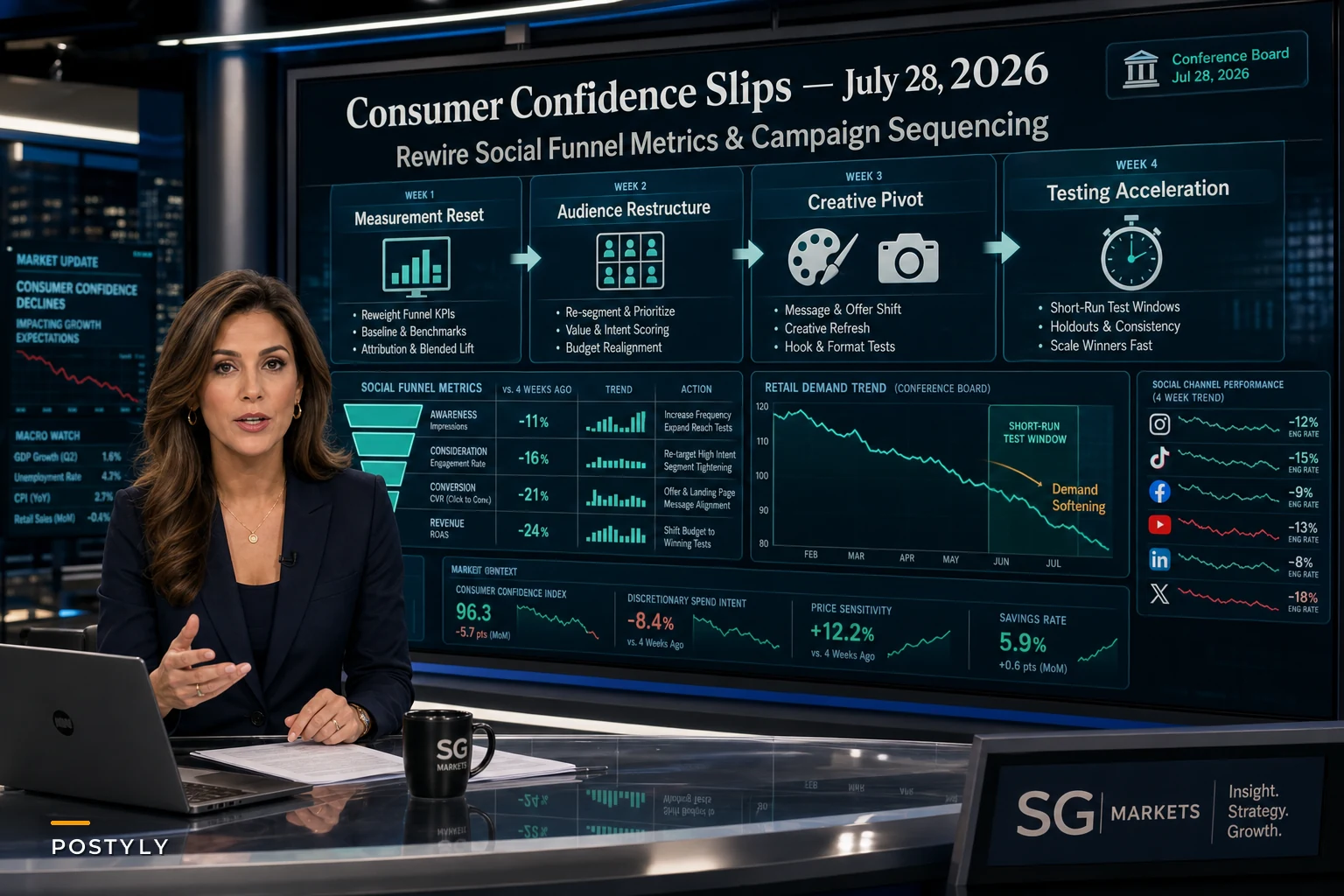

The Conference Board just dropped a number that should make every consumer brand marketer pause: consumer confidence fell to 90.8 in July, marking the third straight monthly decline. People are feeling worse about business conditions and their job prospects, and that shift shows up in how they shop.
For social teams managing consumer brands, this isn't just another economic indicator. A confidence drop this consistent changes which metrics actually matter and how you sequence content across paid and organic channels.
The mistake a lot of teams are making right now? Still optimizing for the wrong part of the funnel. Still measuring success like consumers are in expansion mode when the data says otherwise.
The metric mismatch hurting your ROAS
When consumer confidence slides, purchase consideration windows stretch from days to weeks. Yet most social teams keep reporting on 7-day attribution windows and top-funnel engagement metrics that worked fine six months ago.
During confidence dips, your audience sees your product post on Instagram, saves it, checks three competitor sites, reads reviews, waits for payday, asks their group chat, then comes back through a Google search two weeks later. Your attribution model misses that entire journey.
It hits harder for teams running mixed paid and organic. Organic posts do the heavy lifting across multiple touchpoints, but paid campaigns get all the conversion credit because they're running retargeting at the end. Your CFO sees paid social ROAS dropping and cuts budget, not realizing organic laid the groundwork.
A beauty brand I worked with during a previous downturn ran into this directly. Standard attribution showed paid social at 2.1x ROAS, down from 3.2x the quarter before. Panic mode. But when we extended attribution windows to 28 days and added view-through tracking for saved posts, the real picture came through—organic content was influencing over 60% of eventual conversions, just over a longer timeline.
Recalibrating your measurement stack for cautious consumers
The confidence shift demands a rethink of how you track campaign success. Standard engagement rates and click-through percentages tell you almost nothing about purchase intent when consumers are in protection mode.
Stop managing your social media the hard way.
Postyly helps you plan, schedule, and analyze every post with precision.
- Multi-platform scheduling
- Real-time engagement tracking
- Automated performance reports
No credit card required
Save rates over like rates. Saves indicate genuine purchase consideration, especially when wallets are tight. A post with 500 saves and 2,000 likes outperforms one with 5,000 likes and 100 saves in this environment.
Comment sentiment shifts. Watch for price-related questions, shipping concerns, and return policy inquiries. These spike during confidence drops. Track the ratio of price questions to product questions—when it crosses around 40%, your creative needs to address cost concerns upfront.
Cart abandonment sequences. Your social retargeting should mirror cart abandonment rates. When abandonment jumps 15% month-over-month, retargeting creative needs to shift from product benefits to trust signals and guarantees.
Multi-session conversion paths. Set up GA4 to track how many sessions happen between first social touch and conversion. During confidence dips, this typically jumps from 3–4 sessions to 7–9.
Add save rate to your main dashboard first—it's often the earliest signal of shifting consideration during dips.
Your reporting cadence needs adjustment too. Weekly performance reviews make less sense when your consideration window stretches to three weeks. Move to 14-day rolling averages for organic and 21-day attribution for paid.
The sequencing trap that burns budget
Most teams sequence campaigns assuming linear progression: awareness → consideration → conversion. Confidence drops create loops, not lines. Consumers bounce between consideration and evaluation repeatedly before they actually buy.
Traditional sequencing works like this:
-
Hero product video (awareness)
-
Feature carousel (consideration)
-
Discount offer (conversion)
Cautious consumers don't move through this cleanly. They need multiple trust touches before the discount even matters.
A confidence-adjusted sequence looks more like:
-
Social proof compilation (reviews, UGC)
-
Product in everyday context (not aspirational)
-
Comparison content (vs. alternatives)
-
Value breakdown (cost per use/wear/month)
-
Risk reversal (returns, guarantees)
-
Limited discount with urgency
The critical shift here is that you're no longer selling the product first. You're selling the safety of the purchase decision.
Micro-audience prioritization when broad targeting fails
Broad targeting efficiency crashes during confidence drops. The cost to convert a cold audience member who's already anxious about spending becomes prohibitive. Yet teams keep pumping budget into broad prospecting because that's what the media plan says.
The math is rough. If your broad CAC was $35 during good times and jumps to $58 during a confidence dip, but your loyal customer CAC only moves from $12 to $16, every extra dollar on broad targeting is essentially wasted.
A priority stack that actually holds up:
| Audience Tier | Message Focus | Budget Allocation |
|---|---|---|
| Previous purchasers (last 180 days) | Repeat purchase incentives, loyalty perks | 35–40% |
| High-intent browsers (cart adds, multiple site visits) | Objection handling, guarantees | 25–30% |
| Engaged social followers (saves, consistent engagement) | Exclusive access, community benefits | 20% |
| Lookalikes of recent purchasers only | Social proof, value demonstration | 10–15% |
| Broad prospecting | Testing only | 5% max |
Teams that maintain efficiency during confidence drops aren't the ones with the best creative. They're the ones who ruthlessly prioritize warm audiences and accept that growth will come from depth, not breadth.
Creative pivots that match consumer mindset
Creative that performed well during optimistic periods becomes tone-deaf during a confidence slide. Aspirational lifestyle content feels disconnected. Premium positioning feels out of touch.
A home goods brand shifted this well. Their standard creative featured gorgeous, minimalist spaces with products as accent pieces—beautiful, aspirational, completely wrong for the moment. Their confidence-adjusted creative showed products in realistic, lived-in spaces, featured actual customer homes instead of staged shoots, highlighted durability over style, included price-per-year-of-use calculations, and leaned on testimonials focused on value rather than satisfaction.
The performance difference was notable. Aspirational creative dropped to 0.8% CTR while practical creative held at 2.1% through the dip.
Swapping creative themes isn't enough though. The entire narrative structure needs to shift from "imagine your best life" to "protect what matters."
Testing velocity becomes survival
During stable confidence, you can run month-long creative tests and get clean results. During volatile periods, that cycle is too slow. By the time you have significant data, consumer sentiment has already shifted again.
3-day pulse tests for message resonance
-
Minimum spend
$50/day per variant
-
Success metric
engagement rate and save rate only
-
Decision point
kill or scale to 7-day test
7-day conversion tests for winning messages
-
Minimum spend
$150/day per variant
-
Success metric
cost per conversion, not ROAS
-
Decision point
graduate to evergreen or iterate
Daily creative refreshes for retargeting
-
Swap creative every 2–3 days
-
Test urgency messages vs. trust messages
-
Monitor frequency to prevent fatigue
The platforms' automated optimization works against you during confidence shifts. Their algorithms optimize for historical patterns, but consumer behavior is changing faster than the models can adapt. Manual testing and rapid iteration beat algorithmic optimization during volatile periods.
Building your confidence-adjusted operations
Shifting your social operation for confidence changes can't happen overnight. A phased approach tends to work better than trying to overhaul everything at once.
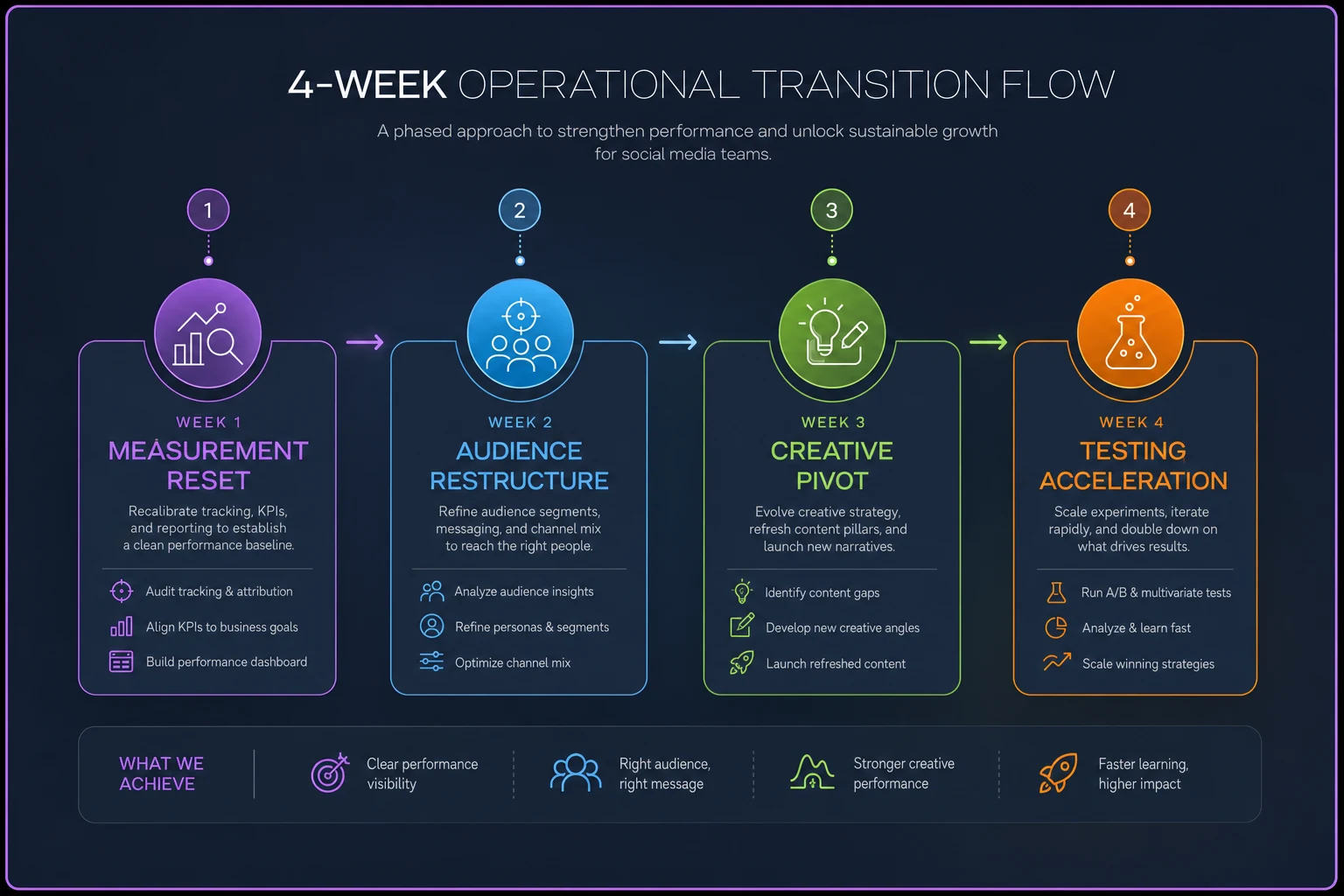
Here's how each week should be structured:
-
Week 1
Measurement reset
- Extend attribution windows in your analytics - Add save rate tracking to your reporting dashboard - Set up multi-touch attribution if you haven't already - Brief your team on the new success metrics -
Week 2
Audience restructure
- Audit current audience targeting - Calculate CAC by audience segment - Reallocate budget toward warm audiences - Pause underperforming broad campaigns -
Week 3
Creative pivot
- Develop trust-focused creative variants - Test practical vs. aspirational messaging - Add price transparency to your content - Build social proof compilations -
Week 4
Testing acceleration
- Implement 3-day pulse test framework - Set up daily creative rotation for retargeting - Document winning messages for scale - Create iteration templates for speed
The teams that navigate confidence drops don't wait for perfect data or complete overhauls. They make rapid, incremental adjustments based on early signals, then build from there.
The measurement framework that actually predicts performance
Traditional funnel metrics assume consistent consumer behavior. Confidence changes break that assumption. You need a dynamic approach that adapts to shifting patterns rather than static KPIs that made sense six months ago.
Track ratio changes instead:
-
Save-to-purchase ratio
When this extends beyond 20:1, your consideration content needs to work harder
-
Comment-to-conversion ratio
If comments spike but conversions don't follow within 14 days, you have a trust problem, not an interest problem
-
Return visitor rate
During confidence drops, this should increase as consumers research more thoroughly
-
Cross-platform touchpoints
Track how many different platforms a converter interacts with before purchase
These ratios give you early warning signals that standard metrics miss entirely. One beauty brand noticed their save-to-purchase ratio jump from 12:1 to 31:1 over two weeks—well before revenue metrics showed any decline. That early signal let them adjust retargeting proactively instead of scrambling after the fact.
Your funnel-to-metric matrix becomes even more critical during confidence shifts, but the weights and importance of each stage change significantly. Top-funnel metrics matter less, while mid-funnel consideration signals become your primary optimization points.
When automation helps and when it doesn't
Confidence-driven pivots create more manual work exactly when teams are under pressure to do more with less. Strategic automation can make a real difference here—but most teams automate the wrong things. They automate posting schedules when they should be automating response patterns. They use AI for creative generation when sentiment analysis would serve them better.
Sentiment monitoring at scale is genuinely useful. Tracking comment sentiment shifts across organic content helps identify which messages actually resonate with cautious consumers. When negative sentiment about price crosses around 30%, creative needs immediate adjustment—and catching that manually across dozens of posts every day isn't realistic.
Dynamic budget allocation rules are worth building too. If broad targeting CAC exceeds 150% of your target, automatic reallocation to retargeting removes a delay that costs real money. Same with content performance pattern recognition—AI-powered platforms can surface which creative formats underperform during pessimistic periods faster than any manual audit.
The best results come from using automation for repetitive analysis and optimization tasks, freeing up human judgment for message development and strategy. It's not about replacing decisions. It's about making faster, better-informed ones.
The next 90 days: your confidence contingency plan
Consumer confidence doesn't flip overnight. It slides gradually, then suddenly. Teams that maintain performance through these shifts have contingency plans ready before they need them.
-
Days 1–30
Foundation setting
- Establish baseline metrics for the current confidence level - Set up extended attribution tracking - Create warm audience segments - Develop trust-focused creative variants -
Days 31–60
Active testing
- Run pulse tests on new messaging - Compare practical vs. aspirational creative performance - Test shortened vs. extended consideration sequences - Document winning patterns for scale -
Days 61–90
Systematic optimization
- Scale winning approaches across all campaigns - Reduce budget waste on underperforming segments - Build automated rules for future confidence shifts - Create playbooks for different confidence scenarios
The mistake most teams make is treating confidence drops as temporary blips instead of fundamental shifts requiring operational change. The brands that grow during uncertain times don't just weather the storm—they rebuild operations to perform in the new reality.
Consumer confidence will recover eventually. It always does. But the teams that adapt quickly don't just survive the downturn—they pick up market share from competitors still running yesterday's playbook. The question isn't whether consumer confidence affects your social performance. It's whether you'll adapt fast enough to maintain momentum while others are still trying to figure out why their campaigns stopped working.
Ready to amplify your brand’s voice?
Join 2,500+ marketers using Postyly to save time, boost engagement, and grow their audiences effectively.