

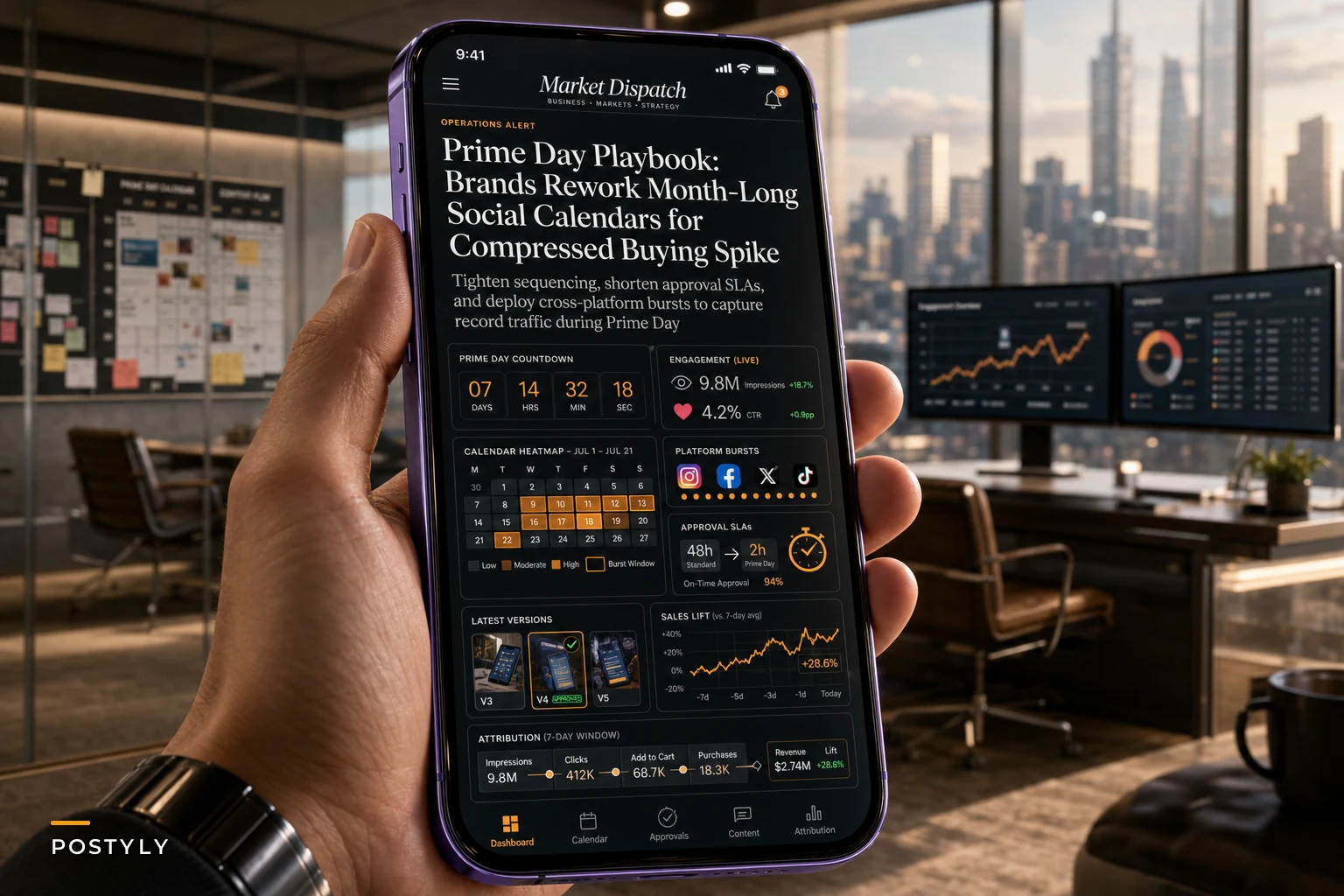

Adobe just released their Prime Day analysis showing $26.3 billion moved through US e-commerce in four days. Day one alone hit $8.3 billion. At this point it's less of a shopping event and more of a compressed Black Friday dropping in the middle of June.
For social media managers, that's an operational problem most teams aren't built to handle. You're managing 15x normal engagement volume while pushing creative at 3x speed, and your approval chain is still running at regular-season pace. The brands that actually captured share during this weren't the ones with the best graphics. They were the ones whose operations could handle the velocity without falling apart.
The velocity problem nobody talks about
Most teams build their Prime Day strategy around creative and messaging. Makes sense. But after watching a lot of brands fumble their execution, the real bottleneck almost never comes from the creative side—it comes from operational throughput.
Think about what actually goes on during Prime Day week. Your community manager is buried in DMs about stock levels. Paid media needs seventeen versions of the same creative approved immediately. The influencer you locked in three weeks ago suddenly wants to shift their posting schedule. And through all of that, you're still supposed to hold posting cadence across six platforms while tracking real-time performance.
The standard playbook—content calendar, scheduled posts, monitor engagement—breaks down fast under that kind of pressure. You need systems designed for surge capacity, not steady-state operations.
Building your surge-ready operational framework
Phase 1: The 30-day runway mapping
Stop managing your social media the hard way.
Postyly helps you plan, schedule, and analyze every post with precision.
- Multi-platform scheduling
- Real-time engagement tracking
- Automated performance reports
No credit card required
Flip your normal content planning process. Instead of building forward from today, work backward from your peak conversion windows. If Prime Day runs June 23-26, your highest-value content needs to be live June 20-22. Not during—before.
Pre-surge (Days -30 to -7)
-
Educational content about deals structure
-
Category primers and buying guides
-
Early access teasers for email subscribers
-
Influencer partnership announcements
Acceleration phase (Days -6 to -1)
-
Deal previews with specific savings amounts
-
Cart-building content showing bundles
-
FOMO messaging around limited quantities
-
Platform-specific countdown content
Peak surge (Days 0 to +3)
-
Flash deal announcements
-
Stock level updates
-
Customer proof posts
-
Real-time engagement responses
The mistake most teams make is treating all three phases with equal resource allocation. Your acceleration phase needs roughly 3x the creative volume of pre-surge, and peak surge needs another 2x on top of that.
Phase 2: Approval chain optimization
Normal approval workflows assume people have time to review, give feedback, and go back and forth. During Prime Day, that window disappears. You need pre-cleared creative frameworks that let you move without second-guessing brand guidelines every single time.
Build a tiered approval matrix:
| Creative Type | Pre-approval Required | Real-time Authority | Max Turnaround |
|---|---|---|---|
| Price updates | Legal only | Social manager | 30 minutes |
| Stock alerts | None | Community team | Immediate |
| Flash deals | Brand + legal | Paid media lead | 2 hours |
| Influencer content | Brand only | Partnerships manager | 4 hours |
| Crisis response | Legal + PR | Director level | 1 hour |
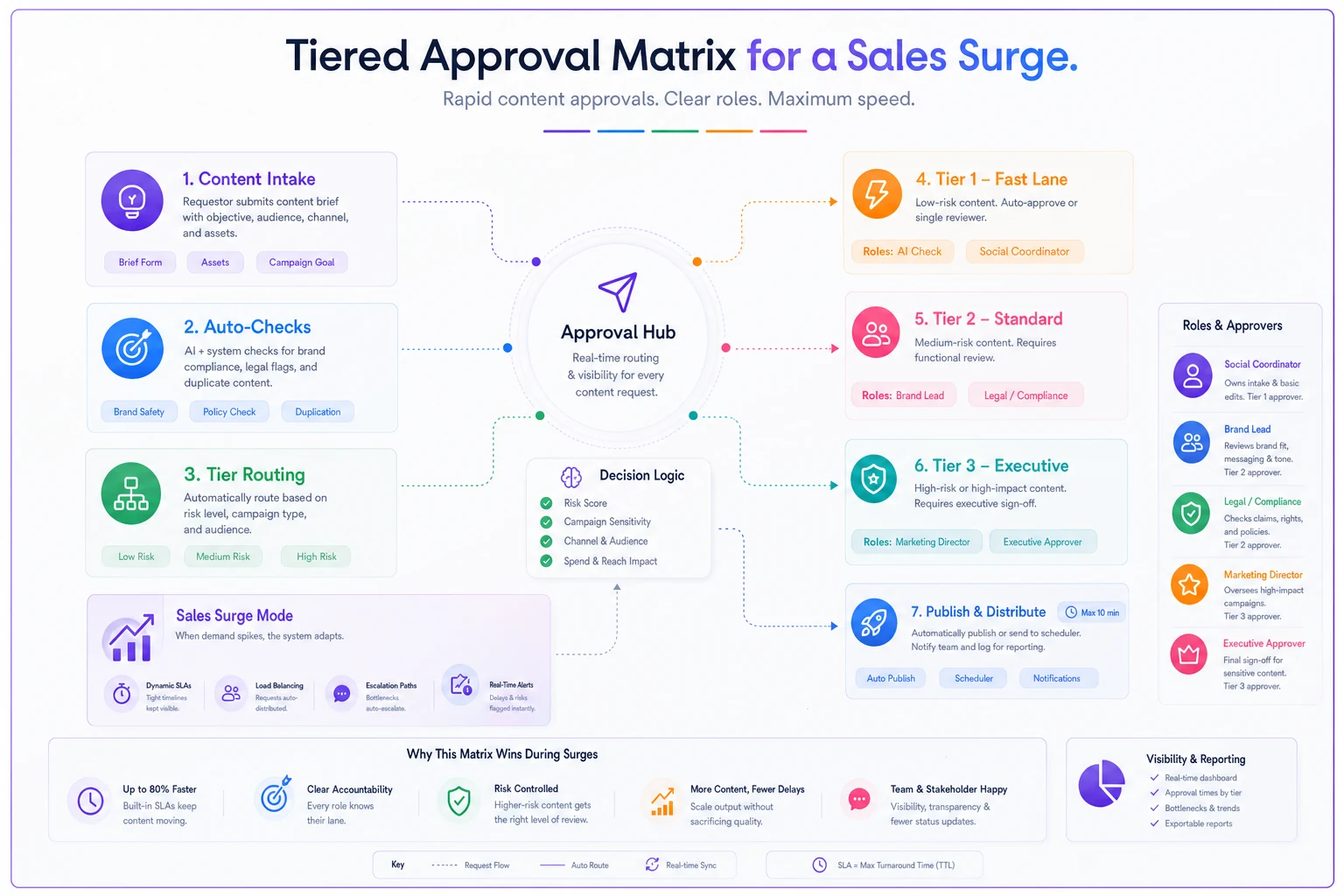
Notice what's not in there—no creative director loop, no CMO sign-off, no revision rounds. During a surge, chasing perfection kills conversion.
Get templated creative shells built for your top 20 message types. Pre-approve them with blanks for specific details. When you need to push a "48-hour flash sale on category X" message, you're filling in variables, not starting a new approval request from scratch.
Phase 3: Cross-platform sequencing without fatigue
Blasting the same message across every platform at once sounds efficient. It's not. You'll reach everyone once and then spend the rest of the week being ignored. Smart sequencing means working with platform-specific behaviors instead of flattening everything into one big push.
Email → Instagram → Facebook → TikTok → Twitter → Pinterest
Start with owned channels where you control timing completely. Email subscribers get first access—that insider advantage matters. Instagram Stories go live two to three hours later, catching the morning scroll. Facebook hits mid-day when desktop usage peaks. TikTok drops during evening hours. Twitter threads summarize for overnight and next-day discovery.
Each platform needs a different angle on the same core message:
-
Email
Full deal details with direct links
-
Instagram
Visual proof and social validation
-
Facebook
Detailed explanations and community discussion
-
TikTok
Behind-the-scenes and entertainment angle
-
Twitter
Quick updates and customer service
-
Pinterest
Inspiration boards and wish list building
Staggered sequencing keeps you present without burning out any single audience.
Real-time monitoring that actually works
Your normal social listening setup won't cut it during Prime Day. You need to be specific about what you're tracking and who's responding.
Build three monitoring streams:
Revenue-impact mentions
Keywords signaling purchase intent, cart abandonment, or technical issues. These get immediate response, even if it means pulling someone off content creation for a bit.
Competitor movements
Not to copy—to find gaps. When a competitor's deal sells out, you push your alternative. When they hit technical problems, you lean into your smooth checkout experience.
Sentiment shifts
Not just positive/negative, but what's actually triggering the emotion. Frustration around shipping? Lead with your delivery speed. Excitement about savings? Amplify the percentage-off angle.
Assign a single inbox per stream so owners see priority messages at a glance.
Assign specific people to each stream. No overlap, no ambiguity about who responds to what. During surge periods, role clarity matters more than flexibility.
The day-after window everyone ignores
Most teams are completely burned out after Prime Day ends. Understandable. But the 72 hours post-event are genuinely one of the better windows for capturing share from competitors who fumbled their execution.
Extended access content: "Missed Prime Day? We extended these three deals just for our followers"
Social proof compilation: Screenshots, testimonials, and customer UGC from the surge
Inventory clearance: Items that underperformed, reframed as post-Prime opportunities
This only works if you plan for it in advance. Designate team members specifically for post-event execution during your surge prep phase. Keep them out of the main surge battle so they actually have energy for the follow-through.
Integrating AI automation without losing authenticity
The teams consistently winning on Prime Day aren't grinding through it manually. They're using AI-powered operational software to absorb volume without sacrificing quality—not to replace human judgment, but to get rid of the repetitive tasks that slow everything down.
Automation handles things like:
-
Resizing creative for different platform specs
-
Scheduling across time zones
-
Flagging high-priority customer messages
-
Generating copy variations for A/B testing
-
Tracking inventory and triggering stock alerts
It's about freeing people to focus on strategy and real-time decisions instead of spending energy on mechanical tasks.
For teams running these surges regularly, having an operational platform that centralizes your content calendar, approval workflows, and performance data makes a real difference. Jumping between seven tools to publish one campaign during peak hours adds up fast. The right content planning system removes those friction points before they become actual bottlenecks.
Common failure points
The creative bottleneck trap: Three weeks perfecting creative, zero time for operational testing. Lock creative two weeks out. Use the final week for dry runs.
The all-hands panic: Pulling everyone into social during the surge leaves regular operations unattended. Keep a reserve team on business-as-usual.
Platform favoritism: Over-indexing on Instagram because it's comfortable, while missing TikTok virality entirely. Every platform needs dedicated attention during a surge.
Metrics blindness: Tracking impressions while missing conversion signals. Build your dashboard around revenue-correlated metrics only.
Your pre-surge checklist
30 days before:
-
[ ] Map backward calendar from peak days
-
[ ] Create approval matrix with named authorities
-
[ ] Build creative template library
-
[ ] Assign monitoring stream owners
-
[ ] Set up automation tools
-
[ ] Schedule operational dry run
14 days before:
-
[ ] Lock all Tier 1 creative
-
[ ] Complete influencer agreements
-
[ ] Test approval chain speed
-
[ ] Verify platform access for all team members
-
[ ] Create crisis communication templates
7 days before:
-
[ ] Final creative approved and uploaded
-
[ ] Team schedules locked (no vacations)
-
[ ] Customer service scripts distributed
-
[ ] Inventory tracking systems verified
-
[ ] Competitive monitoring active
24 hours before:
-
[ ] All hands briefing
-
[ ] Final system checks
-
[ ] Early access emails sent
-
[ ] First wave content live
-
[ ] Monitoring stations active
All hands briefing; Final system checks; Early access emails sent; First wave content live; Monitoring stations active
The difference between scrambling and scaling
Teams that consistently come out of Prime Day with real results tend to share the same traits. They treat it as an operational challenge, not just a creative one. They build for surge capacity instead of hoping steady-state systems will stretch far enough. And they use automation to handle volume so human judgment stays focused on strategy.
The Adobe data makes clear that $26.3 billion doesn't distribute evenly. It concentrates around brands that can actually meet the moment operationally. Your creative can be strong and your deals aggressive, but if you can't hold velocity when the surge hits, you're handing share to whoever can.
The same operational principles apply to every flash sale, product launch, and viral moment, not just Prime Day. The question isn't whether another surge is coming—it's whether your systems will be ready when it does.
The Adobe data makes clear that $26.3 billion doesn't distribute evenly. It concentrates around brands that can actually meet the moment operationally. Your creative can be strong and your deals aggressive, but if you can't hold velocity when the surge hits, you're handing share to whoever can.
The same operational principles apply to every flash sale, product launch, and viral moment, not just Prime Day. The question isn't whether another surge is coming—it's whether your systems will be ready when it does.
Ready to amplify your brand’s voice?
Join 2,500+ marketers using Postyly to save time, boost engagement, and grow their audiences effectively.