

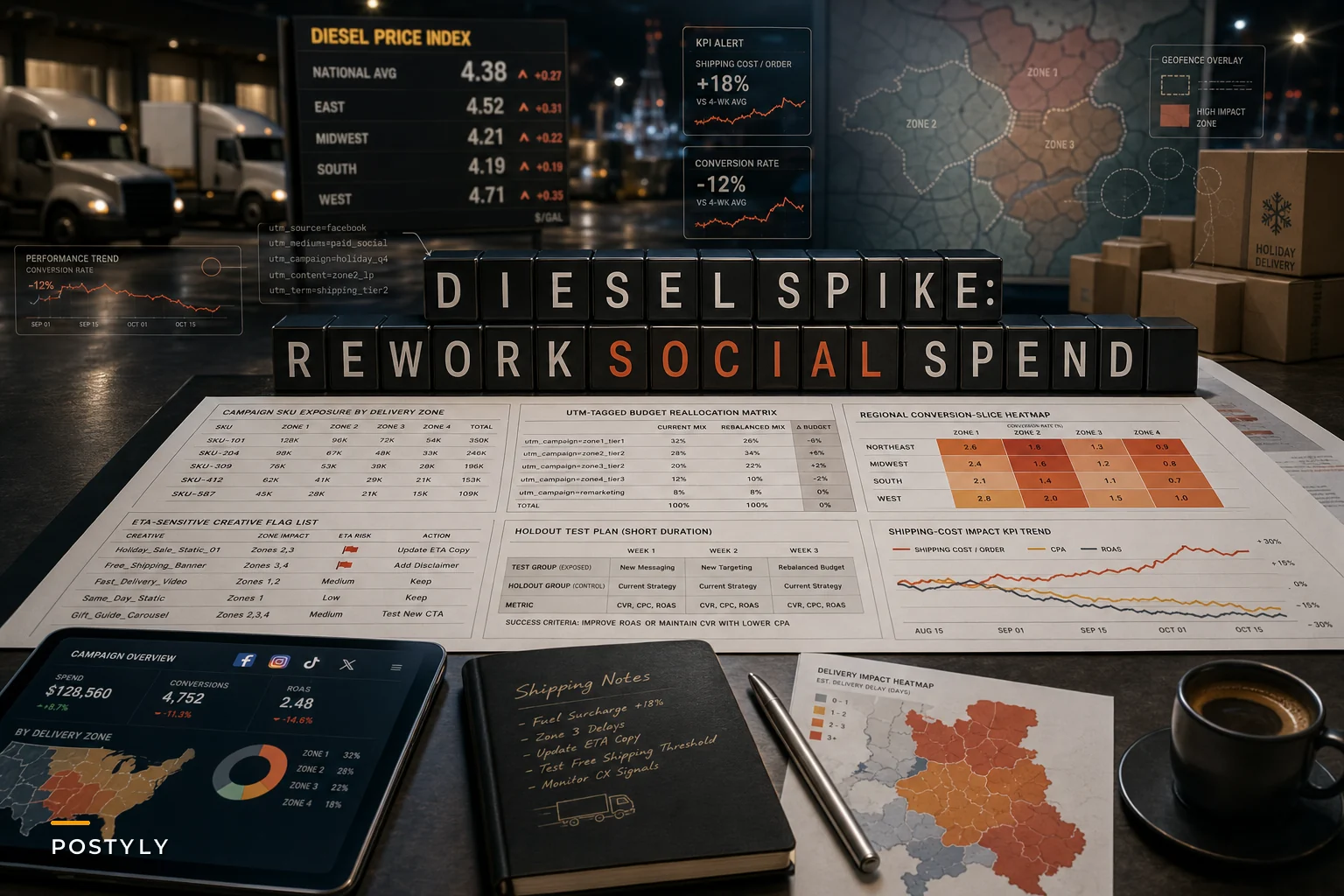

Diesel is the quiet variable most social teams never factor into their campaign plans. That changes this quarter. Reuters reported that the global diesel shortage is likely to stretch into 2027 as storage tanks drain, and CNBC laid out how record diesel prices are set to ripple through the U.S. economy — including the trucks and vans moving holiday orders to front doors.
For most marketers, this reads like a logistics problem. It isn't. It's a campaign problem wearing a logistics costume. When freight and last-mile delivery get more expensive and slower, the promises baked into your ad copy — "free shipping," "arrives by Dec 22," "order today, get it this week" — quietly become liabilities. And the places where you're spending the most ad dollars might be exactly where fulfillment is about to get ugly.
So let's work through what actually breaks, in what order, and how to rework the parts of your campaign stack you control before the holiday traffic hits.
Start by finding your shipping-exposed campaigns — not your shipping-exposed products
When most teams hear "shipping costs are going up," they immediately start looking at the product catalog. Heavy stuff, bulky stuff, low-margin stuff. Reasonable instinct, wrong first move for a social team.
The first thing to audit is your live and scheduled campaigns, cross-referenced against two things: the SKUs they promote and the geographies they target. A product being shipping-sensitive only matters if you're actively spending money pushing it into a region where delivery is getting slower or more expensive.
Here's the distinction that matters. You might have 400 shipping-heavy SKUs in your catalog, but only 12 are featured in active paid campaigns right now. Those 12 are your real exposure. Everything else is theoretical.
A quick way to map this:
| Campaign | Featured SKU type | Primary geo-targets | Shipping risk | Action |
|---|---|---|---|---|
| Holiday Gift Guide – Paid Social | Mixed, some bulky | National | Medium | Add regional ETA copy |
| "Free 2-Day" Retargeting | Small, high-margin | National | Low | Keep running |
| Furniture Flash Sale | Heavy, low-margin | Rural + remote ZIPs | High | Pause or add realistic ETAs |
| Local Pickup Promo | All in-stock | 25-mi store radius | None | Increase budget |
That last row is the one teams consistently overlook. Rising delivery costs don't just create problems — they make local and in-store-fulfillable offers more valuable, almost overnight. More on that in a bit.
The real problem: your ad promises and your fulfillment reality drift apart
The underlying issue isn't diesel. It's a coordination gap that already exists in most retail marketing operations and only becomes visible under stress.
Stop managing your social media the hard way.
Postyly helps you plan, schedule, and analyze every post with precision.
- Multi-platform scheduling
- Real-time engagement tracking
- Automated performance reports
No credit card required
In normal conditions, marketing writes "ships free, arrives in 3–5 days," ops quietly makes it happen, and nobody talks. The copy and the carrier reality stay roughly aligned because there's slack in the system. When freight costs spike and transit times stretch, that slack disappears. Suddenly the copy written six weeks ago in a scheduling tool is making a promise the warehouse can no longer keep.
What comes up repeatedly across e-commerce operations is that nobody actually owns the connection between delivery messaging and delivery capability. The social manager assumes the ETA in the creative is still accurate. Ops assumes marketing will update copy if something changes. Neither checks, because there's no process that forces the check.
This is why shipping disruptions hurt social performance in a way that looks confusing from the dashboard. Your CTR holds, your reach holds, but conversions soften in specific regions and your DMs fill up with "where's my order" and "why does this say 7–10 days now." You're paying full price for clicks that land on a promise your logistics can't honor.
The symptom you'll actually notice first
It usually shows up as a regional conversion dip that doesn't match your creative performance. The ad is doing fine. The landing page is fine. But conversion in the Mountain West or rural Southeast is down 15–20% compared to coastal metros, and nobody can explain it from the creative side. That gap is almost always a shipping cost or delivery-time problem surfacing as a marketing metric.
If you're not slicing conversion by region and shipping tier, you won't catch this until the complaints pile up.
Build shipping visibility into your analytics before you touch budgets
Before reallocating a dollar, instrument the thing you're trying to measure. Otherwise you're guessing.
A lightweight version of this doesn't require a data team:
-
Add a shipping-tier dimension to your UTMs or campaign naming. Tag campaigns that feature shipping-sensitive SKUs so you can isolate them later.
-
Create a region slice in your conversion reporting. Group by delivery zone, not just state — rural vs. metro matters more than broad geography for last-mile cost.
-
Track a "delivery-concern" signal from social. Volume of shipping-related DMs, comments, and replies per campaign. This is a leading indicator; it moves before conversion does.
-
Flag ETA-sensitive creative. Any ad or organic post that names a specific delivery date or "free shipping" gets tagged so you can pull or edit it fast.
-
Set a weekly review. During Q4, check regional conversion against shipping tier every week, not monthly.
Teams that handle disruption well aren't necessarily smarter — they just have faster feedback loops. When your reporting can answer "which regions are softening on shipping-heavy SKUs" in ten minutes instead of two days, you make calmer decisions.
Quick visual: a simple workflow helps get everyone on the same page before the problems scale.
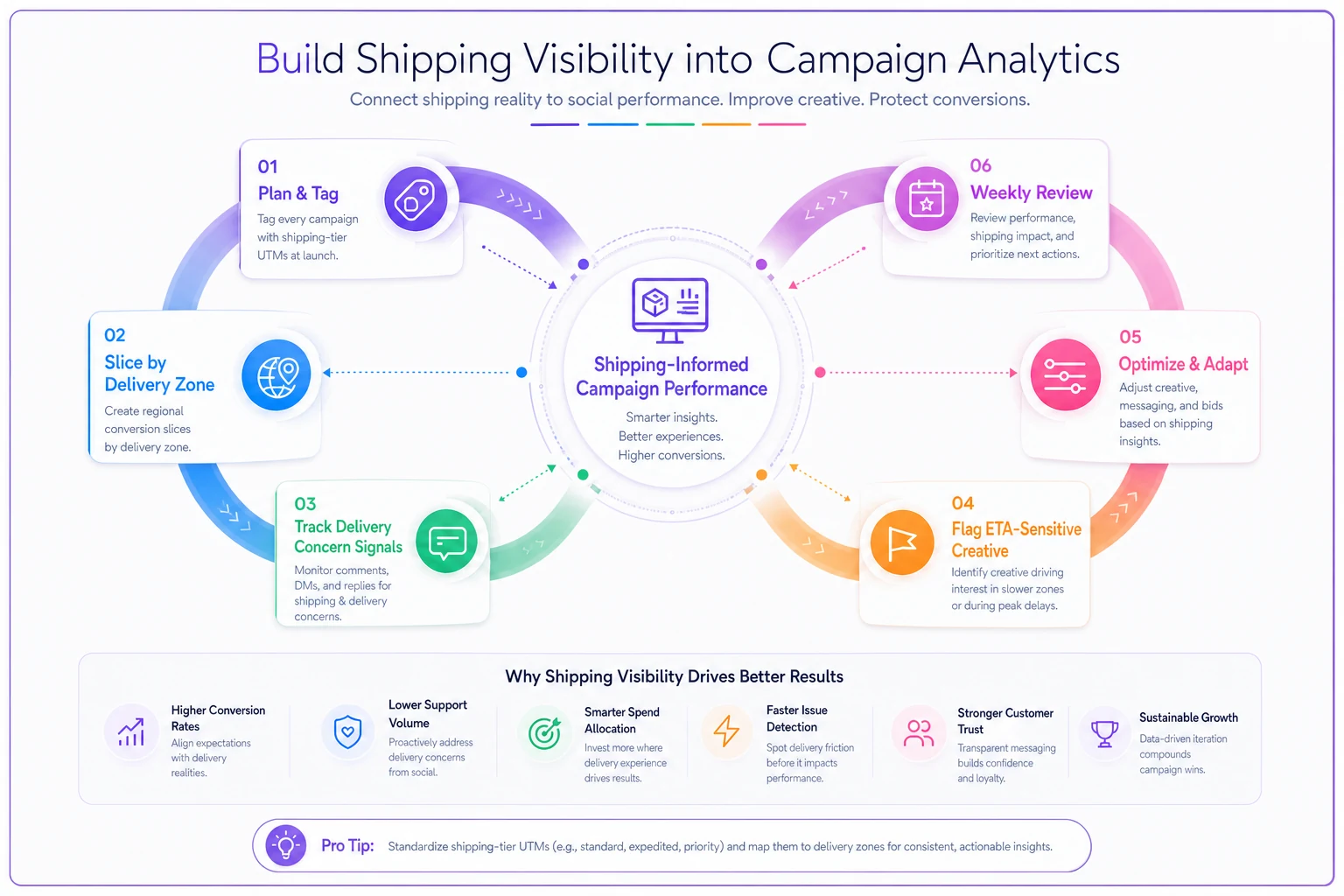
When your reporting can answer the right shipping questions fast, you stop making budget moves based on guesses.
Reallocating budget: lean toward what you can actually fulfill
Once you can see where delivery risk lives, the budget logic gets simpler. Shift spend toward offers that are cheap or safe to fulfill, and away from offers that are now expensive, slow, or risky.
In practice that tends to look like:
-
Up-weight high-margin, small-parcel SKUs. They absorb rising shipping costs without wrecking unit economics, and they ship fast.
-
Up-weight local pickup, BOPIS, and in-store offers in regions where last-mile delivery is deteriorating. A "reserve online, pick up today" campaign bypasses the diesel problem entirely.
-
Down-weight paid spend on bulky, low-margin items going to high-cost delivery zones. You're subsidizing a loss twice — once on margin, once on the delivery.
-
Rebalance paid vs. organic. For shipping-risky promotions, lean organic. You're not committing ad dollars to a message that might need to change, and organic is easier to edit or pull fast.
This is fundamentally a budget allocation decision dressed up as a logistics response, and it follows the same discipline as any channel-level spend call. If you want a structured way to think about where marginal dollars should go across channels and offer types, the framework in our piece on social channel economics and budget allocation carries over cleanly here — you're just adding a fulfillment cost variable to the mix.
When this makes sense — and when it doesn't
This reallocation makes sense when you have genuine differences in fulfillment risk across your catalog and regions. If some SKUs are small and locally stocked and others are bulky and shipped cross-country, you have real levers to pull.
This is a bad idea when your entire catalog is fairly uniform — say, all mid-weight parcels shipped nationally from one warehouse. In that case there's nothing to reallocate toward. Your better move is messaging honesty and ETA clarity, not shuffling budget between offers that all carry the same risk.
Who should skip the local pivot entirely: pure-play e-commerce brands with no physical footprint. The "push in-store pickup" advice is useless if there's no store. Focus instead on realistic ETAs, free-shipping threshold adjustments, and protecting margin on the SKUs you keep promoting.
Fix the messaging layer — this is where social teams have the most control
You can't control diesel prices or carrier capacity. You can control every word of delivery copy your audience sees. This is the highest-leverage area for a social team right now, and the one most likely to get neglected because it's unglamorous work.
Work through these:
-
Profile and bio copy. If your Instagram or TikTok bio says "free 2-day shipping," that's a standing promise you may not be able to keep. Soften or qualify it.
-
Pinned posts and highlights. Old "order by X, get it by Y" content goes stale fast during disruption. Update or archive.
-
Active ad creative. Any specific ETA or shipping claim needs a reality check against current transit times.
-
Shipping/FAQ replies and saved responses. Update canned DM responses for delivery timing, delays, and returns before the volume spikes, not during.
-
Promo sequencing. Make sure you're not scheduled to promote a SKU that's about to go out of stock or become slow-to-deliver in key regions.
The goal isn't to hide the problem. It's to set expectations you can actually meet. A customer told "7–10 business days" who gets it in 8 is satisfied. A customer told "2 days" who gets it in 8 leaves a one-star review and a public comment under your next ad. Same shipment, completely opposite outcome, decided entirely by the copy you wrote.
The approval-speed problem
The operational catch here: honest, responsive messaging requires fast edits, and most retail marketing teams have approval workflows built for planned campaigns, not reactive ones. If pulling a misleading ETA from a live ad takes three days of approvals, the disruption wins.
During Q4 with this kind of volatility, shorten your approval SLA specifically for shipping and ETA copy changes. Give one or two people authority to edit delivery language and pause SKU-specific promos without a full review cycle. Treat it like a pricing error — something that needs a fast path, not a committee.
A real scenario: regional home-goods retailer, mid-November
A home-goods brand with around 18 physical stores and a national e-commerce site ran into this exact squeeze. They were spending roughly $40k–$50k a month on paid social heading into the holidays, with a meaningful chunk pushing bulky items — rugs, small furniture, large decor — nationally with "free shipping" messaging.
As transit costs climbed, their shipping-heavy SKUs to rural and remote ZIP codes started showing a conversion dip of around 18% versus metro areas, and delivery-complaint DMs roughly doubled week over week. CTR and reach looked fine on the dashboard, so it took a while to connect the dots.
Once they sliced conversion by region and shipping tier, the fix was fairly direct. They paused paid spend on the bulkiest low-margin items into high-cost zones, shifted roughly a third of that budget into "reserve online, pick up in-store" campaigns geo-targeted around their physical locations, and rewrote delivery copy to show realistic region-based ETAs instead of a blanket "free 2-day."
The net result wasn't a revenue explosion — it was damage control that actually worked. In-store pickup orders climbed noticeably in store-radius regions, shipping complaints settled back down within a couple weeks, and they stopped burning ad dollars on orders that were losing money on fulfillment. The margin they protected on the reallocation was worth more than the reach they gave up.
The pattern worth remembering
Shipping cost shocks don't announce themselves in your social metrics. They show up as soft regional conversions, rising complaint volume, and ad promises your operations can't keep — all of which look like "campaign problems" until you trace them back to the truck.
Teams that come through Q4 disruptions cleanly aren't the ones with the best creative. They're the ones who kept their delivery messaging honest, built reporting that surfaces regional and shipping-tier differences early, and gave themselves permission to move budget and edit copy fast. Diesel will eventually sort itself out. The habit of keeping your marketing promises aligned with your fulfillment reality is worth building either way — because the next disruption, whatever it is, hits the exact same seams.
Ready to amplify your brand’s voice?
Join 2,500+ marketers using Postyly to save time, boost engagement, and grow their audiences effectively.