


Most social budget arguments happen at the wrong altitude. Someone pulls up a dashboard, points at a channel with a decent CTR, and says "let's put more here." Finance nods, money moves, and three weeks later nobody can explain why the number moved or didn't. There's no shared logic for when money should shift, how much is too much on a single format, or what return actually earns another dollar.
A social channel economics framework fixes that by turning budget allocation into a set of rules instead of a set of opinions. Not rules that lock you into a rigid plan — rules that tell you when a channel has earned more spend, when it's overheating, and when to pull back before you waste the quarter. The decision gets made by the thresholds, not by whoever argues hardest in the meeting.
This piece walks through how the pieces connect: reallocation triggers, spend caps per creative, cost-per-creative buckets, ROI thresholds, and the spreadsheets that hold it all together. If you've already got a portfolio view of paid and organic working together, this is the layer underneath it that decides where the dollars actually land.
Why budget allocation quietly breaks
The failure usually isn't a bad decision. It's the absence of a decision framework, which means every reallocation gets negotiated from scratch.
Here's the pattern. Early on, one person runs the whole budget in their head. They know TikTok is cheap right now, that the Meta retargeting audience is nearly saturated, that the LinkedIn spend is basically a brand-awareness donation. It works because it all lives in one brain. Then the team grows. Three people touch spend, reporting is split across two tools, and the whole thing collapses. Nobody has the full picture, so everyone optimizes their slice — and the slices don't add up to a coherent budget.
-
Winners get starved. A channel producing efficient conversions doesn't get more budget because nobody noticed it crossed a threshold. Money stays where it's always been.
-
Losers get protected. A channel with sunk creative cost and a nice-looking vanity metric keeps its allocation because pulling it feels like admitting a mistake.
-
Creative spend blends into media spend. Teams track how much they paid Meta but not how much they paid to produce the creative that ran on Meta. The two get lumped together and the real cost-per-result is invisible.
The deeper issue is that social spend has two cost layers — media and creative — and most budget frameworks only model one. You can win the media auction and still lose money if your creative cost $8k to produce and burned out in nine days. A serious framework tracks both.
The two cost layers you have to separate
Media spend is what you pay the platform to distribute. It scales with delivery, it's measurable in near real time, and it responds fast to changes.
Stop managing your social media the hard way.
Postyly helps you plan, schedule, and analyze every post with precision.
- Multi-platform scheduling
- Real-time engagement tracking
- Automated performance reports
No credit card required
Creative spend is what you pay to produce the asset — the shoot, the editor, the licensing, the influencer fee, internal hours. Mostly fixed, paid up front, and amortized across however many impressions or conversions the asset delivers before it dies.
The reason this matters: a channel's real efficiency is media cost plus amortized creative cost per result. If you only look at media, cheap-to-distribute channels look artificially strong even when they eat expensive creative that fatigues fast. This is the same problem covered from the asset side in avoiding wasted creative spend with a content portfolio governance model — here we're pushing it up into the budget math itself.
Cost-per-creative buckets
Not all creative costs the same, and it shouldn't be judged the same. Grouping assets into cost buckets lets you set different ROI expectations and different spend caps for each. A $200 UGC clip and a $12k produced spot should never sit in the same performance column.
A workable bucketing looks like this:
Assign each new asset to a bucket before you add media spend so the per-asset cap logic prevents accidental overspend.
| Bucket | Production cost range | Typical use | Min. results to justify | Spend cap per asset |
|---|---|---|---|---|
| A – Low | Under ~$500 | UGC, repurposed organic, quick edits | ~15–25 conversions | 3–4× production cost in media |
| B – Mid | ~$500–$3k | Branded short-form, batch shoots | ~40–80 conversions | 4–6× production cost in media |
| C – High | ~$3k–$12k | Hero spots, influencer productions | ~150+ conversions | 6–10× production cost in media |
| D – Premium | Over ~$12k | Campaign anchors, licensed content | set per-campaign | modeled individually |
The spend cap column is the important part. It's saying: don't pour unlimited media behind a single asset just because it's working today. A Bucket B asset that cost $1,800 to produce shouldn't absorb $40k in media before you've validated a replacement — that's a single point of failure sitting in your account. When that creative fatigues (and it will), the whole channel's performance falls off a cliff.
The bucket also changes how patient you should be. A cheap Bucket A clip that underperforms in the first 48 hours can be killed without much thought. A Bucket C asset that cost real money deserves a longer read window before you write it off — the amortization math needs more volume to play out.
Reallocation triggers
This is the core of the framework — specific conditions that force a budget move without requiring a meeting.
A reallocation trigger has three parts: a metric, a threshold, and an action. The metric is fully-loaded ROAS or cost-per-result (media + amortized creative). The threshold is a number agreed to in advance. The action is what happens when the threshold is crossed.
-
Scale-up trigger. If a channel holds fully-loaded ROAS above target for 7 consecutive days and frequency is under your fatigue ceiling, increase its budget by 15–20%. Cap the increase per cycle so you don't overshoot the audience.
-
Cool-down trigger. If fully-loaded ROAS drops below target for 5 of 7 days, cut the channel's budget by 20% and flag the top-spending creative for review before cutting further.
-
Fatigue trigger. If frequency crosses your ceiling (say 3.2 on a prospecting audience) and CTR drops more than roughly 25% week over week, pause the fatiguing creative — not the whole channel — and shift its budget to the next-best asset in the same bucket.
-
Starvation trigger. If a channel is capped at its current budget but still above target after two full cycles, escalate to raise the cap. Winners hitting a ceiling is a signal the ceiling was set too low.
-
Floor trigger. No channel drops below a minimum learning budget unless it's being fully sunset. Cutting a channel to $40/day doesn't save money — it just produces noisy data you can't act on.
The magic isn't any single trigger. It's that they're pre-agreed. When finance asks why $6k moved from Meta to TikTok last Tuesday, the answer is "the scale-up trigger fired on TikTok and the cool-down fired on Meta" — not "the numbers looked better." That's the difference between a CFO-friendly system and a monthly argument.
Setting ROI thresholds that hold up
A single blended ROAS target across all channels is where most frameworks quietly fail. Channels sit at different funnel positions and deserve different thresholds.
Think in tiers:
-
Direct-response channels (retargeting, high-intent prospecting) carry the highest ROI threshold because they're closest to the sale. If retargeting isn't clearing 3–4× fully-loaded, something's broken.
-
Mid-funnel channels get a lower conversion threshold but are held to secondary metrics — cost per qualified visit, add-to-cart rate — because their job is to fill the pipeline the direct-response channels convert.
-
Top-funnel / brand channels don't get a hard ROAS threshold at all. They get a spend cap and a reach/frequency target. Forcing a direct-response ROI number onto a brand channel is how good awareness programs get killed by bad math.
The trap: applying the direct-response threshold to a mid-funnel channel, watching it "fail," and defunding the exact thing that feeds your bottom-funnel wins. This is why the framework has to sit on top of a portfolio view. If paid and organic aren't aligned into one system, the thresholds will keep contradicting each other — the integrated paid-and-organic portfolio strategy covers that alignment, and this economics layer plugs directly into it.
A sample allocation spreadsheet
Nothing exotic needed. A working sheet has one row per channel and these columns:
-
Channel / funnel tier
-
Current daily budget
-
Media spend (period)
-
Creative spend allocated (amortized)
-
Fully-loaded cost per result
-
Fully-loaded ROAS
-
ROI threshold (tier-specific)
-
Frequency
-
Trigger status (scale / hold / cool / fatigue)
-
Recommended budget change
The trigger status column is a simple formula: it compares ROAS to threshold and frequency to ceiling, then outputs the matching action. Once that's built, the sheet basically tells you what to do. You stop reading dashboards and start reading decisions.
A second tab tracks creative-level economics: each asset, its bucket, production cost, media spent against it, results delivered, and whether it's crossed its per-asset spend cap. That's the tab that catches the single-asset-carrying-the-channel problem before it becomes a crisis.
Keeping both tabs current by hand across five or six channels gets painful fast. That's where a workflow platform that pulls spend and results into one normalized view earns its keep — not to make the decisions, but to keep the inputs fresh enough that triggers fire on real data instead of last week's export.
Visualizing the sheet and triggers helps teams trust the automated reallocations.
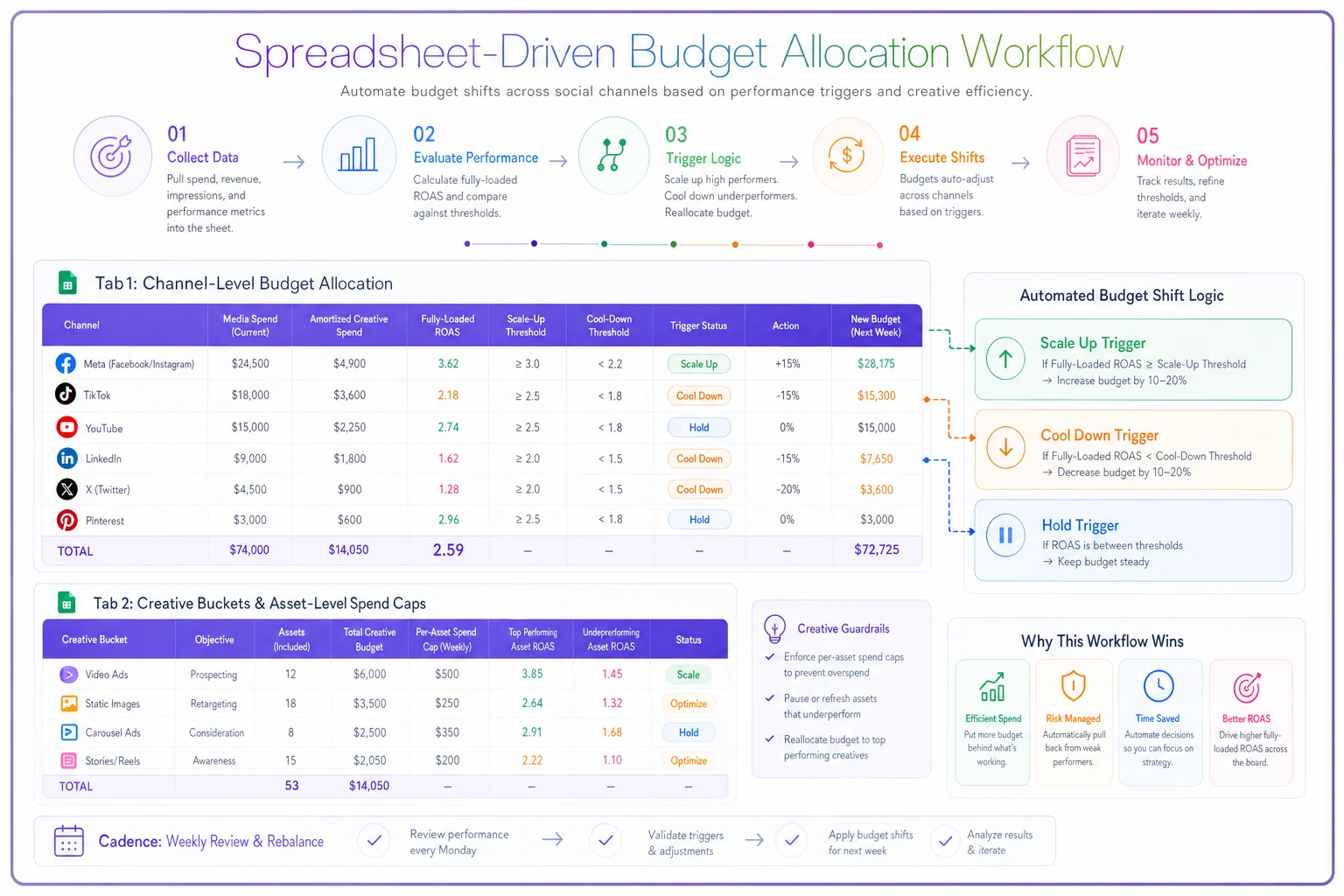
Keeping both tabs current by hand across five or six channels gets painful fast. That's where a workflow platform that pulls spend and results into one normalized view earns its keep — not to make the decisions, but to keep the inputs fresh enough that triggers fire on real data instead of last week's export.
A real scenario
A mid-size DTC skincare brand was running roughly $55k–$60k a month across Meta, TikTok, and a small YouTube line. Blended ROAS looked fine at around 2.4×, so nobody was worried. The problem only showed up once they separated the cost layers.
Meta looked like the star — until creative costs got amortized in. Almost all Meta spend was riding on two hero videos that cost around $9k each to produce. Fully loaded, Meta's real ROAS was closer to 1.9×, and both assets were past a frequency of 4 with CTR sliding. Meanwhile TikTok was running cheap UGC (Bucket A), sitting near 3.1× fully loaded, and capped — it had hit its budget ceiling three weeks earlier and nobody raised it.
They set thresholds by tier, added the triggers, and let the sheet run for about two months. The cool-down trigger pulled roughly $8k off the fatiguing Meta creative. The starvation trigger forced the TikTok cap up. Total budget stayed the same. Blended fully-loaded ROAS moved from around 2.1× to somewhere near 2.6×, and — maybe more importantly — the team stopped relitigating the budget every Monday. The reallocation just happened when the numbers said so.
When this framework makes sense — and when it doesn't
It makes sense when you're running at least three channels, spending enough that a 15% shift is real money, and you've got more than one person touching the budget. That's the point where informal allocation stops scaling.
It's overkill when you're a one-channel, one-person operation spending a few thousand a month. Building trigger tables for a single Meta account is process for its own sake — just watch it and adjust.
Who should hold off: teams that can't reliably attribute results to channels. If your tracking is broken, thresholds built on bad numbers will fire on noise and make things worse. Fix measurement first, then add the economics layer on top. Triggers are only as trustworthy as the data feeding them.
Bringing it together
The framework isn't really about spreadsheets or triggers. It's about moving budget decisions out of the meeting and into a system everyone already agreed to — so a scale-up is automatic, a cool-down isn't a personal defeat, and finance can trace every dollar to a rule instead of a hunch.
Start smaller than you think. Separate media from creative cost, bucket your assets, set tier-specific thresholds, and write down two or three triggers. Run it for a cycle before adding complexity. The teams that actually get value from a social channel economics framework aren't the ones with the fanciest model — they're the ones who let the thresholds make the call instead of quietly overriding them every time the numbers say something inconvenient.
The framework isn't really about spreadsheets or triggers. It's about moving budget decisions out of the meeting and into a system everyone already agreed to — so a scale-up is automatic, a cool-down isn't a personal defeat, and finance can trace every dollar to a rule instead of a hunch.
Start smaller than you think. Separate media from creative cost, bucket your assets, set tier-specific thresholds, and write down two or three triggers. Run it for a cycle before adding complexity. The teams that actually get value from a social channel economics framework aren't the ones with the fanciest model — they're the ones who let the thresholds make the call instead of quietly overriding them every time the numbers say something inconvenient.
Ready to amplify your brand’s voice?
Join 2,500+ marketers using Postyly to save time, boost engagement, and grow their audiences effectively.