



Most wasted creative budget doesn't burn in one dramatic decision. It leaks. A campaign that worked in Q1 keeps getting funded in Q3 because nobody officially killed it. A "brand awareness" content series lives forever because pausing it feels risky and stopping it requires a conversation nobody wants to have. An organic pillar keeps eating production hours because it once went semi-viral eighteen months ago.
The problem isn't that teams pick bad content. It's that they never built a system for unpicking it. Every dollar and every production hour is a funding decision, but most social teams only make those decisions consciously at the start — during planning — and then run on autopilot until budget season forces a reckoning.
Social content portfolio governance is the operational layer that fixes this. Not a spreadsheet of what you posted. A repeatable way to decide what keeps getting money, what gets scaled, and what gets stopped — across paid and organic — on a predictable cadence, using rules you agreed on before you got emotionally attached to any single format.
This post covers the whole system: scorecards, reallocation triggers, scale/stop rules, ROI thresholds, and a quarterly review cadence. Plus the actual worksheets so you can run it yourself.
Why the money leaks in the first place
Most teams treat their content mix like a to-do list, not a portfolio. A to-do list gets things done. A portfolio gets managed — you're constantly asking which positions are pulling weight and which are dead capital.
Without a governance layer, a few predictable things happen.
Sunk-cost thinking runs the show. A team spends three weeks building out a Reels series. It underperforms. Instead of stopping, they double down — "we already invested in the setup, let's give it another month." That month becomes a quarter. The original three weeks becomes twelve.
Paid and organic get judged on different, incompatible standards. Paid gets scrutinized weekly because there's a literal invoice. Organic gets a pass because it "doesn't cost anything" — except it costs your most expensive resource, which is your team's production time. When you don't put a price on organic effort, you can't compare it against paid, and you end up over-investing in organic formats that quietly cost more per outcome than the ads you agonize over.
Nobody owns the stop decision. Launching content is exciting and everyone wants their name on it. Killing content is thankless. So the default behavior is: let it ride. Without an explicit owner and a clear rule, inertia wins every time.
If you've already built out an integrated paid-and-organic portfolio strategy, governance is the enforcement mechanism that keeps that strategy from drifting back into "whatever we did last quarter."
What breaks specifically as the team scales
At a small team — two or three people running everything — governance can be informal because everyone can see everything. You know the newsletter-to-carousel format isn't landing because you're the one making it.
Stop managing your social media the hard way.
Postyly helps you plan, schedule, and analyze every post with precision.
- Multi-platform scheduling
- Real-time engagement tracking
- Automated performance reports
No credit card required
That visibility disappears fast. Here's roughly what breaks as you grow:
| Team size | What governance looks like | Where it breaks |
|---|---|---|
| 2–3 people | Informal, everyone sees everything | Nothing yet — but no records exist when someone leaves |
| 4–8 people | Weekly standups, shared sheet | Paid and organic owners stop talking; duplicate bets appear |
| 8–15 people | Channel leads, separate reporting | Each lead defends their own budget; no shared kill criteria |
| 15+ / multi-brand | Formal reviews, but political | Reviews become negotiation theater, not decisions |
The dangerous zone is that 8–15 range. Enough people to lose visibility, not enough process to compensate. Channel leads start optimizing their number instead of the portfolio's number. The paid lead is proud of a 3.2x ROAS on a campaign that's actually cannibalizing an organic funnel that was converting for free. Nobody catches it because nobody's looking across the whole board.
A typical example: a mid-size team running around 40 active content lines — a mix of paid campaigns, organic series, and always-on evergreen. Ask them which 10 they'd cut tomorrow if forced, and you usually get shrugs or defensive answers. That inability to rank is the symptom. The portfolio is running them.
The scorecard: what "pulling weight" actually means
Every content line — paid campaign, organic series, evergreen pillar — needs to be scored on the same sheet, even though the metrics differ. The point isn't perfect comparability. It's forcing a consistent judgment.
Here's a scorecard structure that works without becoming a data-science project:
-
Efficiency — outcome per dollar (paid) or per production hour (organic)
-
Trajectory — is performance climbing, flat, or decaying over the last 3 review periods?
-
Strategic fit — does this serve a funnel stage you actually need served right now?
-
Marginal cost to sustain — how expensive is it to keep running, not to have built?
-
Substitutability — could a cheaper line deliver a similar outcome?
Notice what's not on there: raw reach, raw impressions, total followers gained. Those are vanity inputs that make bad lines look alive. Score outcomes and cost-to-sustain, not activity.
One thing teams consistently miss: marginal cost to sustain is the most decision-relevant column and the one nobody tracks. A campaign might have a decent ROAS but require your best editor 15 hours a week to keep fresh. That's not really a 3.2x campaign. It's a 3.2x campaign minus your editor's opportunity cost on everything else they could be making.
To tie scoring to real funnel outcomes rather than surface metrics, it helps to have a shared funnel-to-metric matrix so "strategic fit" isn't just an opinion — it maps to a specific stage you can point at.
ROI thresholds and the stop rules that make them real
A scorecard without decision rules is just a report. The rules are what turn scoring into action. Set these before the review, in writing, so they don't get argued into oblivion in the moment.
Scale rule: A line qualifies for more budget when it scores 4+ on Efficiency and Trajectory over two consecutive review periods, and there's evidence the outcome holds at higher spend — not just a small-sample fluke.
Sustain rule: A line stays funded at current level when it's efficient but flat — a 4+ on Efficiency but a 3 on Trajectory. Fine, it works, don't touch it. Not a growth candidate though.
Fix-or-flag rule: A line scoring 2–3 on Efficiency gets one review cycle to improve, with a specific hypothesis attached. Not "let's give it more time." A named change: new hook, new offer, new audience. If the hypothesis doesn't move it, it's done.
Stop rule: A line scoring 2 or below on Efficiency for two consecutive periods gets stopped. No exceptions dressed up as "but it's strategic." If it's strategic and losing money, that's a subsidy decision an exec makes explicitly — not something a channel lead hides inside a content budget.
The stop rule is the whole game. Almost everyone can scale winners. Very few teams can kill losers on schedule. Making it a rule rather than a judgment is what makes it survivable — when the sheet says stop, the sheet takes the blame, not the person who built the thing.
Budget reallocation triggers
Scaling and stopping are only useful if the freed-up money and hours actually go somewhere. Otherwise stopping a line just means the budget quietly evaporates into underspend that finance claws back next quarter.
-
When a line stops, its budget defaults into a "test pool" — not back to general funds. Freed money funds the next set of experiments, not idle capacity.
-
When a line scales, it can only draw from the test pool or from stopped lines — never from the sustain-rated lines that are quietly working. Protect the boring winners.
-
When the test pool grows past a set cap (say 20% of total budget), that's a trigger to promote your best-performing tests into real lines. Don't hoard test budget; a portfolio that's 40% experimental is a portfolio with no conviction.
-
When any single line exceeds a concentration limit (say 30% of spend), review whether you're over-indexed on one bet. Concentration feels great right up until the algorithm changes or the creative fatigues.
That concentration trigger catches a failure mode that's easy to miss: the team scales one winning campaign so aggressively that when it inevitably fatigues, there's a cliff. Governance isn't just about cutting losers — it's about not letting a winner become a single point of failure.
The quarterly review cadence (and why weekly reviews fail at this)
Weekly reviews are for optimization — tweak the creative, shift budget between ad sets, respond to what's happening now. They're the wrong altitude for portfolio decisions. If you make scale/stop calls weekly, you'll thrash: kill a line during a bad week that was actually fine, scale a line during a lucky week that was noise.
Portfolio governance runs on a quarterly cadence with a light monthly check-in.
Monthly (30 min): Update scorecards. Flag any line that tripped a threshold. No decisions yet — just surface the flags so nothing's a surprise at quarter-end.
-
Review every flagged line against the ruleset
-
Make scale/sustain/stop calls — and record them
-
Reallocate freed budget per the triggers
-
Check concentration and test-pool caps
-
Assign owners and hypotheses for anything in fix-or-flag
The recording part matters more than it sounds. Write down why you stopped or scaled each line. Next quarter, when someone wants to resurrect a stopped format, you can point to the decision log instead of re-litigating from memory. Teams that skip the log end up rebuilding the same dead formats every year because institutional memory walks out the door with turnover.
[Score all active lines] → [Monthly flag check] → [Quarterly review meeting] ↓ ↓ [Update scorecards] [Scale / Sustain / Fix-or-Flag / Stop] ↓ [Reallocate freed budget to test pool] ↓ [Assign owners + log decisions] ↓ [Repeat next quarter]
Visualize the governance cycle below.
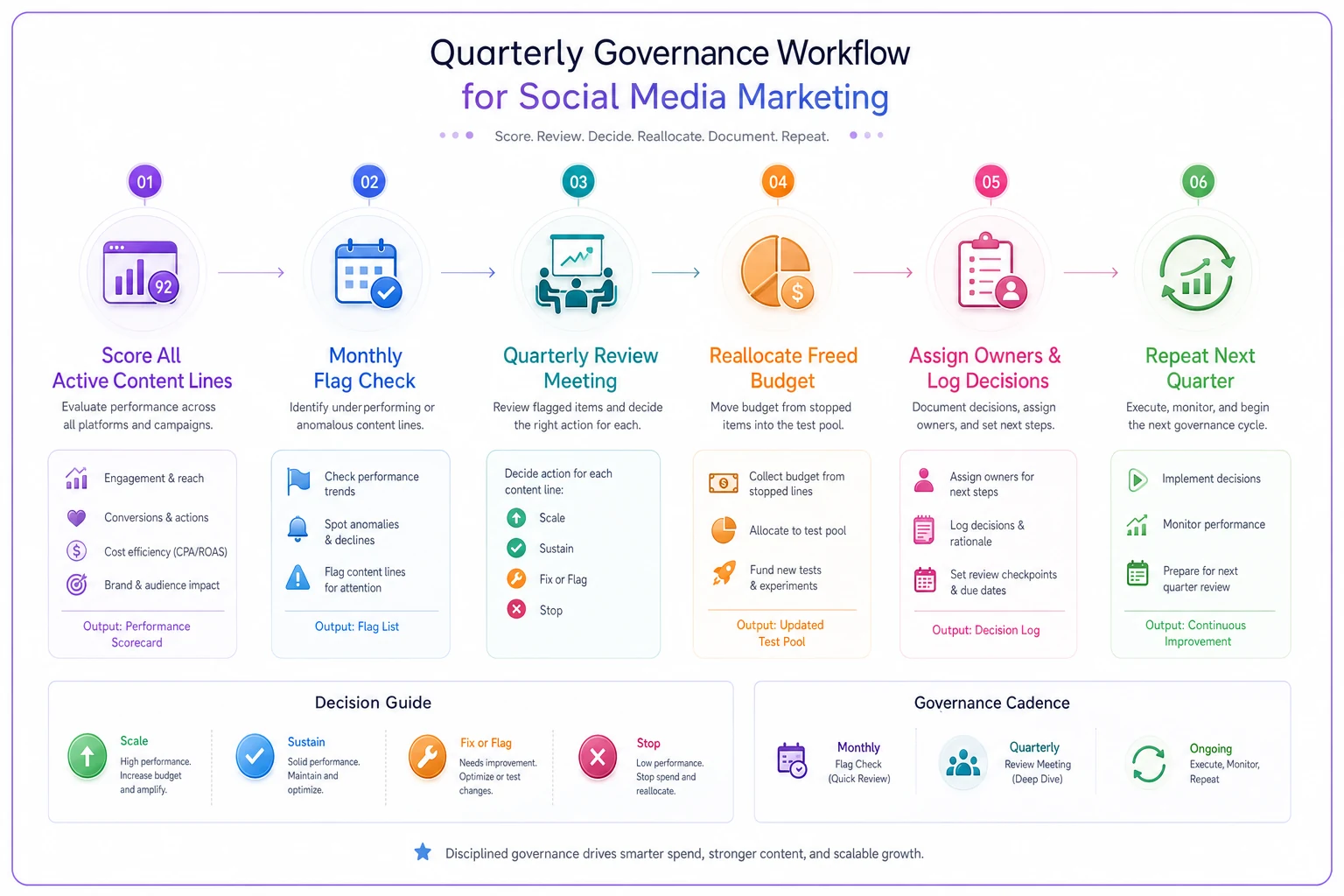
It's not complicated. The hard part is actually doing it on schedule instead of letting it slide when things get busy.
A real scenario
A regional DTC skincare brand — small team, four people on social, running paid and organic together. Their content mix had grown to around 35 active lines over about two years. Nobody had ever formally stopped anything; they just kept layering.
When they finally scored the whole portfolio, the picture was ugly in a useful way. Roughly a third of their production hours were going into two organic series that scored a 2 on efficiency — lots of effort, decent reach, almost no measurable funnel contribution. Meanwhile, a small evergreen carousel line that cost almost nothing to sustain was quietly their best per-dollar performer, and it was underfunded because it wasn't exciting.
They ran the ruleset. Stopped the two dead organic series. Moved those hours into a test pool. Scaled the evergreen line and spun up three variations of it. Over the next two quarters, total production hours actually dropped slightly, but tracked conversions from social climbed somewhere in the 15–20% range — hard to pin exactly given attribution mess, but the direction was unmistakable.
The interesting part wasn't the lift. It was that the lift came from doing less, not more. They'd been spending their most expensive resource — skilled production time — on formats that felt productive and weren't.
When this system makes sense — and when it doesn't
Worth building if you're running more than roughly 15 active content lines, you have both paid and organic in the mix, and enough team that no single person sees everything. That's when the leaks become invisible without a system.
Probably overkill for a two-person team running eight things. You'll know what's working because you're making all of it. Adding formal reviews here just creates busywork. A monthly gut-check is enough.
Who should not do this: if your leadership won't honor the stop rule — if every kill decision gets overridden because someone's attached to their pet project — don't build the system yet. Governance without the authority to enforce it is worse than no governance, because it creates the appearance of discipline while everyone quietly ignores it. Fix the authority problem first.
Where tooling actually helps
The scorecards and rules are the hard part — that's judgment and organizational will, not software. But the operational side benefits from a workflow platform that keeps every content line's cost, outcome, and status in one place, so scoring isn't a two-day archaeology dig through five dashboards every quarter.
Automate a monthly flag report so the lines that trip thresholds surface before your check-ins.
The practical value of AI-assisted operational tooling here is mostly boring in the best way: automatically pulling paid spend against organic production hours, flagging lines that tripped a threshold before your monthly check-in, keeping the decision log so nothing gets re-litigated six months later. When the flag surfaces itself instead of hiding until budget season, the stop decision happens on time. Governance fails from friction, not from bad intentions — reducing the friction of seeing the flags is where automation earns its place.
The same discipline applies to recycled and evergreen content. A governance model pairs naturally with a seasonal evergreen refresh system so your best-performing lines get renewed on purpose instead of quietly aging out.
Closing thought
The teams that waste the least creative spend aren't the ones with the best content instincts. They're the ones who accepted that instinct decays and attachment grows, and built a system that overrides both on a schedule.
Governance isn't glamorous. Nobody gets promoted for the campaign they killed on time. But the portfolio that gets managed — scored, reallocated, occasionally cut without drama — will consistently beat the one that just keeps accumulating whatever felt like a good idea last quarter.
Start by scoring what you've already got. The uncomfortable rows on that sheet are where your next quarter's budget is hiding.
Ready to amplify your brand’s voice?
Join 2,500+ marketers using Postyly to save time, boost engagement, and grow their audiences effectively.