



Most social teams don't have a creative process. They have a queue. Someone drops a brief in Slack, a designer picks it up, it goes live, and then nothing. Nobody knows if it worked well enough to run again. Nobody knows where the source file lives. And six months later two different people are recreating the exact same carousel because neither knew the other one existed.
That's not a talent problem. It's a lifecycle problem. Creative moves through predictable stages — brief, produce, test, iterate, archive — but almost nobody manages those stages as a connected system. Each handoff leaks a little bit of context, a little bit of accountability, and a lot of reusable value.
This is about the whole lane. Not "how to write a better brief" or "how to name your files." How the entire path from idea to archive actually functions when it's built right, where it breaks as you scale, and how scoring rubrics tie the boring archive decisions back to real ROI.
Why the lifecycle breaks in the middle, not the ends
Teams obsess over the two ends. The brief gets a template. The publish step gets a preflight check. Fair enough — those are the visible moments.
The middle is where things rot. Testing gets skipped because "we already know this works." Iteration happens in someone's head instead of on paper. And archiving? Archiving is where creative goes to disappear. Assets get dumped into a shared drive folder called Finalv3ACTUAL and are never seen again.
Across a lot of social operations, the failure follows a specific pattern. Small teams — 2 to 4 people — run the whole lifecycle informally because everyone remembers everything. That works until you're producing more than 40 or 50 distinct creatives a month. At that volume, human memory stops being a reliable index. People start rebuilding things that already exist, re-testing questions that were already answered, and re-running creative that quietly stopped performing three campaigns ago.
The middle breaks because nothing forces a decision at the transition points. A brief that's never scored gets produced anyway. A test with no threshold never concludes. An asset with no archive trigger never leaves rotation. Each stage bleeds into the next without a checkpoint, and the whole thing turns into a slow-moving blob instead of a lane.
The five stages, and the decision that lives inside each one
The trick isn't the stages themselves — everyone knows creative gets briefed and produced. The trick is that each stage should end with a scored decision, not a vibe.
Stop managing your social media the hard way.
Postyly helps you plan, schedule, and analyze every post with precision.
- Multi-platform scheduling
- Real-time engagement tracking
- Automated performance reports
No credit card required
-
Brief — Ends with a go / rework / kill decision based on a brief score. If the brief can't clear a minimum score, it doesn't get production time. This alone kills a surprising amount of wasted work.
-
Produce — Ends with a quality gate, not a "looks good to me." Does it match the brief intent? Is it platform-spec correct? Is it accessible?
-
Test — Ends with a signal read against a pre-set threshold. Not "did it do okay" but "did it clear the bar we agreed on before launch."
-
Iterate — Ends with a decision to scale, adjust, or retire. Iteration without a stopping rule becomes infinite tinkering.
-
Archive — Ends with a reuse classification. Every asset that leaves rotation gets tagged for how (and whether) it can come back.
Four of those five decisions are basically "keep going or stop." That's the whole point. A lifecycle is a series of stop-or-continue gates. Most teams only have one real gate — publish approval — which is why everything piles up around it.
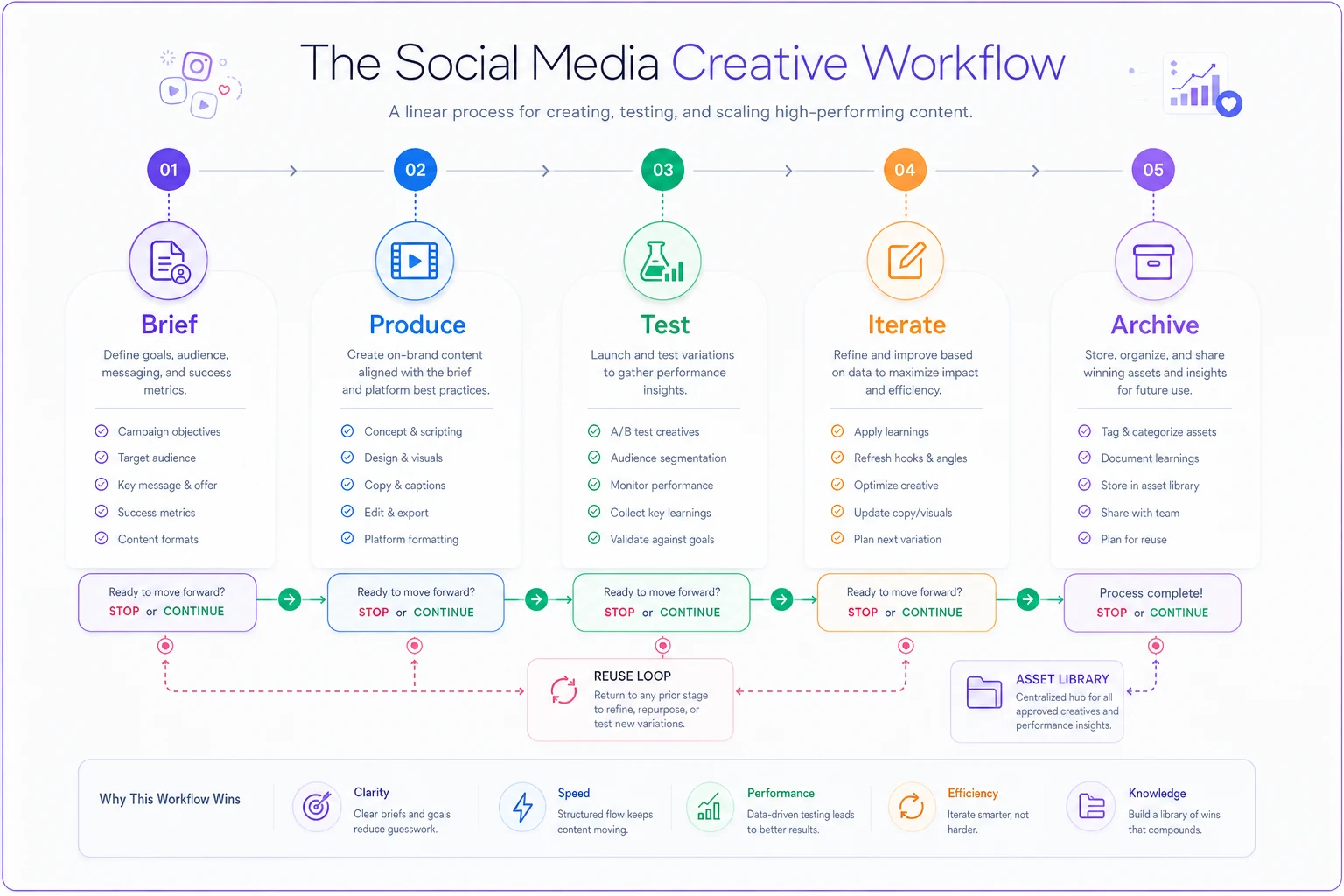
Here's a quick visual of the lane and the stop-or-continue gates.
The brief score: killing bad work before it costs you
The cheapest creative to fix is the one that never gets made. A brief scoring rubric forces the conversation up front, when changing direction costs nothing.
A workable brief rubric doesn't need to be complicated. Score each brief 1–5 on a handful of dimensions and set a minimum threshold to move into production.
| Brief dimension | What you're checking | Weight |
|---|---|---|
| Objective clarity | Is there one measurable goal, not three? | 25% |
| Audience specificity | Do we know who this is not for? | 20% |
| Message single-mindedness | One idea, or a committee wishlist? | 20% |
| Platform fit | Built for the feed it's going to, or generic? | 15% |
| Success definition | Is the win condition written down before launch? | 20% |
A brief that scores below, say, 3.2 weighted goes back for rework. In real operations, the "success definition" row is the one that fails most often. People write briefs full of adjectives — "bold," "scroll-stopping" — and zero numbers. If nobody defines the win before production, nobody can honestly score the result later, which is exactly how you end up with a library full of creative nobody can rate.
One pattern worth noticing: teams that add a brief score usually see their production volume drop in the first month, and their per-asset performance rise. That's not a coincidence. You stopped making the junk.
Test thresholds that actually conclude
A test without a pre-committed threshold isn't a test. It's a thing you look at afterward and rationalize.
Write the pass/fail line in the brief, before anything goes live. Something like: "This UGC-style hook needs to beat our 30-day rolling hook rate by 15% at 3-second view rate, over a minimum of around 8,000 impressions, to move to iteration." Now the test has an ending. Either it cleared the bar or it didn't.
This is where the lifecycle connects directly to your paid strategy. Organic tests that clear a real threshold are the ones worth putting money behind — and there's a whole discipline around promoting proven organic creative into structured paid experiments. If you're doing that handoff, the creative iteration loop for turning organic winners into paid tests covers the signal thresholds that make the transition clean rather than a guess.
The failure mode at scale: teams run dozens of "tests" simultaneously with no shared threshold, so results are incomparable. Creative A "won" against one baseline, Creative B against another, and now you can't tell which insight is real. A shared, documented threshold is what lets you compare across the whole catalog instead of within one campaign.
Iteration: knowing when to stop touching it
Iteration is where good teams waste the most quiet hours. A creative does well, so you make a variant. The variant does okay, so you make a variant of the variant. Three weeks later you've produced eleven versions of one idea with diminishing returns on every step.
The fix is a stopping rule tied to marginal gain. A simple version: if a new iteration doesn't beat the current best by at least your minimum detectable difference, stop iterating on that concept and move it toward archive. You've found the ceiling. Chasing another 2% isn't worth a fresh production cycle.
For teams producing at volume — especially short-form video where the temptation to endlessly tweak is strongest — the iteration decision needs to plug into how you batch and schedule production in the first place. If you're shooting in batches, the retire-vs-reshoot call is basically a slot on your production calendar, which the 1-day batch short-form video shoot-to-shelf blueprint lays out in terms of role checklists and slotting.
Something worth internalizing: the concepts worth iterating on most are rarely the top performers. Top performers are usually near their ceiling already. The best iteration ROI often comes from the second tier — solid ideas that haven't been fully optimized. Teams that only iterate on their number one winner leave a lot on the table.
Automated archive triggers: the part everyone skips
Almost nobody archives on purpose. Assets stay "live" long after they've decayed because retiring something requires a decision, and decisions require someone to own them.
Automated archive triggers remove the decision. You define the conditions once, and assets move to archive when they hit them. Common triggers that hold up in practice:
-
Performance decay — creative drops below X% of its own peak over a rolling window
-
Frequency ceiling — the same audience has seen it more than N times (fatigue trigger)
-
Time-based — anything untouched for 90+ days gets flagged for review
-
Campaign close — assets auto-archive when their parent campaign ends, unless flagged for reuse
-
Compliance/claim expiry — anything tied to a dated offer, price, or disclosure archives on the expiry date
Automating these isn't about laziness. The manual version just doesn't happen. Nobody has "review whether that carousel from March is still worth running" on their calendar. So it keeps running, quietly fatiguing your audience and dragging your averages down.
This is one place where operational software earns its keep — not as a magic wand, but as the thing that watches decay curves and frequency counts so a human doesn't have to remember to. A workflow platform that flags "these six assets crossed their fatigue threshold this week" turns archiving from a task nobody does into a five-minute review. The value isn't the automation for its own sake; it's that the archive stage finally happens on schedule instead of never.
Reuse rules: the entire reason archiving matters
Archiving that just hides assets is pointless. Archiving that classifies assets for reuse is where the ROI hides. The difference is whether your archive is a graveyard or a library.
Every asset leaving rotation should get a reuse classification. A simple three-tier system works:
-
Reusable as-is — evergreen, proven, no dated claims. Can be re-scheduled directly.
-
Reusable with refresh — strong bones, but needs updated stats, dates, or a re-shot intro. Iteration candidate later.
-
Retired — one-off, seasonal, or underperformed. Kept for reference, not rotation.
The reuse rule that saves the most money is straightforward: before any new brief enters production, check the archive for a reusable-as-is or reusable-with-refresh match. Most teams never do this because their archive isn't searchable — it's a drive folder. So they produce net-new every single time, which is the most expensive possible way to fill a calendar.
Before any new brief enters production, search the archive for reusable-as-is or reusable-with-refresh matches to avoid unnecessary net-new production.
A mature archive should be supplying a meaningful chunk of your published creative. If 100% of what you publish is brand new, your lifecycle isn't a loop — it's a straight line that throws away everything at the end.
A filled scoring matrix, tied to an actual ROI decision
Abstract rubrics are easy to nod at and hard to use. Here's what one looks like filled in, for a set of four creatives at the end of a testing cycle, deciding what happens to each.
| Creative | Brief score | Test result vs threshold | Iteration ceiling? | Decay status | Reuse class | Decision |
|---|---|---|---|---|---|---|
| Founder-story Reel | 4.4 | +22% (cleared) | Not reached | Fresh | Reusable w/ refresh | Scale + iterate one variant |
| Product-demo carousel | 3.1 | -4% (missed) | N/A | N/A | Retired | Kill, log the learning |
| UGC testimonial | 4.0 | +16% (cleared) | Reached | Fresh | Reusable as-is | Archive → re-schedule in 60 days |
| Meme-format post | 2.9 | +9% (missed threshold) | N/A | Fatiguing | Retired | Kill, don't rebuild |
The ROI logic reads straight across. The founder-story Reel cleared its bar and still has room to improve, so it earns another production cycle — that's where new budget goes. The UGC testimonial won but hit its ceiling, so there's no reason to spend on iteration; it just gets recycled on a delay, which is essentially free performance. The two misses get killed, but the meme post's near-miss is worth logging so nobody re-briefs it in three months thinking it's a fresh idea.
That last column is the whole game. Every row ends in a resource decision: spend, recycle-for-free, or stop spending. A scored lifecycle turns "which creative should we make more of?" from an opinion into a lookup.
A real scenario: mid-size DTC brand, ~60 creatives a month
A home-goods DTC brand running roughly 55–65 creatives a month across Instagram, TikTok, and paid had the classic middle-of-the-lane rot. Briefs were loose, tests were eyeballed, and their archive was three shared drives no one trusted.
The visible symptom was cost. They were producing almost everything net-new because nobody could find or trust old assets. Their designer estimated something like a third of monthly production was effectively rebuilding things they already owned.
They didn't buy new tools first. They added three checkpoints: a brief score with a rework threshold, a written test threshold in every brief, and a reuse classification on everything that got archived. Then they added one automation — a decay flag on live paid creative — because manually tracking fatigue across 60 assets was never going to happen consistently.
After about two months, net-new production dropped to a bit over half their output; the rest came from reuse-as-is and refresh candidates pulled from the now-usable archive. Per-asset performance ticked up too, mostly because the brief score was quietly killing the weak concepts before they consumed production hours. No heroic transformation — just a lane that stopped leaking.
When this level of structure is overkill
If you're a one- or two-person team publishing maybe 10–15 pieces a month, most of this is too much machinery. You remember your own catalog. Adding scoring gates would slow you down more than the reuse savings would help. Run light — a shared naming convention and a "does this brief have a clear goal" gut check is plenty until volume forces the issue.
The structure starts paying for itself somewhere around the point where no single person holds the whole catalog in their head. That's usually 3+ contributors or roughly 40+ creatives a month. Below that, the overhead of scoring every brief outweighs the leakage you're preventing.
A warning for the enthusiastic: don't build all five gates at once. Teams that try to roll out brief scoring and test thresholds and archive triggers and reuse rules simultaneously usually abandon the whole thing within a month because it feels like bureaucracy. Add one gate, let it become habit, then add the next. The archive trigger and reuse rules are usually the highest-ROI place to start, because they recover value you're already throwing away.
Making the lane hold together
The stages aren't the hard part. Everyone already briefs, produces, tests, and publishes. What breaks is that the transitions between stages have no decision attached to them, so work flows forward regardless of quality, tests never conclude, and archiving never happens. Scoring rubrics are just a way of forcing an honest yes/no at each handoff.
The archive end deserves more respect than it gets. A classified, searchable, trigger-managed archive isn't storage — it's a second content engine. The teams getting the most out of their creative aren't the ones producing the most. They're the ones whose lifecycle actually loops, feeding proven work back into rotation instead of quietly discarding it and starting over every single month.
Build the gates where the leaks are. Score the decisions that actually cost money. And treat your archive like inventory you paid for — because you did.
Ready to amplify your brand’s voice?
Join 2,500+ marketers using Postyly to save time, boost engagement, and grow their audiences effectively.