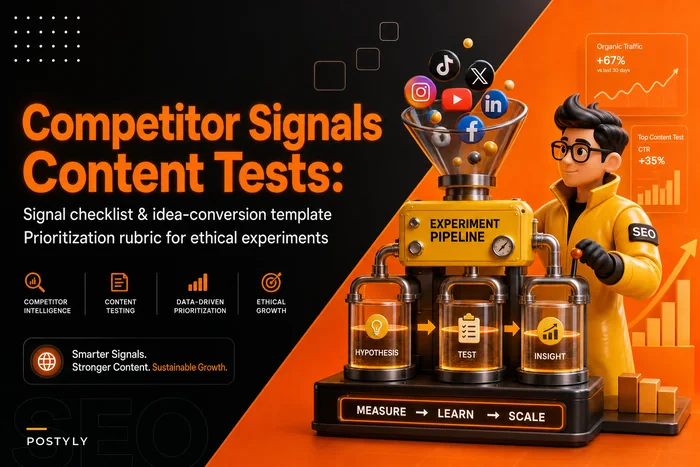



Most social teams don't have a testing problem. They have a memory problem.
The tests get run. Somebody swaps a hook, changes a thumbnail, tries a new CTA. Results come in. Someone screenshots the winner, drops it in Slack, and everyone nods. Two months later a different person on the same team runs almost the exact same test, gets a slightly different result, and now there are two contradictory "learnings" floating around with no way to tell which one to trust.
This is what experiment catalog governance for social media actually fixes — not the tests themselves, but the layer around them that decides what counts as a real experiment, what metadata gets attached, when a result is trustworthy, and where all of it lives so nobody repeats it.
The teams that get this right aren't running more tests. They're running fewer, and every one of them compounds into something the next person can build on. The teams that get it wrong end up with a graveyard of half-remembered A/B tests and a lot of confident opinions backed by nothing.
Here's how this whole system holds together, where it breaks as teams grow, and what a governed catalog actually looks like when it's filled in.
Why testing turns into noise the moment more than one person is involved
A solo social manager can get away with keeping tests in their head. They ran it, they remember the result, they move on. The system is fragile but functional because there's exactly one node in it.
The problem starts at two people. And it gets genuinely ugly at five or six.
Here's the pattern: two people on the same team independently decide to test whether question-based captions beat statement captions. Person A runs it on Instagram carousels in March, sees questions win by a little, and quietly adopts questions. Person B runs it on Reels in June, sees statements win, and adopts statements. Neither of them knows the other one ran it. Neither result was clean enough to actually conclude anything. Now the team has two "best practices" that directly contradict each other, and both feel earned because someone did the work.
This is a coordination failure, not an analysis failure. The individual tests might have been fine. What's missing is the shared record that would have told Person B: "We already looked at this, here's what we found, and here's why it wasn't conclusive."
The second thing that breaks is quality. When there's no bar for what counts as an experiment, everything counts. A post that got more likes than another post becomes "the data shows video hooks outperform." Sample size of two. No holdout. No accounting for the fact that one went out on a Tuesday and one on a Sunday. We've written before about the common mistakes when A/B testing organic posts, and almost all of them trace back to the same root: nobody agreed in advance on what a valid test even is.
The three things a governance layer actually controls
Governance sounds heavy, like committee meetings and sign-off forms. For a social team, it really comes down to three practical controls:
Stop managing your social media the hard way.
Postyly helps you plan, schedule, and analyze every post with precision.
- Multi-platform scheduling
- Real-time engagement tracking
- Automated performance reports
No credit card required
1. Required metadata. What has to be attached to every experiment before it's allowed into the catalog. This is what makes tests searchable and comparable later.
2. Significance thresholds. The pre-agreed bar a result has to clear before anyone is allowed to say "this won." Below the bar, the result gets logged as inconclusive — not as a loss, not as a win.
3. Tagging and dedup rules. The taxonomy that lets someone check, in under a minute, whether this test has already been run or is close enough to something running now that it'd muddy both.
Everything else — the repository, the review process, the catalog format — exists to serve these three. Get these right and the rest is just plumbing.
Required metadata: the fields that make a test reusable
| Field | Why it matters | Example value |
|---|---|---|
| Experiment ID | Lets you reference it forever | EXP-0142 |
| Hypothesis | Forces a real question, not a vibe | "Front-loading the offer in first 3s lifts Reel completion" |
| Platform + format | Results rarely transfer across these | Instagram Reels |
| Primary metric | Stops metric-shopping after the fact | 3-sec-to-complete rate |
| Variable changed | The one thing that differed | Offer placement (0–3s vs 8–11s) |
| Sample size / reach | Determines if the result means anything | ~14k vs ~13k impressions |
| Duration + dates | Catches seasonality and day effects | Apr 2–Apr 9 |
| Result + effect size | Not just "won" — by how much | +18% completion, held after 7 days |
| Significance status | Conclusive / inconclusive / directional | Conclusive |
| Tags | Enables dedup and search | #hook #offer-placement #reels |
| Owner | Who to ask | J. Okafor |
The single most valuable field on that list is variable changed, and it's the one people cheat on most. They'll change the thumbnail and the caption and the posting time, then declare the thumbnail won. Now the result is contaminated and can't go in the catalog as a clean learning. One variable per experiment isn't a nice-to-have — it's the thing that makes the entry worth keeping.
Significance thresholds: the part everyone skips
-
Minimum reach per variant before you're even allowed to read the result (many teams land around 8k–10k impressions per arm for organic, higher for anything below ~2% engagement).
-
Minimum effect size to call it conclusive — often something like a 15–20% relative lift on the primary metric, because anything smaller tends to evaporate on a re-run.
-
A stability check
does the result still hold 5–7 days later, or did it decay? A lot of "wins" are just recency spikes.
Anything that clears reach but not effect size gets tagged directional — worth noting, not worth declaring. Anything below the reach floor is inconclusive and shouldn't influence strategy at all.
The threshold isn't really about statistics for most social teams. It's about permission. It gives whoever ran the test permission to say "this didn't tell us anything" without it feeling like failure. When there's no threshold, every test has to produce a takeaway, and that pressure is exactly what manufactures fake learnings.
What breaks as the team scales
The failure points shift depending on how big the operation is. The pattern is pretty consistent.
At 1–2 people: the risk is total loss. Everything lives in one person's head or a personal spreadsheet. When they leave or go on holiday, the institutional memory walks out with them. Nothing compounds because there's no one to compound it with.
At 3–6 people: duplication becomes the dominant failure. This is the danger zone. Enough people are running tests that overlap is guaranteed, but the team is still small enough that nobody thinks they need a formal system. This is where you get the contradicting-best-practices problem. It's also where "we tested that already" becomes an argument nobody can settle because there's no shared record to point at.
At 7–15 people: the failure mode becomes low-value volume. Now there are enough people that testing is a habit, and the pressure to "always be testing" produces a flood of tiny, underpowered experiments — button color, one word in a caption — that clear nobody's threshold but eat real hours. The catalog, if one exists, fills up with entries nobody trusts. Quality collapses under quantity.
Beyond that: contradiction at scale plus onboarding cost. New hires can't tell which of the 400 catalog entries actually matter, so they either ignore the catalog entirely and re-run everything, or treat weak entries as gospel.
The same absence — a governed catalog — produces a completely different-looking problem at each stage. That's why bolting on a fix for the symptom you have right now usually fails. You solve the duplication problem and then the low-value-volume problem shows up six months later wearing a different mask.
The dedup check: a 60-second workflow before any test launches
Here's the actual workflow that prevents the most expensive failure — running a test you've already run. It's meant to take under a minute, because if it takes longer, nobody does it.
-
Search the catalog by tag. The person proposing a test searches the two or three tags that describe it (e.g.
#hook+#reels). If nothing comes up, proceed. -
Check for near-duplicates. If something comes up, read the hypothesis and variable-changed fields. Is this the same question, or genuinely different? Same platform? A hook test on TikTok is not the same as a hook test on LinkedIn.
-
Decide
new, re-run, or extend.
- New → nothing similar exists, log it and go. - Re-run → same test exists but was inconclusive or is over six months old; re-running is justified, link the old entry. - Extend → the question was answered but you want to test the next layer (the old test found questions beat statements; now test which type of question). Link it and reference the parent. -
Register before launch. The entry gets created with status "running" before the test goes live, not after. This is the step that actually prevents duplication, because a live registry is what the next person searches against.
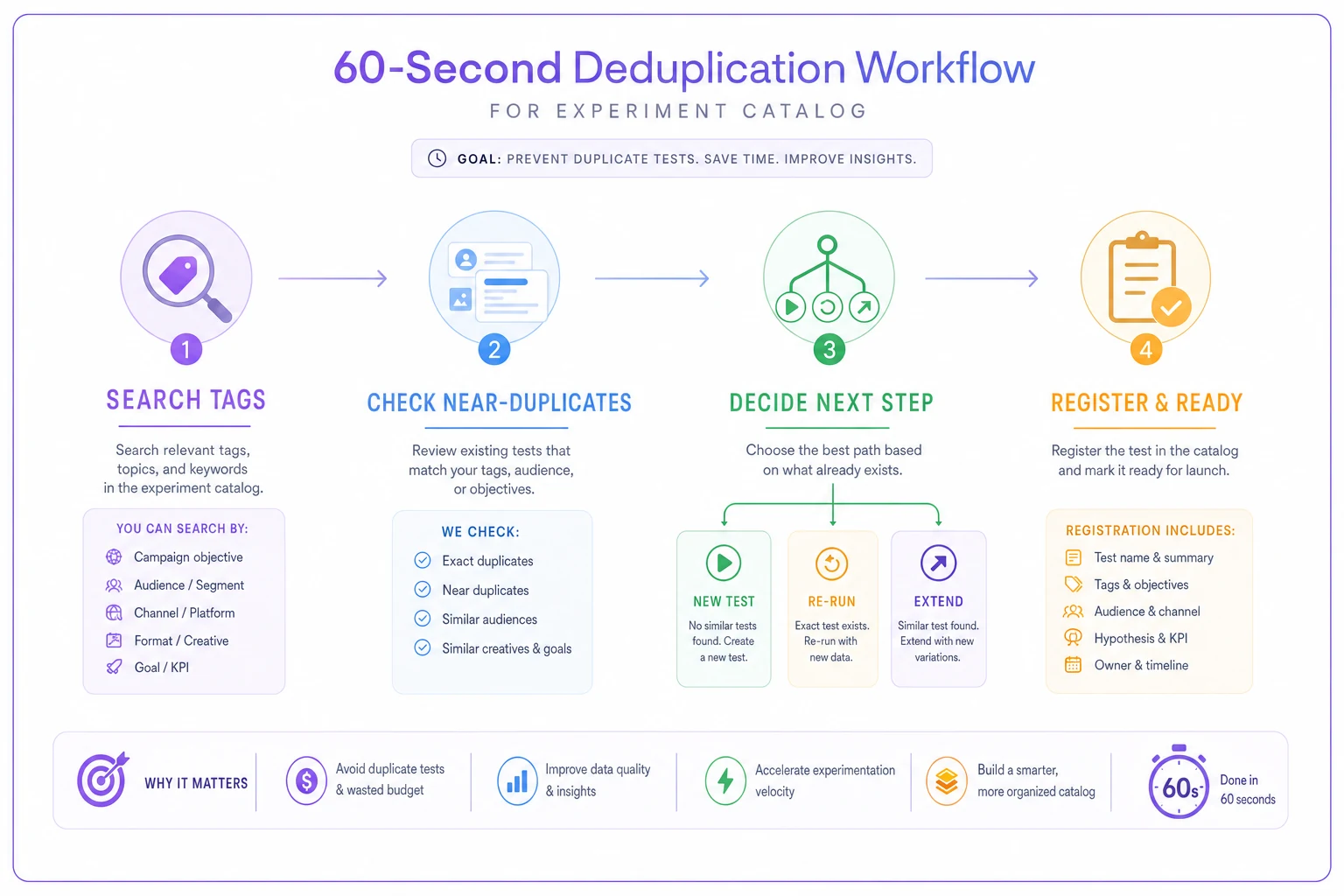
The register-before-launch rule is the one that does the heavy lifting. A catalog that only gets filled in after results come back can't prevent duplication — by the time the entry exists, both overlapping tests have already run.
Make registering before launch a quick form with required tag suggestions so it happens without thinking.
This connects directly to how ideas enter the pipeline in the first place. If your test ideas come from watching what competitors do, the same discipline applies at intake — you can turn competitor content signals into ethical, testable content ideas far more efficiently when there's a catalog telling you which of those signals you've already investigated.
A filled-in catalog: what "good" actually looks like
Abstract rules don't stick. Here are three real-shaped catalog entries so you can see the format doing its job.
-
EXP-0118 - Hypothesis
Native captions (typed on-screen) beat auto-captions for Reel watch time. - Platform/format: Instagram Reels - Variable changed: caption style (native vs auto) - Sample: ~11k vs ~12k impressions, Feb 6–13 - Result: native +22% avg watch time, held on 7-day recheck - Status: Conclusive → rolled into standard workflow - Tags:
#captions#reels#watchtime -
EXP-0119 - Hypothesis
Posting carousels at 7am beats 12pm for saves. - Platform/format: Instagram carousel - Variable changed: post time (7am vs 12pm) - Sample: ~6k vs ~5k impressions, Feb 6–13 - Result: 7am +9% saves - Status: Inconclusive → below reach floor and below effect threshold; not adopted - Tags:
#timing#carousel#saves -
EXP-0120 - Hypothesis
Founder-voice hook beats brand-voice hook on LinkedIn video. - Platform/format: LinkedIn video - Variable changed: hook voice (founder vs brand) - Sample: ~9k vs ~9k impressions, Feb 9–16 - Result: founder-voice +31% 3-sec views - Status: Directional → strong lift but first run, flagged for re-run before adoption - Tags:
#hook#linkedin#founder-voice
Look at what EXP-0119 does for the team. It's a losing entry. But it's arguably the most valuable one in the batch, because the next three people who wonder about posting time will find it, see it was underpowered and inconclusive, and either skip it or design a properly powered version instead of re-running the weak one. A catalog that only records winners is missing half the point.
The public repository: where it lives and who touches it
"Public" here means public within the team — not locked in one person's Notion, not scattered across DM threads. The repository needs three properties:
-
Searchable by tag and platform, because dedup checks live or die on search speed.
-
Write-access for anyone running tests, read-access for the whole team including leadership.
-
A single status vocabulary — running, conclusive, inconclusive, directional — used consistently, with no freelancing on new statuses.
A lightweight review cadence keeps it honest. Once a week or every two weeks, whoever owns the catalog spends fifteen minutes doing three things: confirming any "running" tests older than their expected duration have been closed out, checking that new conclusive entries actually cleared thresholds, and merging any obvious duplicates that slipped through. This isn't a governance board — it's closer to weeding a garden.
Where operational software helps is mostly in the mechanical parts nobody wants to do by hand: enforcing that required fields are filled before an entry saves, flagging near-duplicate tags automatically when someone registers a new experiment, and nudging owners when a "running" test has gone stale. AI-assisted operational tools are genuinely useful for surfacing "hey, this looks a lot like EXP-0118 from February" at the moment of registration, which is exactly when a human is least likely to remember it. But the tooling only matters if the three controls — metadata, thresholds, tags — are already agreed on. Software enforces a system; it doesn't invent one.
When this level of governance makes sense — and when it's overkill
When it's worth it: you have three or more people running tests, results are influencing real budget or strategy decisions, or you've already caught yourself re-running something. The moment a "learning" gets cited in a strategy deck, you need to be able to trace it back to an entry that cleared a threshold. If you can't, you're making decisions on vibes with extra steps.
When it's overkill: you're a solo operator running two or three tests a quarter. Building a full catalog with dedup workflows for that volume is process for its own sake. Keep a simple log, sure, but don't stand up governance for a problem you don't have yet.
Who should not do this: teams that haven't yet fixed their test design problem. If your experiments still change three variables at once and read results at 800 impressions, a catalog just organizes your bad tests neatly. Governance sits on top of sound methodology — it doesn't replace it. Fix how you run a single clean test first, then build the layer that makes them compound.
A quick real scenario
A small DTC skincare brand with a four-person social team was running roughly 8–12 organic tests a month across Instagram and TikTok. No shared record. Over about five months they'd re-tested "UGC vs studio footage" three separate times — twice inconclusively, once with a contaminated setup — and still didn't have an answer they trusted.
They didn't add more tests. They cut down to about six a month, each with a required metadata entry, a reach floor of 8k per arm, and a 15% effect threshold. They registered every test before launch. Within a couple of months the duplicate re-runs stopped entirely, and the catalog had roughly a dozen entries the whole team actually cited in planning. Volume dropped by nearly half; the number of decisions backed by a conclusive result went up. Nothing dramatic happened to the follower count — but the arguments about "what works" mostly ended, which freed up a surprising amount of everyone's week.
The part worth remembering
Testing is only valuable if it accumulates. A single team member running clever experiments in isolation produces momentary insight that evaporates the second they get busy or leave. What turns experimentation into an actual asset is the boring layer around it: agreed metadata, a threshold that gives people permission to say "inconclusive," tags that make dedup a 60-second check, and one place everyone can see.
Start with the three controls. Fill in five real entries — including at least one that didn't work. Register before launch, not after. The catalog will feel like overhead for about two weeks, and then the first time someone says "we already tested that, here's the entry," it'll pay for itself.
Testing is only valuable if it accumulates. A single team member running clever experiments in isolation produces momentary insight that evaporates the second they get busy or leave. What turns experimentation into an actual asset is the boring layer around it: agreed metadata, a threshold that gives people permission to say "inconclusive," tags that make dedup a 60-second check, and one place everyone can see.
Start with the three controls. Fill in five real entries — including at least one that didn't work. Register before launch, not after. The catalog will feel like overhead for about two weeks, and then the first time someone says "we already tested that, here's the entry," it'll pay for itself.
Ready to amplify your brand’s voice?
Join 2,500+ marketers using Postyly to save time, boost engagement, and grow their audiences effectively.