



Most social teams don't notice their taxonomy is broken until a quarterly report contradicts itself. Paid reach looks inflated because a repurposed UGC clip inherited the wrong campaign tag. An influencer video shows up in evergreen performance rollups even though the usage license expired two months ago. Someone renames a tag mid-campaign and suddenly half the historical data won't join anymore.
None of these are analytics problems. They're taxonomy problems that become analytics problems downstream. And the reason they're so painful is that by the time you see the symptom in a dashboard, the bad metadata has already propagated across dozens of assets, joins, and reports.
This is a systems piece. Not "here are 12 tagging tips," but how content taxonomy actually functions as connective tissue between your content library, your rights management, your analytics warehouse, and the people who need to trust the numbers. When it works, tags move automatically, versions stay coherent, expired rights get flagged before a post goes live, and every analytics join lands where it should. When it breaks, you get the slow erosion of trust that eventually makes leadership stop believing your reports.
Why taxonomy quietly breaks in almost every growing social team
At small scale, taxonomy feels unnecessary. One person tags everything, remembers what "Q2promov2" means, and the analytics live in a spreadsheet. Nothing is centralized because nothing needs to be — the whole system fits in one person's head.
Then the team grows. Three people are tagging now. Someone uses paid, someone uses Paid, someone uses paid-social. A freelancer imports 200 clips with no tags at all. The person who invented the original naming scheme leaves. And the metadata that used to be reliable becomes a field of landmines nobody wants to touch.
The pattern that keeps showing up: taxonomy failures aren't caused by people being careless. They're caused by the system having no propagation rules. When you tag a parent asset, nothing decides what happens to the children. When you edit a tag, nothing decides whether that change flows forward or stays local. When a rights window closes, nothing tells the analytics layer to stop counting that asset. Every one of these gaps gets filled by a human remembering to do the right thing — which works until it doesn't.
-
Propagation gaps — a tag applied to a campaign doesn't reliably reach every asset, variant, and crosspost inside it
-
Versioning ambiguity — nobody can tell which version of an asset a metric belongs to, so performance data gets smeared across revisions
-
Rights leakage — content gets used, counted, or repurposed past its licensed window because the taxonomy doesn't know the license exists
Each one compounds the next, so the fixes stack on each other too.
Automated tag propagation: the difference between a taxonomy and a wish
Tag propagation is the rule set that decides how a tag applied at one level of your content hierarchy flows down (or doesn't) to everything beneath it. Most teams never define these rules explicitly, which means propagation happens through copy-paste and memory.
Stop managing your social media the hard way.
Postyly helps you plan, schedule, and analyze every post with precision.
- Multi-platform scheduling
- Real-time engagement tracking
- Automated performance reports
No credit card required
Think about a single influencer campaign. You have:
-
The campaign itself
-
Three creator deliverables under it
-
Each deliverable cut into a Reel, a TikTok, and a Story
-
Two paid variants of the best-performing cut
That's one campaign, but easily 15–20 individual assets, each of which needs to carry the campaign ID, the rights status, the paid/organic classification, and the platform. If a human applies those tags manually, the error rate is not "occasional." In real operations, once you're past a dozen assets per campaign, roughly 1 in 5 will end up with at least one wrong or missing tag.
Good propagation follows a small number of clear rules:
-
Inherited tags flow down automatically. Campaign ID, brand, quarter, and rights-holder attach to every child asset the moment it's created under the parent.
-
Local tags stay local. Platform, format, and variant-specific tags apply only to the asset they describe and never propagate upward or sideways.
-
Conflicting tags trigger a review, not a silent overwrite. If a child asset is tagged
organicbut the parent campaign flips topaid, the system should flag the mismatch instead of quietly changing it. -
Repurposed assets carry provenance. When a clip from Campaign A gets reused in Campaign B, it keeps a reference to its origin so earned/paid separation stays clean later.
That last rule matters more than it looks. A huge share of tagging errors come from reused content that "forgets" where it came from. If your taxonomy can't answer "where did this asset originally live," you will eventually double-count reach or misattribute conversions.
A workable tag-mapping table
| Tag field | Behavior | Applied at | Propagates? | Example values |
|---|---|---|---|---|
campaign_id | Inherited | Campaign | Down to all children | spring24-launch |
brand | Inherited | Account/Campaign | Down | north-line |
rights_status | Inherited + expiring | Asset intake | Down, with expiry | licensed-until-2025-06-30 |
channel_type | Classifying | Deliverable | No | paid, organic, hybrid |
platform | Local | Individual asset | No | tiktok, ig-reels |
variant | Local | Individual asset | No | v1, v2-cta-swap |
origin_ref | Provenance | On reuse | Carries with asset | spring24-launch/clip-07 |
The magic column is "Behavior." Once you classify each tag by how it should move through the system, propagation rules practically write themselves. Most teams skip this and treat every tag as a flat label, which is exactly why their metadata drifts.
This diagram shows the propagation workflow from campaign to child assets and derivatives.
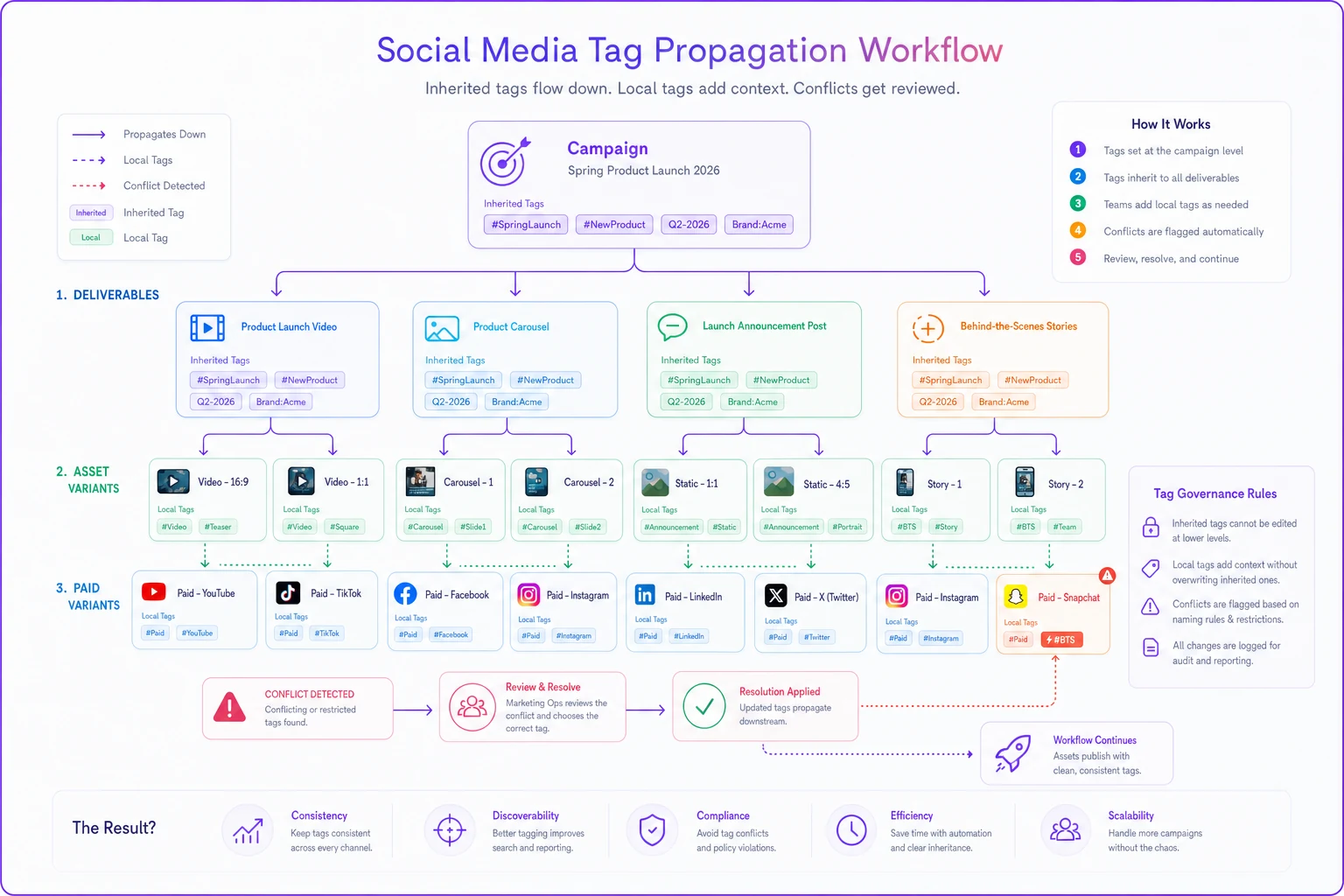
Keep the diagram in mind when you map behaviors.
Versioning semantics: where performance data goes to die
Versioning is the part everyone underestimates. It seems like a content-storage concern, but it's actually an analytics concern — because a version is the unit that performance attaches to.
Here's the failure mode. A post goes live. Two days later someone swaps the thumbnail and tweaks the caption CTA — a real change that affects performance. But the asset keeps the same ID. Now your metrics blend pre-swap and post-swap performance into one number, and nobody can tell that the CTA change lifted saves by a noticeable margin, because the data doesn't distinguish the two states.
Multiply that across an active account making dozens of small edits a week, and your A/B intuition becomes worthless. You think you know what works, but your version history can't back it up.
Clean versioning semantics need three things:
-
Immutable version IDs. Once a version has published and collected data, it's frozen. Edits create a new version, not a mutation of the old one.
-
A clear "current" pointer. People need to find the live version instantly, but the pointer is separate from the version identity. The live version can change; the historical versions stay pinned to their data.
-
Change classification. Not every edit deserves a new version. Fixing a typo isn't the same as swapping a hook. Define which change types are "material" (new version) versus "cosmetic" (same version, logged edit).
A pattern worth borrowing: treat versioning like lightweight version control for publishing safety, but extend it so each version becomes a joinable key in analytics. That way a report can ask "how did v2 perform versus v1" and get a real answer instead of a blended average.
The mistake almost everyone makes here is versioning the file but not the metadata state. If your caption, tags, and rights status can all change without incrementing a version, you'll eventually produce a report you can't reconstruct — because the data that generated it no longer exists in that combination anywhere.
Rights-aware tags: keeping expired content out of your numbers and off your feed
This is where taxonomy stops being an internal tidiness project and becomes a real risk-management layer. Rights-aware tagging means every asset carries not just what it is but what you're allowed to do with it and until when.
The typical breakdown: a piece of UGC or an influencer clip performs well, so it gets pulled into an evergreen rotation or a paid test six months later. Nobody checks the license. The original release covered organic use for 90 days. Now you're running paid spend on content you no longer have rights to, and it's silently inflating your paid performance numbers on top of the legal exposure.
Good intake is the whole game here, and it starts before the asset ever enters your library. The discipline around capturing usage terms, release language, and expiry at the point of intake is the same discipline covered in the UGC rights and releases checklist — and the taxonomy is what keeps that intake data alive and enforceable months later instead of buried in an email thread.
Rights-aware tags need a few properties ordinary tags don't:
-
An expiry date that the system actually reads. A
licensed-untiltag that no dashboard checks is just decoration. -
A usage scope, not just a yes/no.
organic-only,paid-eligible,internal-only— because rights are rarely binary. -
A rights-holder reference so you can trace who to contact if you want to extend.
-
A propagation link to every derivative. If you cut three clips from one licensed video, all three inherit the same expiry.
The operational payoff: when a rights window is about to close, everything derived from that source can be flagged at once, and analytics can automatically stop counting expired assets in active-performance rollups. Without this, expired content lingers in reports for months, quietly distorting your baselines.
Audit roles tied to analytics joins: the part that makes leadership trust the numbers
Most taxonomy guides ignore this entirely: who is allowed to change a tag, and how that authority connects to the joins your analytics depend on.
Every analytics join in your reporting is really a promise. "Join asset performance to campaignid" only works if campaignid is trustworthy. The moment anyone can rename or reassign a tag without a trace, every join built on that tag becomes unreliable — not because it's technically broken, but because you can no longer prove the data means what it claims.
Audit roles fix this by separating three levels of tag authority:
| Role | Can do | Cannot do |
|---|---|---|
| Contributor | Apply existing tags, create local/variant tags | Rename inherited tags, change rights status |
| Editor | Reclassify channel type, promote assets, manage versions | Alter rights or expiry, delete audited tags |
| Steward | Edit taxonomy structure, change rights status, resolve conflicts | (Everything — but every action is logged) |
The rule that ties it together: any change to a tag that participates in an analytics join must be logged with who, when, and why. That log becomes the reconciliation layer. When two reports disagree, you don't argue — you look at the change history and find the exact moment a tag got reassigned.
This is also where taxonomy connects directly to your broader data setup. The join keys, normalization rules, and governance that make cross-source reporting possible all assume the underlying tags are stable and traceable. If you've already invested in a proper data architecture for social analytics, rights-aware audited tags are what keep that architecture honest — they're the difference between pipelines that move clean data and pipelines that move confidently mislabeled data.
A real scenario: mid-size retail brand, ~40 active campaigns a quarter
A retail brand running social across four platforms had a team of six and roughly 40 live campaigns per quarter, heavy on creator content and UGC. Their reporting looked fine until finance asked why paid ROAS had been climbing while ad spend was flat.
The answer, once they dug in: repurposed organic and UGC clips were getting reused in paid tests and inheriting paid tags without provenance. Around a third of what their dashboard counted as paid-driven performance was actually earned reach that had been mislabeled during reuse. Their ROAS wasn't improving — their denominator was polluted.
They rebuilt the taxonomy around behavior-based tags, added origin_ref provenance on every reused asset, made rights expiry a readable field, and locked tag changes behind audit roles. The rebuild took a few weeks and a lot of unglamorous cleanup.
The outcome wasn't a dramatic revenue jump. Their paid and earned numbers finally separated cleanly, ROAS settled to a believable level, and about a dozen assets got pulled from active rotation because their licenses had quietly expired. Finance stopped questioning the reports. That trust was worth more than any single metric.
When this level of taxonomy actually makes sense
Not every team needs this. If you're a solo operator or a two-person team publishing a handful of posts a week, formal propagation rules and audit roles are overhead you'll resent.
This makes sense when:
-
You have three or more people applying tags
-
You reuse content across campaigns regularly
-
You run mixed paid/organic/UGC and need to separate them in reporting
-
Anyone above you makes decisions based on your dashboards
-
You handle licensed content with real expiry dates
This is a bad idea when:
-
Your whole content operation still fits in one person's head
-
You publish rarely and rarely reuse
-
You have no analytics joins to protect yet
Who should hold off: early-stage teams still figuring out what they measure. Taxonomy locks in structure, and locking in the wrong structure is worse than having none. Get your measurement questions stable first, then build the taxonomy to serve them.
Rolling it out without stalling the whole team
The instinct is to design the perfect schema and migrate everything at once. That almost always dies halfway through, because the team can't stop publishing to reorganize six months of history.
A saner order:
-
Freeze naming for new content first. Lock the tag-map and behavior rules for anything created going forward. Don't touch the backlog yet.
-
Add propagation on new campaigns only. Let inherited tags flow automatically for the next quarter's work before worrying about old campaigns.
-
Introduce rights fields at intake. Every new asset gets scope and expiry from day one.
-
Backfill selectively. Only reprocess historical assets that still feed active reports or evergreen rotation. Everything else can stay as-is until it's needed.
-
Turn on audit logging last, once the roles and structure are stable enough that logging captures meaningful changes instead of migration noise.
Start with new content and avoid trying to reprocess the entire backlog at once.
The teams that succeed treat this as a system that grows forward, not a museum that has to be renovated all at once.
The through-line
A content taxonomy isn't a labeling convention — it's the layer that decides whether your analytics can be trusted. Propagation keeps tags consistent as content multiplies. Versioning keeps performance data attached to the thing that actually generated it. Rights-aware tags keep expired content out of your numbers and off your feed. Audit roles keep every join defensible when someone asks where a number came from.
Get these four working together and most of the mysterious dashboard contradictions simply stop appearing. Not because you got better at explaining them, but because the bad metadata never propagated far enough to cause them in the first place. That's the real return on a serious enterprise content taxonomy for social teams — fewer arguments about whether the numbers are right, and more time spent actually acting on them.
Ready to amplify your brand’s voice?
Join 2,500+ marketers using Postyly to save time, boost engagement, and grow their audiences effectively.