



Most social teams can prove reach. Fewer can prove revenue. And almost none can tell you which content type drove which kind of money — direct sales versus the fuzzier stuff like affiliate clicks, lead capture, or a sponsorship renewal that happened because a partner liked the numbers.
That gap isn't a measurement problem. It's an operational one. The rules that connect a Reel to a dollar live in handoff points, tagging conventions, and threshold decisions that nobody wrote down. When those rules stay informal, monetization becomes a guessing game every quarter.
This is a working playbook for the levers themselves: how to set attribution rules that survive a mixed funnel, how to hand a qualified signal to a partner without losing it, where to set KPI thresholds so you stop chasing noise, and a small catalog of experiments that tie content types to specific monetization paths with measurement recipes you can actually run.
Start by separating the two money paths — because they measure differently
Before any attribution rule, you need a clean split between direct and indirect monetization. They behave nothing alike operationally.
Direct monetization is money that happens inside a traceable path: shoppable posts, checkout links, affiliate codes, gated lead forms, paid subscriptions driven from a post. You can usually tie it to a click or a code.
Indirect monetization is money that happens because of content but not through it: a sponsor renewing because your engagement held up, a brand partner increasing spend after a strong campaign, sales that closed weeks later after someone saw three videos and finally converted through a branded search.
The mistake teams make constantly is applying direct-attribution logic to indirect revenue, then panicking when a high-performing awareness series shows "zero conversions." The series wasn't supposed to convert directly. It was supposed to move people into a window where other content closes them.
A practical way to keep them distinct:
| Dimension | Direct path | Indirect path |
|---|---|---|
| Primary signal | Click, code, form submit | Assisted view, branded search lift, partner renewal |
| Attribution model | Last-touch or last-click | Time-decay or holdout-based |
| Measurement window | 1–7 days | 14–45 days |
| Owner | Performance / commerce lead | Partnerships / brand lead |
| Failure mode | Undercounts assists | Overclaims everything |
Keeping this table somewhere visible — even just in a shared doc — forces every piece of content into one of these two buckets before it publishes. If you skip that step, your monetization numbers are already blended in a way you can't unblend later.
Attribution rules that don't fall apart in a mixed funnel
Attribution breaks in social because the same post can generate a click, an assisted view, and a partner-facing metric all at once. The fix isn't a fancier model — it's a small set of written rules that everyone applies the same way.
Stop managing your social media the hard way.
Postyly helps you plan, schedule, and analyze every post with precision.
- Multi-platform scheduling
- Real-time engagement tracking
- Automated performance reports
No credit card required
Four rules that hold up in real operations:
-
One primary conversion per content type. A shoppable post's primary event is the checkout. A lead magnet's primary event is the form submit. Pick one. Secondary events get logged but never counted in the primary revenue line. This single rule kills most double-counting.
-
Assist credit is capped, not uncapped. If you give assist credit to every impression, awareness content will claim credit for everything and your direct sellers will revolt. Cap assist credit to a fixed window — say 14 days — and a fixed weight, around 30% of the conversion value. Slightly arbitrary, sure, but consistency beats theoretical precision here.
-
Codes beat pixels for partner content. For anything involving a creator, affiliate, or co-marketing partner, a unique code or link is the source of truth — not platform-reported conversions. Platform numbers and partner numbers will disagree by 15–25% routinely, and when money changes hands you need one agreed source.
-
Branded search lift is measured, not attributed. Don't try to attribute individual sales to an awareness campaign. Measure the lift in branded search and direct traffic during and after the campaign window, and report it as a range, not a line item. This keeps you honest and keeps finance from expecting a level of precision that doesn't exist.
Teams that get this right treat attribution as a set of agreements, not a technology. The tooling matters, but a well-defined rule applied imperfectly still beats a great model applied inconsistently. If you're still untangling which conversions belong to organic versus paid, sorting out how to map each metric to the right funnel stage before you layer revenue on top is worth doing first — the funnel-to-metric matrix covers exactly that.
Partner handoffs: where monetization quietly leaks
The most common place revenue disappears is the handoff. Content generates a qualified signal — a warm lead, an affiliate click, a sponsorship-ready audience — and then it sits, gets misrouted, or lands with a partner who has zero context.
A typical scenario: a B2B software brand runs a strong LinkedIn thought-leadership series. The posts drive gated whitepaper downloads. Around 180 leads come in over six weeks. But the handoff to sales is a weekly CSV dump with no source tagging, no engagement history, no priority flag. Sales treats them like cold leads. Conversion hovers near 4%. The content team gets blamed for "low-quality leads" when the real problem was a lossy handoff.
What a clean handoff actually needs:
-
A defined trigger. What event moves a signal from "content owns it" to "partner owns it"? A form submit? A code redemption? Three video views plus a click? Write it down.
-
A payload, not just a name. The receiving team gets source content, engagement depth, timestamp, and which offer the person responded to. A name and email alone destroys context.
-
An SLA on the receiving side. A warm lead with a 5-day response lag isn't warm anymore. If partners can't act inside the window, the handoff rule is fiction.
-
A closed loop back. The partner reports what happened — closed, lost, still working. Without this, you can never calibrate which content actually produces monetizable signals.
Visualizing the handoff flow helps make each payload field and SLA explicit.
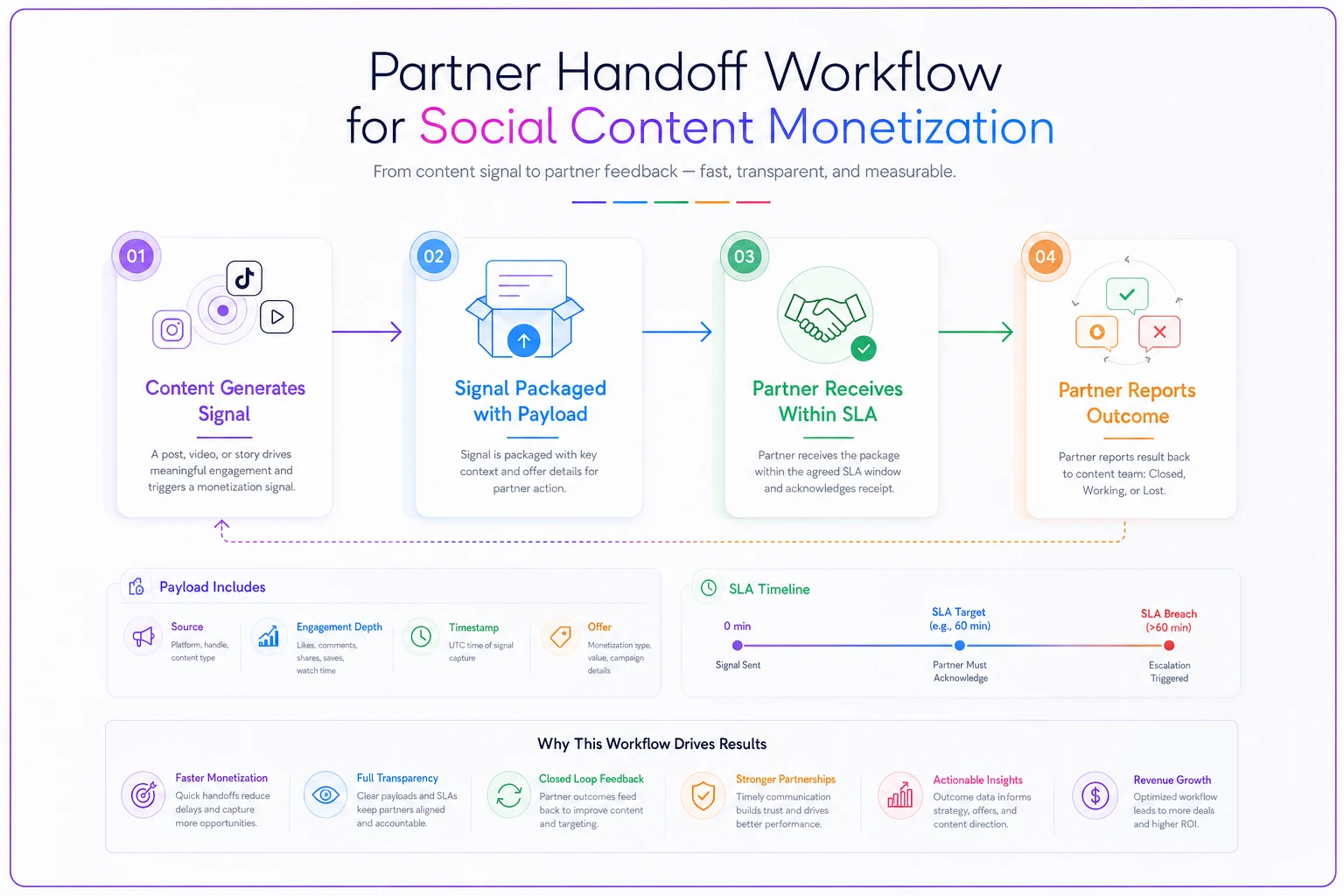
The pattern worth internalizing: monetization is only as good as its weakest handoff. You can have clean attribution and still lose the money at the seam between content and whoever closes the revenue.
KPI thresholds: stop promoting noise into decisions
Thresholds are the least glamorous lever and the one that saves the most wasted spend. Without them, every metric wiggle becomes a meeting, and weak content gets promoted into paid budgets because it "felt like a winner."
The core idea: a metric shouldn't trigger a monetization action until it clears a threshold that actually means something. A post with 12 link clicks isn't a scaling signal. It's noise wearing a costume.
Some workable threshold defaults for a mid-size team:
-
Minimum volume before you read a rate. Don't act on click-through or conversion rate below roughly 500 impressions or 50 clicks. Small denominators lie.
-
A signal must repeat. One strong post is luck. A content pattern that clears your target CTR across three posts is a signal worth funding.
-
Cost thresholds for indirect paths. If a lead-gen content type produces leads above your target cost-per-qualified-lead for two consecutive cycles, it gets paused or reworked — not defended.
-
Renewal-risk threshold for sponsorships. If engagement on sponsored content drops more than roughly 20% below the average you sold the partner, flag it before the renewal conversation, not during.
When evaluating repeating signals, use a rolling 3-post window so individual outliers don't trigger budget shifts.
When organic content clears these thresholds, that's your cue to test it as paid — which is a different discipline with its own signal gates. The full loop for turning proven organic into disciplined paid tests is in turning organic winners into predictable paid tests, and thresholds are what keep that loop from turning into "boost the post the boss liked."
A small experiment catalog: mapping content types to monetization paths
Most playbooks skip this part — actual experiments that connect a content type to a monetization path, with a measurement recipe attached. Pick one, run it clean, and you'll learn more than a quarter of dashboard-staring.
Experiment 1 — Shoppable short-form → direct sales
-
Hypothesis
Product-in-use short videos convert better than product-feature videos.
-
Setup
6 videos, split evenly between the two styles, same product, same link mechanism.
-
Recipe
Measure checkout completions per 1,000 views. Require 500+ views per video before reading. Winner = the style with higher completion rate across at least 2 of 3 videos in its group.
Experiment 2 — Educational carousel → indirect lead capture
-
Hypothesis
A "mistakes to avoid" carousel drives more gated downloads than a "how-to" carousel.
-
Setup
Two carousel formats, one gated asset, unique link per format.
-
Recipe
Track form submits per link, then follow those leads for 30 days for qualified status via the handoff loop. Judge on qualified leads, not raw submits.
Experiment 3 — Creator collab → affiliate revenue
-
Hypothesis
Discount-code creators outperform link-only creators for first purchase.
-
Setup
Matched creators, one gets a code, one gets a tracked link.
-
Recipe
Code redemptions vs tracked-link purchases over a 7-day window. Code is source of truth; reconcile against platform numbers but don't let the platform win the tiebreak.
Experiment 4 — Awareness series → branded search lift (indirect)
-
Hypothesis
A 3-week narrative series lifts branded search enough to justify its cost.
-
Setup
Run the series in one window, hold a comparable prior window as baseline.
-
Recipe
Compare branded search volume and direct traffic in the series window vs baseline. Report as a lift range. Do not attribute individual sales — this is a lift measurement, not a conversion count.
Two direct paths, two indirect, each with a different owner and a different judging metric. Running one experiment from each column per quarter keeps your monetization understanding balanced instead of overweighted toward whatever's easiest to measure.
When this level of rigor actually makes sense
Not every team needs formal attribution rules and handoff SLAs. If you're a small team running mostly awareness content with one occasional affiliate link, this is overkill — you'll spend more on measurement overhead than you'll recover in insight.
-
You have more than one monetization path running at once — say, affiliate plus lead-gen plus sponsorships.
-
Money is changing hands with partners and disagreements over numbers are already happening.
-
Someone in finance or leadership is asking content to justify budget in revenue terms, not reach terms.
Who should not do this yet: teams still fighting basic publishing consistency, or teams without a single owner for either the direct or indirect path. Attribution rules with no owner just become another abandoned spreadsheet. Fix ownership first.
A real scenario: a DTC skincare brand's mixed funnel
A small DTC skincare brand — roughly $40k–$50k in monthly revenue, two-person social team — was running shoppable posts, an affiliate program with about a dozen micro-creators, and an email-driven lead magnet, all measured in one blended dashboard.
The problem surfaced at renewal time. Their affiliate creators and the brand's own dashboard disagreed on sales by around 20%, every month. Payouts got tense. Meanwhile, the lead magnet was quietly producing the best long-term customers, but because those sales closed 3–4 weeks later, the dashboard credited them to whatever ad ran last. The content team kept being told the lead magnet "didn't convert."
The fixes were unglamorous. They assigned one primary conversion event per content type. They made unique affiliate codes the source of truth and stopped arguing about platform numbers. They set a 30-day follow window on lead-magnet leads with a simple closed-loop report from sales.
Nothing about the content changed. But within two cycles, the affiliate payout disputes basically stopped, and the lead magnet — once treated as a dud — got recognized as their most efficient acquisition channel and received more budget. Direct revenue held steady; the difference was they finally knew which content was actually earning it.
That's the whole point of these levers. They don't invent revenue. They stop you from misreading, misrouting, and underfunding the content that was making money all along.
The takeaway
Monetization on social isn't mostly a creative problem or a measurement-tool problem. It's a set of operational agreements: which event counts, who receives the signal, how fast they act, and what threshold turns a metric into a decision. Get those written down and applied consistently, and your content starts mapping to money in a way you can actually defend — to partners, to finance, and to yourself when you're deciding what to make next quarter.
Ready to amplify your brand’s voice?
Join 2,500+ marketers using Postyly to save time, boost engagement, and grow their audiences effectively.