

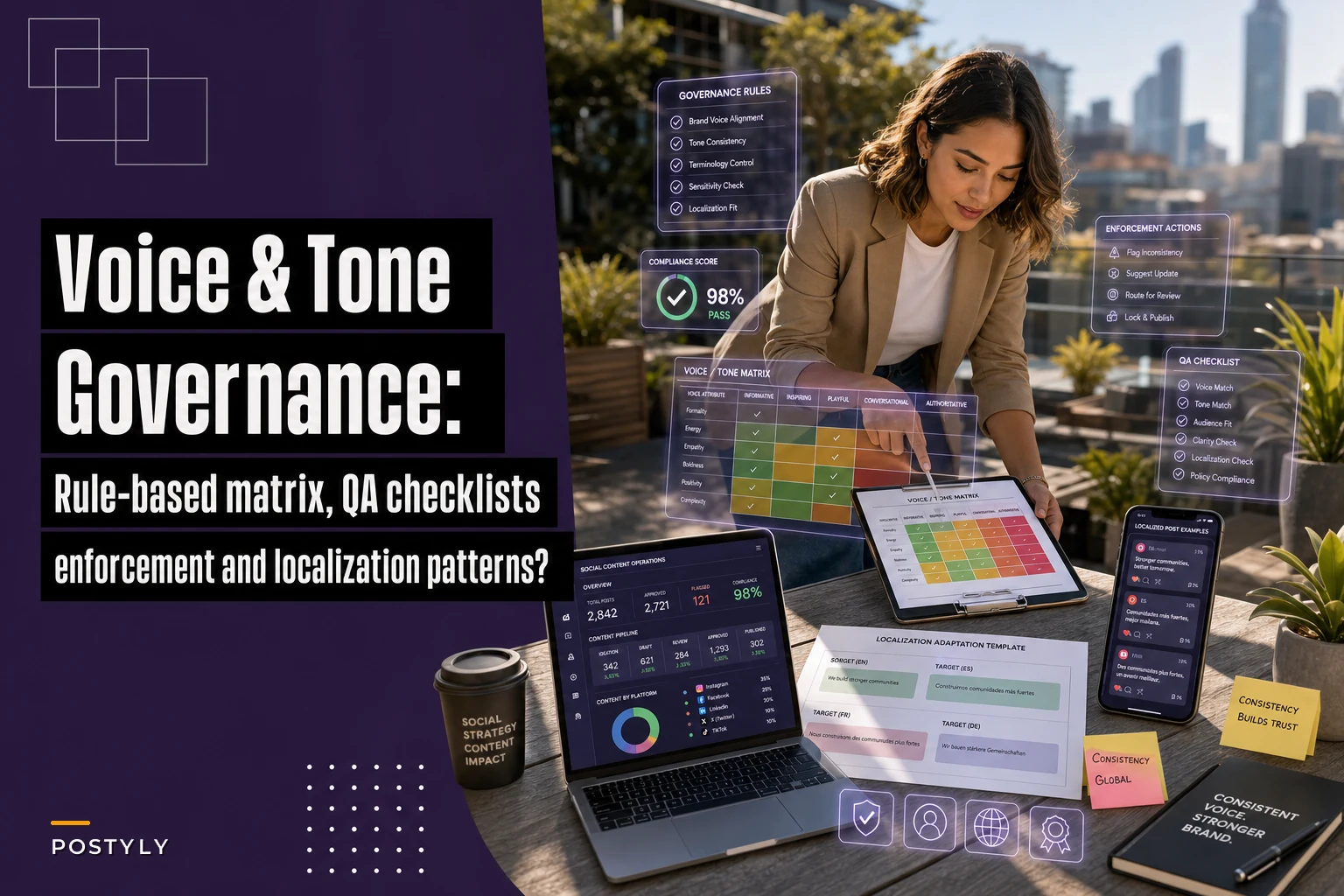

When a brand grows from three social writers to thirty, something weird happens to the voice. Nobody breaks it on purpose. But the Tuesday product post reads like a hype-man wrote it, the Thursday support reply sounds like a legal memo, and the localized German version comes out 30% colder than the English original because the translator "just translated it."
None of these are big mistakes. That's exactly the problem. Voice drift at scale isn't a single catastrophic post — it's a thousand tiny inconsistencies that slowly make your brand feel like six different companies sharing a logo.
This piece is about the governance layer that stops that: the rule-based voice/tone matrix, the QA checks, the enforcement steps, and the adaptation templates that let high-volume production teams and localizers stay on-brand without pinging the brand lead 40 times a day.
Why voice drifts the moment you scale past one writer
Voice stays consistent when one person writes everything, because the rules live in their head. The instant you add a second writer, half those rules become invisible. The new person doesn't know you never use exclamation points in support replies, or that you always say "members" and never "users."
-
Handoffs. A brief goes from strategist to writer to localizer to scheduler. Each pass loses a little context. By the time it publishes, the "warm but concise" tone the strategist intended has become "chatty and long."
-
Speed pressure. During a launch week or a surge, writers stop reaching for the guidelines and start writing on instinct. Instinct varies by person.
-
Platform bleed. A writer nails the LinkedIn voice, then copies 80% of it into TikTok because they're behind. Now your TikTok sounds like a quarterly report.
The pattern underneath all three: your voice guidelines are probably written as inspiration, not as rules a tired person can follow at 4:45pm. "Be authentic and human" is not something a localizer in another timezone can QA against. A rule-based matrix is.
The problem with "voice guidelines" as most teams write them
Most brand voice docs are essays. Three adjectives ("confident, friendly, clear"), a paragraph on personality, maybe a "we sound like / we don't sound like" table. Fine for onboarding. Useless for enforcement.
Stop managing your social media the hard way.
Postyly helps you plan, schedule, and analyze every post with precision.
- Multi-platform scheduling
- Real-time engagement tracking
- Automated performance reports
No credit card required
Here's the tell: if two writers can read your guidelines and produce two posts that both technically "follow" them but sound completely different, your guidelines aren't rules — they're vibes.
What high-volume teams actually need is a decision layer that converts vibe into checkable behavior. "Friendly" is a vibe. "Contractions allowed; second person 'you' preferred over 'the user'; max one exclamation point per post; no emoji in support replies" — those are rules. A localizer can follow them. A QA reviewer can catch violations in ten seconds. And they survive handoffs because they don't depend on anyone remembering the founder's original intent.
This connects to how you structure messaging across channels in the first place. If your core-message matrix already defines what you're saying per platform, the voice matrix defines how it sounds when you say it. The two documents should sit next to each other and reference the same platform list.
Building the rule-based voice/tone matrix
The matrix has two axes that most teams collapse into one — and that collapse is where scaling breaks.
Voice is constant. It's who the brand is regardless of context. Tone shifts by situation. You can be the same brand and still sound different in a celebratory launch post versus a service outage apology. Teams that only document "voice" end up with writers guessing at tone, and guessing produces drift.
Structure the matrix like this:
| Dimension | Voice (constant) | Launch/promo tone | Support/reply tone | Crisis/apology tone |
|---|---|---|---|---|
| Sentence length | Short-to-medium | Punchy, fragments OK | Medium, complete | Full sentences only |
| Contractions | Yes | Yes | Yes | Yes, but sparing |
| Emoji | Sparing | 1–2 max | None | None |
| Exclamation | Rare | 1 per post max | Never | Never |
| Pronoun | "you" / "we" | "you" | "you" / "we" | "we" (own it) |
| Humor | Dry, occasional | Allowed | Warm, never jokey | None |
| Banned words | corporate filler list | same | same | no minimizing words ("just," "simply") |
The banned-words row does more work than people expect. A short, shared list — words you never use ("leverage," "utilize," "revolutionary," "game-changer") plus words that carry the wrong tone in sensitive moments ("just," "simply," "obviously") — is the single easiest thing to QA and probably the most common source of tone bleed.
One thing worth noting: the crisis column is the one nobody fills out until they need it, at 11pm, mid-incident, when the on-call writer defaults to whatever tone they use for promos. Fill it in first, not last.
Adaptation templates for localizers
Localization is where voice governance either holds or falls apart completely. A translator's job, technically, is fidelity to meaning. But brand voice isn't in the meaning — it's in the register, the formality level, the willingness to use humor. A perfectly accurate translation can be completely off-brand.
The fix isn't better translators. It's giving them adaptation rules per market, not just translation tasks. This is the same logic behind treating localization as a rule-based process rather than a freeform one — the approach covered in localizing social content at scale applies directly here, extended specifically to voice.
An adaptation template for each market should lock down:
-
Formality register. English "you" is neutral; German has formal/informal, Japanese has multiple levels. Pick one and write it down so it's not a per-post decision.
-
Humor policy. Some markets
dry humor lands. Others: it reads as unserious for a brand. State whether humor transfers, gets adapted, or gets dropped.
-
Idiom handling. "Move the needle" doesn't localize. The rule should be: replace idioms with the intent, not a literal equivalent.
-
Length tolerance. German runs longer than English — sometimes noticeably so. If a caption has a character limit, the localizer needs permission to restructure, not just translate and overflow.
-
What must stay identical. Product names, legal disclaimers, the CTA verb. These don't get "adapted."
The pattern that kills brands: treating localization as translation plus a spellcheck. The pattern that scales: treating each market's adaptation template as a small extension of the voice matrix, with the same tone columns.
The QA checklist that actually catches drift
QA fails when it's subjective. "Does this sound like us?" produces different answers from different reviewers on different days. The checklist has to be binary — every item is a yes/no a reviewer can answer in seconds.
Use this as a pre-publish pass for every high-volume post:
-
[ ] Correct tone column applied for this post type (promo / support / crisis)?
-
[ ] Sentence length inside the range for this tone?
-
[ ] Contraction and pronoun rules followed?
-
[ ] Emoji count within limit for this platform + tone?
-
[ ] Exclamation count within limit?
-
[ ] Zero banned words present?
-
[ ] Product names and CTA verb exactly as specified?
-
[ ] (Localized posts) Formality register matches the market template?
-
[ ] (Localized posts) No literal idiom translations?
-
[ ] Disclaimers present and unchanged?
Ten items, most catchable in under a minute. The point isn't to slow publishing — it's to make the check so fast and objective that skipping it feels lazier than doing it.
Sample low-risk posts at a fixed rate (for example, 1 in 5) to catch systemic drift without gating publishing.
Worth flagging: don't route every post through a human reviewer. That creates the exact bottleneck governance is supposed to remove. Reserve human QA for the high-risk tone columns (crisis, sensitive support) and sample the rest — check 1 in 5 promo posts rather than all of them. You catch systemic drift without gating the whole calendar.
A workflow that enforces without bottlenecking
Here's how the pieces fit together in an actual production flow, from brief to publish:
-
Brief tags the tone column. The strategist writing the brief picks promo / support / crisis up front. This one field removes most guessing downstream.
-
Writer pulls the matching column. They write against that column's specific rules, not against the general vibe doc.
-
Self-QA on the checklist. Writer runs the binary checklist before submitting. Most violations get caught here, by the person who created them.
-
Localizers apply the market adaptation template. Not free translation — translation constrained by the market's register, humor, and idiom rules.
-
Sampled review. High-risk columns get full human review; low-risk gets spot-checked at a set rate.
-
Violations feed back into the matrix. When the same rule gets broken repeatedly, the rule is probably unclear — fix the rule, not just the post.
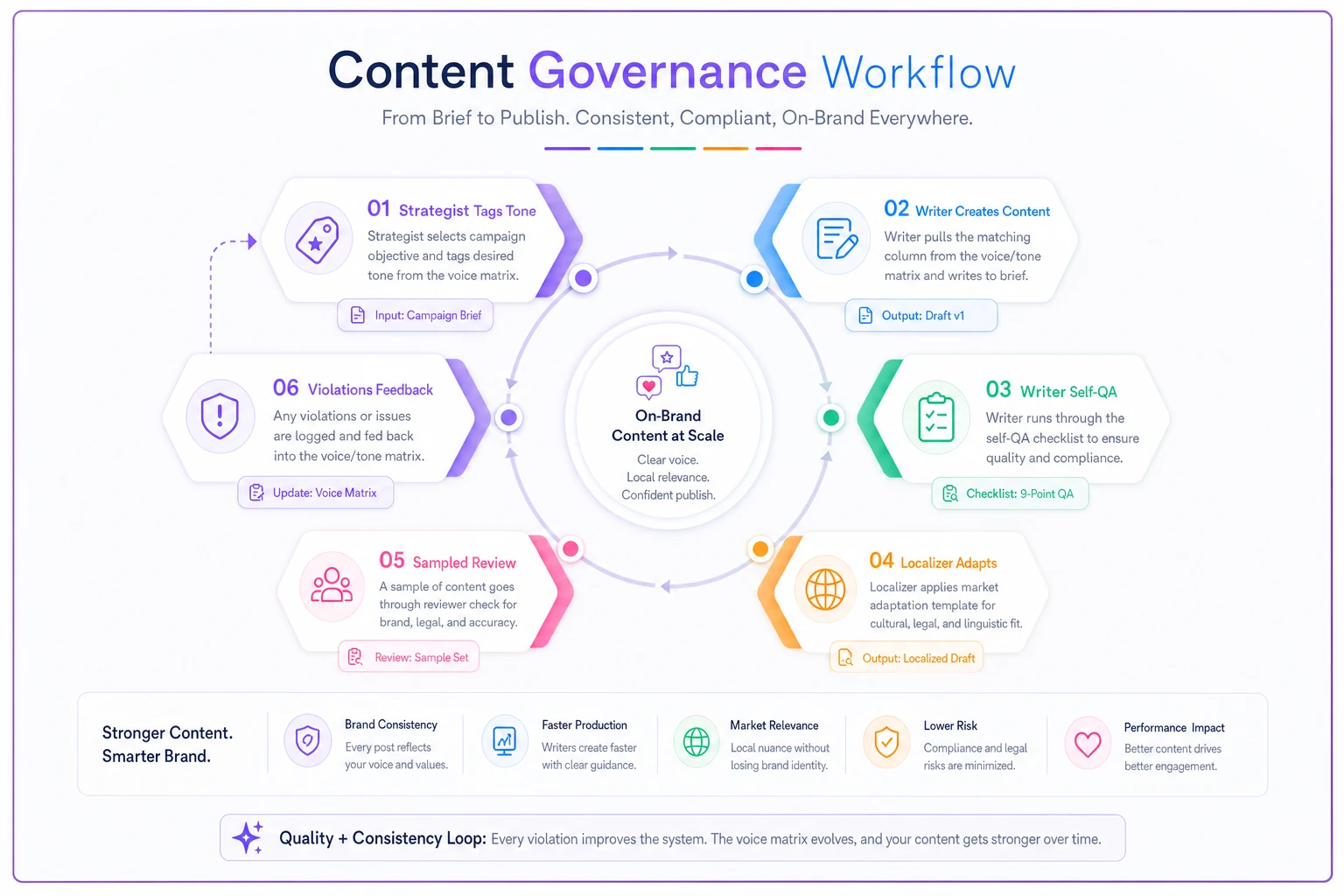
Visualizing the flow makes it clear where automation and sampling remove bottlenecks and where human review actually adds value.
That last step is the one teams skip and the one that matters most long-term. A repeated violation is data. If four writers keep breaking the same emoji rule, the rule is ambiguous or wrong. Governance that only punishes drift, and never updates itself, slowly turns into a document nobody trusts.
A real scenario
A mid-size DTC skincare brand ran social in five languages with a core team of about six, plus a rotating pool of freelance writers and two localization vendors. They had a voice doc — a nice one, three adjectives and a personality paragraph.
The symptom: their French and German channels had noticeably lower engagement on the same campaigns, and their support replies were generating occasional complaints about sounding "cold" or "robotic." The brand lead was spending somewhere around 8–10 hours a week rewriting posts before they went out — essentially acting as a human QA filter for the whole team.
They didn't hire anyone. They built a tone matrix with four columns, a per-market adaptation template for French and German, and the ten-item checklist. Writers self-checked; the brand lead moved to sampling instead of reviewing everything.
Within a couple of months, the brand lead's rewrite time dropped to roughly two hours a week — mostly on crisis and sensitive posts, which is where a human actually adds value. The German channel's engagement gap narrowed once the formality register was fixed (they'd been defaulting to informal "du" in a context where formal read as more trustworthy). Nothing dramatic overnight, but the drift stopped compounding, which was the real win.
When this is worth building — and when it isn't
Build it when: you have more than a handful of writers, you're localizing into two or more markets, or you're pushing high enough volume that no single person can review everything. That's exactly when informal, in-someone's-head rules stop working.
Skip the heavy version when: you're a team of one or two writing in one language. You'd spend more time maintaining the matrix than it saves. A short "we sound like / we don't" doc is plenty at that scale.
Be careful if: your brand voice genuinely isn't settled yet. Governing a voice you haven't defined just locks in confusion. Get the voice roughly right with a small team first, then build the enforcement layer once it's stable enough to codify.
The failure mode to avoid on the other end is over-governance — a matrix so detailed that writing becomes compliance and every post reads like it passed a form. Rules should remove the wrong kinds of variation (drift, off-brand tone, bad localization) while leaving room for the right kind (a genuinely good, human-sounding post). If your matrix is killing personality, you've written too many rules, not too few.
Where the leverage actually is
Voice consistency at scale isn't a talent problem. Your writers are probably fine. It's a translation problem — turning an intent that lives in one person's head into checkable rules that survive handoffs, timezones, and launch-week pressure.
The teams that hold their voice across 40 writers and 8 regions aren't the ones with the most inspiring brand book. They're the ones who did the unglamorous work of writing down what "friendly" actually means as a set of yes/no decisions, then made those decisions easy enough to check that nobody skips them. Get that layer right and voice governance stops being a bottleneck and starts being the thing that lets you scale without sounding like it.
Get that layer right and voice governance stops being a bottleneck and starts being the thing that lets you scale without sounding like it.
Ready to amplify your brand’s voice?
Join 2,500+ marketers using Postyly to save time, boost engagement, and grow their audiences effectively.