



Most segmentation decks die in the same place: a beautiful slide with four personas, color-coded, each with a cute name and a fake quote. Then the content calendar gets built from habit anyway — whatever's trending, whatever the brand lead liked last quarter. The segments never touch the publishing workflow. They were a planning artifact, not an operating input.
That gap — between knowing your audience slices and activating them — is where almost every organic program leaks effort. You can have sharp audience insight and still publish the same undifferentiated feed because nothing in your workflow forces a segment to drive a decision.
This isn't a post about building personas. You already know how to do that. This is about wiring segments into content pillars, activation rules, and measurement so the whole thing runs as a system — one that holds up when you go from posting 20 times a month to 200, and from one brand to six.
Why segmentation collapses the moment it meets a calendar
The core failure is that segmentation lives in a strategy document and activation lives in a scheduler, and nothing connects them. A planner opens the calendar on Monday and starts filling slots. There's no field that says "this post serves Segment B." There's no rule that says "Segment B gets targeted treatment, not broadcast." So every post defaults to broadcast — written for everyone, which in practice means written for no one.
Audience segmentation for organic social only works when a segment produces a constraint on what gets published. If knowing someone is in your "lapsed power user" slice doesn't change the pillar, the format, the hook, or the channel, the segment is decorative.
A second failure shows up in measurement. Teams report on aggregate reach and engagement, so segment-level performance is invisible. You can't tell whether your "early-career professionals" content is working because it's blended into one average. Averages hide everything. A segment that's quietly dying looks fine as long as another segment is carrying the number.
The teams that actually move segment metrics tend to be the ones who made segmentation a tagging discipline first — before any clever content strategy. Every post carries a segment tag and a pillar tag at publish time. That single habit makes the rest of the framework possible.
The three layers that make segmentation operational
Think of this as three connected layers. Skip one and the chain breaks.
Stop managing your social media the hard way.
Postyly helps you plan, schedule, and analyze every post with precision.
- Multi-platform scheduling
- Real-time engagement tracking
- Automated performance reports
No credit card required
Layer 1 — Audience slices. Not demographic personas. Behavioral slices tied to how people actually interact with your content and product. "Watched a tutorial but never signed up." "Signed up, went quiet for 60+ days." "Comments regularly, never shares." These are observable things content can actually move.
Layer 2 — Content pillars. The durable themes your brand owns. Each pillar has a job. Education, proof, community, product, culture — whatever fits your brand. The pillars stay stable; the slices rotate through them.
Layer 3 — Activation rules. The logic that connects a slice to a pillar and tells the team how to publish for it: targeted or broadcast, which channel, which format, what cadence. This is the layer everyone skips, and it's the only one that turns the first two into action.
The mapping between these layers is where the real work is. A single pillar serves multiple slices, but not the same way. Your "proof" pillar might reassure a skeptical lapsed user with a case study while giving an active advocate something they actually want to share. Same pillar, different activation.
This is also where a strong core message matrix earns its keep — it keeps the pillar message consistent across platforms while the activation layer varies the treatment per slice.
Mapping slices to pillars without creating chaos
The instinct is to build a giant grid: every slice crossed with every pillar, every cell filled. Don't. You'll generate 40 "content needs" and ship none of them well.
The better approach is to give each slice a primary pillar and one secondary pillar, and ignore the rest. A slice doesn't need to be served by all your content. It needs one theme that reliably moves it and one that supports it.
| Audience slice | Primary pillar | Secondary pillar | Activation mode | Primary channel |
|---|---|---|---|---|
| Lapsed users (60+ days quiet) | Proof / results | Product updates | Targeted | Email-linked posts, retargetable formats |
| Active advocates | Community | Culture | Targeted | Stories, shareable formats |
| Curious-but-unconverted | Education | Proof | Broadcast → targeted | Feed, short video |
| Cold reach / discovery | Education | Culture | Broadcast | Short video, searchable formats |
| Power users | Product depth | Community | Targeted | Long-form, comments, groups |
The activation mode column does real work here. Cold discovery audiences are a broadcast problem — you're casting wide, optimizing for reach and saveability. Advocates and lapsed users are targeted problems — smaller slices, higher intent, worth tailored treatment even though the absolute reach numbers are lower.
The mistake is treating every slice as a broadcast opportunity because broadcast feels efficient. Your highest-value segments are usually your smallest, and they respond to specificity, not scale.
Targeted vs broadcast: the decision most teams get backwards
Broadcast content goes to the whole feed and lives or dies by the algorithm. Targeted content is built for a specific slice and often reaches them through a narrower path — a Story seen mostly by followers, a reply in a community thread, a post timed and formatted for people already in your orbit.
Worth internalizing: broadcast grows the top of the funnel; targeted moves people through it. Teams that are stuck often have the ratio wrong — 90% broadcast, chasing reach, wondering why reach never converts to anything. The reach is real, but nothing catches it and moves it forward.
When targeted activation makes sense:
-
The slice is small but high-value (advocates, power users, lapsed-but-recoverable)
-
You have a behavioral signal that someone belongs to the slice
-
The content requires context the cold audience wouldn't have
-
You're trying to change a behavior, not create awareness
When broadcast is the right call:
-
You're filling the top of the funnel
-
The slice is too small or too unobservable to target reliably
-
The content is genuinely useful to a wide audience and you want saves/shares to compound reach
-
You're testing a new pillar and need volume to read signal
When targeted is a bad idea: when you don't actually have a reliable mechanism to reach the slice. A lot of "targeted" organic content is really just niche broadcast that the team hopes finds the right people. If you can't name the delivery mechanism, it's broadcast — treat it that way and set expectations accordingly.
The sequencing between the two matters too. The same person shouldn't get hit with broadcast and targeted messaging in a way that feels redundant or exhausting. Getting the post sequencing right is what keeps a multi-slice program from fatiguing the exact people you're trying to keep engaged.
KPI mappings per segment: stop reporting one average
If there's one change that pays off fastest, it's assigning each slice its own primary KPI. The reason aggregate reporting feels unsatisfying is that different slices have different jobs, and judging them all by the same metric guarantees half of them look like failures.
-
Cold / discovery slice → reach, saves, follower growth. You're measuring whether the content earns distribution to strangers.
-
Curious-but-unconverted → profile visits, link clicks, consideration signals. Reach already happened; now you're measuring pull toward the next step.
-
Active advocates → shares, mentions, UGC volume. The job is amplification, not clicks.
-
Lapsed users → reactivation signals — returning comments, clickthroughs from win-back posts.
-
Power users → depth — comment quality, community participation, retention-linked engagement.
The insight most teams miss: a post can underperform on the aggregate dashboard and still be a win for its slice. A win-back post aimed at lapsed users will almost never beat a broadcast reel on raw reach. Judge it on reach and you'll kill it. Judge it on lapsed-user clickthrough and you'll see it's doing exactly its job.
Segment KPIs have to sit inside your broader measurement model, not float next to it. If you've already built a funnel-to-metric matrix, segment KPIs slot in as the row-level detail — they tell you which audience is driving each funnel metric, not just that the metric moved.
The activation pipeline: from slice to published program
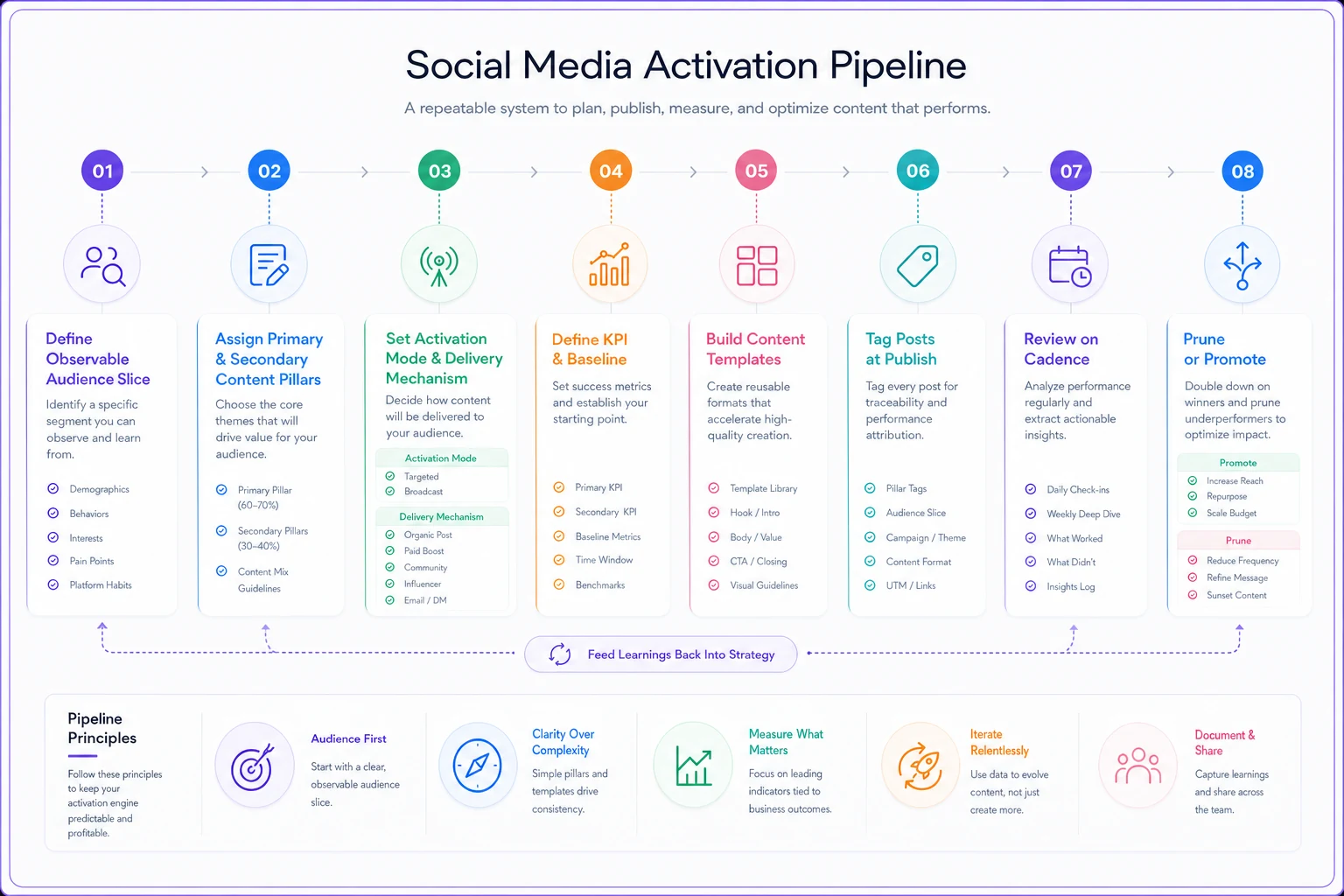
A segment becomes a repeatable program when there's a defined path from "we identified this slice" to "content ships on a cadence and gets measured against its own KPI." The pipeline that actually holds up:
-
Define the slice with an observable signal. Not "busy professionals" — "opened app fewer than 2 times in the last 45 days" or "follows us but hasn't engaged in 30 days." If you can't observe it, you can't activate or measure it.
-
Assign primary + secondary pillar. One each. Write down why that pillar should move that slice.
-
Set the activation mode. Targeted or broadcast, with the delivery mechanism named explicitly.
-
Define the slice KPI and a baseline. What does this slice do now? You need the before number or you can't claim improvement later.
-
Build 3–4 content templates for the pillar/slice combo. Reusable formats, not one-off posts.
-
Tag every post at publish with slice + pillar. Non-negotiable. This is what makes measurement possible.
-
Review on a fixed cadence — weekly for active slices, monthly for slower ones like lapsed users.
-
Prune and promote. Kill slice/pillar combos that don't move their KPI after a fair window. Scale the ones that do.
The step people quietly skip is #6, and it quietly breaks everything downstream. Without consistent tagging, your segment report becomes a reconstruction project every month — someone manually sorting posts by vibe. That doesn't scale past a few dozen posts, and it definitely doesn't survive multiple brands or a growing team.
Make tagging non-optional at publish time — it's the single habit that enables accurate segment reporting.
This is where having a central operational tool helps more than any clever content idea. When your scheduling and analytics setup forces a slice tag and pillar tag at publish — and rolls those up into segment-level reporting automatically — the framework runs itself instead of depending on one diligent person remembering to do it. The point isn't the tool; it's that the tagging discipline has to be structural, not voluntary.
A simple visual shows the pipeline from slice definition to published program.
The point isn't the tool; it's that the tagging discipline has to be structural, not voluntary.
A ready-to-use activation template
Copy this structure for each slice you activate. Keep it to one screen.
-
Slice name
-
Observable signal (the exact rule that defines membership)
-
Estimated size (rough is fine)
-
Primary pillar / secondary pillar
-
Activation mode targeted / broadcast
-
Delivery mechanism (how content actually reaches them)
-
Primary KPI + baseline
-
Cadence (posts per week/month)
-
Content templates (3–4 reusable formats)
-
Review window (when you judge it)
-
Kill criteria (the number that means stop)
The kill criteria line is the one teams resist and the one that keeps the system healthy. Without it, every program lives forever because no one wants to admit their slice idea didn't work. Define the failure condition before you're emotionally attached to the program.
A real scenario: a mid-size DTC skincare brand
A skincare brand with around 85k followers was posting roughly 24 times a month across Instagram and TikTok, all broadcast. Reach was fine — a few hundred thousand monthly — but repeat purchase from social-attributed customers was soft, and the team couldn't explain why. Everything was one average.
They broke the audience into four slices and gave two of them real activation: curious-but-unconverted (profile visitors who never bought) got an education-primary, proof-secondary program on the feed; lapsed buyers (no purchase in roughly 90 days) got a targeted win-back program using Stories and retargetable formats tied to email.
Content volume didn't change much — they reallocated existing slots rather than adding work. What changed was that each slice now had its own KPI and its own templates. Over about two months, the lapsed-buyer program's clickthrough on win-back posts climbed from near-nothing to a steady, consistent lift that aggregate reporting had completely hidden before. The curious-but-unconverted slice's profile-visit-to-click rate improved enough that the team finally had a believable story for how organic was contributing to consideration.
The real win wasn't the numbers. It was that they could finally say which content was doing which job. That's what segmentation is supposed to buy you.
What breaks as you scale
At one brand with one planner, you can hold all of this in your head. The map lives in a spreadsheet, tagging is manual, and it works because one person remembers everything.
-
Tag drift. Two people tag the same slice differently. Your segment report splits in half and both halves look weak.
-
Pillar sprawl. Everyone invents new pillars for their pet content. Soon you have 14 pillars and no discipline, and slice-to-pillar mapping becomes meaningless.
-
Orphaned slices. A slice gets defined, activated once, and forgotten because no review cadence owns it. It quietly consumes calendar slots for months.
-
Measurement that can't aggregate. Each brand reports segments differently, so you can't compare across the portfolio or roll anything up for leadership.
The fix is governance, not more hustle. Lock the pillar list. Standardize slice definitions and their observable signals so "lapsed" means the same thing everywhere. Make tagging structural at publish time instead of a manual afterthought. Give every active slice a named owner and a review cadence so nothing becomes an orphan.
When this framework is overkill
Not everyone needs this. If you're a small team posting a handful of times a week with one clear audience, forcing four slices and per-segment KPIs will just add overhead you can't pay back. Broadcast well, watch your aggregate numbers, and revisit segmentation when you actually see distinct behaviors worth serving differently.
The signal that you're ready is simple: when aggregate reporting stops explaining your results. When "engagement went up" doesn't tell you who or why, and you're making content decisions blind — that's the moment segment-level activation starts paying for itself.
Bringing it together
Segmentation fails when it stays a planning exercise. It works when every slice produces a constraint on what gets published, a mode for how it's delivered, and a KPI it's judged against — all wired into the same workflow where content actually ships. The map, the activation rules, the tagging discipline, and the per-segment measurement are one connected system. Pull any single piece out and the rest collapses.
Start with two slices, not eight. Give each a pillar, an activation mode, a KPI with a baseline, and a kill criterion. Tag everything. Review on a cadence. Prune what doesn't move. That's a repeatable organic program — not a prettier persona deck.
Start with two slices, not eight. Give each a pillar, an activation mode, a KPI with a baseline, and a kill criterion. Tag everything. Review on a cadence. Prune what doesn't move. That's a repeatable organic program — not a prettier persona deck.
Ready to amplify your brand’s voice?
Join 2,500+ marketers using Postyly to save time, boost engagement, and grow their audiences effectively.