


Most rollouts don't fail because the new system is bad. They fail because nobody accounted for how a social team actually spends its day — the 4pm scramble to reslot a post, the DM from legal that changes a caption twenty minutes before publish, the freelancer who lives in a completely different tool than everyone else. You drop a new workflow into that environment and expect it to stick, and instead you get quiet sabotage. People keep the old spreadsheet open "just in case." Approvals still happen over Slack. Six weeks later leadership asks why adoption is at 30%.
A real social media change management playbook isn't a training deck and a launch email. It's a plan for the messy middle — the period where the old way and the new way run in parallel and everyone's confused about which one is real. This post walks through how to structure that middle so the system actually takes hold, using a 90-day pilot as the backbone. Stakeholder mapping, role-based artifacts, adoption KPIs, and escalation paths that respect how social work actually flows.
Why social rollouts break differently than other rollouts
Social teams have a coordination problem that most operational rollouts don't face: the work is time-sensitive, cross-functional, and public. A finance team migrating to a new tool can afford a slow week. A social team can't, because there's a live campaign shipping and a comment section that doesn't wait.
That creates a specific failure mode. When a new system adds even small friction — one extra approval click, one more field to fill — people route around it under deadline pressure. And because social work is bursty, the deadline pressure is constant. So the workaround becomes the norm before the system ever gets a fair trial.
The second issue is fragmented ownership. In a mid-size team, a single post might touch a strategist, a designer, a copywriter, a paid specialist, a community manager, and someone in legal or brand. Each of those people has a different reason to care about the new system — and a different reason to resist it. Roll it out the same way to all of them and you've written training that's half-irrelevant to everyone.
What tends to happen across social operations is that rollouts collapse at the handoff points — the exact seams between roles — not inside any single person's work. That's what most playbooks miss.
Start with stakeholder mapping, not the tool
Before you touch a timeline, map who wins and who loses from the change. Not "who's involved" — who actually experiences a cost or benefit, and how loudly they can complain.
Stop managing your social media the hard way.
Postyly helps you plan, schedule, and analyze every post with precision.
- Multi-platform scheduling
- Real-time engagement tracking
- Automated performance reports
No credit card required
| Group | Daily impact | Influence | How to handle in the pilot |
|---|---|---|---|
| Power users (e.g. content leads, ops manager) | High | High | Co-design with them early; they become your internal champions |
| Blockers (e.g. legal, brand review) | Low-medium | High | Get their sign-off on the approval flow, not the whole tool |
| Daily doers (designers, copywriters, community) | High | Low | Role-specific training only; protect them from irrelevant complexity |
| Occasional users (execs, adjacent teams) | Low | Medium | One dashboard view, zero training, no new logins if possible |
The mistake is spending equal energy on all four. Occasional users get a read-only dashboard and a two-line explainer. Daily doers need the most careful onboarding because they're the ones who'll silently abandon the system. And blockers — legal, brand, sometimes a nervous VP — need to be pulled in early on the specific piece they control, usually approvals, so they don't torpedo the whole thing at the last gate.
Map for silence, not just for noise.
One pattern worth naming: the loudest person in the room is rarely your biggest adoption risk. The quiet designer who nods in the kickoff and then keeps working in the old file for three weeks — that's who sinks the rollout.
The 90-day pilot, broken into three phases
Ninety days is enough time to prove the system works without letting the pilot drag into permanent limbo. Each 30-day block has a different job.
-
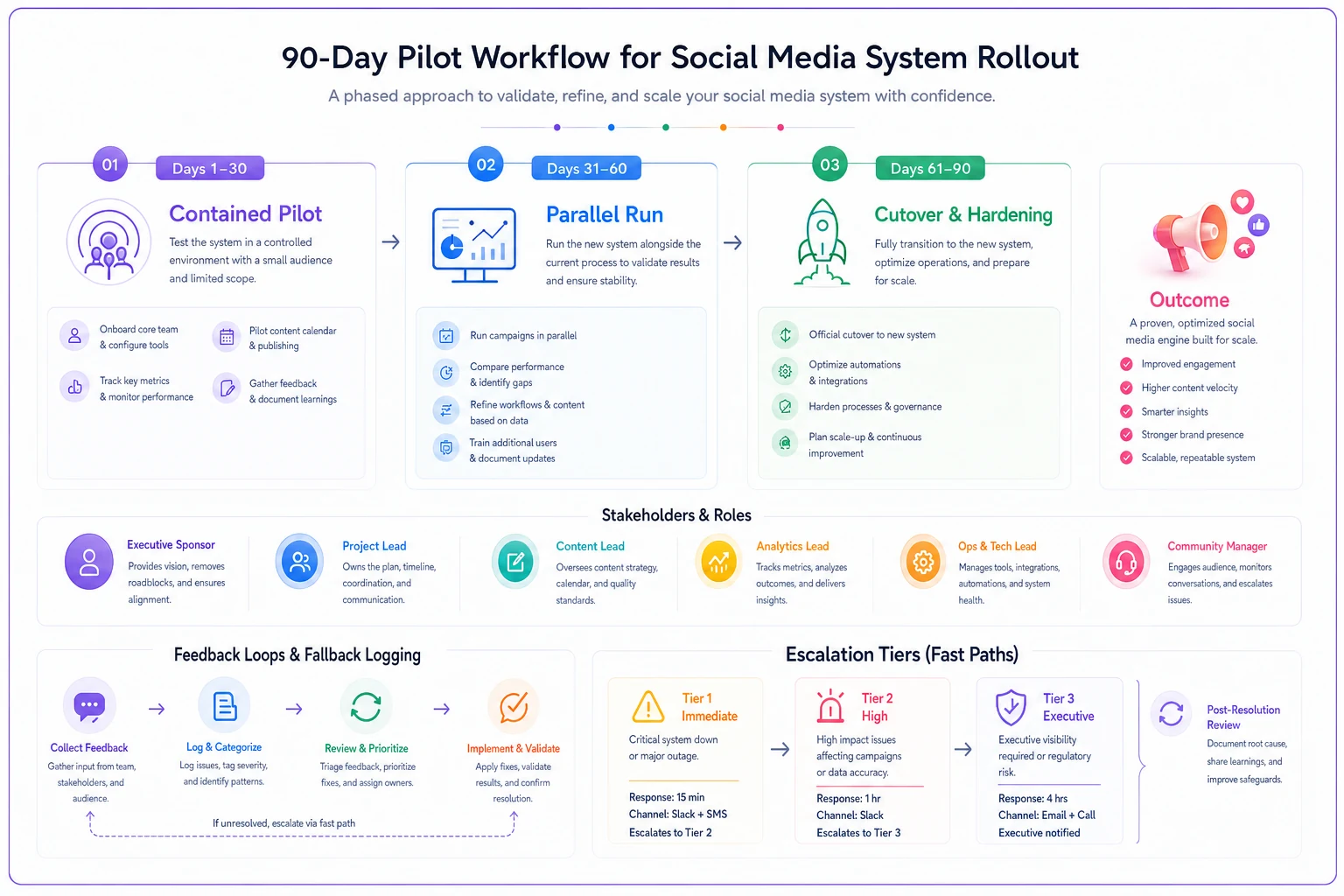
Days 1–30 — Contained pilot. Pick one workflow and one small group. Not the whole team, not every platform. Something like "all organic Instagram and TikTok posts for one brand, run by three people." You want a real, complete workflow end to end — brief to publish to archive — but scoped small enough that failures are recoverable and visible.
-
Days 31–60 — Parallel run. Expand to a second workflow or a second pod, and now you deliberately run old and new side by side. This is where you collect the honest data: where do people still fall back to the old way, and why? Every fallback is a design bug, not a discipline problem. Log them.
-
Days 61–90 — Cutover and hardening. Kill the old workflow for the piloted scope. This is the step teams skip, and it's why so many rollouts never finish — they leave the escape hatch open forever. If the parallel run went well, the old system should feel redundant by now. If people still cling to it, the pilot wasn't actually done.
The reason this beats a big-bang launch: you find the seam failures in the contained phase when they cost you almost nothing, instead of in front of the whole department during a live campaign.
A note on scope creep. Someone always wants to add "just one more workflow" in week two. Resist it. The pilot is a controlled test, and every added variable makes it harder to tell what's actually breaking. If you're managing five workflows across three teams by day 20, you didn't pilot anything — you did a big-bang launch and called it a pilot.
Role-based training artifacts (stop making one deck for everyone)
The single highest-leverage change you can make to a rollout is throwing away the one-size-fits-all training session. Nobody needs to learn the whole system. They need to learn their slice of it, and how their slice hands off to the next person.
-
"training artifact" here isn't a course — it's usually a one-page workflow map, a two-minute Loom, and a quick-reference card.
-
Content strategist / lead how briefs enter the system, how they assign, how they track status across the pipeline. This role needs the full picture; everyone else needs less.
-
Designer / video editor where they pick up work, where they drop finished assets, what fields they must fill so the next person isn't blocked. That's it.
-
Copywriter where captions live, how versioning works, how they know a piece is approved vs. in review.
-
Paid specialist how organic winners get flagged and passed into paid testing, and what metadata they inherit.
-
Community manager what they can see and act on post-publish, and how issues escalate.
-
Legal / brand reviewer only the approval queue. Nothing else. Do not make them learn the tool.
The failure mode with training is over-explaining. When you show a designer the analytics governance module they'll never touch, you're teaching them the system is complicated and not for them. Ruthless relevance builds confidence faster than completeness.
If you're building these role definitions from scratch, it helps to have your operating cadence already documented — the way roles, SLAs, and a weekly sprint fit together is covered well in this breakdown of repeatable social content operations for mid-size teams, and it's worth aligning your training artifacts to whatever sprint structure you're already running.
Adoption KPIs that actually mean something
Login counts lie. Someone can log in daily and still run all their real work in a spreadsheet. You need KPIs that measure whether the workflow moved, not whether people opened the app.
-
Percent of pieces that went brief-to-publish inside the system — not partially, fully. This is your core adoption signal.
-
Fallback rate — how often work happened in the old tool or in Slack instead. You want this trending toward zero across the parallel-run phase.
-
Handoff latency at the seams — how long an asset sits between "designer done" and "copy picked it up." Rollouts that improve this are usually real; rollouts that don't are usually theater.
-
Approval cycle time — did the new gate speed things up or add drag? If legal review got slower, adoption will quietly die there.
-
Rework rate — how often something bounces back because a field was missing or a version was wrong.
Set thresholds before the pilot, not after. A reasonable target might be: 80%+ of piloted pieces fully in-system by day 60, fallback rate under 15% by day 75. The exact numbers matter less than picking them in advance so you can't rationalize a failing pilot as a success.
One thing people miss: a temporary dip in speed during the parallel-run phase is normal. People are learning. If you panic and roll back at the first slow week, you'll never get through the dip to the improvement on the other side. Watch the trend line across weeks, not any single week.
Escalation plans built around social timing
Social work has a clock on it, so your escalation plan can't be a ticket that gets answered in two business days. When the new system blocks a publish that needs to go out in an hour, people need a fast, clear path — otherwise they'll bypass the system entirely, and that bypass becomes permanent.
-
Tier 1 — Blocked but not time-critical. Async question, answered same day by a designated pilot lead. Log it, because a cluster of Tier 1 issues in one area usually points to a design flaw.
-
Tier 2 — Blocked with a same-day deadline. Direct ping to the pilot owner with a defined response window (say, 30 minutes). There's a documented manual workaround so the post still ships.
-
Tier 3 — Live campaign or crisis. Pre-agreed permission to bypass the new system for that one instance, with a required post-mortem afterward. The bypass is allowed because it's rare and logged — which keeps it from becoming the norm.
The part most teams miss: escalation data is your best redesign input. Every Tier 2 and Tier 3 event is telling you exactly where the system doesn't fit real work. If half your escalations come from the approval gate, the gate is wrong. Treat the escalation log as a bug tracker for the rollout itself.
A real scenario
A mid-size consumer brand's social team — around eight people plus two freelancers — was moving from a tangle of shared drives, spreadsheets, and Slack threads into a single content operations system. A previous attempt six months earlier had stalled at roughly 40% adoption because they launched everything to everyone at once, then couldn't tell why half the team ignored it.
The second attempt used the phased pilot. They started with just the organic content pod — three people, two platforms — for the first month. Fallback to the old spreadsheet was high early on (people reached for it maybe a third of the time under deadline pressure), but because it was logged, they found the cause: the approval step was pinging legal for posts that didn't need legal review. They fixed the routing rule, and fallback dropped to under 15% within a couple of weeks.
By the end of the 90 days, brief-to-publish inside the system was sitting somewhere around 85% for the piloted scope, and handoff latency between design and copy dropped noticeably — a step that used to sit overnight was clearing in a few hours. Nothing dramatic on paper, but the difference from the first attempt was that this time it stuck. Expanding to the paid and community pods afterward took a fraction of the effort because the workflow was already proven.
Getting the archive and reuse side working was part of why it held — pairing the rollout with a clear creative lifecycle from brief to archive meant finished assets didn't vanish into someone's desktop after publishing, which had been a major reason people distrusted the old setup.
When a formal pilot playbook makes sense (and when it doesn't)
This whole approach is overkill for a two-person team. If one person can hold the entire workflow in their head, a 90-day phased pilot with tiered escalation is bureaucracy for its own sake. Just switch tools and move on.
The formal playbook starts paying off when you have enough people that handoffs happen between individuals who don't sit next to each other, when legal or brand review is a real gate, and when stalled adoption doesn't just annoy you but actively slows down live campaigns. That's roughly the point where you've got specialized roles and cross-functional handoffs — the same threshold where operational maturity generally shifts, which the social content operations maturity model maps out in more detail by stage.
Who should not do this: teams still figuring out their basic workflow. If you don't yet know who owns what, a change-management pilot will just formalize the chaos. Get the underlying operating model roughly stable first, then roll out the system on top of it. Piloting a new tool over an undefined process is how you end up automating confusion.
The part that actually determines success
A social rollout lives or dies at the seams between roles, not inside anyone's individual work. People generally learn their own slice fine. What breaks is the handoff — the designer who doesn't know the copywriter is blocked, the approval that sits in a queue nobody's watching, the freelancer working in a tool no one else can see.
Build the whole plan around those seams. Map stakeholders by who feels the handoff friction. Train per role but emphasize the handoff. Measure latency at the joints. Escalate fast when the joints jam. Do that, and the 90 days do what they're supposed to — not just install a tool, but rewire how work actually moves through the team, in a way that survives the next live campaign instead of quietly reverting the moment things get busy.
Do that, and the 90 days do what they're supposed to — not just install a tool, but rewire how work actually moves through the team, in a way that survives the next live campaign instead of quietly reverting the moment things get busy.
Ready to amplify your brand’s voice?
Join 2,500+ marketers using Postyly to save time, boost engagement, and grow their audiences effectively.