


Most social teams don't fail because of bad ideas or weak talent. They stall because the operation underneath the content never grew up. A team that was fine posting 12 times a week suddenly needs to manage 40 assets across five markets, three approval layers, and a paid team that wants everything yesterday — and nothing about how they work has actually changed. Same tools, same folder chaos, same "who approved this?" Slack thread at 11pm.
A social content operations maturity model gives you a way to see where you actually are, not where your headcount suggests you should be. Team size and operational maturity are almost completely disconnected. There are 4-person teams running tight, efficient operations and 15-person departments still copy-pasting captions between spreadsheets. Maturity isn't about how many people you have — it's about how much of your operation survives when a key person is out for two weeks.
This piece walks through the stages, what the org chart and tooling should look like at each one, the roles you hire in what order, and a rough 12–18 month roadmap to move up a level without blowing everything up. There's also a diagnostic checklist at the end you can run against your own team.
Why "just hire more people" doesn't fix a broken operation
When output demand doubles, the instinct is to add bodies. More creators, more editors, more coordinators. But if your operation has no shared source of truth, no defined handoffs, and no approval logic, each new person adds coordination cost faster than they add capacity. The fifth hire makes the team slower, not faster, because now there are five people who all need context and no system that holds it.
The real bottleneck is rarely production. It's the space between production steps — the wait for approval, the hunt for the final file, the re-shoot because someone worked off an old brief. Those gaps don't show up on anyone's job description, so nobody owns them. And they compound as you scale.
That's why a maturity model matters. It forces you to fix the connective tissue — handoffs, ownership, tooling — at each stage, instead of throwing headcount at what's actually a structural problem.
The four stages of social content operations maturity
Most teams sit somewhere between Stage 1 and Stage 2 and think they're at Stage 3.
Stop managing your social media the hard way.
Postyly helps you plan, schedule, and analyze every post with precision.
- Multi-platform scheduling
- Real-time engagement tracking
- Automated performance reports
No credit card required
| Stage | What defines it | Team shape | Biggest risk |
|---|---|---|---|
| 1. Improvised | One or two people doing everything; knowledge lives in their heads | Generalist(s) | Total dependency on individuals |
| 2. Structured | Repeatable calendar, basic roles, but manual coordination | Small pod, shared calendar | Approval and handoff bottlenecks |
| 3. Coordinated | Defined SLAs, role separation, versioned assets, analytics loop | Specialized roles + ops owner | Cross-team friction, tool sprawl |
| 4. Scaled | Multi-market, governance, self-serve systems, predictable throughput | Pods by function/region + central ops | Bureaucracy, slow experimentation |
Stage 1 — Improvised
This is the founder-marketer, the solo social manager, or the two-person team where one person shoots and edits and the other writes and posts. Output can actually be really good at this stage because there's zero coordination overhead. One brain holds the whole strategy.
The problem becomes obvious the moment that person gets sick, quits, or goes on leave. Nothing is documented. The content calendar lives somewhere between memory, a notes app, and a half-finished spreadsheet. Passwords are in one person's browser. There's no version control — the "final" video is whatever's in the Downloads folder that day.
Org chart: Social Manager (does everything) → maybe a freelance editor.
Tooling milestone for this stage: a single shared content calendar and one asset folder with a naming convention. That's it. Don't buy a stack. The one upgrade that actually matters here is getting knowledge out of one person's head and into a shared doc — even a rough one.
The most common mistake at Stage 1 is buying enterprise tools way too early because a webinar convinced someone they needed them. You don't need an approval matrix when there's one approver. You need a place where the next person could find things.
Stage 2 — Structured
Now there's a small pod. Maybe a social manager, a designer, a video editor, and someone doing community management. There's a real calendar, a rough weekly rhythm, content going out consistently across a few platforms.
This is where the space between steps starts to hurt. The designer finishes a graphic, drops it in Slack, and it sits there until the manager notices. Someone posts a version with a typo because the corrected file was never re-shared. Approvals happen "whenever the manager gets to it," which might be same-day or might be Thursday.
Teams at this stage almost always underestimate how much time coordination eats. In practice, it usually shows up as a manager spending two or more hours a day just chasing status — where's the video, did legal see this, is the caption final. That's not strategy work. That's traffic control.
Org chart:
-
Social Manager (owns calendar + strategy)
-
Content Creator / Video Editor
-
Designer
-
Community Manager (often part-time or shared)
Tooling milestones:
-
A real content management workflow with statuses (draft → review → approved → scheduled → published)
-
A single asset library with versioning
-
A publishing/scheduling tool everyone actually uses
-
A lightweight preflight step before anything goes live
The move that unlocks Stage 2 → 3 is defining SLAs — how long each handoff is allowed to take — and making status visible so nobody has to ask. If you want the detailed blueprint for how a mid-size team runs a weekly sprint with clear roles and SLAs, we've laid that out in our guide to repeatable social content operations for mid-size teams.
Stage 3 — Coordinated
At Stage 3 the team has specialized. There's separate ownership for organic, paid support, community, and analytics. Approvals follow a defined path with time limits. Assets are versioned so nobody publishes the wrong cut. There's an analytics loop actually feeding decisions instead of a monthly "how'd we do" recap nobody reads.
The new failure point here is cross-team friction and tool sprawl. Paid wants organic winners handed off cleanly; organic feels like paid keeps changing the goalposts. The analytics person built dashboards nobody trusts because everyone tags campaigns differently. Somehow the team is paying for nine tools that half-overlap.
Something worth watching at this stage: teams often have more process than they can actually maintain. They wrote a beautiful 40-step approval doc that nobody follows because it's too heavy. Maturity here isn't more rules — it's the right rules enforced consistently.
Org chart:
-
Head of Social / Social Ops Lead
-
Organic Content Lead → creators, editors, designers
-
Paid Social Coordinator (or tight partnership with the paid team)
-
Community/Engagement Lead
-
Analytics/Insights owner
The critical hire that defines Stage 3 is someone who owns operations rather than content. Call it a Social Ops Lead or a producer — their whole job is the connective tissue: SLAs, handoffs, tooling, keeping the workflow honest. Teams that skip this role tend to oscillate between Stage 2 and 3 indefinitely.
Tooling milestones:
-
Unified campaign tagging and a governed analytics layer
-
Role-based approval flows with time limits
-
Central asset library with rights/usage metadata
-
A documented content taxonomy so anyone can find and reuse assets
Consistency of message across platforms becomes a real risk once multiple people own different channels. A shared framework helps — we walk through building one in the core-message matrix for cross-platform content.
Stage 4 — Scaled
Stage 4 is multi-market or multi-brand, high throughput, with governance that keeps things consistent without a human personally checking every post. Work is organized into pods — by function, region, or brand — with a central operations function setting standards.
Throughput is predictable. You can say "we produce roughly 200 assets a month across six markets" and actually be right most of the time. Onboarding a new team member takes days, not months, because the system carries the context, not a person.
The risk flips at this stage. The danger is no longer chaos — it's bureaucracy. So many gates and standards that testing a new idea takes three weeks of sign-off. Scaled teams that stay sharp deliberately protect a fast lane for experiments that skips the heavy governance path.
Org chart:
-
VP/Director of Social
-
Central Social Ops team (standards, tooling, analytics governance)
-
Regional or brand pods (each with content + community + coordination)
-
Specialized functions
paid, creative studio, insights
Tooling milestones:
-
Self-serve templates and localized asset systems
-
Automated compliance/preflight checks at scale
-
Cross-market performance benchmarking
-
Governance layer for rights, disclosures, and brand consistency
Localization becomes its own discipline at this stage — you can't manually adapt everything for every market. Rule-based templates and cultural QA are what keep quality up without a giant translation bottleneck, which we cover in localizing social content at scale.
Hiring order: who to bring on, and when
One of the most common mistakes is hiring in the wrong sequence — bringing on a specialist before the operation can actually support them. Here's a saner order as you climb the stages:
-
Social Manager (generalist) — Stage 1. Owns everything, sets the foundation.
-
Content Creator / Video Editor — early Stage 2. Production is usually the first thing to overload.
-
Designer — Stage 2. Visual consistency and volume.
-
Community Manager — Stage 2–3. Once engagement volume outpaces the manager.
-
Social Ops Lead / Producer — Stage 3. The hire that makes everything else work together. Do not skip this.
-
Analytics/Insights owner — Stage 3. When decisions need to be data-led, not gut-led.
-
Paid Social specialist — Stage 3–4. When organic winners deserve real spend behind them.
-
Regional/brand pod leads — Stage 4. When one team can't hold every market.
The Ops Lead is the hire teams delay the longest and regret the most. Everyone wants another creator. Almost nobody wants to hire the person who makes the creators' work actually ship on time. But that role is the difference between Stage 2 and Stage 3.
A rough 12–18 month roadmap between stages
[Stage 2: Structured] | v Months 1–3: Make the invisible visible (statuses in one system, define handoff SLAs) | v Months 4–6: Fix the handoffs (preflight step, versioning, track actual vs. SLA time) | v Months 7–9: Hire and empower the Ops Lead (tighten SLAs with real data, reduce tool sprawl) | v Months 10–12: Build the analytics loop (standardize tagging, one trusted dashboard, connect organic to paid) | v Months 13–18: Harden and prepare for scale (document taxonomy, formalize approval matrix, enforce governance) | v [Stage 3: Coordinated]
Months 1–3: Make the invisible visible. Get every piece of work into one system with a status. No more "it's in Slack somewhere." Define your handoff SLAs even if they're generous at first — approvals within 24 hours, say. The goal isn't speed yet. It's visibility.
Months 4–6: Fix the handoffs. Now that status is visible, attack the slowest gaps. Add a real preflight step. Set up versioning so the wrong file can't go out. Start tracking how long each stage actually takes versus the SLA.
Months 7–9: Hire and empower the Ops Lead. Bring in the person who owns the workflow. Their first 90 days should be tightening SLAs based on real data and cleaning up tool sprawl. This is usually when throughput noticeably improves.
Months 10–12: Build the analytics loop. Standardize campaign tagging. Get one dashboard people trust. Connect organic performance to what gets tested in paid. Decisions should start coming from data, not gut feel.
Months 13–18: Harden and prepare for scale. Document the taxonomy so assets are reusable. Formalize the approval matrix — right-sized, not bloated. Set governance for rights and disclosures. By now the operation should survive people leaving without falling apart, which is the real test of Stage 3.
That timeline flexes. A focused small team can move faster; a team fighting legacy tools and turf wars moves slower. The order matters more than the exact months.
Here's a simple visual of the key steps in that 12–18 month workflow.
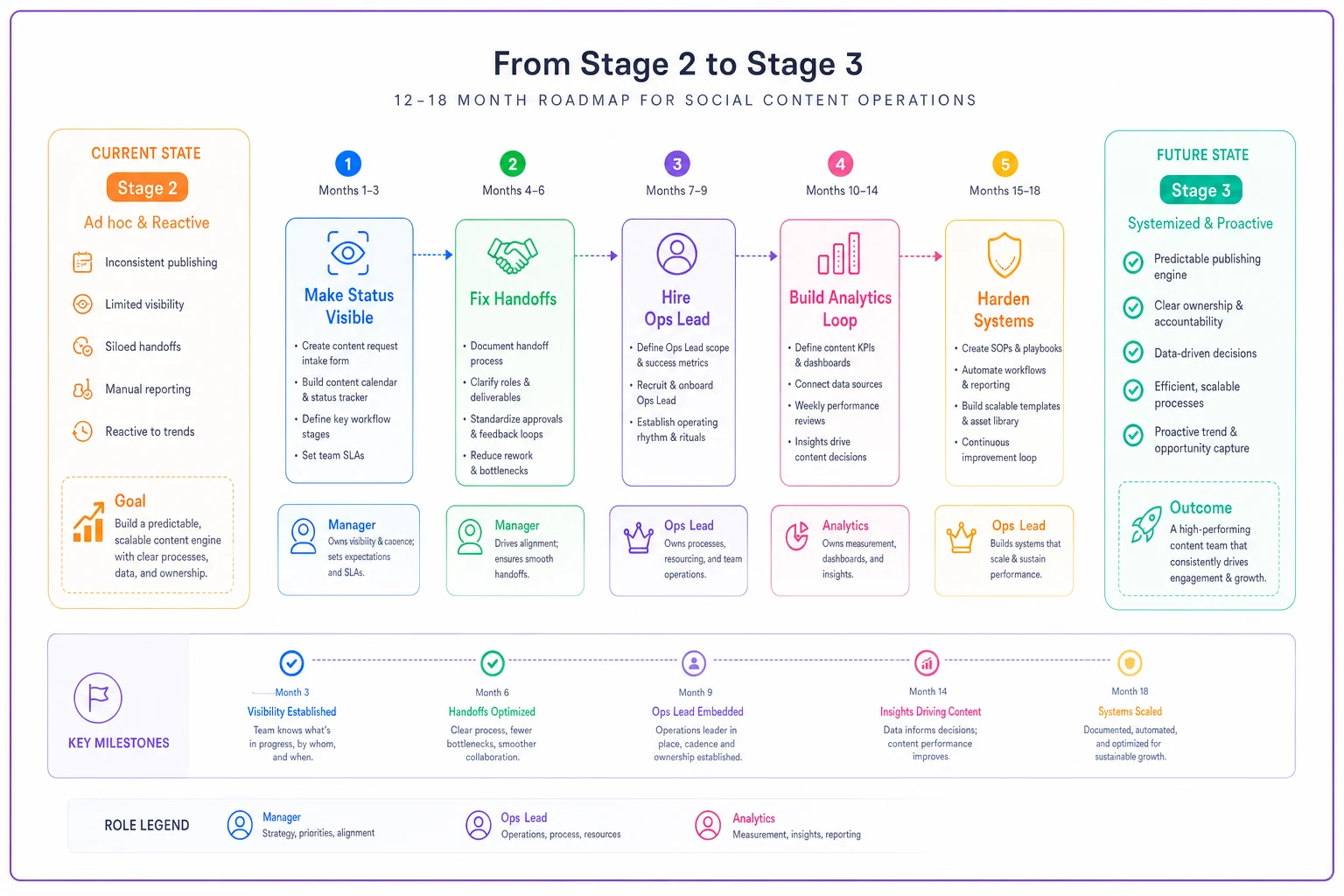
The pre/post explanation above maps directly to the diagram: visibility → handoffs → Ops hire → analytics → scale readiness.
A quick real scenario
A mid-size DTC brand's social team — about six people — was producing solid content but constantly missing launch dates. They were a textbook Stage 2 team convinced they were Stage 3.
The problem wasn't creative quality. Approvals had no time limit and lived in email, and the "final" asset was whatever the manager last downloaded. On a typical product launch, roughly a third of scheduled posts went out late or with outdated creative. Their manager was spending somewhere around 10–12 hours a week just chasing status.
They didn't hire anyone at first. They moved every piece of work into one workflow with visible statuses, set a 24-hour approval SLA, and added versioning so old files couldn't ship. About two months in, late posts dropped significantly, and the manager got a meaningful chunk of that time back. Then they hired an Ops Lead — into a system that person could actually run instead of rebuild. Within a couple of quarters they were operating like a real Stage 3 team.
Fix the structure before adding the headcount. Reverse that order and you just add a person to the chaos.
Where tooling actually earns its place
As teams climb these stages, the coordination work — status chasing, version control, SLA tracking, keeping the asset library sane — quietly eats capacity that should be going toward actual content and strategy. This is where AI-assisted operational platforms genuinely help, not as a magic content generator, but by handling the connective tissue humans are bad at holding consistently: flagging assets stuck past their SLA, catching when someone's working off an old version, keeping the calendar and asset library in sync, and surfacing what's late before it becomes a fire drill.
The point isn't to automate creativity. It's to automate the traffic control so your actual people can spend their hours on content and strategy instead of asking "where's the file?" A team that offloads coordination overhead can often operate a stage above its headcount — which is really what maturity is about.
Diagnostic checklist: what stage are you actually at?
Run this honestly. If you're saying "sort of" to most of a stage's items, you haven't reached it yet.
You're at Stage 2 or below if:
-
[ ] Knowledge about how things work lives mostly in one or two people's heads
-
[ ] You'd struggle to onboard someone in under a month
-
[ ] "Final" files sometimes get confused with old versions
-
[ ] Approvals have no time limit
-
[ ] Your manager spends more time chasing status than doing strategy
You've reached Stage 3 if:
-
[ ] Every piece of work has a visible status in one system
-
[ ] Handoffs have defined SLAs that are actually tracked
-
[ ] Assets are versioned and can't be published by accident when outdated
-
[ ] Someone explicitly owns operations, separate from content
-
[ ] You have one analytics view the team genuinely trusts
-
[ ] The operation would survive a key person taking two weeks off
You've reached Stage 4 if:
-
[ ] You operate across multiple markets or brands with consistent quality
-
[ ] Throughput is predictable enough to forecast
-
[ ] New team members are productive in days, not months
-
[ ] There's a fast lane that lets experiments skip heavy governance
-
[ ] Governance (rights, disclosures, brand) is enforced by systems, not memory
Running this checklist with your team is usually more uncomfortable than expected — which is the point. It's a lot easier to fix a gap you've actually named.
The teams that scale well aren't the ones with the most people or the flashiest tools. They're the ones who figured out early that maturity lives in the gaps — the handoffs, the ownership, the shared source of truth — and fixed those before demand forced their hand.
Use the stages as a mirror, not a ladder to rush up. Figure out where you honestly are, close the specific gap in front of you, and hire in an order that gives new people a system to plug into instead of a mess to untangle. Do that, and you can punch a full stage above your headcount — which is exactly what the best social operations do.
Ready to amplify your brand’s voice?
Join 2,500+ marketers using Postyly to save time, boost engagement, and grow their audiences effectively.