



When social personalization breaks at scale, it almost never breaks in an obvious place. You don't get one giant failure. You get a slow drift where the creative team ships 40 variants of a campaign, analytics can't tell which variant drove the lift, and three weeks later nobody can answer a simple question from leadership: which version actually worked, and for whom?
That gap — between the people making variants and the people measuring them — is where most personalization programs quietly fall apart. Everyone is doing their job. The creative team is personalizing. The analysts are measuring. But they're working off different definitions of what a "variant" even is, and no shared system connects a creative decision to a measurable outcome.
This article is about the governance layer that sits between those two worlds. Not the fun part of personalization (the clever copy, the segment-specific hooks) but the boring infrastructure that makes personalization provable at scale: the tiers, the required metadata, the modular asset rules, the testing discipline, and the measurement guardrails. Get this right and personalization compounds. Get it wrong and you're just making more stuff nobody can evaluate.
Why personalization quietly collapses between creative and analytics
Here's a pattern that shows up constantly. A team decides to personalize by audience segment. Sounds reasonable. The brief says "make versions for new customers, loyal customers, and lapsed customers." Three segments, three variants, done.
Except the creative team interprets that as copy changes. The analyst expected audience targeting changes. The paid team added a fourth variant on the fly for a retargeting pool nobody documented. And when the reporting comes due, the UTM parameters say loyal_v2 but the creative file is named returning-customers-final-FINAL, and there's no way to join those two things without someone manually eyeballing a spreadsheet.
-
The strategist decides why to personalize (segment, intent, lifecycle stage)
-
The creative team decides how to personalize (hook, visual, offer)
-
The analytics team decides how to measure it — usually after both of the above are already locked
By the time analytics gets involved, the taxonomy is already a mess. You can't retroactively tag what you didn't plan to tag. This is the core reason personalization programs stall somewhere between "we tried a few variants" and "we have a repeatable system that tells us what works."
What breaks isn't the idea. It's the absence of a shared schema that travels with the asset from brief to report.
Personalization tiers: not everything deserves the same rigor
The first mistake teams make is treating all personalization as equal. A swapped headline for a geo-region is a different beast than a fully reworked creative concept for a high-value segment. If you apply heavy governance to both, people rebel and route around the process. If you apply light governance to everything, your big strategic bets get measured as sloppily as your minor tweaks. So tier it. Here's a practical structure that holds up across most enterprise social programs:
Stop managing your social media the hard way.
Postyly helps you plan, schedule, and analyze every post with precision.
- Multi-platform scheduling
- Real-time engagement tracking
- Automated performance reports
No credit card required
| Tier | What changes | Governance required | Measurement expectation |
|---|---|---|---|
| Tier 0 — Cosmetic | Caption wording, emoji, minor CTA phrasing | Lightweight; no formal test | Monitor only, no significance claim |
| Tier 1 — Modular | Swappable modules (hook, offer, proof point) on a shared base asset | Required metadata + variant log | Directional read; holdout optional |
| Tier 2 — Segment | Audience-specific creative built for a defined segment | Full metadata schema + test plan | Proper test with significance threshold |
| Tier 3 — Concept | Distinct creative concepts tied to strategy bets | Full schema + pre-registered hypothesis | Rigorous measurement, guardrails enforced |
The value of tiers isn't bureaucracy. It's that it tells everyone how much proof is expected before you draw a conclusion. The most common mistake is a team shipping a Tier 1 cosmetic variation and then presenting the result to leadership as if it were a Tier 2 segment test. The measurement rigor never matched the claim, and now a decision is being made on noise.
One rule worth locking in: the tier determines the measurement standard, and that standard gets set before the creative is made — not after the numbers come in. That ordering matters more than any individual threshold you pick.
Required metadata: the schema that travels with the asset
If there's one thing that separates teams who scale personalization from teams who don't, it's this: the winners attach metadata at creation, not at reporting. The schema is non-negotiable and it rides with the asset from brief to archive. Here's a baseline metadata schema that works for most social personalization programs. Every variant carries these fields:
``
assetid:            unique, immutable (e.g. Q2-RETARGET-0147)
campaignid:         parent campaign reference
personalizationtier: 0 | 1 | 2 | 3
segmentkey:         controlled vocabulary (new | loyal | lapsed | geoxx)
variantaxis:        what's being varied (hook | offer | visual | format)
variantvalue:       the specific value (hooka | offer15pct | etc.)
baseassetref:      parent asset if modular
channel:             ig | tiktok | li | yt | metapaid
hypothesisid:       links to the test plan (required for Tier 2+)
testid:             links to the experiment record
owner:               creative owner
createddate:        ISO date
rightsexpiry:       if applicable
``
The field that teams skip most often — and regret — is variant_axis. Without it, you know you have five variants but not whether they differ by hook, offer, or format. That makes any analysis meaningless, because you can't attribute a performance difference to a specific creative decision. If variant A differs from variant B in three ways at once, you've learned nothing you can reuse.
The segmentkey field is the second most common failure point, specifically because people use free text. Someone types returning, someone else types loyal, someone else types repeatcustomer, and now your three-way test looks like a six-way test in the data. A controlled vocabulary — a fixed list of allowed values — is boring, and it's the single highest-leverage thing you can enforce.
This metadata discipline connects directly to how your broader content taxonomy and analytics joins are structured. If you've already built a solid data architecture for social analytics, the personalization schema should plug into it rather than live as a separate spreadsheet that drifts out of sync.
Modular asset variants: build for recombination, not duplication
This is where creative operations and personalization governance actually meet. Teams that personalize at scale don't produce dozens of standalone assets. They produce a base asset plus swappable modules, and the metadata describes which modules are in play.
Think of a short-form video with three defined slots: an opening hook (0–2s), a core demonstration (the middle), and a closing offer card. Keep the demonstration fixed and vary only the hook and the offer, and you've built a modular system where every variant is cleanly attributable. You know exactly what changed. Compare that to the alternative — someone re-edits the whole video "to make it feel fresh for each segment" — and now nothing is comparable to anything.
-
Define the base asset and lock the elements that stay constant across all variants.
-
Identify the variant axes — the specific slots allowed to change (hook, offer, proof point, CTA).
-
Constrain the values per axis — three hook options, two offer options, not infinite.
-
Name every module so the metadata can reference it directly (
hooka,offer15pct). -
Log the combination each variant represents, so the full matrix is visible.
-
Cap total combinations to what you can actually measure with your traffic volume.
Name every module so the metadata can reference it directly (
hooka,offer15pct).
That last point is where discipline matters most. Three hooks, two offers, and two formats gives you twelve combinations. On a channel pushing modest volume, you will never reach significance on twelve cells. You'll just dilute your sample into mush. Teams build out the full matrix because it's easy in the design tool, then wonder why every test comes back inconclusive.
The modular approach also feeds cleanly into asset reuse. When a hook wins, it's a named, reusable module — not buried inside a finished video you'd have to reverse-engineer to repurpose. This is the same logic behind a healthy creative lifecycle from brief to archive: assets structured for reuse at creation save enormous time downstream.
Testing rules: what counts as a real test versus a vibe
Most "personalization tests" on social aren't tests. They're two variants launched at different times, to overlapping audiences, with no holdout, and a winner declared because one had a slightly higher engagement rate over a three-day window. That's not evidence — it's a coin flip with extra steps.
-
Pre-register the hypothesis. Write down what you expect and why, before launch. If you can't articulate the hypothesis, you're not testing — you're browsing.
-
One variant axis per test for Tier 2+. If you're changing the hook and the offer at once, you can't attribute the result. Fine for Tier 1 directional reads, not for strategic claims.
-
Set the significance threshold before you look at results. Pick it based on the tier and the cost of being wrong. Don't move the goalpost when the data arrives.
-
Define the minimum detectable effect. If your traffic can only detect a 20% swing but you're chasing a 3% improvement, the test can't answer your question. Know this before you run it.
-
Use holdouts for lift claims. If you want to say personalization drove a result, you need a group that didn't get it. Without a holdout you're measuring correlation and calling it causation.
The single most common mistake across personalization testing is peeking — checking results daily and stopping the moment one variant looks ahead. This massively inflates false positives. Check a running test every day for a week and you'll almost always find a day where one variant "wins" by chance. Decide the test duration in advance and don't touch the stop button until you're there.
A second recurring error is ignoring audience overlap. On paid social especially, two variants targeting similar interest pools will cannibalize each other's delivery. The platform optimizes toward one, starves the other, and now your "test" is really just the algorithm picking a favorite for reasons that have nothing to do with creative quality.
Measurement guardrails that keep conclusions honest
Guardrails are the rules that stop a personalization program from drawing confident conclusions out of noise. They sit between raw platform metrics and the story you tell leadership. Without them, every energetic analyst becomes a source of over-claimed wins, and over time leadership stops trusting any of the numbers.
The guardrails that matter most:
Minimum sample before any read. Set a floor — a minimum number of impressions or conversions per cell — below which no result gets reported as a finding. Anything under the floor gets labeled "insufficient data," full stop. This one rule kills a huge share of bad decisions.
Metric hierarchy tied to funnel stage. A variant optimized for a top-funnel hook should be judged on top-funnel metrics (hold rate, hook retention), not on conversions it was never designed to drive. Judging a brand-awareness variant by last-click purchases is how good creative gets killed for the wrong reasons.
Consistent attribution window across variants. If variant A is measured on a 7-day window and variant B on a 1-day window, the comparison is garbage. The window is a property of the test, not of each variant.
Guardrail metrics alongside the primary metric. If a variant lifts click-through but tanks downstream conversion rate, that's not a win — it's a misallocation. Always pair the headline metric with a "did we break something downstream" check.
A quick real-world example of how this goes wrong: a team runs a lapsed-customer personalization push, sees a 30% jump in click-through on the personalized variant, and declares victory. But they never checked the sample — the personalized cell had a few hundred clicks against a control of several thousand. The "30% lift" was well inside the noise band. Three weeks later they scaled it, spend went up, and the lift evaporated. The guardrail they were missing wasn't fancy. It was just a minimum-sample rule nobody enforced.
A workflow that keeps creative and analytics in sync
Governance only works if it's embedded in the flow of work, not bolted on at the end. Here's how the pieces connect in a program that actually holds together:
The strategist opens a personalization brief and assigns a tier before any creative starts. That tier decides the measurement standard. In the same brief, they define the segment keys (from the controlled vocabulary) and the variant axes allowed. For Tier 2+, they register a hypothesis and a test ID.
Here's a simple visual of that workflow.
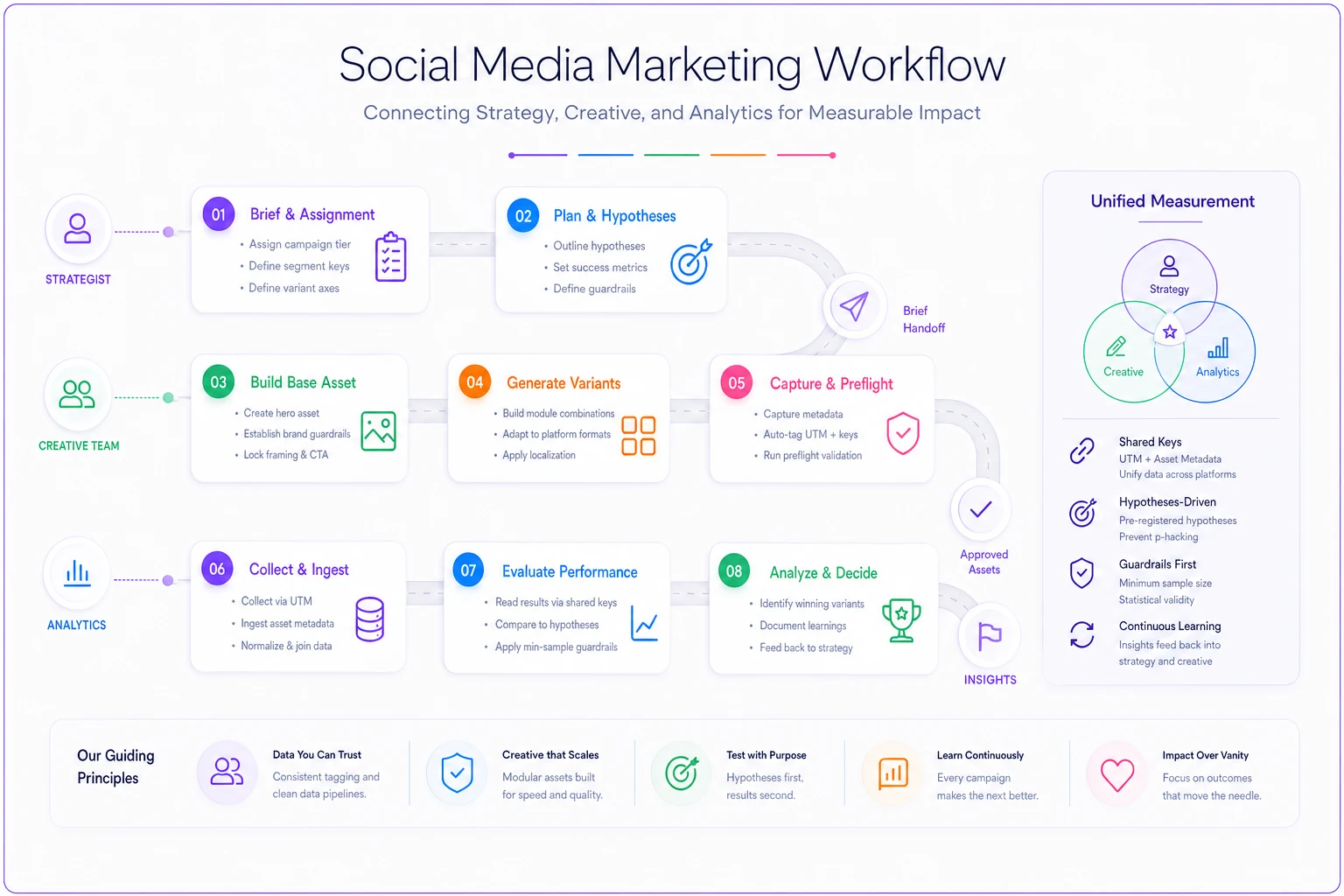
The creative team builds from a base asset and produces only the module combinations specified in the brief. Each variant inherits the metadata schema at creation — tier, segment key, variant axis, hypothesis ID — and nothing ships without those fields populated. A preflight check rejects any asset missing required metadata, the same way a publishing checklist catches a broken link.
Analytics doesn't scramble at reporting time because the join already exists: the UTM structure and the asset metadata share the same keys. The variantaxis and segmentkey fields map directly to how the data is sliced. When the test reaches its pre-set duration and minimum sample, the result gets read against the pre-registered threshold — not against whatever looks good that week.
This is where shared operational platforms earn their place. When tiers, metadata rules, and guardrails live in a system that both creative and analytics actually touch, the handoffs stop leaking. Metadata gets captured at creation instead of reconstructed later. Validation flags a missing hypothesis_id before launch rather than after reporting fails. The point isn't automation for its own sake — it's that the schema stays consistent across dozens of people and hundreds of variants without someone policing a spreadsheet every week. That consistency is the entire ballgame at scale.
It also helps to anchor everything to a single source of messaging truth so personalization varies presentation without fragmenting the core message. A core-message matrix does exactly that — it defines what stays constant while your tiers and modules define what's allowed to flex.
When heavy personalization governance makes sense — and when it doesn't
This makes sense when: you're running meaningful paid spend behind personalization, you have enough volume per segment to reach significance, and leadership is making budget decisions based on which variants win. At that point, sloppy governance costs real money, and the schema pays for itself.
This is a bad idea when: you're a small team posting a handful of times a week with modest reach per post. You will never hit minimum sample on segment-level tests, so building out a four-tier governance system just adds friction without adding evidence. Run Tier 0 and Tier 1, keep a simple variant log, and skip the heavy apparatus until your volume justifies it.
Who should not do this: teams still fighting basic consistency problems — different people naming files differently, no agreed segment vocabulary, no shared calendar. Personalization governance sits on top of operational basics. If the foundation is shaky, fix the taxonomy and workflow first. Layering personalization tiers on a chaotic operation just creates a more sophisticated mess.
A real scenario
A mid-size DTC brand with an in-house social team of six was running segment-based personalization across Meta and TikTok — new, loyal, and lapsed customers, each with their own creative. On paper it looked sophisticated. In practice, their reporting was a monthly argument. The creative lead swore the lapsed-customer variants were their best work; the analyst couldn't confirm it because file names and UTM tags didn't line up, and nobody had logged which variant differed on what.
They weren't short on effort. They were short on a shared schema. The fix wasn't more variants — it was fewer, cleaner ones. They cut their variant count by roughly a third, locked a controlled segment vocabulary, enforced a variant_axis field so every variant changed exactly one thing for their Tier 2 tests, and set a minimum-sample floor before anyone reported a "win."
Within a couple of months, the monthly reporting argument basically disappeared. They could point to a specific hook that outperformed for lapsed customers — with a defensible test behind it — and reuse that module across channels. The measured "wins" dropped in number, which initially looked like bad news, but the wins that remained actually held up when scaled. Spend got reallocated with more confidence, and the creative team stopped feeling like their good work was invisible. The gain wasn't a dramatic revenue spike. It was trust in the numbers, which turned out to be the thing that had been missing all along.
The real point
Personalization at scale isn't a creativity problem. Most teams have plenty of creative range. It's a governance problem — the quiet infrastructure of tiers, metadata, modular rules, and measurement guardrails that lets you connect a creative decision to a measurable outcome and reuse what works.
The teams that win here aren't the ones making the most variants. They're the ones who decided, up front, how much proof each variant needs, attached the schema at creation, and refused to declare a winner before the data earned it. That discipline is less glamorous than the clever hook. But it's the difference between a personalization program that compounds and one that just generates more stuff nobody can evaluate.
Start with the tiers. Lock the metadata schema. Enforce the guardrails. Everything else — the segment-specific creative, the reusable winning modules, the confident budget decisions — gets a lot easier once the governance layer underneath actually holds.
Ready to amplify your brand’s voice?
Join 2,500+ marketers using Postyly to save time, boost engagement, and grow their audiences effectively.