


Most enterprise creator programs are built on a quietly broken assumption: that each activation is its own project. You brief someone, they post, you pull the metrics, you move on. Six months later nobody remembers who that creator was, what rights you actually secured, or whether the numbers were any good compared to the last three campaigns. The institutional memory lives in a spreadsheet somebody left when they changed jobs.
That's the real problem with how most teams approach creator work — not the briefs, not the payments, not even the ROI math. It's that there's no lifecycle. Creators enter and exit as one-offs, and the compounding value that should build over time just evaporates.
A proper creator influencer lifecycle strategy treats a creator relationship the way a good sales org treats a pipeline: as stages, each with its own owners, KPIs, and decision gates. Scout, nurture, co-create, measure, evaluate. When those stages connect — and when the data from stage five feeds back into stage one — you stop paying to re-learn the same lessons every quarter.
This is how the whole system fits together, where it breaks as you scale, and what actually changes when you run it as a lifecycle instead of a series of disconnected activations.
Why one-off activations quietly cost more than they look like they cost
On paper, a single activation looks cheap and clean. You pay a flat fee, you get deliverables, you report reach. But the hidden costs sit outside that transaction.
Every time you start from zero with a new creator, you're paying a re-onboarding tax: legal reviewing terms again, someone rebuilding a brief from scratch, an account manager learning the creator's posting rhythm and audience quirks. In real operations, this usually shows up as a program where 70–80% of the roster is "new to us" every year, even though half of them performed fine and could have been re-activated for a fraction of the cost and effort.
There's also the rights problem. A one-off mindset means rights get negotiated for one campaign window. Then marketing wants to reuse a great piece of content six weeks later for a paid test, and suddenly you're either re-negotiating usage or quietly violating the original agreement. A lifecycle approach forces you to think about rights and exclusivity as relationship-level terms, not campaign-level afterthoughts.
And then there's the measurement gap. When each activation is scored in isolation, you can't tell whether a creator is trending up or down for you, whether your best performers are the ones you keep re-signing, or whether you're accidentally over-indexing on whoever happens to be popular that month. You lose the longitudinal view that makes the whole program get smarter over time.
The five lifecycle stages, and what each one is actually responsible for
The point of naming stages isn't to add process for its own sake. It's so that ownership is clear and nothing falls through the cracks between "we found someone interesting" and "we know whether they were worth it."
Stop managing your social media the hard way.
Postyly helps you plan, schedule, and analyze every post with precision.
- Multi-platform scheduling
- Real-time engagement tracking
- Automated performance reports
No credit card required
Here's the backbone, with the stage owner and the core question each stage answers.
| Stage | Core question | Primary owner | Exit gate |
|---|---|---|---|
| Scout | Is this creator worth a first conversation? | Discovery / research | Fit score above threshold |
| Nurture | Can we build a real relationship before we transact? | Partnerships / community | Warm, responsive, aligned |
| Co-create | Can we produce something together that performs? | Campaign / creative | Deliverables shipped, rights secured |
| Measure | What actually happened, cleanly attributed? | Analytics | Verified results logged |
| Evaluate | Do we deepen, maintain, or exit this relationship? | Program lead | Tier decision recorded |
The stages that get skipped most often are Nurture and Evaluate — which is exactly why so many programs feel transactional. Teams rush from Scout straight into Co-create because there's a campaign deadline, and they never run a real Evaluate because by the time the numbers land, everyone's already onto the next thing.
Scout: filtering for fit, not just follower count
Scouting at enterprise scale isn't about finding anyone — it's about filtering hard enough that Nurture doesn't drown in dead ends. The mistake most teams make here is scouting on reach and aesthetics alone, then wondering why conversion is flat.
A better scout filter weighs three things roughly equally: audience overlap with your actual buyers, engagement quality (saves and shares over vanity likes), and content-brand fit. A creator with 40k engaged followers in your exact niche will usually outperform a 400k generalist, and the cost difference is enormous. Mid-tier creators in a tight vertical consistently drive better cost-per-real-action than big names, but they never get scouted because the follower count doesn't impress a VP.
Scout KPIs: number of qualified creators identified, fit-score distribution, scout-to-nurture conversion rate.
Nurture: the stage everyone skips and later regrets
Nurture is where you build a relationship before money changes hands — engaging with their content, sharing early product access, having an actual conversation about what they care about. It's unglamorous and hard to attribute, which is precisely why it gets cut when budgets tighten.
But nurtured creators sign faster, negotiate less aggressively, and produce more authentic content because they actually know your brand. Programs that run a 4–6 week nurture window before first activation tend to see noticeably better on-brand output and fewer rounds of creative revision. The revision savings alone often justify the nurture time.
Nurture KPIs: response rate, sentiment of interactions, time-to-first-yes, nurture-to-co-create conversion.
Co-create: where operations either hold or collapse
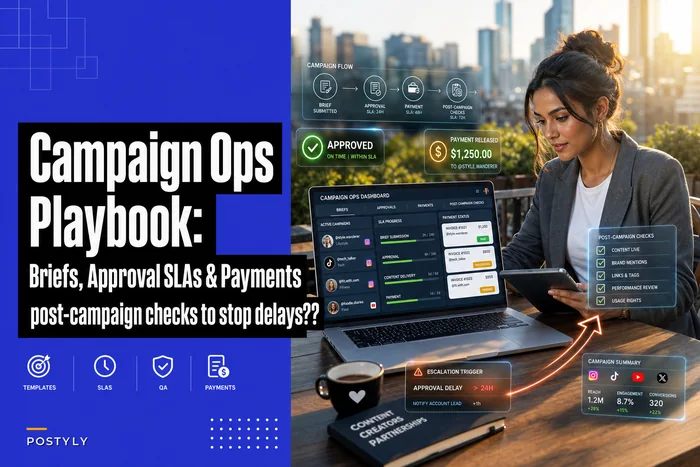
This is the stage most enterprise teams already have some machinery for — briefs, approvals, deliverable tracking, payment. If yours is shaky here, that's a separate fix worth getting right first; the mechanics of briefs, approval SLAs, payments, and post-campaign checks are covered in depth in the influencer campaign operations playbook, so I won't re-tread that ground.
What matters for the lifecycle is that Co-create is where you lock rights and exclusivity terms that will matter later. If you want to reuse content in paid, get paid usage rights now. If you want category exclusivity, define the window and the competitor list now. Retrofitting these is expensive and often impossible.
Co-create KPIs: on-time deliverable rate, revision rounds per asset, rights-secured percentage, cost per deliverable.
Measure: clean attribution or the whole lifecycle is guesswork
If your measurement is muddy, every downstream decision is muddy. The Evaluate stage can only be as good as the numbers feeding it. That means consistent tracking links, clear windows, and separating creator-driven results from everything else happening in the same period.
The most common failure here is comparing creators on inconsistent metrics — one campaign measured on reach, the next on clicks, the next on promo-code redemptions — so you literally can't rank your roster. Standardize the scorecard before you scale the program, not after.
Measure KPIs: attributed conversions, cost per acquisition per creator, engagement rate vs. roster benchmark, content reuse value.
Evaluate: the decision that turns activations into partnerships
Evaluate is where you make the call that most programs never make explicitly: deepen, maintain, or exit. This is the stage that converts a one-off into a partnership — or correctly decides not to.
Run a real evaluation after each activation and tier the creator. High performers with good rights terms and low friction move toward partnership. Solid-but-average performers stay in a maintain pool. Poor fits exit cleanly, with notes so nobody re-scouts them in eight months.
Evaluate KPIs: percentage of roster tiered, repeat-activation rate, partner-tier retention, roster-level ROI trend over time.
A staged lifecycle connects all five of these in sequence — data flows forward, decisions feed back into scouting, and the whole program gets smarter with each cycle rather than resetting from scratch every quarter.
Governance: rights and exclusivity as relationship terms
When you think in relationships instead of transactions, rights and exclusivity stop being fine print and become strategic levers.
A few principles that hold up across enterprise programs:
-
Rights should scale with tier. A first-time creator might grant organic-only usage for 90 days. A partner-tier creator negotiates broad paid usage as a standard part of an ongoing deal — which is exactly what makes their content viable for the kind of systematic paid testing described in turning organic winners into predictable paid tests.
-
Exclusivity has a price and a window. Category exclusivity is worth paying for with high-value partners, but only if you're actually activating them enough to justify locking out competitors. Paying for exclusivity you don't use is pure waste.
-
Document rights where the content lives. Rights that live in an email thread are rights you'll eventually violate by accident. They need to travel with the asset — searchable, tied to expiry dates, visible to whoever's about to reuse the content.
-
Build exit into the terms. What happens to content usage when the relationship ends? Define it upfront so you're not scrambling later.
Rights disputes almost never come from bad faith. They come from a marketer three teams over who reused a great asset without knowing the usage window had expired. Governance is mostly about making the rules visible at the moment of decision.
A partnership evaluation template you can actually use
When you get to Evaluate, you need a consistent rubric — otherwise "should we re-sign?" becomes a vibes-based conversation dominated by whoever liked the creator most. Here's a scoring approach that works. Rate each dimension 1–5:
-
Performance vs. benchmark — did they beat, meet, or miss your roster median on the primary metric?
-
Operational friction — on-time delivery, revision rounds, communication quality. Low friction is worth a lot at scale.
-
Rights and flexibility — did they grant usable terms without a fight?
-
Audience fit trend — is their audience drifting toward or away from your buyer?
-
Content reusability — how much of what they made can you legitimately use again?
Sum the scores. Rough banding: 20+ moves toward partner tier, 14–19 stays in the maintain pool, below 14 exits. The exact thresholds matter less than applying the same rubric to everyone, every time, so your roster decisions are actually comparable across quarters.
This only works if you run it consistently. A scorecard that gets used for two quarters and then abandoned tells you nothing useful about your roster trends.
The ROI ladder: from one-off to durable partnership
Turning activations into partnerships isn't a single leap — it's a ladder, and each rung should be justified by results from the one below.
Rung 1 — Test activation. Single campaign, minimal rights, flat fee. You're buying information as much as reach. Cheap to enter, cheap to exit.
Rung 2 — Repeat activation. They beat benchmark, friction was low. You re-activate with slightly better terms and a bit more creative trust.
Rung 3 — Preferred creator. Multiple strong activations. You negotiate broader usage rights and start giving them earlier access and more input. Cost per activation usually drops here because onboarding is done and trust is established.
Rung 4 — Partner. Ongoing agreement, category exclusivity where it makes sense, deeper co-creation, sometimes revenue-share or affiliate structures. This is where the economics get genuinely good — and where the social content monetization playbook becomes relevant, because partner-tier relationships are where affiliate and monetization mechanics actually pay off at scale.
The whole point of the ladder is that you earn your way up it with data. Teams that skip rungs — jumping straight to a big exclusive partnership on gut feel — get burned when the creator underperforms and they're locked into a long, expensive deal.
A real scenario: what changes when you run the lifecycle
Consider a mid-market DTC brand running creator campaigns through a fragmented process — different marketers briefing different creators, rights tracked in email, no shared scorecard. Over a year they worked with around 60 creators, re-signing maybe 8 of them, mostly by accident because a marketer happened to remember someone.
After moving to a staged lifecycle — a shared scout filter, a light nurture step, a standardized measurement scorecard, and a quarterly evaluate-and-tier review — the shape of the program changed within about two quarters. The roster shrank to roughly 40 active creators, but re-activation of proven performers climbed to around a third of campaigns. Because they were re-signing known quantities, revision rounds dropped noticeably and rights disputes basically disappeared, since terms were now negotiated at the relationship level.
The headline wasn't a dramatic revenue explosion. It was that cost per activation on repeat creators came down meaningfully, and the team stopped spending half its energy re-onboarding people it had already worked with. That reclaimed capacity went into nurturing a small set of high-potential creators toward partnership — which is where the real long-term value lives.
When a full lifecycle makes sense — and when it doesn't
This system is built for scale. It's overkill for some teams and essential for others.
When it makes sense: you're running enough creator volume that institutional memory is failing you, multiple people are involved in creator decisions, you want to reuse content across organic and paid, or you're seeing the same re-onboarding waste every quarter.
When it's a bad idea: if you run three or four creator activations a year, a lightweight tracker and good notes will serve you fine. Building five-stage governance around a handful of campaigns is process for process's sake, and it'll slow you down more than it helps.
Who should not do this: teams that haven't yet fixed their basic Co-create operations. If your briefs are chaotic and payments are late, layering a lifecycle framework on top just adds structure to a broken foundation. Get the operational fundamentals solid first, then build the lifecycle around them.
Making it hold together as you grow
The hardest part of a creator lifecycle isn't designing the stages — it's keeping the data connected as the program grows. Scout data needs to inform who you nurture. Co-create rights need to be visible when someone wants to reuse content. Measure results need to feed the Evaluate rubric. Evaluate decisions need to shape next quarter's scouting.
When all of that lives in scattered spreadsheets and email threads, the lifecycle exists on paper but breaks in practice — which is why so many programs quietly revert to one-off mode within a year. This is where having your creator data, rights, scores, and stage-tracking in one connected system genuinely matters. Not because the tooling is magic, but because a lifecycle only compounds value when the stages can actually see each other.
AI-assisted workflows can help close that gap — flagging rights expirations before someone reuses an asset, surfacing which maintain-pool creators are trending up and worth re-scouting, keeping the evaluation scorecard consistent across everyone who touches the program. That's the connective tissue that stops a lifecycle from decaying back into disconnected activations.
Here's a simple visual of that workflow.
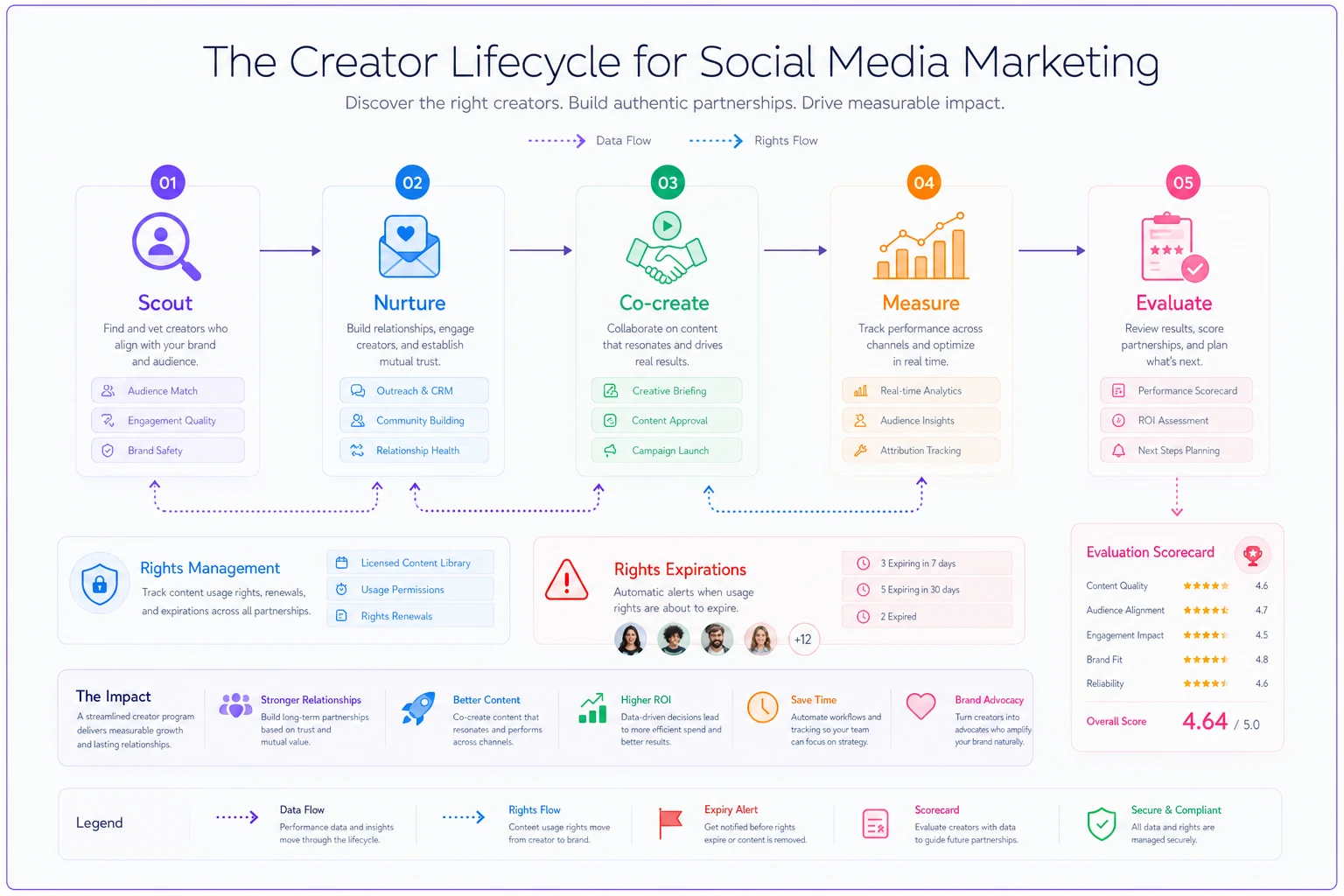
Flag rights expirations before reuse to avoid accidental violations.
AI-assisted workflows can help close that gap — flagging rights expirations before someone reuses an asset, surfacing which maintain-pool creators are trending up and worth re-scouting, keeping the evaluation scorecard consistent across everyone who touches the program. That's the connective tissue that stops a lifecycle from decaying back into disconnected activations.
The goal isn't more process. It's making sure that every creator you work with makes the next creator decision smarter — and that the value you build with people doesn't walk out the door every time a campaign ends.
Ready to amplify your brand’s voice?
Join 2,500+ marketers using Postyly to save time, boost engagement, and grow their audiences effectively.