

Two people posting the same product angle in the same week isn't the scary version of duplication. The scary version is quieter: the brand team greenlights an "authentic customer stories" push while, three floors and one time zone away, the regional social lead is negotiating almost the exact same thing with a creator agency. Neither knows the other exists. Both budgets get spent. Both get reported as wins. And the audience sees a strange echo — the same message, slightly reworded, twice inside ten days.
Duplication in hybrid teams isn't really a creativity problem. It's a coordination problem, and it hides in the gaps between people who don't sit near each other, don't share a standup, and only overlap for a few hours of the workday. A monthly social coordination cadence is the thing that closes those gaps — not with more meetings, but with a fixed rhythm of decisions, handoffs, and clear ownership that makes accidental overlap almost impossible to miss.
This post is about that one problem: campaign duplication across distributed and hybrid social teams. Not calendar-building in general, not paid/organic strategy. Just the coordination machinery that keeps two teams from spending against the same idea.
Where the duplication actually comes from
If you trace real duplication incidents back to their root, they almost never start with someone deciding to copy someone else. They start with information that never traveled.
A typical pattern: the central content team plans in a shared calendar. Regional teams plan in their own docs because the central calendar "doesn't fit their market." The paid team plans inside the ad platform itself, where campaigns get named and launched without ever touching the content calendar. Now you have three planning surfaces that don't reconcile. The overlap only becomes visible after publish, when someone in a reporting review says "wait, didn't we already do this?"
-
Async handoffs with no acceptance step. Work gets tossed over the wall — "here's the brief, run with it" — with no moment where the receiving side confirms what's in scope and what's explicitly not.
-
Overlapping mandates. The brand team owns "brand storytelling." The product team owns "feature launches." A customer testimonial about a feature belongs to… both. Nobody drew that line, so both act on it.
-
Time-zone drift. When your APAC lead's morning is your US team's end of day, decisions made in one window aren't seen until the next, by which point work has already started.
-
Creator and influencer pipelines running in parallel. Agency-sourced creators and in-house UGC often get briefed against the same theme because the briefs come from the same quarterly priorities but flow through different people.
None of these are people being careless. They're structural gaps — which means you fix them structurally, with a cadence, not by asking everyone to "communicate better."
What duplication actually costs
The wasted media spend is the obvious line item, and it's real. But the more expensive costs are the ones nobody assigns to a budget.
Stop managing your social media the hard way.
Postyly helps you plan, schedule, and analyze every post with precision.
- Multi-platform scheduling
- Real-time engagement tracking
- Automated performance reports
No credit card required
A mid-size brand running social across a central team plus four regional pods once had three clear duplication events in a single quarter — same message, overlapping windows, split ownership. Direct waste came out to somewhere around $9k–$12k in redundant paid support and creator fees. Annoying, survivable.
-
Audience fatigue. The same core message hitting the same segment twice compresses performance on both runs. The second one especially underperformed — saves and shares were roughly a third below their baseline for that content type.
-
Attribution noise. When two overlapping campaigns run simultaneously, you genuinely can't separate what drove what. Every downstream report from that period is a little bit fiction.
-
Trust erosion internally. The regional lead who got scooped stops sharing plans early, because sharing early feels like handing away their idea. That defensiveness creates more duplication, not less.
That last one is the quiet killer. Duplication makes teams hoard information, and hoarding information causes more duplication. A good cadence breaks that loop by making early visibility feel safe and normal.
The monthly cadence, laid out
The core idea: one fixed monthly rhythm where every planning surface reconciles against a single view before anyone commits budget or briefs a creator. Weekly sprints handle execution — this cadence sits above them and exists purely to catch overlap while it's still cheap to catch.
Here's the shape of a month that works:
-
Week 1 — Intake and surface. Every team (central, regional, paid, creator) drops their planned themes for the next month into one shared coordination agenda. Not full briefs. Just theme, target segment, intended channels, and rough timing window. Exposure, not polish.
-
Week 1 — Overlap review. One person — the coordination owner — scans for collisions: same theme, same segment, overlapping windows. Flagged items go to a short reconciliation call, the only mandatory sync in the whole cadence.
-
Week 2 — Reconciliation and ownership assignment. For each flagged collision, one team gets the theme, the other pivots or sequences. This is decided, written down, and — critically — the pivot is confirmed by the team that gave something up. That confirmation is the acceptance step most teams skip.
-
Week 2–3 — Handoffs go out. Briefs get written against a reconciled plan. Creator pipelines and paid campaigns brief from the same agreed themes.
-
Week 4 — Pre-publish check. A lightweight second scan before the month goes live, because plans drift. This catches the "we added something last-minute" duplications the Week 1 pass couldn't see.
A quick visual of the monthly coordination flow can help teams internalize the steps.
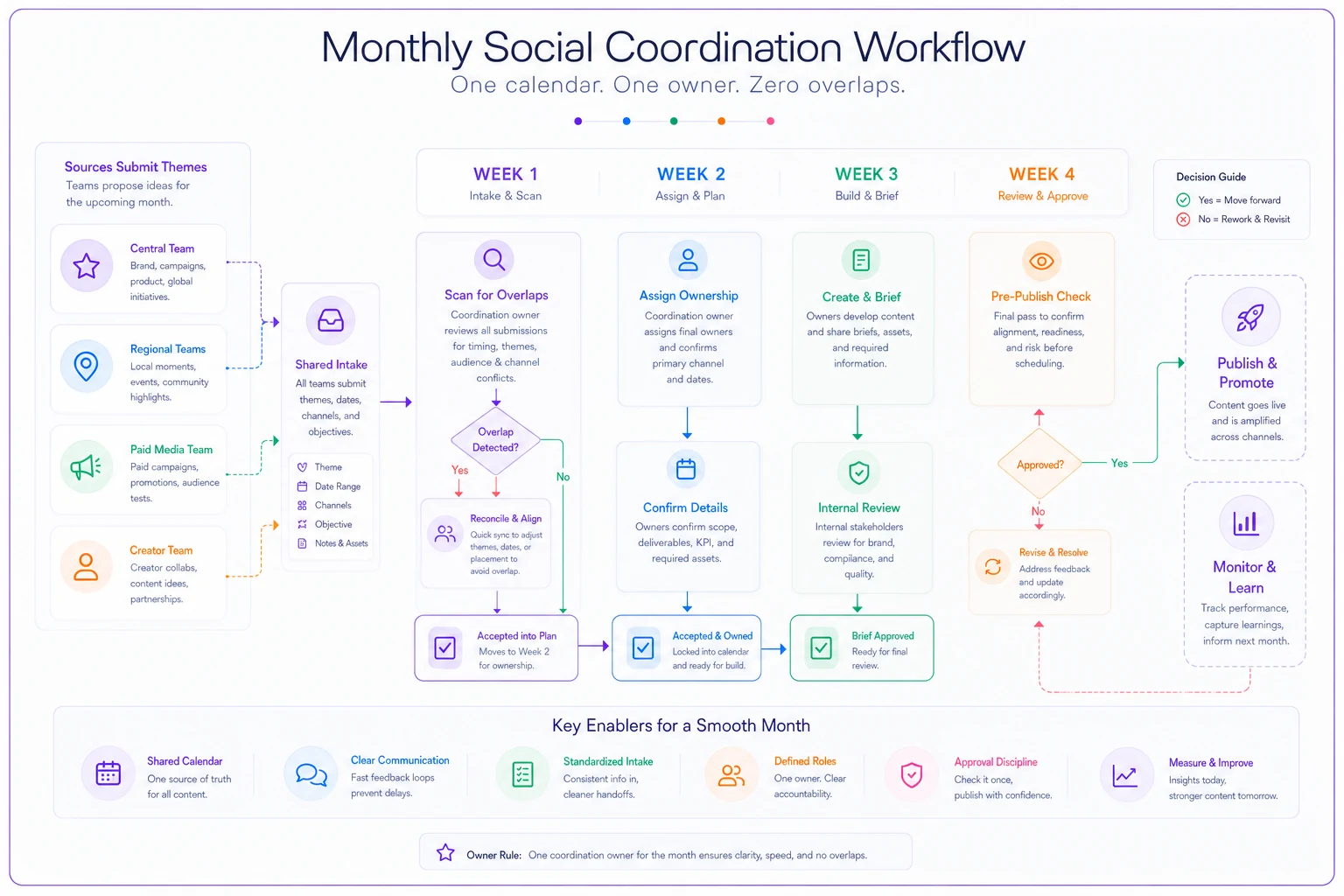
Notice what's not here: daily coordination, endless meetings, a central body approving every post. The cadence touches the plan four times a month at defined moments. Between those moments, teams run their own weekly sprints and post sequencing without asking permission.
The handoff form that actually prevents overlap
Most handoff forms are glorified brief templates — they describe the work but say nothing about boundaries. A handoff form built to prevent duplication needs three fields that ordinary briefs leave out:
-
In scope exactly what this piece of work covers.
-
Explicitly out of scope the adjacent territory this work does not touch, so a neighboring team knows it's theirs.
-
Adjacent owners who owns the themes sitting next to this one — named individuals, not just teams.
That "explicitly out of scope" line does more work than everything else combined. When a regional lead reads "this campaign covers loyalty-member testimonials but NOT new-customer acquisition stories," they immediately know the acquisition angle is open — or if they had it planned, they know to raise it now.
| Field | Example entry |
|---|---|
| Theme | Customer testimonials — loyalty tier |
| In scope | Existing loyalty members, video format, IG + TikTok |
| Explicitly out of scope | New-customer stories, feature-specific reviews, paid amplification |
| Target segment | Repeat buyers, 6+ months tenure |
| Timing window | March 10–20 |
| Owning team | Central content |
| Adjacent owners | Regional (acquisition), Product (feature reviews) |
| Acceptance status | ☐ Confirmed by adjacent owners |
Make the acceptance checkbox a required field in your intake system so adjacent owners must explicitly confirm before briefs proceed.
That last row is the acceptance criteria. Nothing moves to production until adjacent owners have confirmed there's no collision. It's one checkbox, but it forces the conversation to happen before money is spent instead of after.
Acceptance criteria: the step everyone skips
Hybrid teams get this wrong more consistently than almost anything else. They treat a handoff as complete when it's sent. It's not complete until it's accepted.
-
Adjacent owners have reviewed the in-scope/out-of-scope boundaries and confirmed no collision.
-
Timing windows have been checked against the shared calendar, not just assumed clear.
-
Any creator or influencer briefs tied to this theme are logged against the same theme ID, so agency work and in-house work reconcile. (If you run creator campaigns, tie this into your existing influencer campaign operations flow so agency-sourced ideas surface in the same intake as everything else.)
-
The paid team has confirmed the theme against active and queued ad campaigns.
Without an explicit acceptance step, "I assumed someone would flag it" becomes the default. Everyone assumes visibility exists. Acceptance criteria replace assumption with a recorded yes.
A conflict-resolution runbook for when two teams both want it
Reconciliation isn't always clean. Sometimes two teams have legitimate, funded plans for the same theme, and someone has to decide. Without a pre-agreed runbook, this turns into a status contest — whoever's more senior or louder wins, and the loser quietly stops cooperating.
-
Proximity to audience wins. The team closest to the specific target segment gets first claim. A regional team usually understands its market's version of a message better than central does.
-
If proximity is equal, sequencing beats splitting. Don't run both simultaneously. Space them — one team takes this month, the other takes the theme next month with a fresh angle. Splitting causes the exact fatigue you're trying to avoid.
-
If sequencing doesn't work, differentiate the cut. Same theme, genuinely different treatment and segment. Requires sign-off from the coordination owner that the two won't read as duplicates to the same person.
-
Escalation is a last resort, with a deadline. Unresolved collisions escalate to the social lead, who decides within 48 hours. No open-ended debates.
The value of writing this down isn't the specific rules — it's that they're agreed before there's a conflict. When the runbook is neutral and pre-committed, the team that pivots doesn't feel scooped. They followed a rule everyone signed up for, and that's what keeps early sharing safe.
RACI tuned specifically for duplication
Generic RACI charts assign ownership of deliverables. For duplication prevention, you need RACI over the coordination moments — intake, overlap review, reconciliation, acceptance. That's a different map.
| Coordination step | Responsible | Accountable | Consulted | Informed |
|---|---|---|---|---|
| Monthly intake submission | Each team lead | Coordination owner | — | All teams |
| Overlap review / scan | Coordination owner | Social lead | Paid lead | All teams |
| Reconciliation decisions | Coordination owner | Social lead | Affected team leads | All teams |
| Handoff acceptance sign-off | Adjacent owners | Coordination owner | — | Originating team |
| Pre-publish final check | Coordination owner | Social lead | — | All teams |
The single most important role here is Coordination owner — one named person accountable for scanning and reconciling. Not a committee. Committees diffuse responsibility until nobody's actually watching for overlap. One person owns the scan, and that person is empowered to flag anything without needing rank to do it.
If your approval flows are already formalized, this RACI slots in before creative approval kicks in — so overlap is caught before you burn approval cycles on work that's going to conflict anyway. The mechanics of layering these gates cleanly are covered in the permissioned approval flows breakdown.
Where centralizing this actually helps
You can run this entire cadence in a shared doc and a recurring calendar hold. For a small hybrid setup — one central team and two regions — that's genuinely enough. Don't over-engineer it.
The point where a doc stops working is when the number of planning surfaces exceeds what one person can hold in their head during a scan. Once you've got four-plus pods, a paid team, and an agency creator pipeline, the manual overlap scan gets unreliable. Themes get worded differently across teams, and the collision isn't obvious to the eye.
That's where a shared operational platform earns its place. When everyone submits themes into one intake, the system can flag timing-window collisions and surface similar themes across teams automatically. The acceptance checkboxes get enforced rather than hoped for. The value isn't automation for its own sake — it's that the reconciliation scan stops depending on one person's memory and attention on a busy Friday. When intake, handoff acceptance, and the pre-publish check all live in one place, collisions surface on their own instead of getting discovered after they've already cost money.
But tooling only matters if the cadence exists first. Software enforcing a rhythm nobody agreed to just generates ignored notifications.
When this cadence is overkill
A monthly coordination cadence is not free — it costs a couple of hours a month per team lead and one mandatory reconciliation sync. That's a bad trade in a few situations.
-
You're a single co-located team with one calendar. You'd be adding process to solve a problem you don't have.
-
Your teams already share a real weekly standup where plans surface naturally. Add the handoff form, skip the separate cadence.
-
Volume is low enough that duplication would be obvious anyway — if you publish twelve things a month, you'll notice.
You need it if you've had even one real duplication incident, you run three or more planning surfaces, or your teams span time zones with limited overlap. The tell is simple: if you can't answer "who's touching theme X this month?" in under a minute, the cadence pays for itself.
A real scenario
A DTC skincare brand ran social through a four-person central team plus three regional leads (US, UK, ANZ) and an agency handling creator content. Over one quarter they duplicated a "morning routine" theme twice and a "sensitive skin" testimonial push once — roughly $8k in redundant paid and creator spend, plus visibly softer performance on every second run.
They put in a monthly intake with the out-of-scope field and a single coordination owner — their US social lead, given around two hours a week for it. The reconciliation sync ran maybe 25 minutes most months. Over the next quarter they caught four collisions at intake before anything got briefed, including one where the agency and the UK team had independently planned near-identical creator content for the same launch window.
No dramatic revenue story here. Redundant spend dropped to near zero, the second-run fatigue disappeared, and — the part the lead cared about most — regional teams started submitting plans earlier. Early submission stopped feeling like giving ideas away and started feeling like protecting their claim.
The thing to take away
Campaign duplication in hybrid teams isn't a discipline failure, and you won't fix it by asking people to loop each other in more. It's a gap between planning surfaces that don't reconcile, and it closes with a fixed monthly rhythm: surface everything early, scan for collisions, resolve them with a pre-agreed runbook, and don't let a handoff count as done until an adjacent owner has confirmed there's no overlap.
Build the cadence first, keep it lightweight, and give one named person the job of catching collisions. The out-of-scope line on the handoff form and the acceptance checkbox will do more for you than any amount of "let's communicate better" — both are just ways of making information travel before the money does.
Campaign duplication in hybrid teams isn't a discipline failure, and you won't fix it by asking people to loop each other in more. It's a gap between planning surfaces that don't reconcile, and it closes with a fixed monthly rhythm: surface everything early, scan for collisions, resolve them with a pre-agreed runbook, and don't let a handoff count as done until an adjacent owner has confirmed there's no overlap.
Build the cadence first, keep it lightweight, and give one named person the job of catching collisions. The out-of-scope line on the handoff form and the acceptance checkbox will do more for you than any amount of "let's communicate better" — both are just ways of making information travel before the money does.
Ready to amplify your brand’s voice?
Join 2,500+ marketers using Postyly to save time, boost engagement, and grow their audiences effectively.