


Most social teams have "playbooks." What they usually have is a folder of docs written by three different people over eighteen months, half of which reference a LinkedIn feature that no longer exists and a TikTok trend that died before Q2.
The problem isn't that teams don't document. It's that documentation without governance rots. A playbook is only useful if it produces the same quality of decision regardless of who's holding it — the senior strategist who wrote it or the contractor who started Tuesday. That reproducibility is the whole point, and it's what almost nobody engineers on purpose.
Why channel playbooks quietly fall apart
The failure is rarely dramatic. It's slow drift.
You write a solid TikTok playbook in January. By June, TikTok has changed how it weights watch-time, three new people have joined who never read the original doc, and your best-performing format is something the playbook never mentioned because it didn't exist yet. Nobody updated it — not because they're lazy, but because there was no trigger forcing an update and no owner accountable for it.
The pattern that keeps showing up: teams treat playbooks as reference material instead of operational contracts. Reference material is optional. Contracts have owners, review dates, and consequences when they're wrong. The moment a playbook stops being enforceable, it stops being read.
The second issue is the "one big doc" trap. Teams write a single monolithic social playbook covering everything from LinkedIn thought-leadership to X reply strategy. It reads fine but it's impossible to govern, because each platform moves at a different speed. LinkedIn's ranking behavior might be stable for a year; TikTok's shifts every quarter. Bundling them means either you update everything constantly (nobody does) or you let the fast-moving platforms rot inside a doc that feels current because the slow parts still are.
The three things every governed playbook needs
Strip away the formatting and a genuinely reproducible channel playbook comes down to three components. Miss any one and it drifts.
Stop managing your social media the hard way.
Postyly helps you plan, schedule, and analyze every post with precision.
- Multi-platform scheduling
- Real-time engagement tracking
- Automated performance reports
No credit card required
Decision rules. Not guidelines — rules with clear conditions. "Post educational carousels on LinkedIn" is a guideline. "If the topic is a customer proof point AND we have permission to name the client, lead with the outcome number in the first line; if we don't have naming permission, anonymize by industry and company size" is a decision rule. The difference is whether two different people reading it would make the same call. Guidelines produce variance. Rules reduce it.
Variance checklists (local vs. global). This is the piece almost everyone skips. Some things must be identical across every channel — your core positioning, your non-negotiable claims, your legal disclosures. Some things should differ by channel — hook style, format, cadence, tone. A governed playbook explicitly labels which is which. Without that split, one of two bad things happens: either you enforce global consistency so hard that TikTok content sounds like a LinkedIn press release, or you let local freedom run so wide that your brand says contradictory things across platforms.
KPI contracts. Each playbook commits to what success looks like on that platform specifically, and what metric the person running it is actually accountable for. Measuring LinkedIn and TikTok against the same engagement rate is a governance failure — you're pretending two different jobs are the same job. The contract names the primary metric, the guardrail metric (the thing that shouldn't get worse while you chase the primary), and the review window.
Here's how those three pieces map across platforms in practice:
| Component | TikTok | X | |
|---|---|---|---|
| Primary KPI | Qualified profile visits / lead form fills | Retention rate + saves | Reply-driven reach / clickthroughs |
| Guardrail metric | Follower quality (title fit) | Comment sentiment | Ratio (replies vs. reactions) |
| Decision-rule density | Low — stable platform | High — needs frequent rules | Medium |
| Review cadence | Quarterly | Every 4–6 weeks | Monthly |
| Local variance allowed | Format, hook length | Format, sound, trend layering | Thread structure, timing |
| Global (locked) | Positioning, claims, disclosures | Positioning, claims, disclosures | Positioning, claims, disclosures |
The locked row is identical everywhere — intentionally. The stuff that protects the brand never varies. Everything above it is where the platform gets to be itself.
The templated pattern: one skeleton, many playbooks
The reason most teams can't keep five channel playbooks current is that each one is shaped differently, so there's no muscle memory for updating them. The fix is a single governance template that every channel playbook fills in the same way. Same sections, same order, same review fields — different content.
A workable skeleton looks like this:
-
Playbook owner and reviewers. One accountable name, not a committee. Plus who signs off on changes.
-
Last reviewed / next review date. Visible at the top. If it's overdue, the playbook is flagged as untrusted.
-
Locked global elements. The positioning, claims, and disclosures pulled directly from your master messaging source — not retyped, referenced. Your core message matrix should be the single origin these link back to, so a change there propagates instead of creating five slightly different versions of the truth.
-
Local variance rules. What this channel is allowed to change and by how much.
-
Decision rules. The if/then logic for the recurring calls people actually face.
-
KPI contract. Primary metric, guardrail, target range, review window.
-
Known-good formats. Living list, dated, with the format's current performance range.
-
Deprecation log. What used to work and why it stopped.
The deprecation log is underrated. When someone new suggests "let's try posting three times a day on LinkedIn," the log already says you tried it in March, follower quality dropped, and you cut back. That's institutional memory turned into an operational asset instead of tribal knowledge that walks out the door when someone quits.
Once you have the skeleton in place, governance review becomes a predictable routine rather than a recurring argument about whose version of the doc is correct.
What breaks when you scale from one person to a team
At solo or two-person scale, none of this feels necessary. One person holds all the context. The playbook lives in their head and it's genuinely fine.
The break happens somewhere around four to six people, or when you add your third distinct channel — whichever comes first. Suddenly the same question ("how aggressive can we be with this competitor comparison?") gets three different answers depending on who you ask. Content that would've been caught by the person-who-just-knew now ships, because that person is on PTO and nobody else has the context.
A common pattern with mid-sized B2B teams: they add TikTok on top of existing LinkedIn and X presence, and within a couple of months two problems surface that feel unrelated but aren't. First, TikTok content starts making product claims the legal team never approved, because the TikTok freelancer never saw the same guardrails the LinkedIn team worked under. Second, LinkedIn engagement rate gets used as the yardstick for TikTok success — which makes the TikTok work look like a failure when it's actually doing its job, driving saves and retention that LinkedIn was never optimized for.
Both problems trace to the same root: no shared governance template. The freelancer had a "playbook" that was really just a Slack thread. The KPI expectation lived in a spreadsheet nobody had aligned on. Once you rebuild around a single template with locked global claims and per-channel KPI contracts, the legal exposure closes within a review cycle and TikTok stops being judged against the wrong scoreboard. Nothing exotic — just the same structure applied consistently, with owners and review dates that actually get honored.
Making variance decisions without endless debate
The hardest governance calls are the "how different is too different" ones. Teams either freeze (everything needs approval) or fragment (everyone does their own thing).
A cleaner approach is to pre-decide variance tiers so the debate happens once, not every post:
-
Tier 0 — Locked. Positioning, factual claims, pricing statements, legal disclosures. Zero variance. Changing these requires going back to the source doc, not the channel playbook.
-
Tier 1 — Adapt, don't alter. The message stays the same; the packaging changes. A stat that leads a LinkedIn post can become a TikTok hook. Same truth, different clothes.
-
Tier 2 — Channel-native freedom. Format, sound, meme layering, thread length, posting rhythm. Owner's discretion within the KPI contract. No approval needed.
Once people know which tier a given element sits in, most "can I do this?" questions answer themselves. The approval load drops because you're only escalating Tier 0 and edge-case Tier 1 calls. Everything else the owner just handles — which is the entire point of hiring capable people.
This tiering also connects directly to how you sequence and repurpose content. When you're moving a message across platforms without exhausting your audience — the mechanics covered in post sequencing across platforms — Tier 1 is doing the heavy lifting. Same core, re-packaged per channel, sequenced so it doesn't feel like the same post copy-pasted five times.
When strict governance is the wrong move
This isn't free, and it isn't always worth it.
Skip the heavy version if you're a one or two-person operation. Governance overhead only pays off when multiple people make the same category of decision. If it's just you, a lightweight checklist beats a full contract system. You'll spend more time maintaining the machinery than you save from it.
Be careful applying this to brand-new channels you're still learning. If you've been on Threads for six weeks, you don't yet know what your decision rules should be. Writing rigid rules too early locks in guesses. For genuinely new channels, run loose and experimental first — treat the early period as research, apply the signal-gathering discipline from turning competitor content signals into testable ideas, and only formalize the playbook once you've seen real patterns hold across a couple of months.
Don't over-govern fast-moving platforms with slow review cycles. If your TikTok playbook is on a quarterly review but the platform shifts monthly, your governance is structurally behind. Match review cadence to platform volatility, or the "governed" playbook becomes the least trustworthy doc you own.
The failure mode to watch: governance that exists to make the org feel controlled rather than to make decisions faster and safer. If your playbook process adds approval steps without reducing bad outcomes, it's theater. Cut it.
Keeping playbooks alive instead of dead
The single biggest determinant of whether this works is whether reviews actually happen. A playbook with a "next review: quarterly" field that everyone ignores is worse than no playbook, because it looks trustworthy while being stale.
Two lightweight habits keep them alive. First, tie every review to a real trigger, not just a calendar — a platform algorithm change, a format that suddenly dropped, a new team member onboarding. Calendar reviews get skipped; triggered reviews feel necessary. Second, make the owner report on the KPI contract at whatever cadence you already run performance check-ins. If the primary metric is drifting from target, that's the forcing function to open the playbook and ask what changed.
Where operational tooling genuinely helps is in removing the friction of finding the right rule at the moment of decision and flagging when a playbook is overdue. A workflow platform that surfaces the relevant decision rule when someone's drafting for a specific channel — and quietly nudges an owner when a review date passes — does more for consistency than any amount of well-intentioned documentation. The value isn't automation for its own sake. It's that the rule shows up when it's needed instead of sitting in a doc nobody reopens. Governance fails at the moment of forgetting, and reducing forgetting is where the leverage actually is.
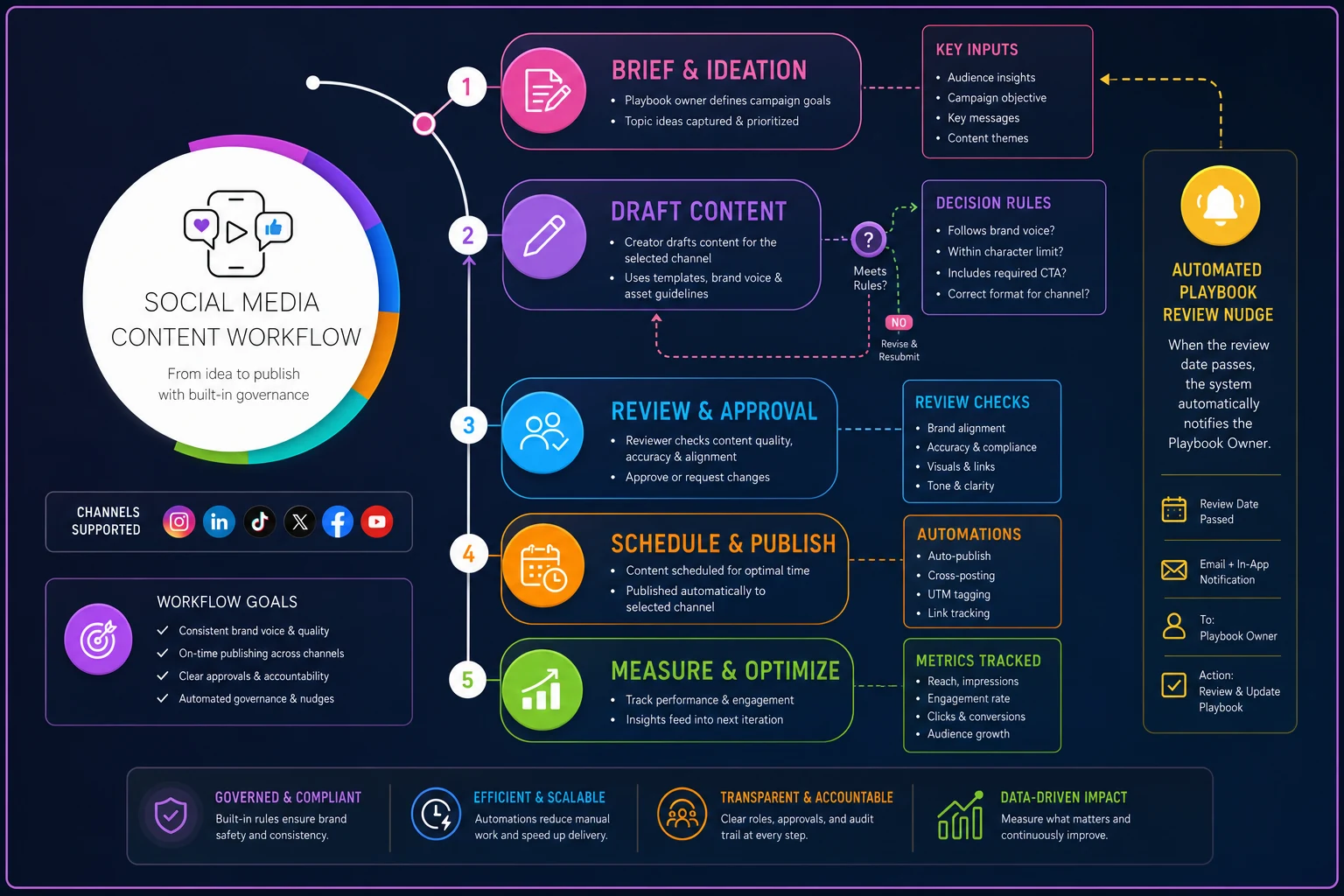
A simple visual of this flow makes it clear how rules surface at the moment of drafting and how owners get nudged when reviews lapse.
Tie review triggers to observable events (algorithm change, format drop, new hire) rather than calendar dates.
The value isn't automation for its own sake. It's that the rule shows up when it's needed instead of sitting in a doc nobody reopens. Governance fails at the moment of forgetting, and reducing forgetting is where the leverage actually is.
The real point
Channel playbook governance isn't about control or process for its own sake. It's about making your team's tenth-best day still produce work that's on-brand, legally clean, and measured against the right scoreboard — even when the people who wrote the rules aren't in the room.
The teams that scale well aren't the ones with the most detailed playbooks. They're the ones whose playbooks stay honest as everything around them changes: platforms shift, people leave, channels multiply. That honesty doesn't come from writing better docs. It comes from building the small, unglamorous system — owners, review triggers, locked-vs-local tiers, KPI contracts — that keeps the docs from lying to you.
Start with one channel. Give it a real owner, a real review date, and a real KPI contract. Get that working before you template it across the rest. Governance you actually follow on one platform beats governance you designed beautifully for five and abandoned by spring.
Ready to amplify your brand’s voice?
Join 2,500+ marketers using Postyly to save time, boost engagement, and grow their audiences effectively.