


Most social teams treat privacy as a checkbox somewhere upstream — legal signs off on a cookie banner, someone updates the privacy policy, and everyone assumes the analytics keep flowing untouched. Then a data subject request comes in, or a platform changes its consent API, or an auditor asks a simple question: "Show me exactly which rows in your dashboard came from users who never opted in." And the whole thing falls apart, because nobody built the plumbing to answer that.
Consent isn't a front-end concern. It's a data-lineage concern. Every conversion you attribute, every audience you build, every retention cohort you chart — those are downstream of a consent decision that most measurement pipelines silently ignore. When the pipeline treats consented and non-consented data as the same, you don't just have a legal problem. You have a measurement problem, because your numbers now include people who legally shouldn't be in them.
This post walks through how the pieces actually fit together: how consent state should propagate into analytics, what retention tables should look like, where anonymization rules belong, who owns what during an audit, and how tagging and UTM joins either preserve or destroy your ability to prove compliance. Less about the law, more about the operational machinery underneath it.
Why privacy consent governance breaks in the same predictable ways
The pattern is remarkably consistent across teams of every size. Consent gets captured at one layer — usually the website or the platform SDK — and then the signal just evaporates. The event fires into your analytics stack carrying campaign parameters, device info, and a user identifier, but not the one field that matters most: did this person consent to being measured, and for what purpose?
In practice, it looks like this. A user lands from a paid Instagram post, declines analytics cookies, but the platform pixel already fired on page load. That event lands in your warehouse with a full UTM string attached. Three weeks later, someone builds a "paid social conversion" report, and that non-consented event is quietly padding the numbers. Nobody did anything malicious. The pipeline just wasn't designed to carry the consent flag alongside the campaign data.
This usually happens because consent capture and analytics instrumentation are owned by two different teams who never sat in the same planning meeting. The web team owns the consent banner. The marketing analytics team owns the tags and UTMs. The data engineering team owns the warehouse. Each one assumes the other handled it. The gap isn't technical difficulty — it's that no single role is accountable for consent traveling with the data end to end.
And it compounds. Once non-consented data is mixed into your tables, cleaning it out retroactively is painful, because you often can't tell which rows are which. The consent state was never written down at ingestion. That's the original sin of most social analytics pipelines: they capture the what happened without the were we allowed to record it.
Consent-to-analytics flow: making the signal travel
The fix starts with treating consent as a first-class field that flows through every stage, not a gate that either lets everything through or stops at the banner. Think of it as a stamp that gets attached at the earliest possible moment and never gets stripped.
Stop managing your social media the hard way.
Postyly helps you plan, schedule, and analyze every post with precision.
- Multi-platform scheduling
- Real-time engagement tracking
- Automated performance reports
No credit card required
A workable flow in plain terms: when a user interacts with your consent mechanism — whether it's a CMP on your site, an in-app prompt, or a platform-level permission — you capture a structured consent record covering the purposes granted (analytics, personalization, ad measurement), a timestamp, the mechanism version, and a stable pseudonymous key. Every event fired afterward carries a reference to that consent state. When events hit your ingestion layer, the pipeline reads the consent flag before deciding what to do with the row: full retention, anonymized retention, or drop.
The critical design decision is where enforcement happens. If you enforce only at the reporting layer — filtering out non-consented rows when someone builds a dashboard — you've still stored data you shouldn't have. If you enforce at ingestion, you're safer, but you lose the ability to correct mistakes when consent state arrives late, which it often does because consent APIs are asynchronous and messy. Most mature setups do both: a hard drop at ingestion for clear non-consent, and a filtering layer downstream for the ambiguous middle.
-
Capture consent as a structured event, not a boolean buried in a cookie. Record purposes separately so "analytics yes, ad personalization no" is actually expressible.
-
Attach a consent reference to every downstream event at the tagging layer, so the join key exists before data ever reaches the warehouse.
-
Enforce at ingestion first — route events into consented, anonymized, or discard paths based on the flag.
-
Re-validate at the modeling layer, because late-arriving consent updates and withdrawals need to reshape existing tables.
-
Log every enforcement decision so you can later prove why a given row was kept, anonymized, or dropped.
That last step is the one everyone skips, and it's the one auditors care about most. Being compliant isn't enough — you have to be able to demonstrate the decision trail. If your data architecture already has a strong ingestion and normalization layer, this fits naturally into it; the groundwork covered in designing a data architecture for social analytics is exactly where consent enforcement should live rather than being bolted on afterward.
Log every enforcement decision so you can later prove why a given row was kept, anonymized, or dropped.
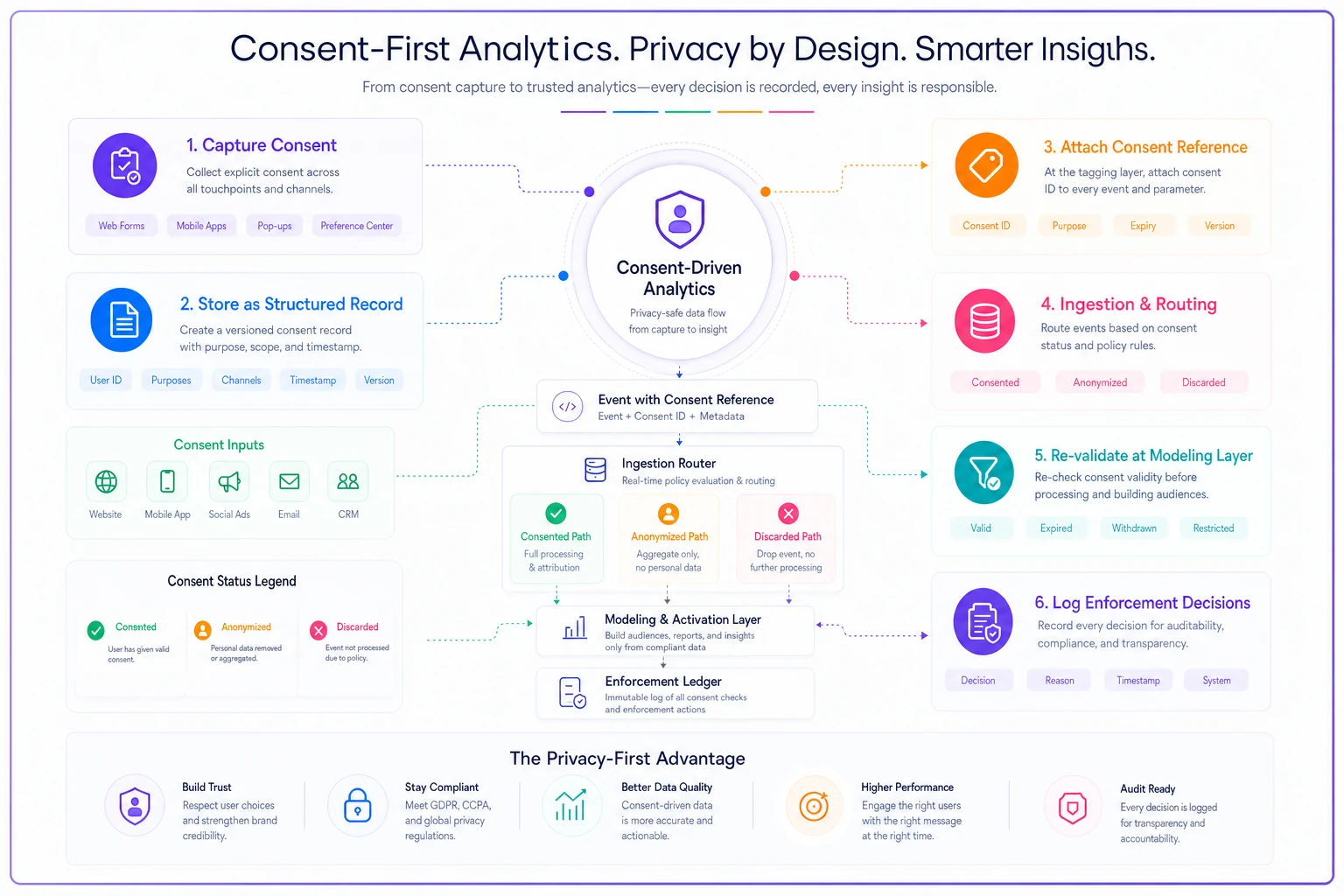
A simple diagram like this makes it easier to explain where enforcement and logging happen.
Retention tables: deciding what dies and when
Retention is where good intentions go to rot. Teams write a policy — "we keep raw event data for 14 months" — and then never build the machinery to actually enforce it. Two years later there's a table with 40 months of raw events in it because nobody wired up the deletion job.
The problem is that "retention" isn't one number. Different data types have genuinely different useful lifespans and different legal exposure. Raw, identifiable event data is high-risk and rarely useful past a certain point. Aggregated, anonymized metrics are low-risk and worth keeping for years to spot seasonality and long-term trends. Lumping them together forces a bad compromise: either you keep sensitive data too long or you throw away trend data you actually need.
A retention schedule that reflects how the data is actually used tends to look something like this:
| Data type | Contains identifiers? | Typical retention | What happens at expiry |
|---|---|---|---|
| Raw event stream (clicks, views, sessions) | Yes | 12–14 months | Hard delete |
| User-level attribution records | Yes (pseudonymous) | 12 months | Anonymize or delete |
| Consent records | Yes | Life of relationship + audit window | Retain (legal basis) |
| Campaign-level aggregates | No | 24–36 months | Retain |
| Anonymized cohort/trend tables | No | Indefinite | Retain |
The nuance most teams miss: consent records often need to outlive the data they authorized. If you delete the proof that someone consented, you can't defend having processed their data in the first place. So consent logs frequently have the longest retention of anything in your stack, which feels counterintuitive but makes sense once you think about who's asking the questions during an audit.
The other trap is retention that doesn't respect withdrawal. Someone opts out today — your retention clock for their historical data shouldn't keep ticking on the old schedule. Withdrawal should trigger its own accelerated path: anonymize or delete their identifiable records regardless of where they were in the normal retention window. If your tables don't have a clean way to find "everything tied to this pseudonymous key," you can't honor withdrawal quickly, and that's a real liability.
Anonymization rules: the difference between "hidden" and "gone"
Anonymization is where a lot of teams accidentally lie to themselves. They hash an email, feel good about it, and call the data anonymous. But a hashed identifier that still lets you single out and re-target an individual isn't anonymous — it's pseudonymous, and it's still fully in scope for privacy regulation. The distinction matters enormously because truly anonymized data usually falls outside most privacy rules, which is exactly why it's worth the effort for long-term retention.
The practical rule of thumb: data is anonymized only when you genuinely can't re-identify the individual, even by combining it with other data you hold. That's a high bar, and it's why aggregation is usually the safer path than transformation. A cohort of "users who saw campaign X in week 3" with counts and rates is anonymous. The same data with row-per-user hashed IDs is not.
-
At ingestion for data you never need at the individual level — drop identifiers immediately, keep only what feeds aggregates.
-
At a scheduled transformation step for data that's useful at user-level for a while, then collapses into anonymized aggregates once the attribution window closes.
-
On withdrawal or expiry as the enforcement mechanism for retention rules.
A subtle failure point: partial anonymization that leaves quasi-identifiers intact. Strip the name and email but keep exact timestamp, precise location, device model, and referring URL, and you've built a fingerprint that re-identifies people without much effort. Real anonymization means being ruthless about the combination of fields, not just the obvious ones. When teams get audited and fail on this, it's almost always because they anonymized the "PII" they recognized and left a dozen quasi-identifiers untouched.
Role-based responsibilities: who actually owns the audit
The single biggest reason privacy audits go badly isn't missing data — it's that nobody can say who's responsible for what, so questions bounce between teams until the auditor loses patience. Consent governance is inherently cross-functional, and that's exactly why it needs explicit ownership rather than shared vagueness.
-
Marketing / social analytics owns the tagging and UTM layer — ensuring every campaign carries consistent parameters and that consent references attach at the point of instrumentation. If a UTM string is malformed, that's this team's problem to catch.
-
Data engineering owns ingestion enforcement, retention jobs, and anonymization transformations. They own the mechanics of the rules but not the definition of them.
-
Legal / privacy owns the definitions
what purposes exist, what retention windows are defensible, what counts as anonymized. They set the policy; they don't run the pipeline.
-
A designated data steward owns the connective tissue — making sure the policy legal wrote is actually reflected in the jobs engineering built. This role is the one most teams don't staff, and it's the reason the gap between "policy on paper" and "policy in production" stays open.
That steward function matters more as you scale. A small team can get away with informal coordination because three people talk daily. Once you're spread across campaign managers, agencies, regional teams, and an offshore data function, the informal coordination collapses and the gaps between owners become invisible until an audit finds them. The social data operating model for the enterprise framing is useful here — privacy ownership should map onto the same operating model as the rest of your data responsibilities, not float off as a separate legal thing.
A quick audit-readiness checklist worth keeping visible:
-
- [ ] Can you produce the consent record for any given analytics event?
-
- [ ] Can you list every table containing identifiable data and its retention window?
-
- [ ] Can you demonstrate the deletion job actually ran, with logs?
-
- [ ] Can you show what happens to a user's data when they withdraw consent?
-
- [ ] Can you prove your "anonymized" tables can't be re-identified?
-
- [ ] Does a single named person own reconciling policy with pipeline reality?
If you can't check all six, you don't have a governance system — you have a set of good intentions distributed across people who each assume someone else is handling it.
Tagging and UTM joins: where compliance quietly succeeds or fails
This is the part most privacy discussions skip entirely, and it's where social measurement lives or dies. Your UTM parameters and tags are the join keys that connect campaign activity to outcomes. If those keys aren't consistent, you can't build attribution. But if they are consistent and you never joined consent state into them, you've built a beautifully reliable pipeline for measuring people who didn't agree to be measured.
The core issue is that UTMs describe the campaign but say nothing about the person's consent. A join between your ad platform export and your on-site analytics typically keys on some combination of UTM parameters, timestamp windows, and a user or session identifier. That join needs to carry the consent flag through, or the joined table inherits the same blind spot — now amplified, because attribution multiplies the reach of every non-consented row.
-
Standardize UTM taxonomy first. You can't reliably join what you can't reliably parse. Inconsistent casing, freeform campaign names, and missing parameters make consent-aware joins nearly impossible because the rows don't match cleanly.
-
Carry a consent reference key alongside campaign parameters, not in a separate system that has to be joined later under different keys.
-
Resolve consent at the same grain as your join. If you attribute at the session level, your consent flag needs to exist at the session level too, or you'll be joining consent from one grain onto events at another and getting it wrong.
-
Treat late-arriving consent as a re-join event. Consent APIs update asynchronously; your joins need to be re-runnable so a withdrawal or a late grant reshapes the attributed data correctly.
The consistency requirement here overlaps heavily with content and metadata discipline. A lot of the same taxonomy hygiene that makes campaign measurement reliable is what makes consent-aware joins possible — the thinking in the rights-aware enterprise content taxonomy work applies directly, because a tag map that can't be trusted for content also can't be trusted for consent lineage.
A real scenario: a mid-size DTC brand's audit near-miss
A direct-to-consumer skincare brand running heavy paid social — roughly $80k–$100k a month across Meta and TikTok — got a data subject deletion request that turned into a full internal review. The request itself was simple. The problem was they couldn't answer it.
When they went looking, they found their attribution tables keyed on a mix of UTM strings and a hashed device identifier, but the consent state lived in a totally separate CMP export that keyed on a different identifier entirely. No clean join between "here's what this person did" and "here's what they agreed to." Their raw event table had close to 30 months of identifiable data despite a stated 14-month policy, because the deletion job had silently failed about a year earlier and nobody was watching the logs.
The fix took about a quarter of focused work. They rebuilt consent capture as a structured event with a stable key, pushed that key into the tagging layer so it rode along with every UTM'd event, and wired ingestion to route data down consented, anonymized, and discard paths. They set up retention jobs with actual monitoring, so a silent failure would page someone. And they named a data steward to own the reconciliation between what legal wrote and what the pipeline did.
The outcome wasn't dramatic in the way marketing case studies pretend. Their reported paid-social conversion numbers actually dropped by a noticeable margin once non-consented events stopped padding the totals — uncomfortable, but correct, and it made their attribution defensible for the first time. More importantly, the next deletion request took minutes instead of a scramble across three teams. They could finally answer the auditor's original question.
When to build this properly — and when it's overkill
This becomes worth building when you're operating across multiple regulatory regions, running enough spend that attribution decisions move real budget, storing user-level data for any meaningful window, or when the number of people touching the pipeline has grown past the point where everyone knows what everyone else is doing. Those are the conditions under which informal coordination stops working and the gaps turn into liabilities.
This is a bad idea when you're using it as a substitute for actually minimizing data collection. The cleanest privacy posture isn't a sophisticated consent pipeline — it's not collecting identifiable data you don't need in the first place. If you can measure what you need with aggregated, anonymized data, do that and skip most of this complexity entirely. Governance machinery should manage the data you genuinely need to keep, not justify hoarding data you don't.
The team that should not attempt this is one without a single accountable owner. If you build all the technical pieces but leave ownership distributed across three teams who each assume someone else is watching the retention logs, you've built something that looks compliant and fails at the first real test — which is more dangerous than doing nothing, because it creates false confidence.
Privacy governance for social analytics isn't a legal add-on that sits beside your measurement stack. It is part of the measurement stack. Consent state is a data field that has to travel from capture through tagging, ingestion, modeling, and reporting. Retention isn't a policy document — it's a set of jobs that either run or don't. Anonymization is a design decision about where identifiers die. And every one of those depends on someone being clearly, unambiguously responsible for making the pipeline match the policy.
The teams that handle this well aren't the ones with the most sophisticated tooling. They're the ones who made consent a first-class citizen in their data flow early, standardized their tags before they needed to, and gave one person the job of keeping the plumbing honest. Everything else — the tables, the jobs, the join logic — follows from those decisions. Get the lineage right, and the audit takes care of itself. Get it wrong, and you'll find out the hard way, usually when someone asks the one question your pipeline was never built to answer.
Ready to amplify your brand’s voice?
Join 2,500+ marketers using Postyly to save time, boost engagement, and grow their audiences effectively.