


The tension is almost always the same. The social team wants a number by Friday for a board deck. The data team says the pipeline doesn't join paid and organic cleanly yet, so any number they give you comes with a shrug. So the social manager pulls something manually from the native dashboards, ships it, and three weeks later someone in finance asks why the "reach" figure doesn't match what data reported. Now there are two truths, and both teams look sloppy.
This isn't a tooling gap. It's a missing operating model — a clear agreement about who owns what, how fast data flows, and what each side is actually promising the other. Most enterprises never write this down. They hire a social team, hire (or borrow) a data team, and assume the two will figure out the handoffs on their own. They don't. They renegotiate every request from scratch, indefinitely.
What follows is the operating model we've watched work at the org level: role definitions that don't overlap, data SLAs that mean something, service contracts between social and data, a 90-day rollout, and a role-split decision table you can copy into a doc today.
Why the friction shows up in almost every org
The root cause is that social data sits between two departments measuring success differently. Social is measured on output and engagement — did the content ship, did it perform, did the community respond. Data is measured on accuracy, governance, and reusability — is the number defensible, is it consistent across reports, will it hold up next quarter.
Those incentives quietly pull in opposite directions. Social wants speed and is fine with "good enough." Data wants correctness and is fine with "later." Neither is wrong. But without some agreement in the middle, every request turns into a small standoff.
There's a pattern worth naming: when there's no operating model, the most senior person in the room wins each individual argument. That feels fine day to day. At scale it's chaos, because decisions aren't reproducible. The same request gets answered differently depending on who's less busy that week. You can't build reporting on top of that.
The second failure is ownership ambiguity around the messy middle — tagging conventions, UTM discipline, campaign naming, the definition of a "session" from social. Both teams assume the other owns it. So nobody does. Six months later you've got 40 variations of the same campaign name and no way to roll them up.
Role definitions that don't overlap
The fix starts by separating three jobs that usually get blurred into "the social team" and "the data team." In practice you need four distinct roles, even if one person wears two hats early on.
Stop managing your social media the hard way.
Postyly helps you plan, schedule, and analyze every post with precision.
- Multi-platform scheduling
- Real-time engagement tracking
- Automated performance reports
No credit card required
-
Social Operator — owns publishing, community, creative performance reads, and the day-to-day "what's working" judgment. They consume data; they don't build pipelines.
-
Social Analyst (embedded) — sits inside social, but speaks data. Owns tagging discipline, campaign naming enforcement, and translating messy social reality into clean inputs. This is the role most orgs skip, and it's the one that prevents the majority of the friction.
-
Data Engineer — owns pipelines, source connections, normalization, and the warehouse tables social reporting is built on. Covered in more depth in our piece on designing a data architecture for social analytics.
-
Analytics/BI owner — owns definitions, the metric layer, and the reports leadership actually sees. They arbitrate what "reach" means so there's one answer.
The single biggest structural insight here: the embedded Social Analyst is the load-bearing role. When it's missing, the Data Engineer inherits a firehose of dirty inputs and the Social Operator inherits numbers they don't trust. Put a translator in the middle and both sides settle down.
A quick note on reporting lines. The embedded analyst should report operationally into social but functionally into the data org — dotted line up to the BI owner. That keeps their standards aligned with the warehouse while their day job stays close to the content.
Data SLAs that actually mean something
"SLA" gets thrown around loosely. In a real operating model, an SLA is a promise with a number attached and a consequence when it's missed. Vague SLAs — "we'll get you the data soon" — are worse than none, because they create the illusion of an agreement without actually making one.
Every data promise between the teams should specify three things: freshness (how current), turnaround (how fast on a new request), and fix time (how fast a broken number gets corrected).
| SLA type | What it promises | Realistic enterprise target | Who owns it |
|---|---|---|---|
| Standard dashboard freshness | Core social metrics updated on schedule | Every 24h, by 9am | Data Engineer |
| Campaign tagging turnaround | New campaign tagged + mapped before launch | Within 1 business day of brief | Social Analyst |
| Ad-hoc pull request | One-off number for a deck or exec ask | 2–3 business days | Analytics/BI owner |
| Data incident fix | Broken join or missing source restored | Same day if reporting-blocking | Data Engineer |
| Definition dispute resolution | "Which number is right" arbitration | 48 hours, documented | Analytics/BI owner |
The number that matters most in practice is the ad-hoc turnaround. Most conflict lives here. When social knows a real one-off pull takes 2–3 days, they stop treating every Slack message as an emergency and start batching requests. When turnaround is undefined, everything is urgent and nothing gets prioritized well.
One thing that consistently comes up: SLAs only work if there's a request intake that isn't a DM. The moment requests arrive through five different channels, the SLA clock becomes unmeasurable. A single intake form — even a basic one — is what makes the promise enforceable.
Service contracts between social and data
An SLA covers speed. A service contract covers scope and responsibility — what each team is on the hook for, and what they explicitly are not. This is where you kill the "I thought you owned that" problem.
A workable contract has four sections:
-
Inputs social owns. Clean campaign names, correct UTM parameters, tagging applied before launch, brief submitted through intake. If these arrive wrong, the data team's obligation pauses until they're fixed. That last clause matters — it stops data from being blamed for garbage inputs.
-
Outputs data owns. The metric definitions, the warehouse tables, the standard dashboards, and the accuracy of joins between paid, organic, and web. If social pulls a raw native number and it disagrees with the warehouse, the warehouse is source of truth by contract.
-
Shared decisions. New metric definitions, changes to campaign taxonomy, deprecating an old report. Neither side changes these unilaterally. This is the clause that prevents someone quietly renaming a field and breaking six dashboards.
-
Escalation path. Who decides when the two teams disagree, and how fast. Usually the BI owner for definition fights, a shared director for priority fights.
Here's what that chain looks like in practice: social submits a campaign brief through intake → the embedded analyst applies the tagging and naming standard → the campaign launches with clean inputs → data's pipeline picks it up automatically because it followed the taxonomy → reporting rolls up correctly with no manual reconciliation. When that chain holds, nobody spends Friday afternoon fixing names by hand.
The campaign-to-report workflow:
-
Social submits campaign brief via intake form
-
Embedded analyst validates naming and applies UTM taxonomy
-
Campaign launches with clean, structured inputs
-
Data pipeline auto-classifies the campaign based on taxonomy rules
-
Warehouse tables update on the agreed freshness schedule
-
Standard dashboards reflect accurate, joined paid and organic data
-
Any disputes escalate through the defined path — BI owner for definitions, shared director for priorities
Running this sequence consistently is what separates teams that report confidently from teams that spend the last day of every month reconciling spreadsheets.
This diagram shows the typical handoffs and decision points in that flow.
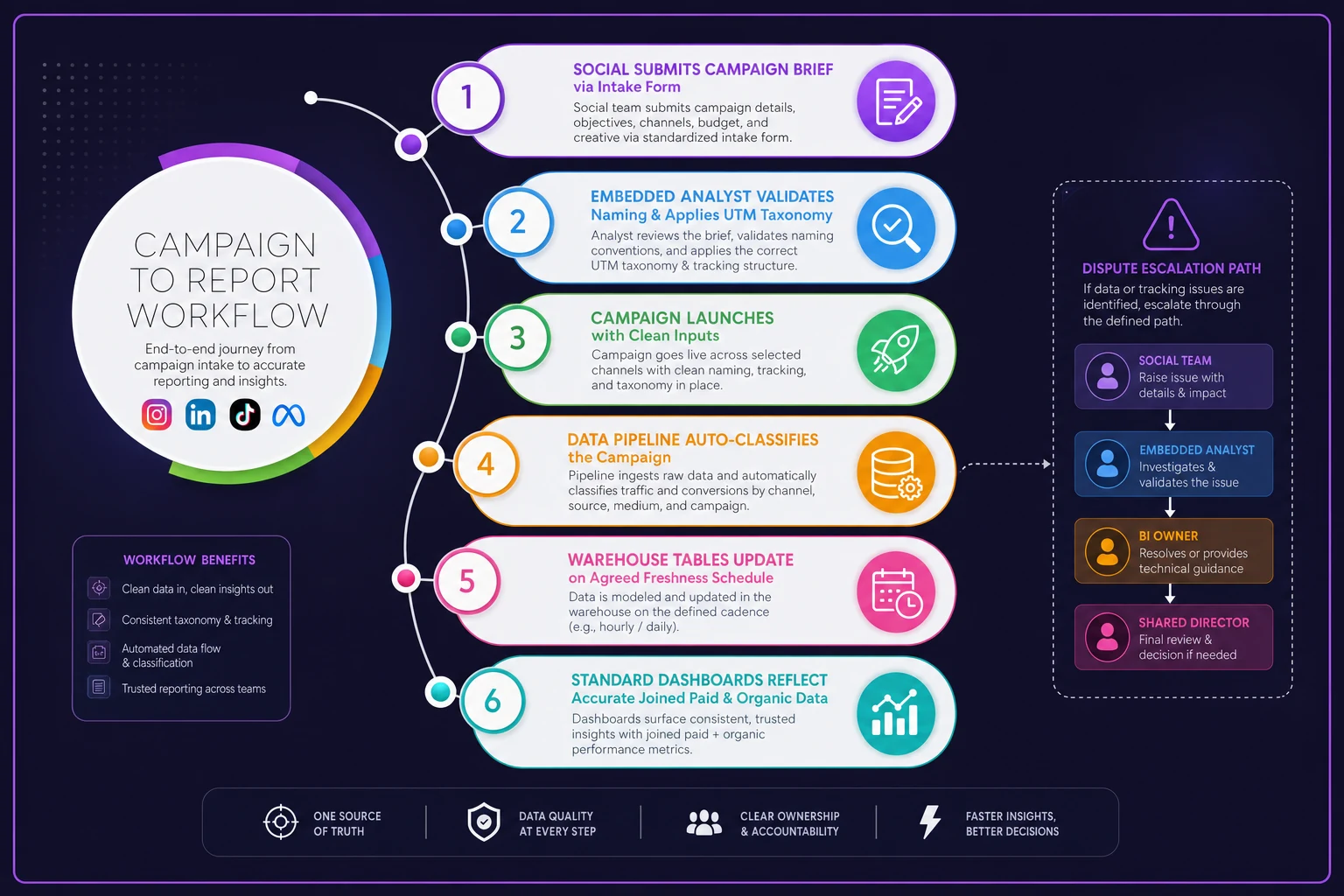
When that flow is automated and enforced, the teams stop firefighting and start shipping reliable reports.
Where automation quietly earns its place
Most of the manual pain in this model lives in the repetitive middle — checking that every campaign followed the naming rules, flagging when a UTM is malformed, catching that a source stopped reporting overnight, nudging when an SLA clock is about to breach. This is exactly the work that burns out the embedded analyst and slows the data engineer.
AI-assisted operational tooling helps here without being the star of the show. A workflow platform that watches your intake, validates campaign naming against the taxonomy, and pings the right owner when a freshness SLA is about to miss removes the babysitting work. It doesn't replace judgment — it just enforces the boring rules consistently so people aren't the ones remembering to check.
Automate enforcement of tagging and freshness alerts, not the human decisions about metric definitions.
Teams that scale cleanly tend to automate the enforcement of their operating model, not the model itself. The roles, the contracts, the definitions — those still require humans who understand the business. But the repetitive checking? That's a reasonable thing to hand off.
A 90-day rollout checklist
You don't roll this out all at once. Sequence it so each phase produces something usable before the next one depends on it.
Days 1–30 — Define and align
-
Name the four roles and who fills them (two hats is fine)
-
Stand up a single request intake form for all social→data asks
-
Draft the first service contract (inputs, outputs, shared, escalation)
-
Agree on the top 10 metric definitions in writing
-
Freeze a campaign naming + UTM standard
Days 31–60 — Instrument and test
-
Route every new campaign through the taxonomy before launch
-
Publish the SLA table and start measuring turnaround against it
-
Designate the warehouse as source of truth; retire conflicting manual pulls
-
Run a live incident drill (break a source on purpose, time the fix)
-
Have the embedded analyst audit one month of historical tagging
Days 61–90 — Harden and hand off
-
Review SLA hit rates; adjust targets that were unrealistic
-
Automate naming validation and freshness alerts
-
Lock the shared-decision process for definition changes
-
Build the standard exec view so leadership stops asking for one-offs — our executive one-pager framework is a useful template here
-
Document everything in one place both teams can find
The mistake to avoid: trying to instrument (days 31–60) before definitions are frozen (days 1–30). If you automate on top of shifting definitions, you just automate the confusion faster.
The role-split decision table you can copy
When a task lands and nobody's sure who owns it, this table settles it. Copy it, adjust the names, put it where both teams work.
| Task | Social Operator | Social Analyst | Data Engineer | BI Owner |
|---|---|---|---|---|
| Apply campaign tags/UTMs | — | Owns | — | — |
| Enforce naming taxonomy | Informed | Owns | Consulted | Consulted |
| Build/maintain pipelines | — | — | Owns | Informed |
| Define what a metric means | Consulted | Consulted | Informed | Owns |
| Standard dashboard freshness | Informed | Informed | Owns | Consulted |
| Ad-hoc exec pull | Requests | Consulted | Consulted | Owns |
| "Which number is right?" | Informed | Informed | Consulted | Owns |
| Read creative performance | Owns | Consulted | — | — |
| Fix a broken data source | Informed | Informed | Owns | Informed |
The pattern to internalize: the analyst owns inputs, the engineer owns plumbing, the BI owner owns meaning, and the operator owns action. Almost every dispute is really a disagreement about which of those four buckets a task belongs in. Once the buckets are clear, the arguments mostly stop.
A real scenario
A mid-market retail brand — roughly 25 people across marketing, a two-person social team, one data engineer shared with the broader analytics group. Before any operating model, their monthly reporting cycle took around six working days, most of it spent reconciling native numbers against the warehouse and re-agreeing on definitions each time. Exec one-off requests came in through Slack, email, and hallway conversations, and each one blew up someone's afternoon.
They didn't hire anyone new. They reassigned one social coordinator into the embedded analyst role, wrote a one-page service contract, and stood up a single intake form. Within the first quarter the reporting cycle dropped to around two days. Ad-hoc requests fell by roughly half — not because leadership asked for less, but because a standard exec view answered most of what they used to request one-off. The two-truths problem basically disappeared once the warehouse was declared source of truth in writing.
Nothing about that was flashy. The win came from clarity, not headcount.
When this model is overkill
Not every team needs this. If you're a small social team pulling straight from native dashboards, with no board deck and no paid-organic joins to reconcile, a full operating model is bureaucracy you'll resent. You'd spend more time maintaining the contract than it saves you.
It starts paying off when three things are true at once: multiple people request data from multiple sources, leadership consumes the numbers, and paid and organic need to roll up together. That's usually where measuring across the funnel gets genuinely complicated — the funnel-to-metric matrix is a reasonable gut-check for whether you're at that level of complexity yet.
Rolling this out top-down as a mandate with no analyst in the middle is a bad idea regardless of org size. Without the translator role, you've written rules nobody can operationally follow, and both teams will quietly route around them. The model lives or dies on that middle seat.
Where to start
If you want one move that matters more than the rest: create the embedded analyst role and the single intake form this week. Those two things — a person who owns clean inputs, and one door for requests — resolve most of the day-to-day friction before you've written a single SLA.
The contracts, tables, and automation make the model durable, but the translator and the intake make it work.
The teams that get this right aren't the ones with the biggest data stack. They're the ones who wrote down who owns what, agreed on what the numbers mean, and stopped renegotiating it every Friday.
Ready to amplify your brand’s voice?
Join 2,500+ marketers using Postyly to save time, boost engagement, and grow their audiences effectively.