
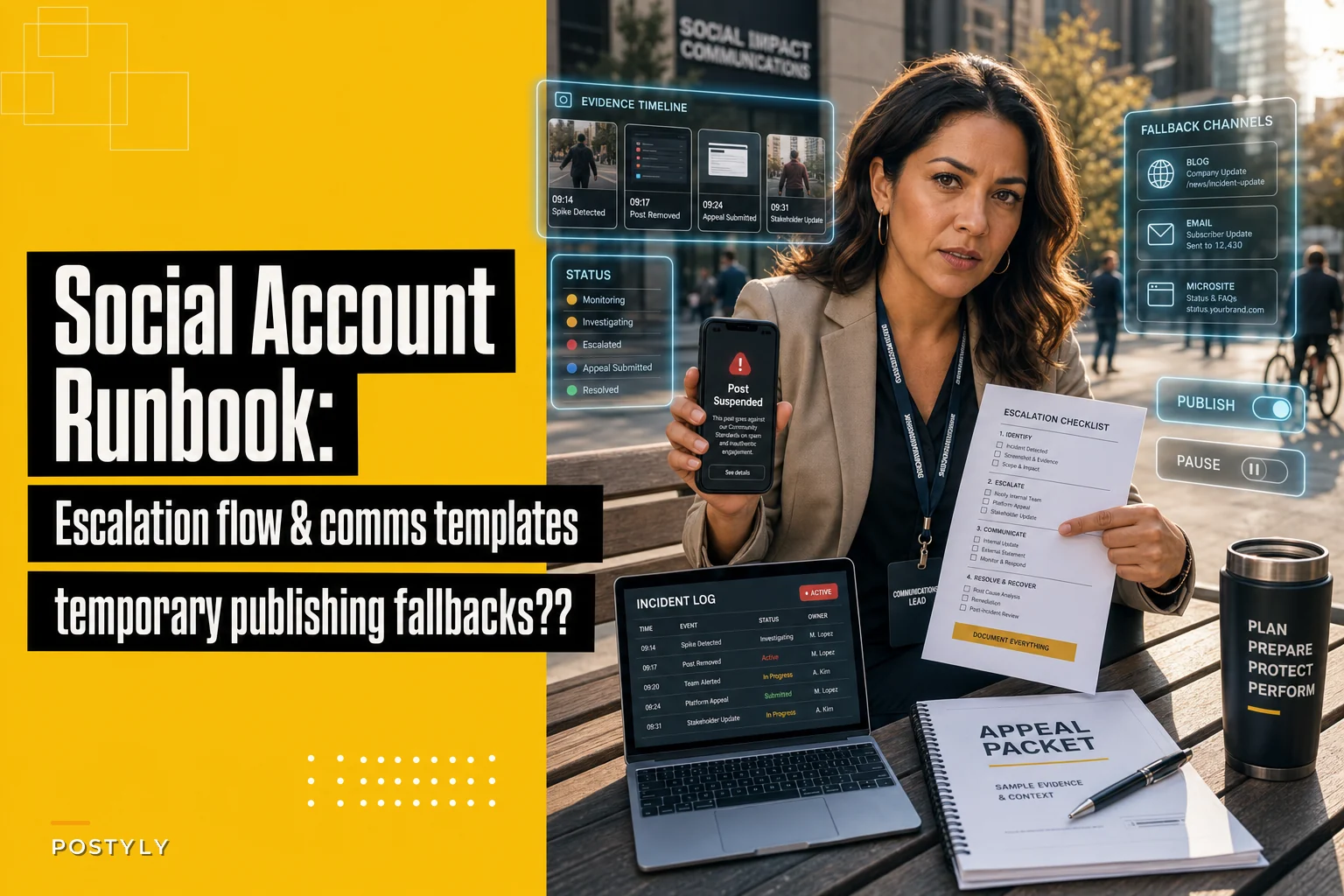

Most social teams don't plan for suspension because it feels like something that happens to other people. Then a Tuesday morning arrives, someone tries to post the campaign kickoff, and the account manager screen shows "This account has been restricted" with zero context. No email. No reason. No timeline. The content calendar you spent three weeks building is now sitting behind a locked door, and the executive team is already asking why the launch didn't go out.
The problem isn't that suspensions happen. Almost nobody has a decision tree ready for the first 60 minutes — and that first hour is where most teams lose their recovery window, their audience, or their internal credibility. This piece is the runbook itself: who does what, where you publish in the meantime, what you tell people, and how you clean up after the account comes back.
What a suspension actually looks like in practice
Suspensions rarely arrive as a clean, well-explained event. They show up in messy variations, and knowing which one you're dealing with changes your entire response.
The most common forms:
-
Full suspension — the account is invisible to the public, you can't log in or post, and appeals go through a generic form.
-
Publishing restriction — the account exists but you can't post, run ads, or use certain features (common after a flagged ad creative or a copyright strike).
-
Shadow restriction — nothing looks broken internally, but reach collapses to near zero overnight. No notification, no banner.
-
Third-party tool lockout — your account is fine, but your scheduler loses API access because the platform revoked the app's token, so nothing publishes even though you did nothing wrong.
That last one catches teams off guard constantly. The account is healthy, the content is approved, and the publishing tool just quietly stops pushing posts. You can go two or three days before anyone notices the scheduled posts never went live.
The reason variation matters: a full suspension is an appeals-and-communications problem. A shadow restriction is a diagnostics problem. A tool lockout is an access-recovery problem. If your runbook treats all three the same, you'll waste the first hour doing the wrong thing.
The first 60 minutes: who does what
The biggest failure in a suspension isn't the suspension itself. It's four people independently refreshing the appeals page, nobody documenting anything, and the CMO finding out from a customer tweet before the social team has said a word internally.
Stop managing your social media the hard way.
Postyly helps you plan, schedule, and analyze every post with precision.
- Multi-platform scheduling
- Real-time engagement tracking
- Automated performance reports
No credit card required
-
Confirm and classify (minutes 0–10). One person — the on-call owner — confirms it's real (not a browser glitch or a cache issue) and classifies it: full, publishing, shadow, or tool lockout. Screenshot everything with timestamps.
-
Open the incident log (minutes 5–15). Start a single timestamped document. Every action, every email, every platform response goes here. This becomes your appeal evidence and your post-incident record.
-
Notify the escalation chain (minutes 10–20). Based on severity, trigger the matrix below. Don't skip this to "look into it first." Silence is what burns trust.
-
Freeze automated publishing (minutes 15–25). Pause the scheduler so nothing fires into a restricted account and creates a messy paper trail — or worse, publishes into a half-working account and gets flagged again.
-
Decide on temporary publishing (minutes 20–40). Choose whether you activate a backup channel now or wait. More on that below.
-
File the appeal with evidence (minutes 30–60). Use your templates. Don't freelance the appeal under stress.
Each step feeds directly into the next. Skipping the incident log in step two means your appeal in step six has no supporting documentation. Skipping the escalation notification in step three means leadership hears about it from somewhere else first.
Here's the incident response flow visually:
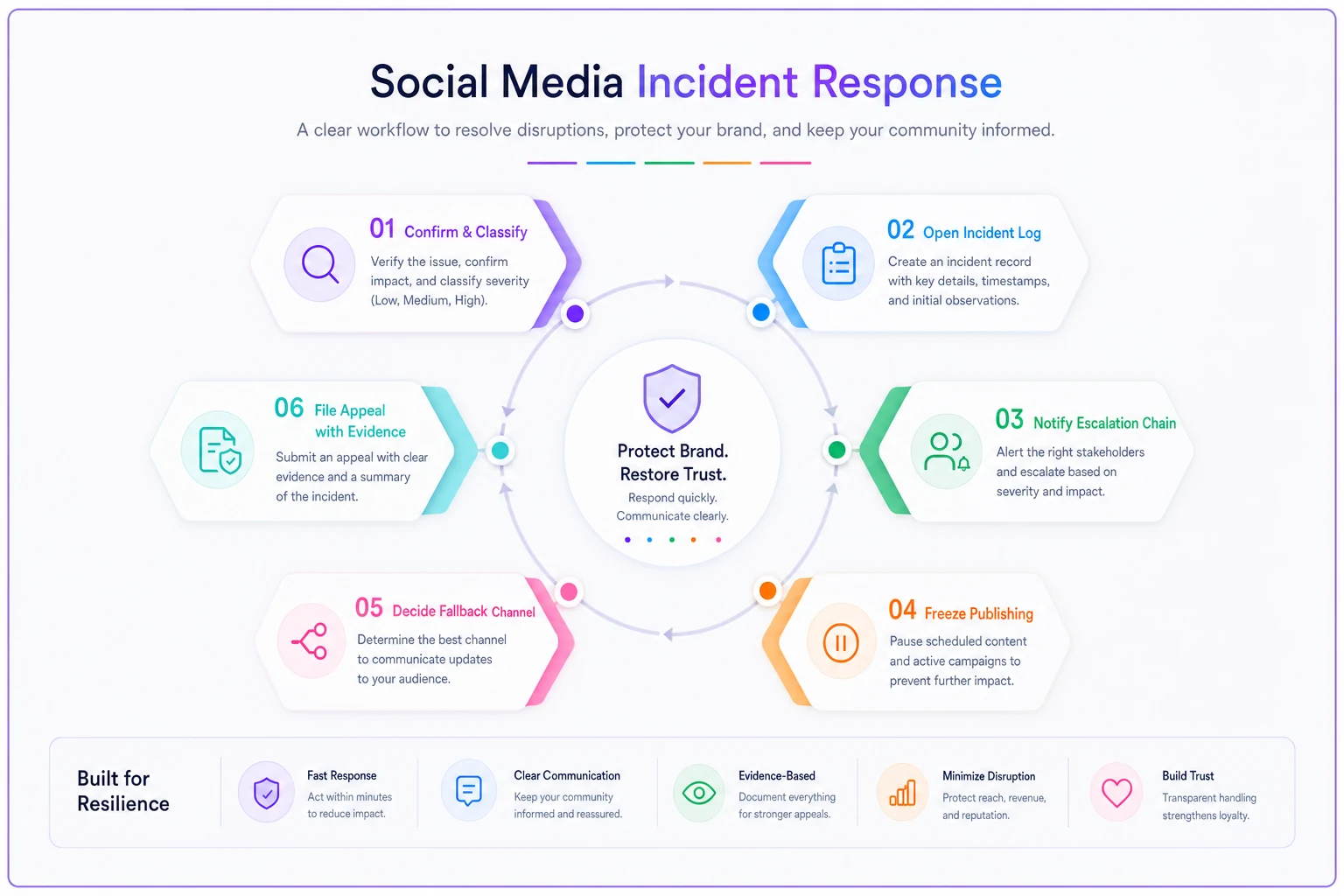
Keep this sequence handy during the first hour so roles and next steps are obvious.
Escalation matrix
| Severity | What triggered it | Who gets notified | Response window |
|---|---|---|---|
| P1 — Full suspension of primary handle | Account invisible, login blocked | Social lead, Marketing director, Legal/Comms, exec sponsor | Immediate, within 15 min |
| P2 — Publishing restriction or ad account hold | Can't post or run paid | Social lead, paid media owner, Marketing director | Within 30 min |
| P3 — Shadow restriction / reach collapse | Metrics tank, no banner | Social lead, analytics owner | Within 2 hours |
| P4 — Third-party tool lockout | Scheduler API revoked | Social lead, ops/tooling owner | Within 1 hour |
The point of severity tiers is to stop teams from either overreacting (dragging Legal into a reach dip) or underreacting (treating a full suspension as a wait-and-see). Assign real names to each role before an incident, not during one.
Temporary publishing alternatives
This is the part most runbooks skip entirely, and it's the one that actually protects your audience relationship during the dead window.
Your realistic fallback options, roughly in order of usefulness:
-
Secondary owned channels you already run — email list, SMS, your blog, a newsletter. These reach your existing audience directly and don't depend on any platform's goodwill. If you keep an executive one-pager for social performance, you likely already have the reporting muscle to show leadership what you redirected and where.
-
A parallel brand account on the same platform — a support handle, a careers account, a regional sub-account. Not ideal for sales messaging, but it keeps a presence and can point followers somewhere.
-
A different platform where you already have a footprint — if your main handle is on one network, a modest but real presence elsewhere becomes your megaphone.
-
Executive and employee personal accounts — the most underused option. A founder or senior leader posting "we're aware our main account is temporarily down, here's where to find us" humanizes the gap and travels fast.
-
Partner and creator channels — if you run influencer relationships, a quick note to a few trusted creators can bridge an audience gap without you controlling a single asset.
What tends to happen across a lot of teams is that the content for the fallback window is the actual bottleneck, not the channel. The channels exist. But nobody has decided what you're allowed to say on them, so the backup sits empty while people debate tone in a thread.
Fix that in advance. Pre-write a short "we're temporarily away" message for each fallback channel, and keep a small library of evergreen posts that are safe to publish anywhere during an incident — no time-sensitive claims, no promotions that need legal sign-off. This is a concrete, unglamorous task that pays off badly if skipped.
When a temporary channel makes sense — and when it doesn't
Activating a backup isn't always the right call. If you're dealing with a shadow restriction and reach might recover in 48 hours, moving your audience to a different platform can confuse people and split your following permanently.
Activate a fallback when:
-
It's a full suspension and the appeal timeline is unknown.
-
You have a time-sensitive launch or commitment that can't slip.
-
The suspension is public enough that silence looks worse than redirecting.
Hold off when:
-
It's a likely-temporary shadow dip and your appeal is strong.
-
Moving the audience would cost more trust than the short gap.
-
You haven't confirmed the suspension is real (genuinely, check the browser first).
If you're dealing with a shadow restriction and reach might recover in 48 hours, moving your audience to a different platform can confuse people and split your following permanently.
Communications templates
Under stress, people write bad appeals and worse public statements. Templates remove that risk. You want three categories ready to fill in, not compose from scratch.
1. The platform appeal. Calm, factual, specific. State what the account is, what you believe triggered the action, why you believe it's an error or has been resolved, and what you've changed. Attach your incident log screenshots. Avoid emotion, avoid threats, avoid "I demand." Reference specific policy sections if you can.
2. The internal update. Short, frequent, honest. Leadership tolerates bad news far better than silence. A simple format: what happened, current status, what we're doing, next update time. Send it even when there's no change — "no update yet, next check at 2pm" is a real update.
3. The public-facing message. Only if the gap is visible. Keep it light, non-defensive, and action-oriented: acknowledge, point to where people can find you, promise a return. Don't speculate publicly about why it happened or blame the platform — that ages badly if the suspension turns out to be your fault.
The internal update is the one teams get most wrong. They go quiet while "figuring it out," and that silence is exactly what makes executives assume the social team is in over its head. A boring update every two hours buys more goodwill than a brilliant recovery with no communication in between.
A real scenario
A mid-sized DTC skincare brand — small social team of three, one primary handle driving the bulk of their new-customer discovery — got hit with a full publishing restriction after an automated system flagged a promotional post as a prohibited claim. No warning. It landed the morning of a product-drop campaign they'd spent roughly six weeks building.
No runbook existed. The first two and a half hours went entirely to confusion: three people filing separate appeals, nobody logging anything, and the founder learning about it from a customer DM. By the time they redirected to email, they'd burned most of the launch-day momentum. The drop underperformed their prior launch by somewhere around 30–40%, and the account stayed restricted for about five days.
After that, they built the runbook described here — escalation matrix, pre-written appeal and fallback messages, an incident log template, and a small library of safe-to-publish evergreen posts. About four months later a different flag hit, this time a shorter publishing hold. The on-call owner classified it within ten minutes, email and the founder's personal account carried the announcement the same morning, and the appeal (with a clean log attached) cleared in under 48 hours. The revenue dip that second time was minor — a soft day, not a lost launch.
The content didn't change. The response speed did.
Post-incident remediation
Getting the account back is not the end. The account that came back is the same one that got flagged, and if you don't fix the root cause you're just waiting for round two.
Run this within a few days of recovery, while memory is fresh:
-
Root-cause review. What actually triggered it? Pull the exact post, ad, or action. If it's unclear, document that too — unknown causes change how you operate going forward.
-
Content audit. Scan recent posts for similar risk. If one claim got flagged, others like it probably will.
-
Approval gap check. Did the flagged content clear your normal review, or did it skip a step? A strong preflight checklist and lightweight version control catches a surprising share of the content that gets accounts in trouble before it ever publishes.
-
Backup verification. Did the fallback channels actually work under pressure? Was the email list current? Did the personal accounts have the right access?
-
Runbook update. Every incident teaches you something the runbook didn't cover. Fold it in immediately.
The teams that recover cleanest are almost always running tight content operations with clear SLAs and roles day to day. A suspension is just a stress test of operations you already have — or don't.
Who should not over-invest in this
If you're a solo operator with a small following and no revenue riding on a single platform, a full tabletop runbook is overkill. Keep an email list, screenshot your appeals, and move on.
The runbook earns its keep when a single account carries meaningful revenue, when multiple people touch publishing, or when leadership expects an answer the moment something breaks. Those conditions describe a lot more teams than most want to admit.
On the tooling side, a scheduler or workflow platform helps only if it lets you pause publishing instantly, keeps a clean audit trail of what went out and when, and holds your fallback content ready to deploy. That audit trail becomes your appeal evidence. But the runbook is the real asset. No tool saves a team that hasn't decided who classifies the incident, who files the appeal, and where they publish while they wait.
Build the plan before you need it. The morning the screen says "restricted" is not the morning to figure out who's in charge.
Ready to amplify your brand’s voice?
Join 2,500+ marketers using Postyly to save time, boost engagement, and grow their audiences effectively.