


Most moderation backlogs don't come from too much content. They come from ambiguity about who decides what, and when. A comment sits in a queue for eleven hours not because it's hard to judge, but because three people each assume someone else owns it. Multiply that across dozens of edge cases a day and you get the thing every social lead dreads: a queue that grows faster than the team can clear it, and a legal team that finds out about problems from screenshots instead of from you.
The fix isn't hiring more moderators or buying a smarter filter. It's building an enterprise community moderation operating model — policies, thresholds, and escalation paths that make most decisions automatic and the rest fast. When the model works, roughly 80% of items never need a human at all, and the 20% that do route to exactly the right person with a clear deadline attached.
This is a blueprint you can actually use. Policy tiers, a delegation ladder, automation triggers, SLA-backed lanes, and a 90-day rollout with a KPI contract. Copy the tables, adjust the thresholds, run it.
Why moderation breaks at scale (and it's rarely the volume)
At small scale, moderation works because one person holds the whole context in their head. They know the brand voice, they know which topics are sensitive, they know when to loop in legal. There's no operating model — there's just Priya, who's been doing it for two years.
Then the account grows, a campaign goes viral, or the company adds three new markets. Priya can't be everywhere. She trains two junior moderators, but she never wrote down how she decides. So the new people either escalate everything (backlog explodes) or nothing (risk explodes). Both failures trace back to the same root cause: judgment lived in one head and never got turned into a system.
The pattern that shows up across enterprise social teams is pretty consistent:
-
The queue has no lanes. A spam comment and a defamation threat sit in the same undifferentiated list, sorted by timestamp. The urgent thing waits behind fifty trivial things.
-
Escalation is a Slack DM. There's no defined path, so it depends on who's online and who feels confident interrupting a director.
-
Nobody owns the gray zone. Clear violations get removed. Clear-safe content stays. The ambiguous middle — which is where all the real risk lives — becomes a game of hot potato.
-
Legal is a black box with no SLA. When something finally reaches legal, it disappears for days, and moderators learn to stop escalating because it feels pointless.
What breaks isn't capacity. It's coordination. And coordination problems don't get solved by working harder — they get solved by making decisions structural instead of personal.
The three-tier policy model
Every moderation decision should fall into one of three tiers. This is the backbone of the whole model, because it determines whether a human ever touches an item at all.
Stop managing your social media the hard way.
Postyly helps you plan, schedule, and analyze every post with precision.
- Multi-platform scheduling
- Real-time engagement tracking
- Automated performance reports
No credit card required
| Tier | What it covers | Who acts | Target action time |
|---|---|---|---|
| Auto-approve / auto-remove | Clear-cut cases matching known patterns: obvious spam, banned keywords, whitelisted repeat commenters | System (rules + classifier) | Instant |
| Human-review | Ambiguous tone, borderline policy, sensitive-but-not-legal topics, high-visibility threads | Community manager or moderator | 2–4 business hours |
| Legal-escalate | Defamation, regulated claims, threats, IP disputes, anything referencing an active legal matter | Legal + comms lead | 1 business day acknowledged, 3 to resolve |
The discipline here is being honest about tier one. Teams get nervous about automating removals, so they push far too much into human-review, and the queue clogs. Auto-actions only belong on high-confidence, well-defined patterns — and every automated decision should be logged so it can be audited and reversed.
A useful rule: if you can write the decision as an if-then statement without hedging, it belongs in tier one. "If comment contains [banned term] and account age < 24h, remove." That's automatable. "If comment seems kind of aggressive but might be sarcasm" — that's always human-review.
Worth flagging: your auto-remove rules will misfire sometimes, and that's fine as long as there's a fast appeal path. A system that removes 500 spam comments and wrongly grabs 3 legit ones is a good trade — if those 3 users can flag it and get a human within a few hours.
The delegation ladder for community managers
Tiers tell you what kind of decision it is. The delegation ladder tells you who is allowed to make it. Without this, every judgment call floats up to the most senior person available, and they become the bottleneck for everything.
-
1. Level 1 — Front-line moderator. Handles all auto-approve overrides, routine human-review items, and standard responses from an approved template library. Can hide, warn, and reply. Cannot ban or issue official statements.
-
2. Level 2 — Community manager. Handles escalated human-review items, decides on account bans, approves off-template responses, and owns individual thread strategy. Can escalate to legal.
-
3. Level 3 — Community lead / brand safety owner. Owns policy exceptions, coordinates cross-market issues, decides when a situation becomes a "situation," and is the single point of contact for legal and comms.
-
4. Level 4 — Legal + comms. Only touches legal-escalate items and anything that could become public. Bound by their own SLA (see below).
The ladder only works if each level has explicit authority boundaries written down. The most common failure is a Level 1 moderator who's genuinely capable but technically not allowed to ban, so they wait for a Level 2 who's in a meeting, and a harassing account keeps posting for three hours. Give front-line people enough authority to act on the obvious stuff. Reserve the ladder for genuine judgment.
A quick sanity check: track how often items skip a level or bounce back down. If Level 3 keeps handling things that Level 2 should own, your boundaries are drawn wrong, or your Level 2s aren't confident enough to act.
Automation triggers: what should move without a human
Automation in moderation isn't about replacing judgment. It's about routing, flagging, and clearing the obvious so humans spend time on things that actually need a brain. The best-run teams use automation to shape the queue, not to make the hard calls.
-
Keyword + context routing. Comments matching a legal-sensitive term list skip the normal queue and land straight in the legal-escalate lane, tagged and timestamped.
-
Velocity spikes. When a single post gets a sudden surge of comments — say, 5x its normal rate in 15 minutes — the system flags it for a Level 2 to check. That's usually either a viral moment or a coordinated pile-on, and both need eyes fast.
-
Repeat-offender detection. Accounts with prior removals get their new comments auto-prioritized for review rather than sitting in timestamp order.
-
Sentiment thresholds on high-visibility threads. On posts above a certain follower or reach threshold, the bar for auto-approve gets stricter automatically.
-
Language and market routing. Comments get routed to moderators who cover that language and region — a phrase that's harmless in one market can be a serious problem in another. If you localize content across markets, your moderation routing should mirror that same market logic. The same thinking behind rule-based templates and cultural checks for localizing content at scale applies directly to how you split moderation lanes by market.
Visualizing this routing helps align engineering and ops.
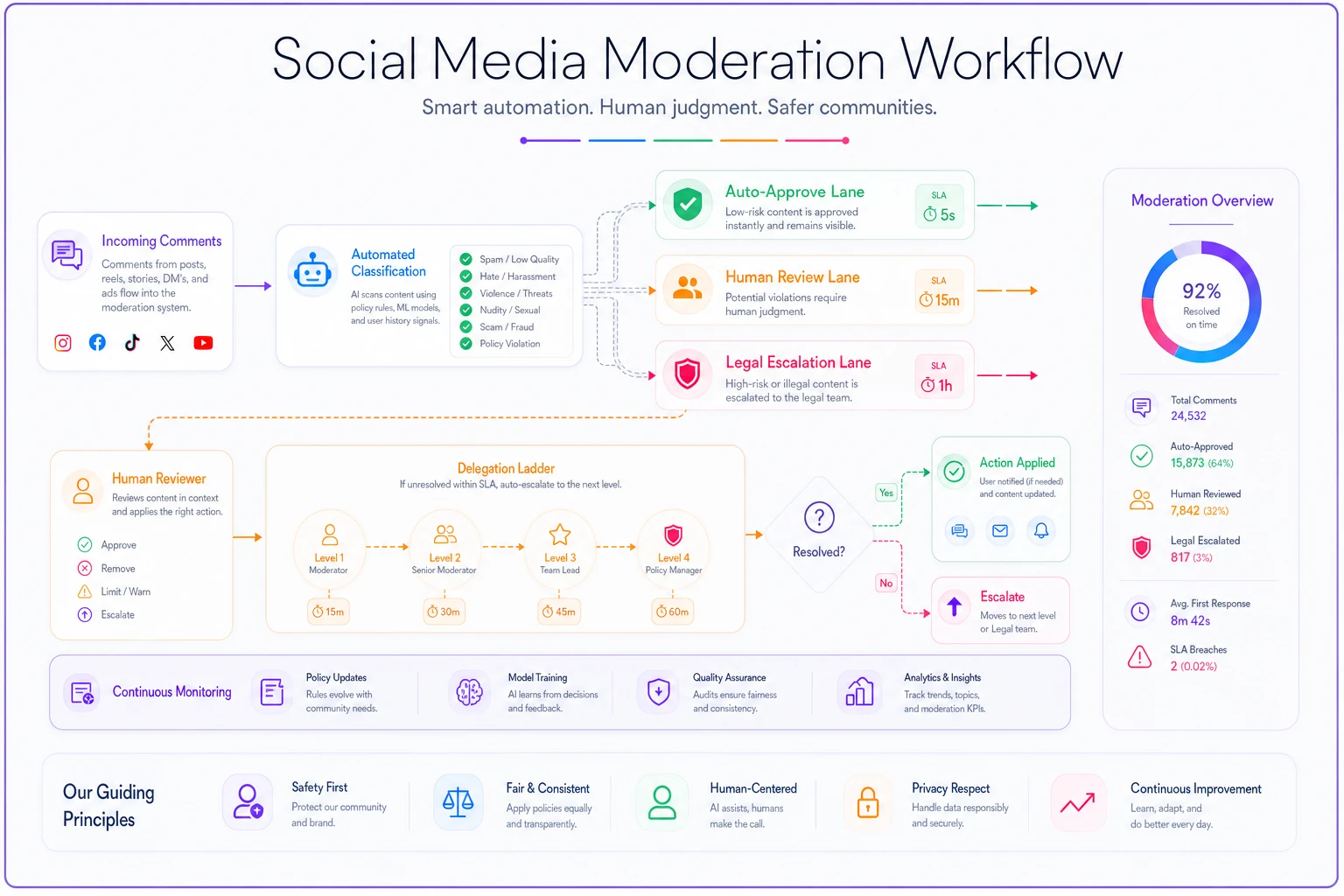
The mistake to avoid: automating the decision to remove sensitive content. Automate the routing of it. Let the classifier say "this looks like it might be defamation" and send it to a human fast — don't let it delete something that turns out to be a legitimate customer complaint. A wrongful auto-removal on something sensitive costs a lot more than a two-hour human review.
SLA-backed moderation lanes
Lanes are what turn a single overwhelming queue into a system where the right things get handled first. Each lane gets its own SLA, and the SLA is a promise the whole team is measured against — not a vague aspiration.
| Lane | Example content | Acknowledge SLA | Resolve SLA |
|---|---|---|---|
| Crisis / legal | Threats, defamation, regulated-claim violations | 30 minutes | Same business day |
| Brand-risk | Off-brand replies gone viral, PR-sensitive threads | 1 hour | 4 hours |
| Standard review | Ambiguous tone, borderline policy calls | 4 hours | 8 business hours |
| Low-priority | Spam appeals, minor formatting, FYI mentions | 1 business day | 2 business days |
Two things make lane SLAs actually work. First, acknowledge and resolve times are separate. Acknowledging means a human has seen it and it's now owned — that alone kills most of the "did anyone catch this?" panic. Separating them means a moderator can grab a crisis item in 20 minutes even if the full resolution takes the rest of the day.
Separate acknowledge and resolve SLAs so items are visibly owned quickly.
Second, legal has an SLA too. This is the piece most teams skip, and it's exactly why moderators stop escalating. If legal-escalate items have no acknowledgment deadline, escalation feels like tossing things into a void. When legal commits to a one-business-day acknowledgment, community managers escalate freely because they trust the item won't disappear.
One more thing worth considering when building lanes: official replies and posted statements need to meet the same standard as your published content — captions, alt text, readable formatting. The same accessibility and QA discipline you apply to social content should extend to moderation responses, especially anything that becomes a pinned or public reply.
A real scenario: consumer brand, comment queue out of control
A mid-size consumer brand running about six active social accounts hit a wall during a product launch. Comment volume roughly tripled for two weeks, and their two-person moderation team was drowning. Response times on flagged items crept from a few hours to well over a day, and a couple of borderline product claims in the comments sat unaddressed long enough that legal found out through a customer email — never a good look.
The problem wasn't the volume. It was that everything went into one queue, sorted by time, with no distinction between "someone's asking about shipping" and "someone's making a defamatory claim about a competitor in our replies." Both waited equally.
They rebuilt around lanes and tiers. Auto-rules cleared obvious spam and routine questions to a template library, which took roughly 60% of the volume off the human queue immediately. A legal-sensitive keyword list routed a handful of items a day straight to a fast lane. Front-line moderators got clear authority to hide and warn without asking permission, with escalation reserved for genuine judgment calls.
Within about six weeks, acknowledgment time on flagged items dropped from over a day to under three hours, and crisis lane items were getting eyes in under an hour. The team didn't get bigger. The queue got structured.
The 90-day rollout
You can't flip this on overnight, and teams that try tend to create chaos and revert within a month. A phased rollout builds trust in the system as it goes — each phase giving people time to actually learn the model before the next layer lands.
Days 1–30: Define and instrument.
-
Write your three policy tiers and get legal to sign off on the legal-escalate definitions specifically.
-
Draft the delegation ladder and confirm authority boundaries with each level.
-
Audit your current queue
what percentage is truly auto-actionable? The number is usually higher than people expect.
-
Set up logging so every decision — automated or human — is recorded. You need this baseline before you change anything.
Days 31–60: Pilot lanes and light automation.
-
Turn on auto-actions for only the highest-confidence patterns. Start narrow.
-
Stand up the lanes with SLAs, but run them in "shadow mode" first — track whether you'd have hit the SLAs before you're formally accountable to them.
-
Give front-line moderators their expanded authority and watch the escalation-bounce rate.
-
Hold a weekly review of every auto-removal that got appealed and tune the rules accordingly.
Days 61–90: Enforce SLAs and formalize the KPI contract.
-
Move lanes from shadow mode to enforced.
-
Publish the KPI contract (below) and start reporting against it weekly.
-
Review the legal SLA with the legal team using real data from the pilot — this is where you renegotiate anything that turned out unrealistic.
-
Document the whole thing so the next hire inherits a system, not tribal knowledge.
An honest note on rollout: the first two weeks of enforced SLAs will feel rough. People miss deadlines while they're still learning the lanes. Track the misses, find the patterns, and adjust thresholds. A system that's slightly wrong but consistent beats one that lives in someone's head.
The KPI contract teams can adopt
A KPI contract is a written agreement about what "good" looks like, so nobody's arguing about it during a crisis. Keep it small enough that people actually remember it.
-
Acknowledgment SLA adherence ≥ 95% of items acknowledged within lane SLA.
-
Resolve SLA adherence ≥ 90% resolved within lane SLA.
-
Auto-action accuracy ≤ 2% of auto-removals successfully appealed (measured monthly).
-
Escalation health legal-escalate items acknowledged within their SLA ≥ 98% of the time.
-
Backlog stability queue size at end of day should not trend upward week over week.
-
Ladder calibration fewer than 10% of items bounce between delegation levels.
The last two are the ones that catch problems early. If backlog is trending up even while SLA adherence looks fine, you're outgrowing your capacity and it's time to add rules, add people, or both. If items keep bouncing between levels, your authority boundaries are wrong. Both signals are worth watching before they become obvious.
When this model makes sense — and when it doesn't
This is built for teams handling meaningful daily volume across multiple accounts or markets, with real brand or legal exposure. If that's you, the structure pays for itself quickly in reduced risk and faster response.
When it's overkill: a single account with light comment volume and one person handling everything. If Priya can hold it all in her head and the queue never backs up, you don't need lanes and ladders yet. Build the model before you're drowning, but don't over-engineer a two-person operation.
Who should not rush this: teams without legal buy-in. The legal-escalate tier only works if legal agrees to their SLA. If you build the whole thing and legal won't commit to acknowledgment times, escalation stays broken and nothing else in the model can compensate. Get that agreement first, even if it's just a handshake on a one-day acknowledgment window.
One more thing: if a lot of your moderation involves user-generated content you might want to reuse or amplify, your intake needs to capture rights and permissions cleanly at the moderation stage — not later when you're scrambling to trace what was agreed. The same intake metadata and release discipline used for UGC rights belongs in your moderation workflow so permissions don't become a problem after a comment turns into a feature.
Making the system stick
The teams that succeed with this treat moderation as an operational function with owners, deadlines, and metrics — not as a reactive chore someone squeezes in between other work. Once decisions live in tiers, authority lives in a ladder, and every lane carries an SLA, the queue stops being a source of dread and becomes something you can actually manage.
Moderation backlogs aren't a staffing shortage. They're the visible symptom of judgment that was never written down and coordination that was never designed. Build the operating model, instrument it honestly, and give it 90 days to settle. What you end up with isn't a team that works harder — it's a system that handles the easy calls automatically and gets the hard ones to the right person, fast, every time.
Moderation backlogs aren't a staffing shortage. They're the visible symptom of judgment that was never written down and coordination that was never designed. Build the operating model, instrument it honestly, and give it 90 days to settle. What you end up with isn't a team that works harder — it's a system that handles the easy calls automatically and gets the hard ones to the right person, fast, every time.
Ready to amplify your brand’s voice?
Join 2,500+ marketers using Postyly to save time, boost engagement, and grow their audiences effectively.